disability rights
At dawn, Sara Al-Ananza wakes up to prepare for her long trip to school in Amman more than 70 kilometers away from Ajloun Governorate where she lives with her family.
Sara accompanies her father every day to Amman to pursue her studies at Abdullah Ibn Oum Maktoum School for students with visual impairment.
After the school refused to allow Sara to stay in the dormitories, citing instructions by the Ministry of Education, she was forced to spend two and a half hours on the road each day.
Sara relies on her father for transport and has to wait for him to finish his work and take her home, an added psychological and physical burden for her. While her peers return to homes around the capital to rest, and prepare for a new school day, Sara remains stuck at school waiting for her father.
Since starting Grade 7, Sara has faced the challenge of having to stop her academic pursuit as she has to travel all the way from Ajloun to Amman five days a week. Sara says, "For Grade 7 students, there is no residence, and every day I commute back and forth to school in Amman, the matter becomes tiring for my family and me”.
Located in the center of Amman, the Abdullah Ibn Oum Maktoum School is the only government school in Jordan that caters for students with visual impairment (poor vision and blindness). Students from remote governorates are usually unable to attend for lack of adequate transportation. The school’s policy also refuses applicants who have completed grade 6 to live in the dormitories.
Mahmoud Al-Ananza (Sara's father) faces the challenge of keeping his daughter enrolled at the specialist school for people with visual impairment, where she has been since the first grade.
Students and their parents not only struggle with the commute and the hardship of the distance traveled, but also the monthly transportation cost of approximately JOD 300 ($425), a heavy cost that dents the Al-Ananza family’s budget.
Sara's father doubts his ability to continue to meet his daughter’s schooling needs saying, "There are girls in Sara's class who were unenrolled by their families and sent home".
He calls for a solution that keeps students with special needs in education, "Otherwise, we are thinking of taking her out of school. We cannot afford it anymore," says Sara’s father.
Source: The administration of Abdullah Ibn Oum Maktoum School for the Blind Students
Aya Choucair is a student with visual disabilities who is now in Grade 8 at a government school and faces difficulties studying, according to her father. "She receives audio lessons. For her homework and problem solving, her sister helps her," says Aya’s father.
Not as lucky as Sara, Aya was forced to abandon her education at Abdullah Ibn Oum Maktoum School after completing Grade 6 since she was no longer allowed to stay in the school’s dormitories.
Aya lives in the northern Irbid Governorate and "after Grade 6, she needed to commute, and this required money, time and effort," her father said.
Aya’s father went to a government school near their home to enroll his daughter. But it was not easy since the local principal was reluctant to admit a visually impaired student. Aya’s father had to file a complaint which finally secured his daughter’s enrollment in the local school.
Around 1/5 of these people live in Irbid
Hover over the map to view percentage
Source: Data analysis of Latest Jordan Population and Housing Census (2015)
My son was happy at school, and my dream was that he could stay there until he completes Grade 12"
"My son was happy at school, and my dream was that he could stay there until he completes Grade 12," says Umm Omar bitterly. She found herself forced to look for another school for her son Omar after he completed Grade 6 at Abdullah Ibn Oum Maktoum School last year.
Umm Omar lives with her two sons in Irbid Governorate, and the absence of adequate and affordable transportation for students from her governorate constitutes an obstacle to her son’s education.
After her separation from her husband, Umm Omar’s difficult economic circumstances compounded her struggle to secure the fees necessary to enroll her son at a private school that caters for her child's needs. She questions the validity of inclusive education in government schools, as her son has already spent three years in a school for students with visual impairment.
The option of keeping Omar at Abdullah Ibn Oum Maktoum School does not seem realistic. He would have to commute 90 km each way between Amman and Irbid, which is difficult and costly. “I mean if my son wants to go and come daily, he needs money," says Umm Omar.
She says that providing transport will not reduce the difficulty of going to the capital daily from remote areas. Providing specialized schools close to his home is the solution, she adds.
Source: Jordan Ministry of Education- Special education program
Farah Ahmad, 15 years old from Balqa, has already been forced to leave school completely after ending her education at Abdullah Ibn Oum Maktoum School due to the lack of suitable transportation, according to her mother.
Farah has been out of school for three years, despite her being an outstanding student, her mother said.
After leaving Abdullah Ibn Oum Maktoum School, Farah was unable to continue her education at a school near home, after the local principal refused to enroll her, arguing that she was prone to falling or hitting something, according to Farah's mother.
Farah is not the only one deprived of education, as Jordan provides special educational services for persons with need to only 2% of students. It is believed that those in need are 10% of students, according to the 10-Year Strategy for Inclusive Education.
Students with visual impairment (blindness and poor vision) receive their education in Abdullah Ibn Oum Maktoum School, north of the capital Amman.
The school stands on a ten-acre estate and has a student dormitory accommodating students until their 6th grade according to Najah Al-Khalaila, the school principal.
The school has 30 classroom divisions accommodating only 300 students, and only 11 students are taken in at the school's dorms.
The school has 25 buses to provide supervised transport to students from different areas within the Central Region of Jordan (Amman and its suburbs), according to the school principal.
Source: The administration of Abdullah Ben Um Maktoum School for the Blind Students
The school buildings also include facilities that provide specialized services for students who need visual rehabilitation (examination) and face learning difficulties, as well as speech and hearing problems. It also provides training in life skills related to mobility in a home-like environment, according to Al-Khalaila.
Dr. Ahmad Al-Louzi, an activist for the rights of people with visual disabilities, says the establishment of schools for the blind contradicts the principle of inclusive education.
Al-Louzi, who has visual impairment and heads the Association for Friendship for the Blind, says the solution lies in applying the inclusion policy by equipping government schools that are already in place in different governorates to provide curricula in Braille and have staff trained to deal with students who are visually impaired.
The activist points out that ensuring the attendance of visually disabled students from remote governorates at specialized schools for the blind is a difficult matter that no one can afford.
About 1,100 disabled students are enrolled in specialized schools administered by the Ministry of Education. About half of them receive education in the Northern Region, while the other half are in the Central Region and the Southern Region, according to data obtained from the Department of Programs for Students with Disabilities in the Ministry of Education.
The former director of the Education Department in the Ministry of Education, Sami Mahasis, explains that Abdullah Ibn Oum Maktoum School can accommodate 2000 students, but the number of enrollees does not exceed 300.
Mahasis underscores the importance of establishing other schools that are ready for blind students in the north and south of the country, so that those students can continue receiving the education that caters to their special needs, along with providing transportation to avoid the need for students to stay in dorms.
He acknowledged the great hardship parents have been facing to transport their children from remote governorates to the school for the blind in the capital Amman, saying that he also believes that students can be included in government schools while teachers trained in Braille are made available for use in teaching.
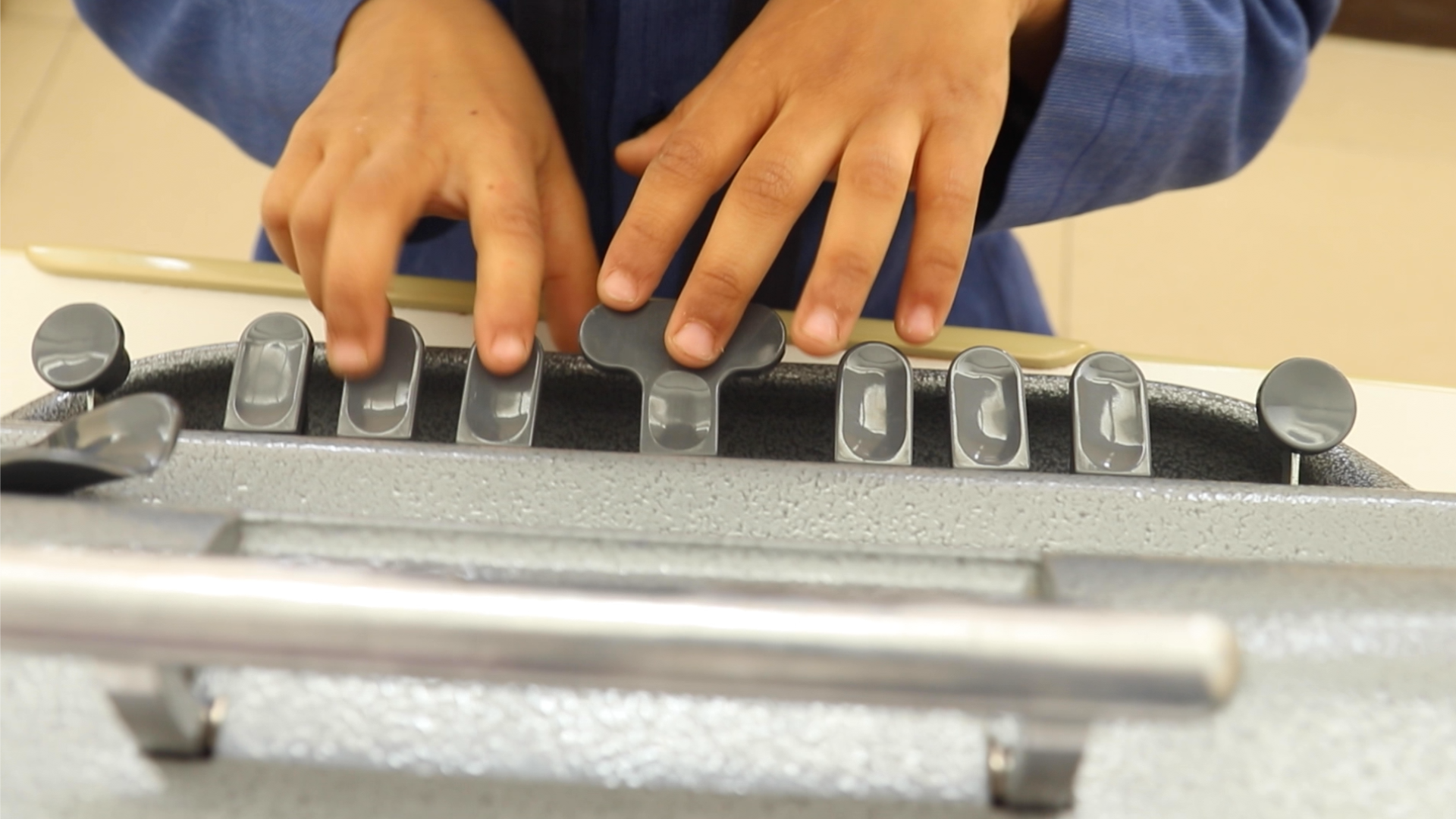
Pre-Grade 6 students learn to write in Braille.
The CEO of the Point of Light Organization for the education of the visually disabled, Fairuz Amr, explains that the Jordanian Constitution guarantees everyone the right to education.
Amr, a human rights activist, noted that the Persons with Disabilities’ Act No. 20 of 2017 prohibits the exclusion of any person from any educational institution on the basis of or because of disability.
The law also stipulates that if a person with disabilities cannot join an educational institution due to the lack of necessary provision of accessible formats, the Ministry of Education must find appropriate alternatives, including ensuring that the person is enrolled in another educational institution, Amr explained.
The director of programs for students with disabilities in the Ministry of Education, Dr. Mohamed Al-Rahamna, justifies the non-admission of post-Grade 6 students to dorms by what he describes as a change in psychological and physiological characteristics of students in this stage – a change he believes makes separation of students of different age groups preferable.
Al-Rahamna says that after this stage students need a social environment that is suitable for them – a familial and home environment – after having acquired the skills they need.
Pre-Grade 6 students need intensive services from specialists to inculcate some of the necessary skills, including the use of Braille in reading and skills related to improving the student's knowledge and meeting their developmental characteristics in early grades, according to Al-Rahamna.
The data of students enrolled in Abdullah Ibn Oum Maktoum School show that more than half of those who had benefited from the educational services at the facility have finished the Grade 6, while only 14 percent of the students finish the last final three grades of the twelve-year school.
Students of the first three grades are a small percentage of beneficiaries from the school’s educational services
Hover over class to view percentage
Grade 1-6
Post Grade Six
Source: The administration of Abdullah Ben Um Maktoum School for the Blind Students
Al-Rahamna recognizes that the allocation of a school for the blind is a form of segregation that contradicts with the 10-Year Strategy for Inclusive Education; this has prompted the ministry to consider a reverse inclusion process by enrolling non-disabled students in the school.
In 2020, the Ministry of Education launched the 10-Year Strategy for Inclusive Education, in cooperation with the Supreme Council for the Rights of Persons with Disabilities.
The plan includes the rehabilitation of educational staff, the alignment of curricula in accessible forms and the provision of school facilities and buildings to include persons with disabilities into the education sector, and to allow them access to facilities and services on the basis of equality with others.
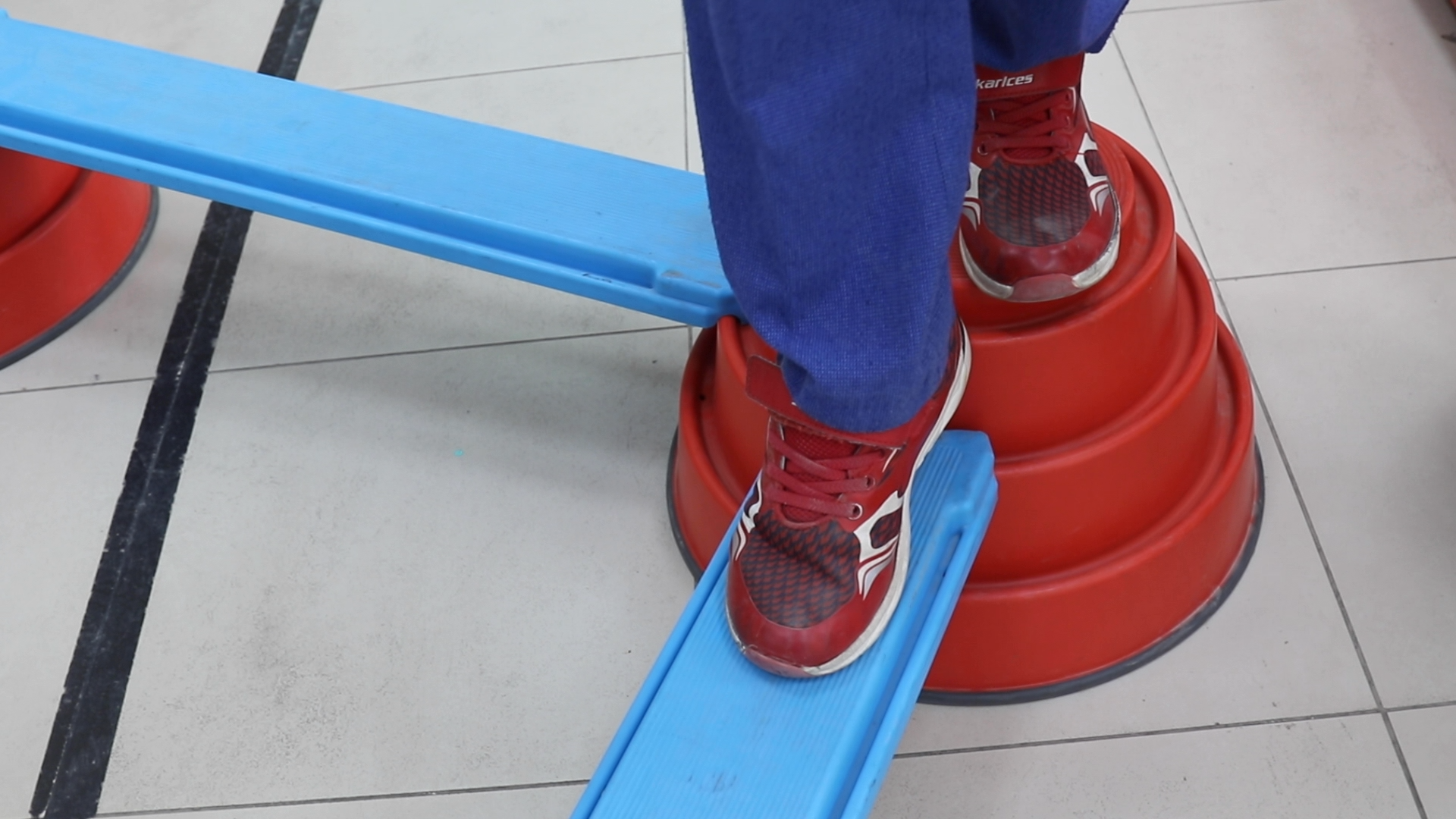
School students are trained on mobility skills
"We have blind students enrolled in government schools, and we meet the requirements of blind students in inclusive schools as much as possible," says Al-Rahamna . He called for training teachers to be able to teach those students and provide them with the physical facilities inside the school so that students can move, citing an application of this at a school in the Karak Governorate.
Special education specialist Israa Daoud explains that the Braille skills of visually disabled students are not the same for all by the end of Grade 6; some students are not ready to move to an unequipped government school.
Daoud, the mother of a visually disabled student, says she believes that inclusive education is the best solution, but special books need to be made available to them, while educational and administrative staff need special training and buildings should be rehabilitated to this end. "Inclusion is not just getting students into a school; that would be destructive and not inclusive," says Daoud.
Students in normal schools receive verbal and audio education and don’t learn to read and write in Braille, she adds.
The lack of services led Daoud to establish an association with a group of parents of students with visual disabilities to hold Braille courses and network with specialists in this field.
Daoud says that blind students are different from the rest of students with disabilities; they only need pedagogical alternatives, like being taught to read and write in Braille and to be trained in mobility to be self-reliant.
When this story was published, Sara Al-Ananza had started her new school year and joined the school's dorm thanks to her father's pleas with the school's administration. The rest of her colleagues are still looking for suitable specialized education in their home areas to suit the need of those challenged students far from the capital.