Economy
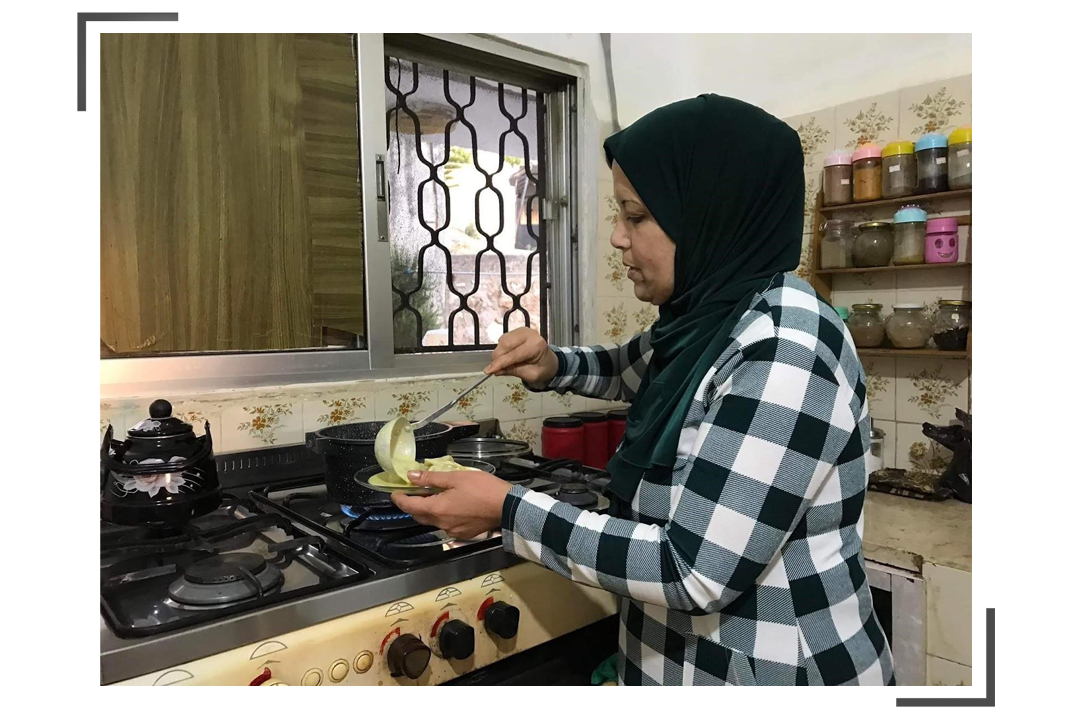
No one visit the area. Umm Mohammad says complaining about the scarcity of guests visiting her home kitchen, while wistfully scanning the empty road for potential tourists from her balcony overlooking the museum of the old city in Umm Qays.
Umm Mohammad used to prepare dozens of dishes made from local produce such as beans, okra, green beans and germanders for the city’s visitors. Nowadays, she misses the buzz of tourists crowding her kitchen to savour her dishes.
“I live in the village of Umm Qays, which all Jordanians say is the place for tourism and good food,” adds Umm Mohammad.
Umm Mohammad lives in a spacious house where one room has been converted to reflect the traditional Arabic style to welcome visitors who usually arrive very hungry and exhausted, to her surprise, after their long day spent roaming the green paths of Umm Qays.
Her husband usually prepares lunch for their family of eight, and the modest income she earns from serving food for tourists, helps her to support the family.
Umm Mohammad, over 40 years now, is afraid that she may lose her investment due to the decline in demand as visitors to the area of Umm Qays have been scarce lately.

From her Kitchen that is enveloped in the spicy scent of her cooking Umm Mohammad looks at the ancient ruins of her town and adds that “I don't know what to say at all! I mean, this village is treated unfairly!” The columns and facades of the Gadara houses of Umm Qays can be seen from her kitchen and locals refer to their village as “Mkeis” a place still teeming with life after the passage of many civilizations through the region since it was part of the ten Greek-Roman Decapolis cities of Gerasa Philadelphia, Gadara (Umm Qais),, Pella, Abila, Dium, Hippos, Scythopolis, Damascus, and Canatha.
Number of tourists
Source: Statistics on Tourism, Jordanian Ministry of Tourism and Antiquities
Jordan’s archaeological sites saw a growth in touristic activities in pre pandemic period. However, this activity did not extend to the Umm Qays’ region.
Statistics from the Ministry of Tourism reveal that the number of visitors to the Umm Qays area has halved between 2017 and 2019 at a time when the country witnessed a 70% increase in the number of tourists visiting archaeological sites across the country.
Analysis of data published by the Jordanian Ministry of Tourism for 2017-2019 shows that the decline in the number of tourists in Umm Qays resulted from the decline in domestic tourism that fell by about 80% during that period.
Moreover, the Coronavirus pandemic delivered a severe blow to tourism in that area as the number of foreign tourists visiting the region has declined since 2020, and records show that Umm Qays received only 14 tourists last year for every 100 tourists it received in 2019.
Like other residents of Umm Qays, Umm Mohammad earns her living from the services she provides to tourists; any decline in the number of tourists visiting the region negatively impacts her business.
Claudia Bührig, director of the archaeological survey project in Umm Qays, explains that the city is of special importance since it embodies some of the historical values of the region: It contains antiquities from the Hellenistic and Roman eras, as well as residential ruins that bear witness to the beginnings of contemporary Jordan.
Bührig, who is also the director of the German Archaeological Institute in Amman says that “We have landmarks and ruins at the top of the hill and the wall of a fortress from the Hellenistic era as well. Literally you are surrounded by history here.”
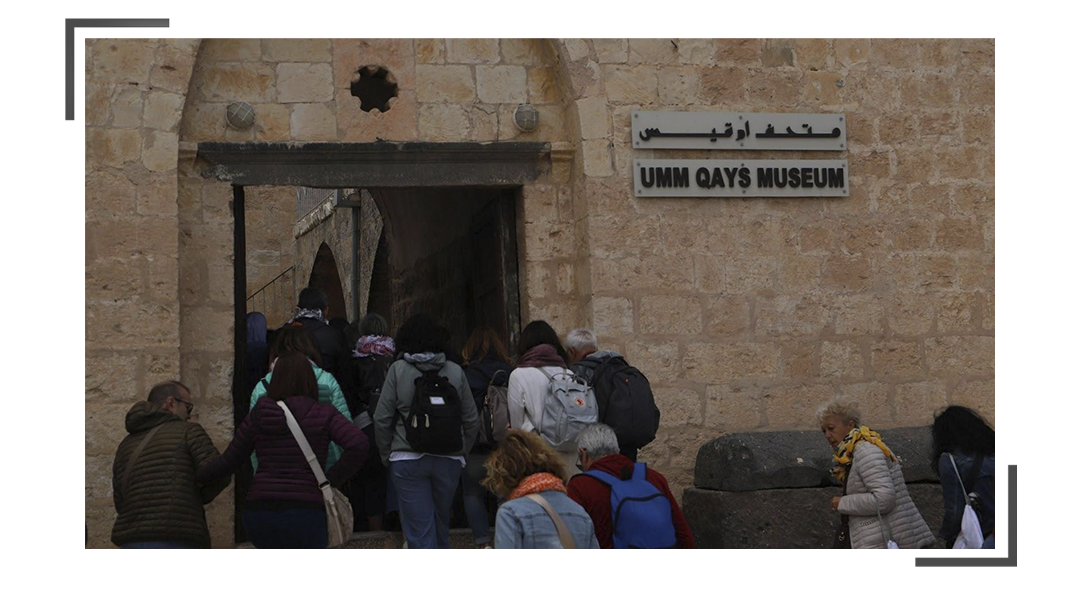
Ahmad Al-Omari sat in Umm Qays Archaeological Museum, waiting to receive a call requesting his services as a guide for a tourist group in the hope to reveal the secrets of Umm Qays, and to tell them the stories of its towering columns.
But for Ahmad Al-Omari, hours have passed by, without a tourist in sight.
The museum dates back to the late Ottoman period and contains antiquities, most notably the mausoleum which showcases the words of a Roman poet:
“Oh, passer-by
As you are now
I used to be
And as I am now
you shall be
So, enjoy life because you are mortal”
Those words reverberate amongst the few visitors in their various languages as Ahmad hopes that the museum would be as packed with visitors as it truly merits.
In addition to his work as a tourist guide, Al-Omari leads tourist groups in countryside walks around Umm Qays, explaining to the visitors the region’s history. We accompanied him on a tour and we let him speak.
Umm Qays faces a number of challenges besides the decline in tourism. According to Al-Omari, visitors to Umm Qays do not spend a long time there, depriving its residents from an important income. He adds that “These short excursions stops, do not benefit the residents of the area as visits to Umm Qays last for an hour and then they would move on.”
Al-Omari attributes the short visits to the limited accommodation availability in the city. He stresses the need to improve the infrastructure and to arrange for various attractions to lure a bigger number of tourists. He also explains that it is important to put signs up in prominent places to facilitate access to the sites of the town as it is hard to rely on mobile applications for directions since they often provide inaccurate information about the roads leading to the city’s ruins.
Number of tourists
Source: tourism statistics- Ministry of Tourism and Antiquities
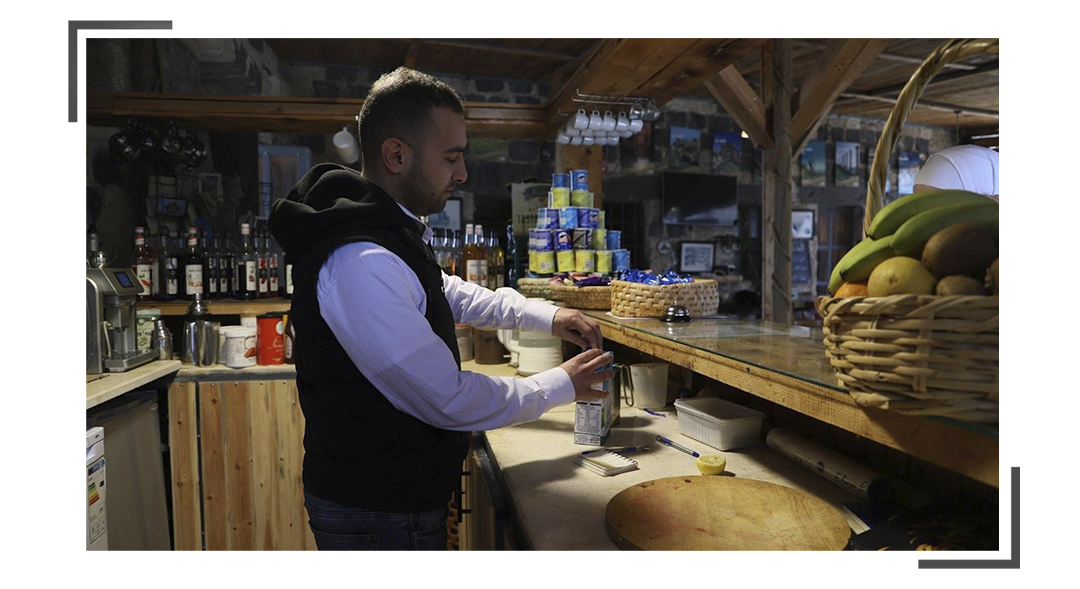
In a corner of his empty coffee shop, twenty-eight-year-old Saleh al-Rousan was preparing a cup of coffee. Al-Rousan established this coffee shop in “Al Harat Al-Fowga” more than four years ago. He studied electrical engineering, but when he failed to find a suitable job, he established his own business.
The coffee shop is a few metres away from the Umm Qays Museum. Saleh was dreaming of attracting visitors to his coffee shop. Nowadays, Saleh stands in his empty coffee shop.

photo showing Saleh working at his coffee shop a few metres away from the ruins
In addition to the lack of visitors and their short stay there, Saleh’s work is seasonal. He points out that the number of tourists drops dramatically in winter when he fails to even cover his expenses.
He says, “The people of Umm Qays have been marginalized from a touristic perspective. The route to get here is rough, and the services are not up to par, as they are in other areas.”
Saleh continue to dream that tourists will flock to his coffee shop, a few steps away from the museum
The Umm Qays region lacks the necessary facilities that could serve tourists. The area is not only rich in ruins but is also rich in its environmental diversity, which includes various agricultural fields and many water dams, such as Wadi Al-Arab Dam. Religious tourism is also common, as the city houses Christ’s Grotto, where it is said that Jesus took refuge in addition to a nearby airstrip for VIP visitors.
Capacity 55 people
Founded in 2018
Capacity 3 beds
Founded in 2019
Capacity 20 beds
Founded in 2019
Capacity 180 people
Founded in 1991
Capacity 14 beds
Founded in 2016
Source: Ministry of Tourism: “Restaurants” and Booking.com
It was not easy to count the number of places earmarked for accommodations in Umm Qays, as places have closed down, then re-emerged again, and sometimes owners of accommodations featuring on maps were not easy to reach.
Manar Issam came from Amman to visit Umm Qays and to eat in one of its most famous restaurants says in astonishment “I expected there would be more people in Umm Qays, especially on a weekend.” Manar was surprised by how little is known about the city’s offerings as she did never hear about the small projects serving the locals or about the social kitchens available there before.
Manar’s words about the poor marketing for Umm Qays are in line with the budget figures of the Department of Antiquities, that reveal a significant decline in the budget allocated for the restoration and reconstruction of the ruins of Umm Qays between 2012 and 2017. No allocations were made after that period.
In 2018, Umm Qays did not feature on the General Department of Antiquities’ budget, instead the allocations went to the restoration and maintenance of Irbid’s antiquities.
A request was submitted to the General Department of Antiquities to find out the share of the budget that used to be allocated to Umm Qays’ region, which has been re-directed to archaeological sites in the Irbid governorate since 2018, but the General Department of Antiquities declined to disclose any data related to this matter.
Actual expenditure (Jordanian Dinar)
The Department of Antiquities / General Department of Antiquities did not disclose the city’s share from restoration allocations
Source: tourism statistics- Ministry of Tourism and Antiquities

Nadia Al-Khawaldiyah, a tourist from Oman in the Gulf, has been to Umm Qays more than once. She sat down enjoying the charm of the place, the view of the Golan Heights and Lake Tiberias. She was introduced to the city in 2006 and believes that the site has witnessed a clear development over recent years, but it still needs more services.
“I visited this place four times, but there were no tour guides to help me.” She adds, “If there were guides and pamphlets, we would know more about the region and the services. There isn’t anyone who could show us around the area.”
For German expert Claudia Bührig, Umm Qays is a reflection of “the history of both Jordan and the region.” She says that “new generations must have an understanding of what they have, and we must preserve what they see.”