

This investigation reveals the gender-based discrimination, harassment, and sexual blackmail faced by female journalists in Somalia. It also highlights the absence of clear, written policies within media organizations to address violence or discrimination, as well as the lack of robust legislation criminalising sexual harassment in the country. In carrying out this investigation, we used the testimony of ten female journalists, the findings of a questionnaire, field studies, and interviews with officials from advocacy groups and trade unions.
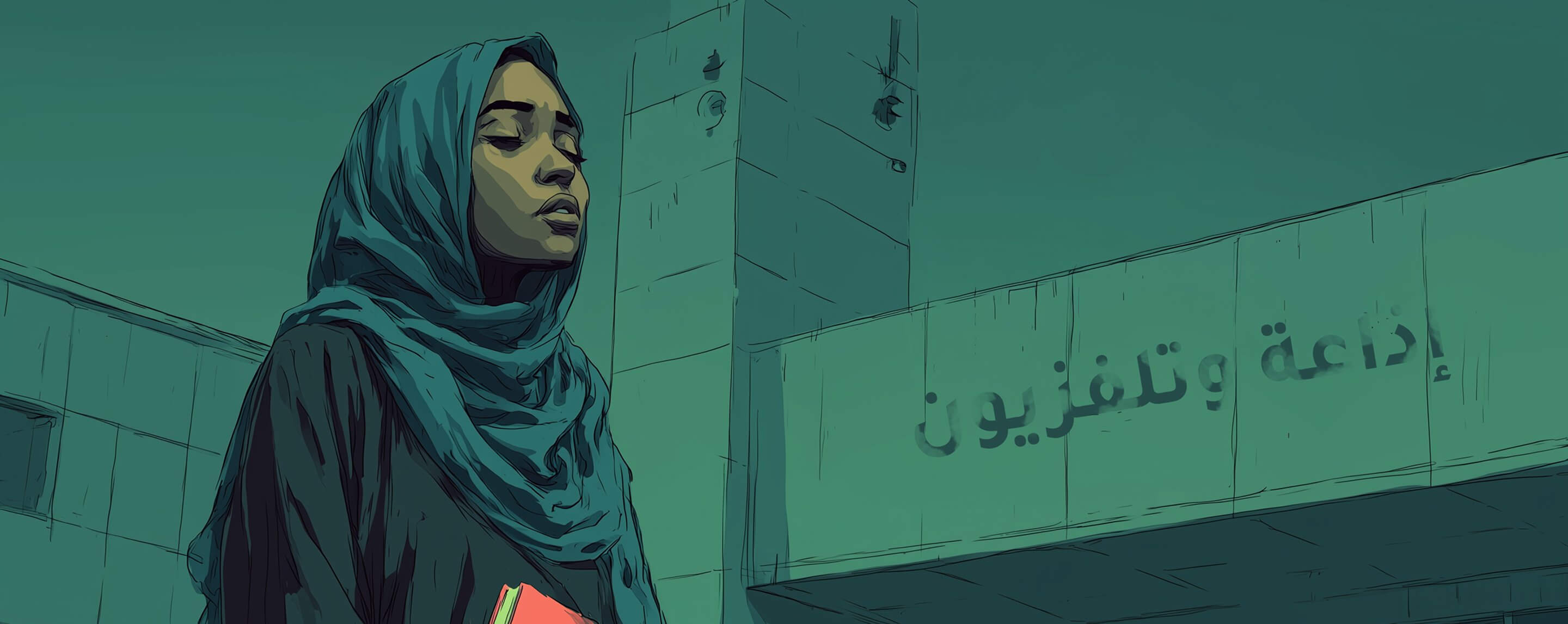
After a tough day in the field, 30-year-old journalist Halima (Pseudonym) went back to the radio station where she works. Despite being exhausted from working non-stop for many hours, she decided to keep going and to write up her story. As she sat at her desk, recalling what she had seen and busy writing and thinking, her manager called her over. He offered her a glass of water and said how pleased he was with her work.
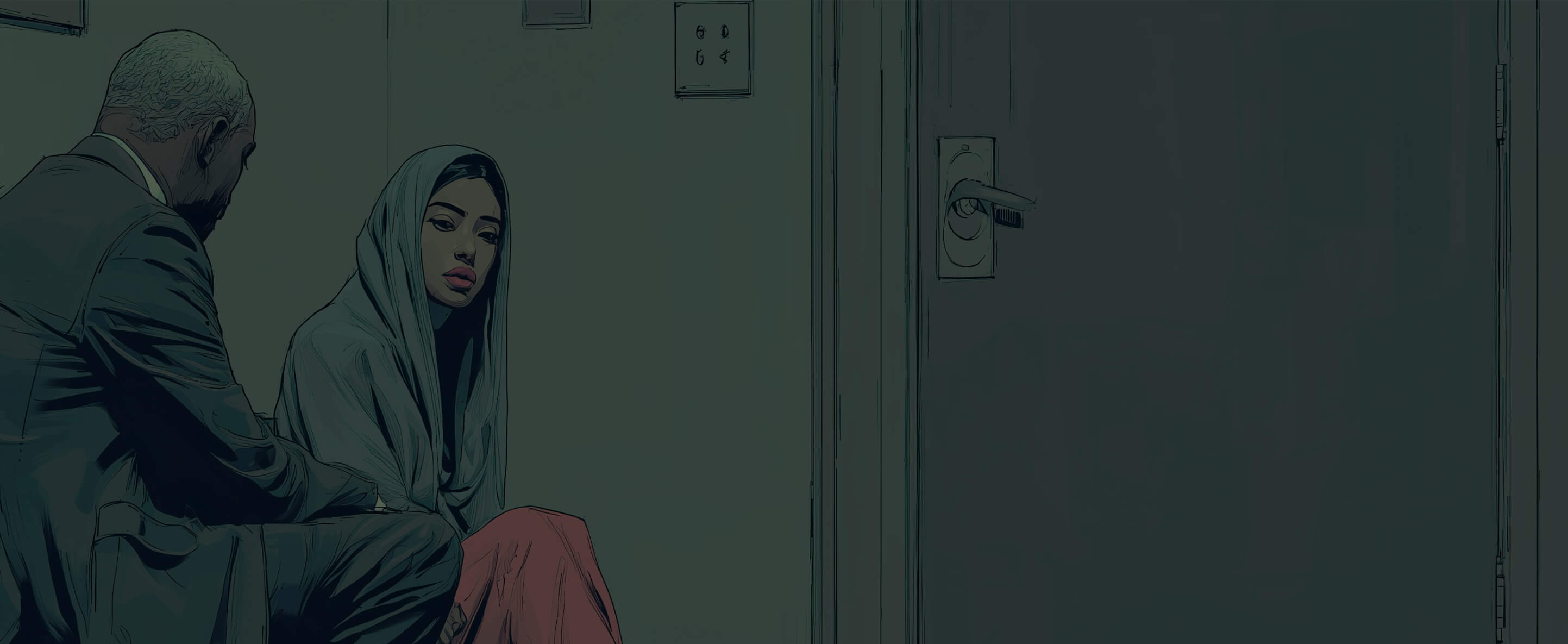
This gave Halima such a sense of professional appreciation that she no longer felt tired. But that lasted only a few seconds until her manager suddenly sat down beside her and put his hand on her leg. He had tried to attract her attention before with remarks that went beyond mere “compliments,” such as “You have a beautiful body… You’re beautiful, let’s get along.” But this was the first time he had harassed her physically.
Halima says she tried to push him away: “He tried to sexually assault me, but I resisted him, pushed him away and ran off.” After that she quit the radio station and never went back. What surprised her was that he then threatened to kill her. As a result, Halima did not dare tell anyone, she says.
“Only for Men”
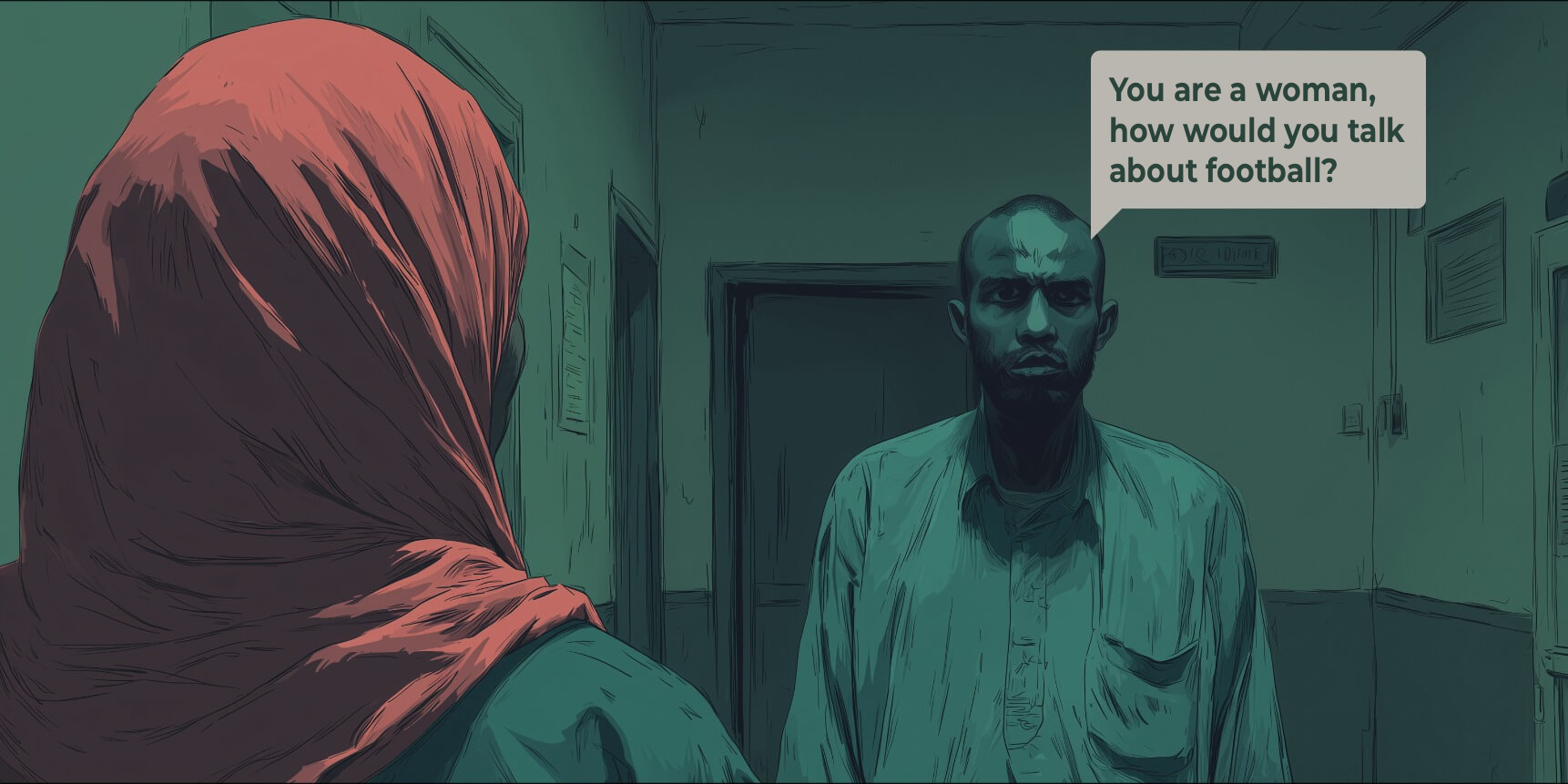
What happened to Halima was no isolated incident, but part of the deliberate discrimination she has faced throughout her five years at the job. It served as a reminder to her that the world seems to be “for men only.” Halima remembers what the former director of the radio station where she worked told her when she pitched the idea of a sports program: “You’re a woman, how are you going to talk about football?” Not only was she denied the chance to put her idea into practice, she says, but they even took it and gave it to a male colleague.
Halima is one of the women journalists I interviewed. Thirty other female journalists like her, working in both state and private media in provinces across Somali, took part in a questionnaire I conducted for this investigation. The majority (approximately 83 percent) had faced discrimination. This was for the most part over salary and financial allowances, but also included discrimination in the allocation of work and responsibilities, and to a lesser extent in opportunities for promotion and taking on managerial roles.
Discrimination and harassment: the reality for women journalists in Somalia
Ilhan Hassan (Pseudonym), who has worked in many newsrooms during her ten-year career in journalism, says that most Somali women journalists regularly face situations where their dignity is diminished, simply because they are women.
Pointing to her own experience, she says that, as a field reporter in “turbulent” times and places, she witnessed bombings, fires and protests, and covered these just like her male colleagues, but they were sometimes given priority simply because they were men.
Maryan Seylac who also worked as a field reporter, founded the “Somali Media Women Association” in 2006 to defend the rights of female journalists, 300 of whom have so far used the association’s services. Maryan says her professional experience showed her another aspect of discrimination, recalling that the management of one television channel in the capital, Mogadishu, forced women journalists to take turns cooking for their male colleagues.
Maryan thinks that the abuse faced by women journalists inside media organizations – including sexual discrimination, denial of promotion, and sexual exploitation – is more serious than abuse they face while working in the field, and even more serious than online violence.
In 2025, the Somali Media Women Association published a study entitled “Gender in Media Content in Somalia: A Baseline Study.” It reveals a significant gap between how management in Somali media organizations and female journalists view women's empowerment in the media, particularly in the coverage of political and economic issues.
The study was based on a questionnaire and interviews with eight managers and eight female journalists, along with analysis of the output of the organisation. The results showed that half of the managers insisted that women journalists were regularly assigned political and economic issues to cover. Most of the women journalists, by contrast, felt that this happened only rarely.
“Special Understandings” and Pressure
Among the women journalists we interviewed was “Heba” (Pseudonym). She was one of five who had faced physical or verbal harassment among a group of ten female journalists who told me someone had pressured or attempted to blackmail them sexually.
Heba was barely 20 when she began working as a photojournalist, following in the footsteps of her late father, who lost his life while covering an attack on a Mogadishu hotel by Al-Shabaab — a designated terrorist organisation.
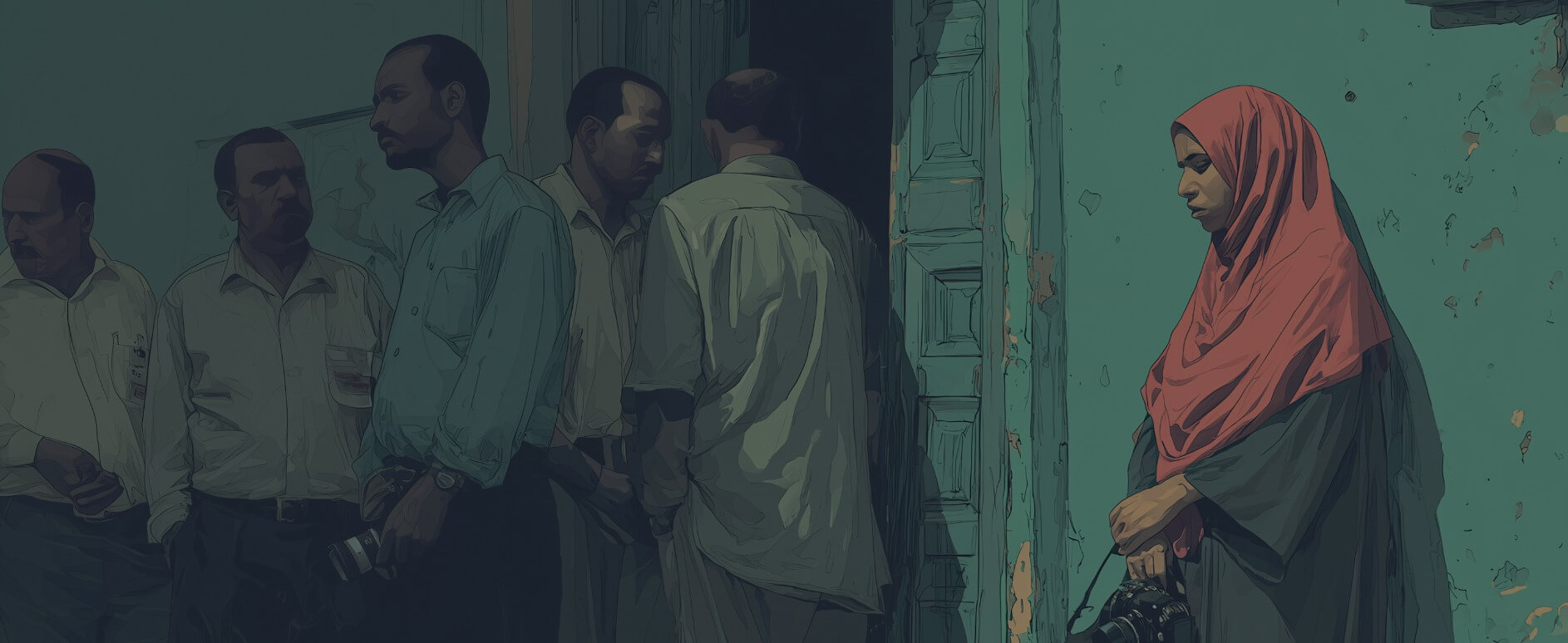
Heba told me that, from the start of her career, she faced open discrimination from her male colleagues and heard derogatory remarks belittling the role of women, such as “A woman’s place is in the kitchen, not in the field… and camera work is a profession for men only.” She says that when she took up photojournalism, it was a field almost entirely dominated by men, many of whom refused to work alongside women. This caused a lot of frustration among female camera operators and drove some to leave the profession altogether.
This hostile environment did not deter Heba, though. She chose to persevere and, defying both social and professional constraints, assert her right to be both a camera operator and a field reporter.
While Heba strove with the demands of working as a photojournalist, particularly in the dangerous environment of the capital, Mogadishu - and with no support from her male colleagues, who saw her as an outsider – she had to face an even greater ordeal. One of the officials in the organisation offered her the chance of a better job and a higher salary in exchange for what he described as “special arrangements.”
After Heba rejected the man’s advances, he then went from bargaining to making threats. He stopped her from receiving assignments, projects, and travel opportunities, and warned that she would not find another job if she continued to refuse him.
The results of the survey I conducted show a shocking picture of what goes on behind newsroom doors. Around 67 percent of women who responded to the survey reported having been subjected to sexual harassment - mostly in the workplace itself - at least once and in some cases over a period of years. The most alarming thing was that the perpetrator was not usually a casual acquaintance. The data indicates that around 75 percent of incidents were committed by people in leadership positions in the organisation, while 20 percent were carried out by journalist colleagues and five percent by other staff. Despite the gravity of these findings, around 70 percent of women who suffered discrimination or harassment chose to keep silent and not make a complaint. This shows a widespread mistrust of the mechanisms meant to provide protection and accountability within media organizations.
Survey Results
Ownership of media organizations where female journalists reported discrimination
80% of those who experienced harassment reported that the incident occurred in the workplace
90% of those who reported harassment said it was repeated
Perpetrators of harassment
Reporting of harassment
Catharine MacKinnon, a lawyer who served as the First Special Gender Advisor to the prosecutor of the International Criminal Court, argues in her book Sexual Harassment of Working Women: A Case of Sexism, that gender discrimination and sexual harassment in the workplace are a direct expression of what she calls the “inequality approach,” maintaining that sexual harassment is a form of gender-based discrimination at work.
Between 2023 and 2025, the National Union of Somali Journalists (NUSOJ) documented 79 cases of sexual and gender-based violence against female journalists in various cities across Somalia. These abuses included harassment, assault, attempted rape, intimidation and online abuse, which caused fear and lasting psychological harm to every victim.
Women journalists were abused while carrying out field assignments or in newsrooms or on social media by colleagues or supervisors who exploited their positions of authority.
Abdalle Mumin, Secretary-General of the Somali Journalists Syndicate, an NGO, says that the union has set up a confidential and “anonymised” system to document cases of sexual assault and exploitation faced by women working in media, and that it has recorded a dozen cases in the last two years (2024–2025).
Abdalle explains that many women prefer not to make complaints for reasons including fear of social stigma and victim-blaming, and the potential long-term consequences. He adds that women who report sexual violence often face dismissal from their job, and strained family relationships, while some victims stay silent, thinking this will be safer for them.
He acknowledges that this reality makes the task of his union extremely difficult, but that they continue to work systematically and cumulatively to document cases, and provide whatever support they can to victims. Abdalle cites the example of one woman journalist who lost her job after she refused her manager’s advances. The union covered the costs for her to travel back to her family, who lived in a rural area. He emphasizes that this incident is far from unique, rather, it reflects a pattern that recurs in various forms within media workplaces.
No Protection Policies
From the evidence I have gathered, there seems to be a common thread running through all media organizations where there have been incidents of sexual harassment and blackmail. This is the lack of any clear internal policies, or binding codes of conduct, governing relationships at work, particularly those between the sexes.
The survey results show that most women journalists who experienced sexual harassment said they were unaware of any such policies within their organizations. The remaining few said they were sure their organisation had no such policy. This shows that there is a vacuum when it comes to regulation, something that makes the working environment even more hazardous.
Regarding this same issue, Farhia Kheyre, head of the Somali Women Journalists Organisation (SWJO), agrees there are no formal policies in place to combat discrimination and harassment in media organizations. But she points out that the SWJO issued a charter in 2019 to protect women journalists and promote a safe working environment. This, she says, was received positively by some newsrooms, which went ahead and installed CCTV cameras and put new regulatory measures in place.
The SWJO published a study at the end of 2025 on gender in the Somali media sphere. Interviews with managers of media organizations showed that having written policies regarding gender remained a rarity. Only one manager said his organisation had an official policy with provisions to prevent sexual harassment, while the majority of others relied on informal practices or a general adherence to government laws, with no clear internal frameworks or enforcement mechanisms.
I contacted a number of officials across several media organizations to see if they had written policies to treat discrimination and sexual harassment as a criminal offence, but only two responded. One was Burhan Dini Farah, director of Radio Kulmiye, who said the management there monitored how officials and supervisors behaved to ensure they did not abuse their authority over staff, particularly women. He said regulations were in place governing professional relationships, which prohibited any form of harassment or discrimination. These, he insisted, were enforced without exception.
The other respondent was a woman journalist working in an administrative position at the government-run radio and television station in Benadir State, who asked to remain anonymous. She said she knew of no written policy within her organisation for dealing with issues of violence or discrimination, adding that problems facing women were dealt with according to tribal custom or by mutual agreement, rather than within any formal institutional framework.
Legal Loopholes
A lawyer in Mogadishu, who also asked to remain anonymous, thinks part of the problem stems from lack of awareness. He says many women in journalism and other fields do not realize that the treatment they face amounts to a crime, which should be reported and for which someone should be held accountable. He holds employers themselves responsible for this shortcoming, for failing to hold regular awareness-raising sessions with their staff. This, he argues, leads to women’s rights being undermined and allows perpetrators to escape punishment.
The lawyer goes on to say that internal company policies, even if there are any, are not enough to ensure accountability in cases of sexual harassment and blackmail, because enforcing penalties requires recourse to the courts. This is compounded by structural problems, the most serious being that the Somali Penal Code of 1962 has never been updated to reflect the nature of contemporary crimes or to ensure more effective protection for victims.
A study entitled “Somalia: Gender Justice and the Law” - published jointly by several UN agencies in 2022 - concluded that there was a clear legislative gap, since there was no specific provision in Somali law criminalizing sexual harassment.
At the same time, legislation covering the workplace was significantly updated with the enactment in 2024 of the National Labour Act No. (36). According to the report “Gender Justice and Equality Before the Law,” the new labor act prohibits all forms of discrimination in the workplace - whether in recruitment, training, pay or promotion - and requires employers to have policies in place to ensure equality and equal opportunities. The act also prohibits all forms of sexual harassment in the workplace, whether verbal, physical or behavioural, and requires employers to have written policies and a confidential complaints system to curb abuses.
The labor act punishes offenders with fines of between 100,000 - 500,000 Somali shillings ($174 - $870) and possible suspension of the professional licence in the event of a repeat offence. The penalty is increased in cases involving physical assault or serious harassment. These sanctions, however, remain purely administrative and professional, rather than criminal. For that to happen, the penal code would need to be amended to include sexual offences, particularly in the light of the rejection by the People’s Assembly of the previous draft bill in 2020.
A female lawyer in the Office of the Attorney General – who spoke on condition of anonymity – explains that, although there is no standalone law that explicitly addresses sexual harassment in the workplace, such actions are not left without legal classification. They are included in and can be prosecuted under the general legal provisions covering sexual assault.
She goes on to say, however, that this general framework is insufficient and that a package of legislative reforms is needed to address the shortcomings in legislation dealing with crimes against women. She particularly highlights the need for a clear law governing harassment in the workplace, which would include a precise definition of the various forms of abuse and compel organizations to provide safe and confidential channels for reporting it.
This lawyer also underlines the need to increase female representation in law enforcement bodies – the police, the attorney general’s office and the judiciary – to boost the confidence of victims and ease fears around filing a complaint. She also calls for wide-ranging community awareness programs to foster a culture of respect for the rights of women and to criminalize violence against them, not merely as a legal text, but as an actual binding daily practice.
Fearing she would lose her job and her income, small as it was, dreading retaliation from the official responsible, and with no hope of finding anyone who would listen to her complaint, Heba reluctantly opted to keep silent. While she had to watch the man who had abused her continue to progress in his career, she remained weighed down by an experience she had yet to come to terms with.
While Heba refused to give in to blackmail and threats, and stood by her right to work to support her family and continue her career as a photojournalist, Halima, who had been sexually assaulted, paid a different price. She lost her passion for her profession and left both journalism and Somalia behind. “What happened caused me severe psychological pain,” she says.
Today Halima is telling her story for the first time. Though several years have now passed, she still fears people will blame her rather than show solidarity, and is determined to ensure her children do not find out what happened. Her hope is that clear legislation will be enacted to protect women journalists, and she insists that “the development of any country depends on the women who live there.” Her message to other women journalists is “Protect yourselves; stand up for your rights” - a painful admission that silence did not protect her; rather, it provided protection for her abuser.
All names used are pseudonyms.
The images were created using AI
This investigation was produced with the support of ARIJ.