Port of Beirut Suspicious Tender
French Company Bids Against Itself, Wins by Acclamation
Issamar Lteif, Jamil Saleh and others report
 05/05/2024
05/05/2024
On August 4th, 2020, an explosion deemed the most powerful of its kind
in Lebanon’s history rocked the country’s capital, destroying the Port
of Beirut and leaving traces of damage still visible to this day. Two
months after that explosion, discussions of the port’s reconstruction
began. However, instead of being a saving grace, this step- which was
supposed to revive this vital institution wrecked by the blast- became
a “hidden curse”. This happened following the agreement between
political parties on the one hand, and administrative and ministerial
parties on the other, by way of terms and conditions tailored to
benefit a sole stakeholder: the French company CMA-CGM, owned by
French-Lebanese businessman Rodolphe Saadé.
The French Group is owned by the Saadé family, known to have a close
relationship with French President Emmanuel Macron who visited Beirut
port accompanied by Rodolphe Saadé, to inspect the damages immediately
after the blast. This business group had established its Levant
regional office in Beirut, covering projects in Saudi Arabia, Syria,
Iraq, Egypt, Sudan, Jordan, Cyprus and Greece. The Group also manages
the container terminals in both Beirut and Tripoli ports, as the sole
shareholder of the two operating firms.
According to research data, the company (whose head office is in
Marseille, France), applied for a public tender that was promoted
discretely and indirectly, in a way that contradicts statements by
Minister of Public Works and Transport, Ali Hamiyeh, and Port of
Beirut Director General, Omar Itani. Contrary to Lebanese law, this
tender was neither declared open publicly nor advertised in the media,
marking the first violation committed by the company, aside from the
actual contract’s details.
The first phase of the tender preparations, which included setting up
new terms and conditions for the project, was completed with the
assistance of a specialized French and German team. The team added its
legal and administrative touches to the rule book in coordination with
the Lebanese Public Procurement Authority, to draft the terms and
conditions fairly, equitably and transparently, in accordance with the
international charters for trade and public procurement.
Lebanon’s Chairman of the Public Procurement Authority, Jean
Al-Alliyeh, who received a ministerial request to “render an opinion”
on the terms and conditions, believes these terms- developed in
coordination with French parties- preserve the rights of all bidding
parties. Al-Alliyeh also notes that Port of Beirut does not directly
fall under the mandate of the state’s Central Inspection Department.
The port is governed by its own administrative law, and its affairs
are managed by an internal body, separately from other public
administrations. The French company was awarded the contract for the
rehabilitation and operation of the container terminal only, and is
therefore not involved in operations in any other part of the Beirut
port.
This was confirmed following an inspection conducted by the
investigative reporting team inside the port. However, Al-Alliyeh did
not cover in his statement the mechanism that was adopted. And this
begs the question: to what extent did the French company commit to the
specifications set in the terms and conditions rule book? Or Did it
violate the law, and has forcibly excluded other companies?
Al-Alliyeh further notes that the tender for containers in the port of
Beirut did not take place within the state’s Public Procurement
Authority; it was rather done under the port’s internal committee, as
the Minister of Public Works is not bound by law to seek the opinion
of the Procurement Authority (article 113). According to the general
financial regulations of Port of Beirut, the Ministry of Public Works
has the right not to seek the opinion of the Public Procurement
Authority as the port’s internal rules of procedure limit any
follow-up by the public procurement Authority and the state’s audit
office (pre-audit only).
According to the Central Inspection Department, following scrutiny of
the contract along with terms and conditions, the Public Procurement
Authority submitted its feedback and amendments to the French
company’s contract, in a manner consistent with the public interest
and the Lebanese government’s fiscal balance. But the Procurement
Authority has not received any legal reply or official document
confirming the implementation of the said amendments. This brings into
question the agreement signed then, by virtue of which CMA-CGM won the
tender.
Al-Alliyeh asserts that if it is proven that the company did not
correct the technical errors in the technical specifications document,
its application for the tender must be rejected and the tender must be
conducted anew. If new investors do not come forth for any reason, the
Procurement Authority must take into account the public interest,
which requires the container terminal to be operational. Terms and
specifications would then be amended once again following the
announcement, Al-Alliyeh adds, thus offering other companies the
opportunity to participate and compete, to prevent monopoly (as this
is a legally binding procedure that should be enforced even in
situations of emergency).
Legally, no side has the right to accept an “incomplete” or
“non-compliant” tender, for lack of another bidder. In such case,
other legal routes are thought usually, and specifications and
conditions are re-evaluated, and a new bidding process is annouced
again.
The current Lebanese Minister of Public Works Ali Hamiyeh, who is well known for often boasting about his closeness to “a certain political party”, believes “the contract signed by the French company will bring into the State’s treasury $20 million CMA-CGM will pay for a period of two years, out of $33 million”, arguing that “this contract is an important step to establish the principle of better services for less costs”.
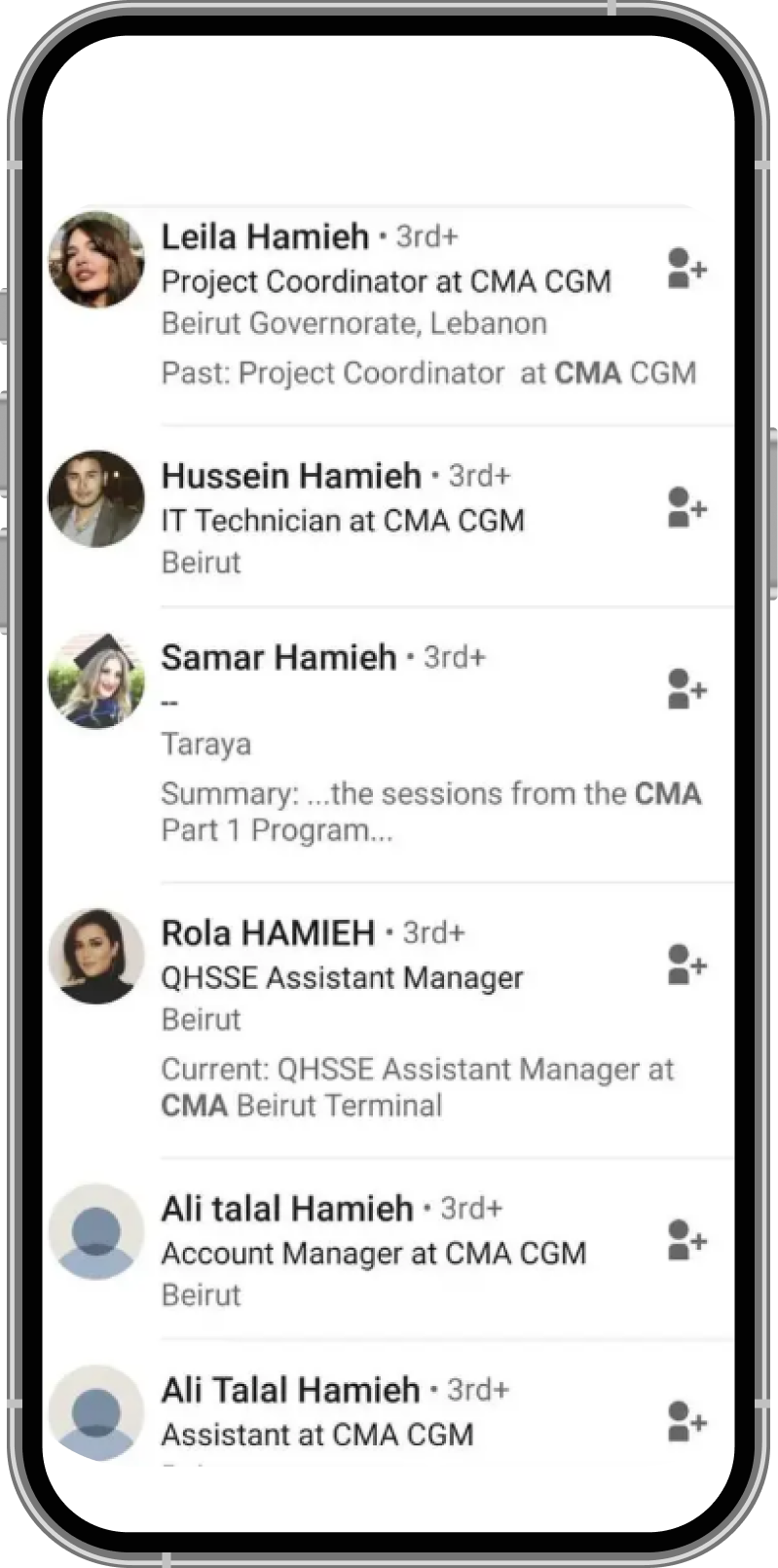
In March 2023, some pictures went viral on social media platforms
and made big waves, as they revealed how many members of “Hamiyeh”
family were hired in the French company’s Beirut headquarters.
Curiously enough, these individuals’ employment records with the
company were swiftly removed, mere hours after the uproar online.
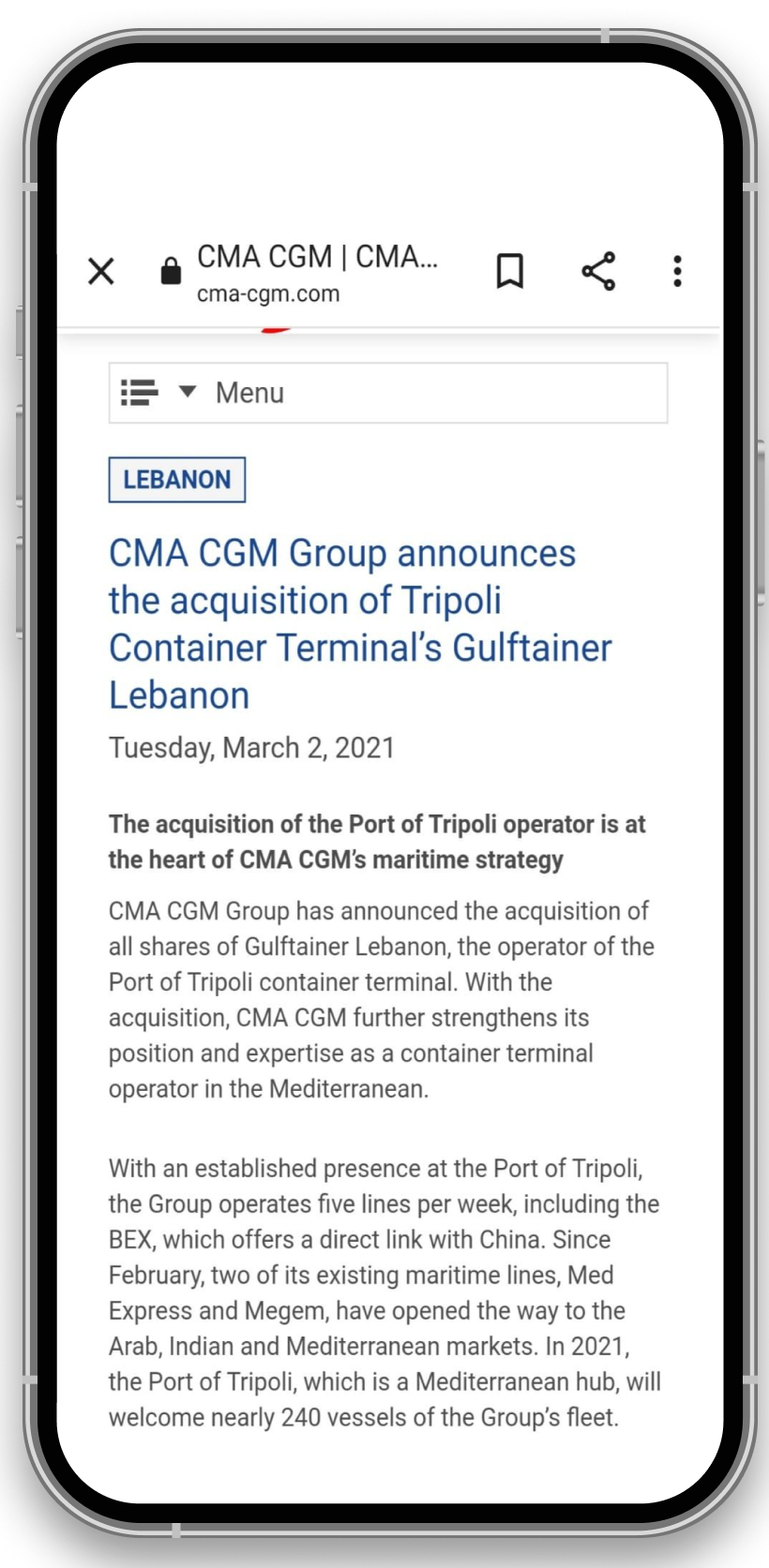
Looking into CMA-CGM and its owners, and based on the statements of
some specialized engineers, we have found that “Saadé’s Company”
bought Gulftainer, which was previously owned by Lebanon’s Prime
Minister Najib Mikati and Antoine Ammatoury. The pair sold it to
CMA-CGM in 2021, prior to the date of the tender, meaning that in
effect the French company was bidding against itself in the tender
(the French company is legally registered in Lebanon, therefore it
operates Gulftainer under its commercial license without official
registration, which is permitted by Lebanese law. That is why we
made sure to visit the commercial register in Tripoli to confirm
this point, and we found that Gulftainer is registered in Dubai, and
thus has no commercial records in Lebanon).
The CMA-CGM group remains one of the most fortunate companies in
terms of winning tenders and being awarded contracts under the
current Lebanese government for “unknown reasons.” The French
company is active and involved in various Lebanese sectors, with the
aim of investing at very low rates compared to other offers. This
excludes competitors usually, and prevents other companies from
accessing these tenders, turning as a result the “fair competition”
stipulated by law into one dominated by “monopoly.”
The latest acquisition attempt by the French company targeted the
postal service. In March 2023, the alliance of “Colis Privé” and
Merit Invest - CMA-CGM owns one of them - was awarded a contract to
manage Lebanon’s postal company “Liban Post”. They took over the
postal products and services in Lebanon from “Mikati”, with a
bidding questioned by the Tender Management Authority, especially
since the aforementioned alliance was the only applicant for the
tender. This strips the process from both principles of transparency
and fair competition.
To view the video translation, please Click Here.
Speaking to the investigation team, Port of Beirut Director General
Omar Itani confirmed that CMA-CGM was awarded the tender because it
was cheaper than the previous company, which operated the container
terminal for 15 years and whose contract expired before the port
blast. The French company acquired the operation contract for only
$11, which amounts to less than a fourth or the previous company’s
rate, he noted.
Based on the numbers Itani gave, some logical questions arise: how
will CMA-CGM pay what it owes the Ministry with this meagre cost? What
economic benefits will Lebanon reap while the company keeps a profit
rate of up to 80%, according to Itani’s statement, while only 20% goes
to the state treasury?
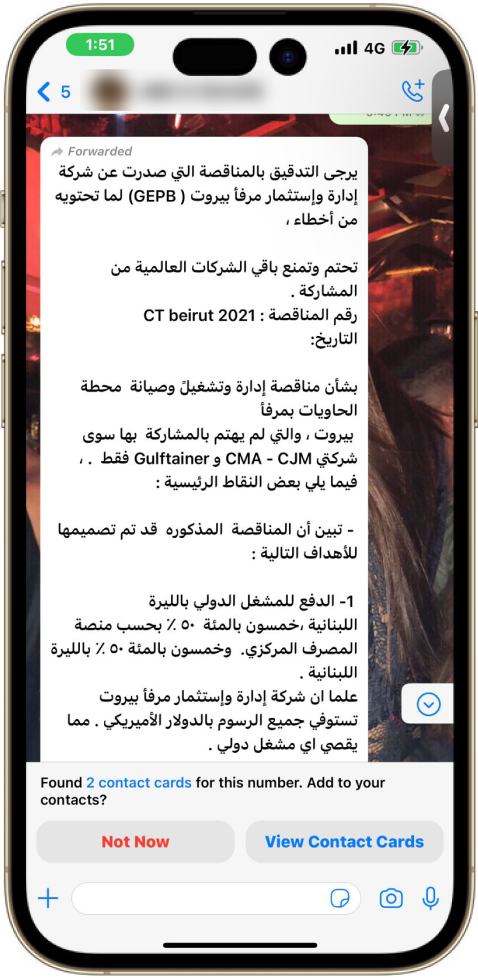
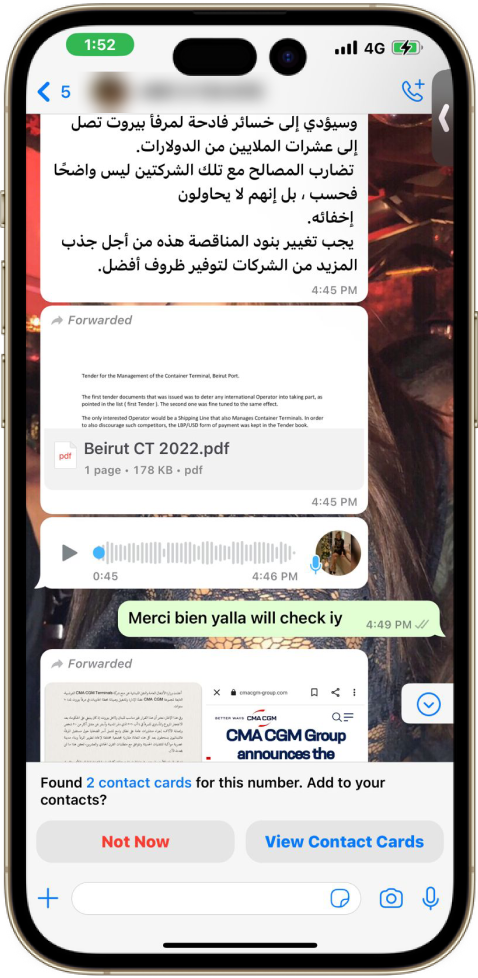
The investigation team sent a copy of the French company CMA-CGM's
contract to specialized engineers who worked on the file, soliciting
their opinion on it and asking them to identify the fundamental errors
it contains. Their response came as follows:
1- Payment to the international operator is in Lebanese pounds; 50%
according to the Central Bank’s exchange rates platform, and 50% in
Lebanese pounds. Note that the Beirut Port Management and Investment
Company collects all fees in US dollars; a formula that alienates most
international operators.
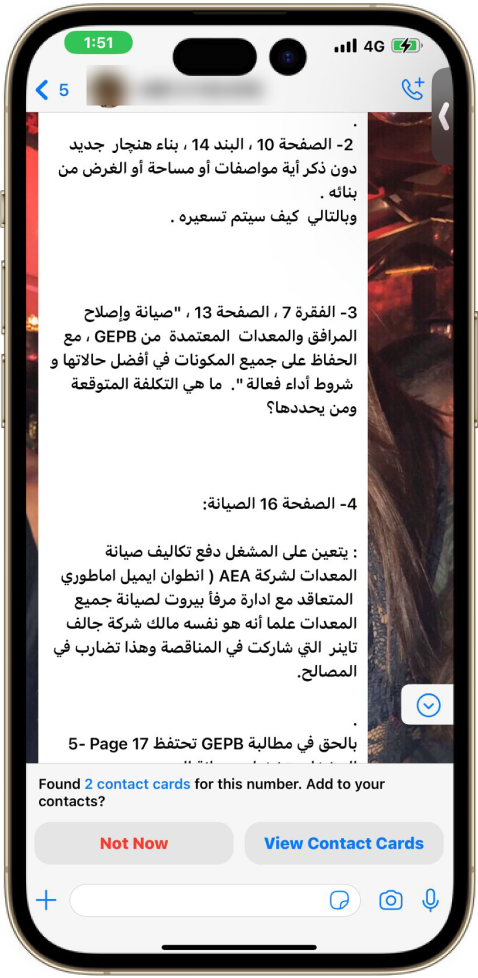
2- Page 10, clause 14 includes the construction of a new hangar, while
failing to mention any specifications such as the area, or purpose and
how will it then be priced?
3- Page 13, paragraph 7 includes “maintenance and repair of facilities
and equipment approved by “Gestion et Exploitation du Port de
Beyrouth”, which means Temporary Committee for Management and
Investment of the Port of Beirut (GEPB), while maintaining all
components in top condition and ensuring efficient performance.” What
is the expected cost for achieving that and who determines it?
4- Page 16, maintenance: “The operator must pay the costs of equipment
maintenance to Mr. Antoine Emile Amatoury’s company (aea), contracted
with the Beirut Port Administration, to maintain all equipment”. This
is despite the individual mentioned being the owner of Gulftainer,
which participated in the tender, and this is a clear case of conflict
of interest.
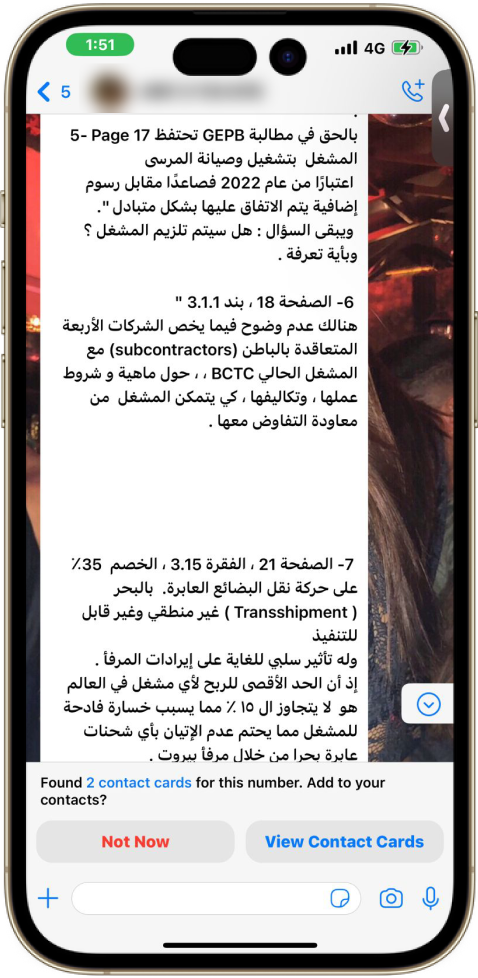
5- Page 17, “The Temporary Committee for Management and Investment of
the Port of Beirut (known by its French acronym of GEPB) reserves the
right to demand that the operator manages and maintains the dock from
2022 onwards for an additional fee, to be mutually agreed upon.” This
begs the question: Will the operator be contracted? And at what rate?
6- Page 18, clause 3.1.1, there is a lack of clarity regarding the
four subcontractors working with the current operator Beirut Container
Terminal Consortium (BCTC). This concerns the nature and conditions of
their work, and related costs, so that the operator can re-negotiate
with them.
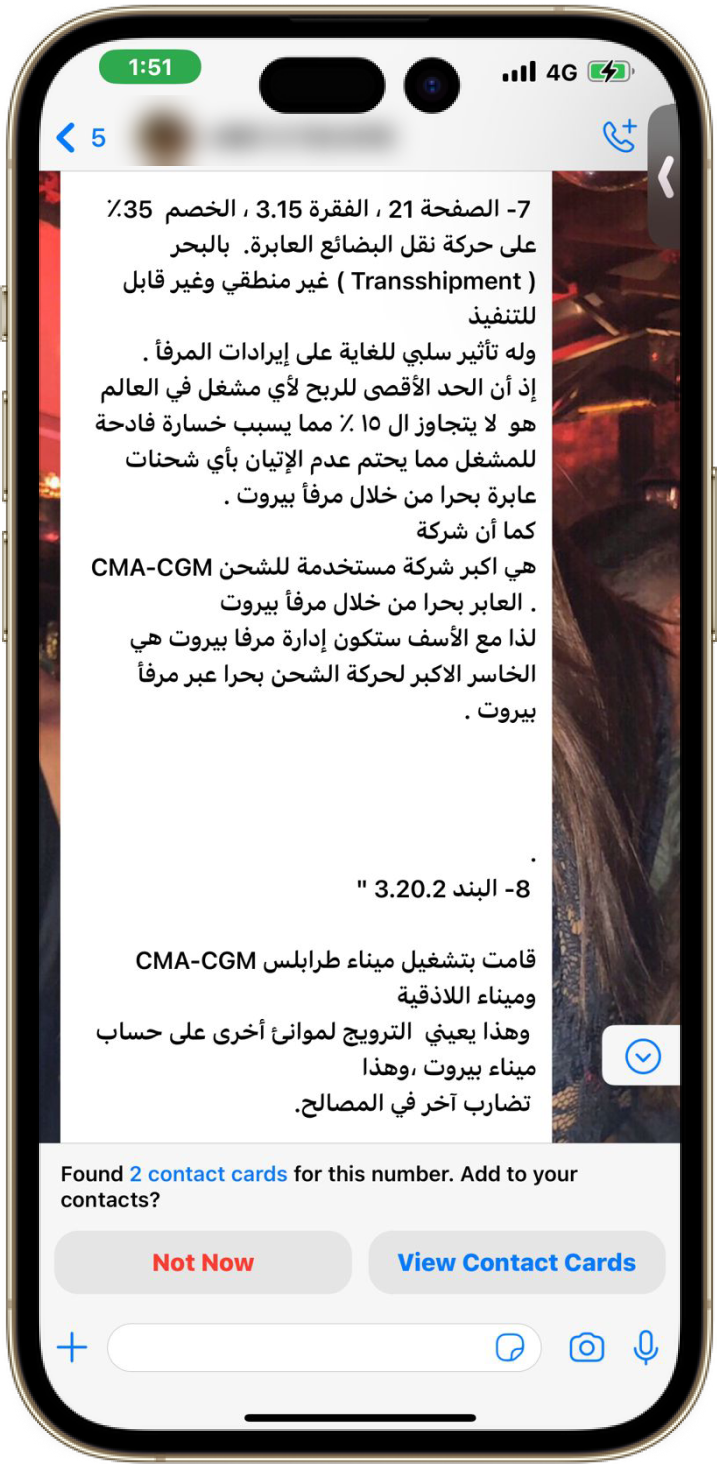
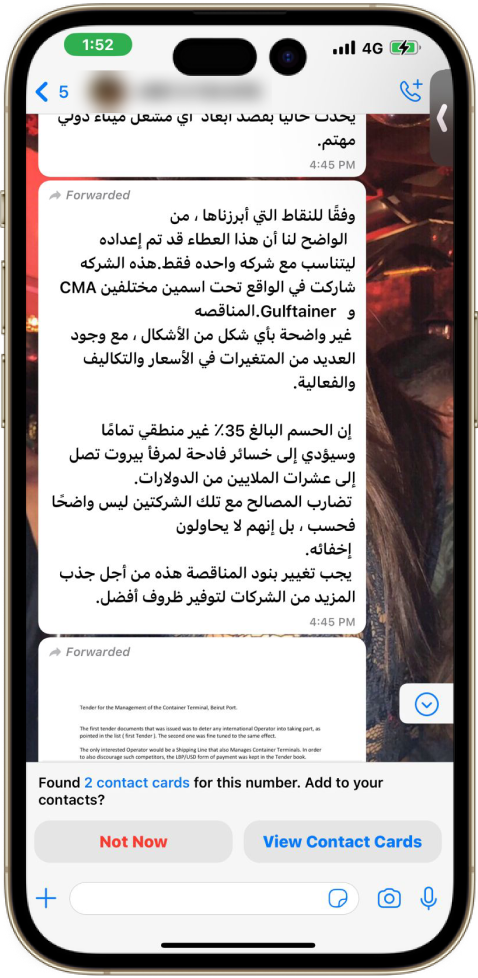
7- Page 21, Paragraph 3.15, a 35% discount on transshipment (the
transit of sea-shipped goods) is unreasonable and unenforceable, and
has a very negative impact on the port’s revenues. The maximum margin
of profit for any operator in the world does not exceed 15%. Also,
CMA-CGM has the most transshipment operations through the port of
Beirut. Therefore, the Beirut Port Administration is set to lose the
most from transshipments through the port.
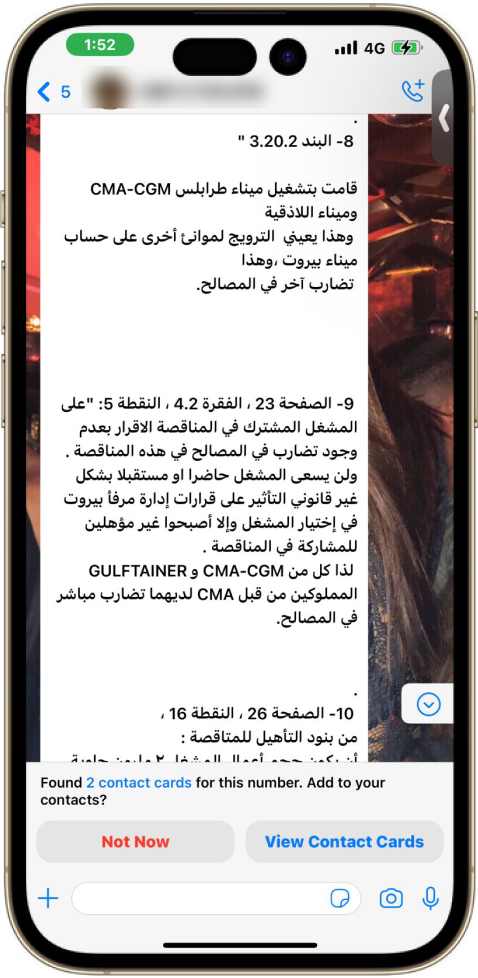
8- Page 23, paragraph 4.2, point 5: “The operator participating in the
tender must acknowledge that there is no conflict of interest in this
tender; and the operator must not seek, whether at present or in the
future - illegally - to influence the decisions of the Beirut Port
Administration in selecting the operator. Otherwise they will become
an ineligible bidder.” So, both CMA-CGM and Gulftainer, owned by
CMA-CGM, have a direct conflict of interest.
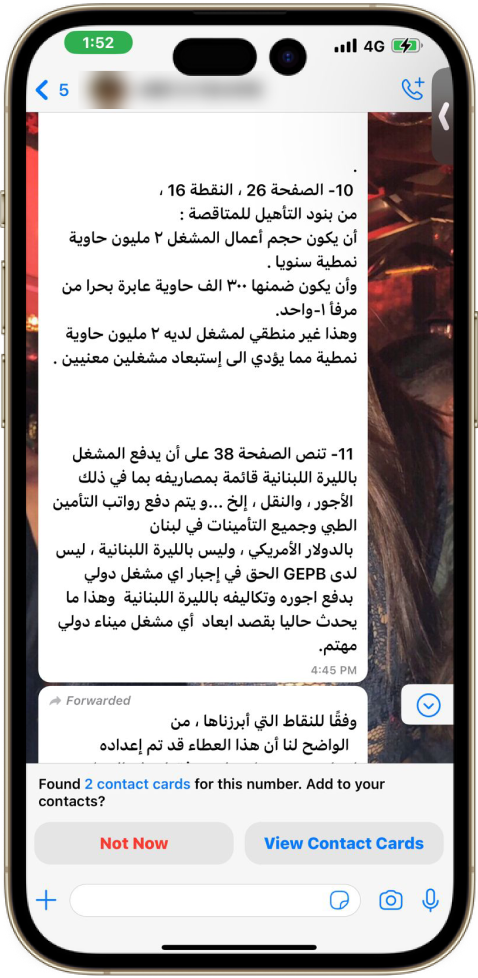
9- Page 26, point 16. Concerning the eligibility criteria for taking
part in the tender: “The operator’s business volume must be two
million Twenty Foot Equivalent Unit (TEU) annually, including 300,000
TEUs transiting by sea from one port.” This doesn't make sense for an
operator with 2 million TEUs; which leads to the exclusion of relevant
operators.
10- Page 38 stipulates that the operator pays a list of his expenses
in Lebanese pounds; including wages, transportation etc... Medical
insurance and all other insurance costs in Lebanon are paid in US
dollars. The Temporary Committee for Management and Investment of the
Port of Beirut (known by its French acronym of GEPB) has no right to
force any international operator to pay wages and costs in Lebanese
pounds. This is currently happening with the intention of alienating
any interested international port operator.

Click to display the images in larger size
It seems obvious that CMA-CGM group is preparing for large-scale
long-term investments in Lebanon. Some media outlets have mentioned
that the French company will be laying out plans to acquire stakes in
Lebanon’s national carrier, Middle East Airlines (MEA), especially
after its partnership in the field of air transport with Air France.
It is also looking to invest in the airport expansion project and the
building of a new passenger terminal, “terminal 2”, following the
suspension of the contract that the Ministry of Public Works had
recently signed with Lebanese Air Transport (LAT).
Meanwhile, Al-Modon, a Lebanese electronic newspaper, mentioned in a
previous report that the French company tried to buy L'Orient-Le Jour
newspaper, but its request was rejected.
Based on the right of reply stipulated by law in the media, we
contacted the French company CMA-CGM’s headquarters in Marseille,
France. We informed company officials of our investigation’s findings,
and asked them to clarify some points accordingly. However, the
company did not provide us with the “contract” being investigated, in
accordance with the right of access to information, noting that this
procedure violates French laws and Lebanese laws equally.
Back to the content of the response, the French company indicated that
it “was established in Lebanon over 40 years ago, and serves the
interests of the State. It has no connections to political parties or
competing rivalries as some claim, and is not affected by the general
economic atmosphere as perceived by other Lebanese. It took over the
contract in a legal manner, like all other contracts by virtue of
which it operates.”
Some points caught our eye here particularly. For example, the company
sang the praises of its institutional history and achievements,
elaborating in its responses on issues that touch on these points.
However, it contented itself with a brief comment on the issue of
August 4 (the date of the Beirut port explosion) and the “suspicious”
contract, without going into further details.
On the subject of the employment of relatives and friends of the
Lebanese Minister of Works, Ali Hamiyeh, in the French company’s
Beirut branch, we asked the French company to provide us with the
names of these people, so we could gauge the veracity of accusations
circulating on social media. However, the company rejected this
request, explaining “literally” in the email that it “has nothing to
do with any political or sectarian affiliation of its employees, as it
usually does not interfere in these matters. Concerning its
recruitment and candidates acceptance mechanism, the company claimed
that this is unified across its branches worldwide, and is carried out
according to the competence of candidates and not any other
consideration.”
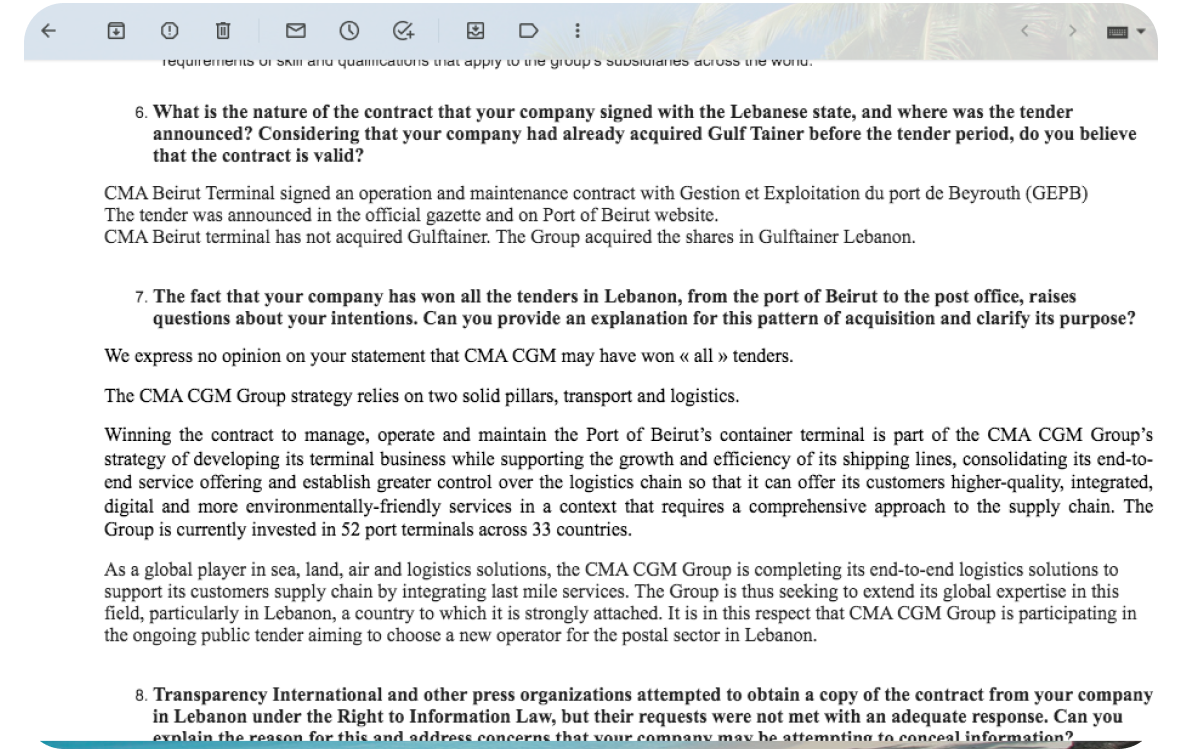
When we asked about the French company’s acquisition of Gulftainer, it
asserted that it “has not acquired it, but acquired shares in it.”
This confirms our findings concerning the legal violation, in that the
company was competing with itself by owning shares in Gulftainer.
Upon asking the company why CMA-CGM suddenly acquired the majority of public ports and institutions in Lebanon- raising suspicions of the Public Procurement Authority- knowing it did not meet the standards set forth in some instances, it stated in its reply that “the CMA-CGM Group strategy relies on two solid pillars, transport and logistics. Winning the contract to manage, operate and maintain the Port of Beirut’s container terminal is part of the CMA-CGM Groups strategy of developing its ports terminal business supporting the growth and efficiency of its shipping lines. As a global player in sea, air land and logistics solutions, the CMA-CGM Group is completing its end-to-end logistics solutions to support its customers supply chain by integrating last mile services. The Group is thus seeking to extend its global expertise in this field, particularly in Lebanon. It is in this respect that CMA-CGM Group is participating in the ongoing public tender aiming to choose a new operator for the postal sector in Lebanon”. It is worth mentioning the contract was annulled for non-compliance with the conditions set forth by the Public Procurement Authority.

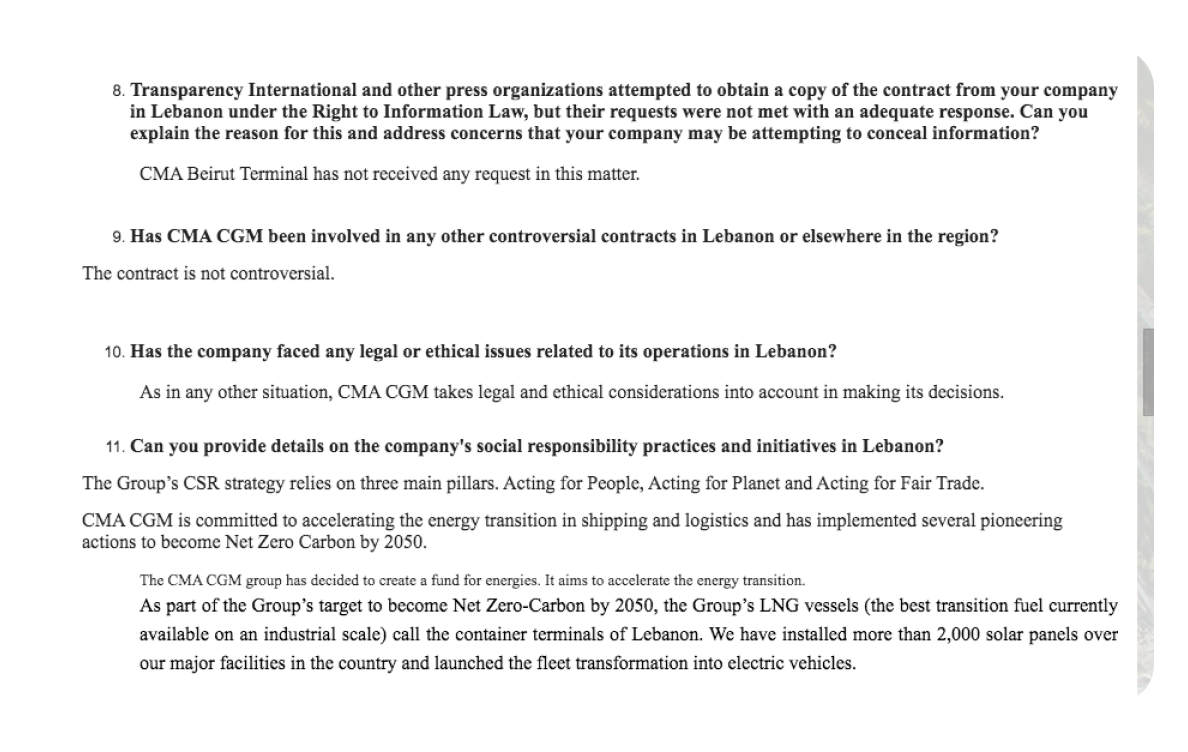
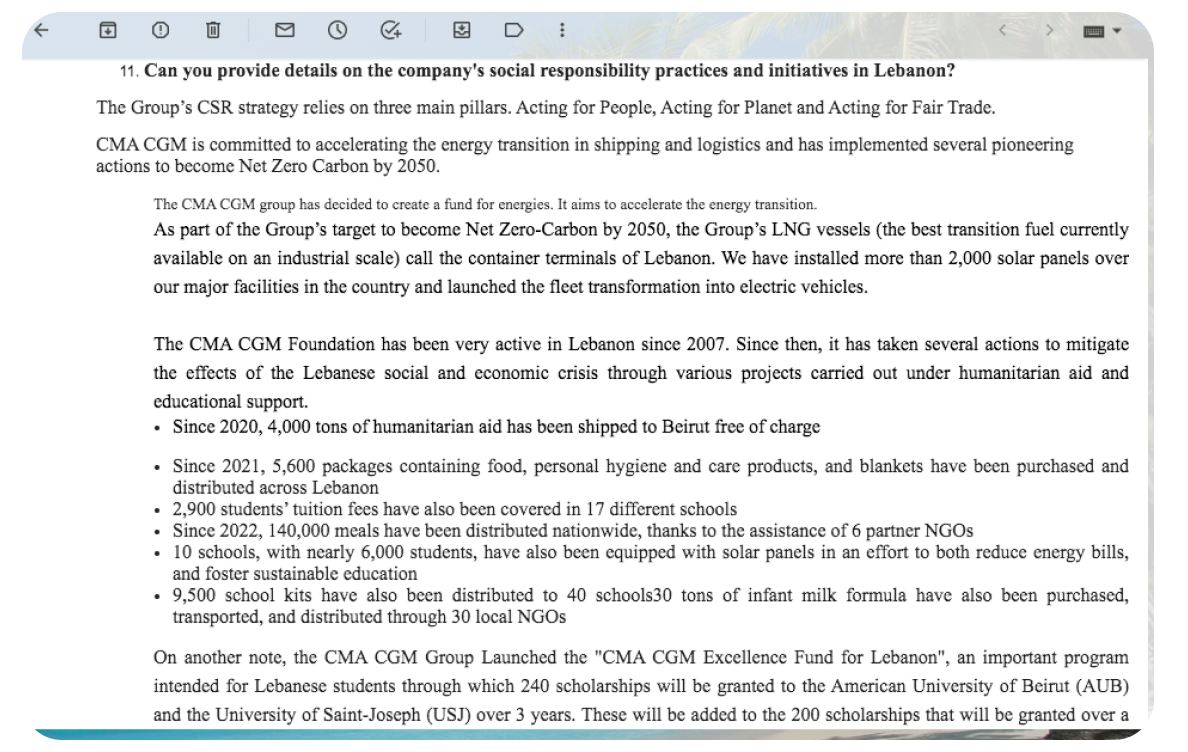
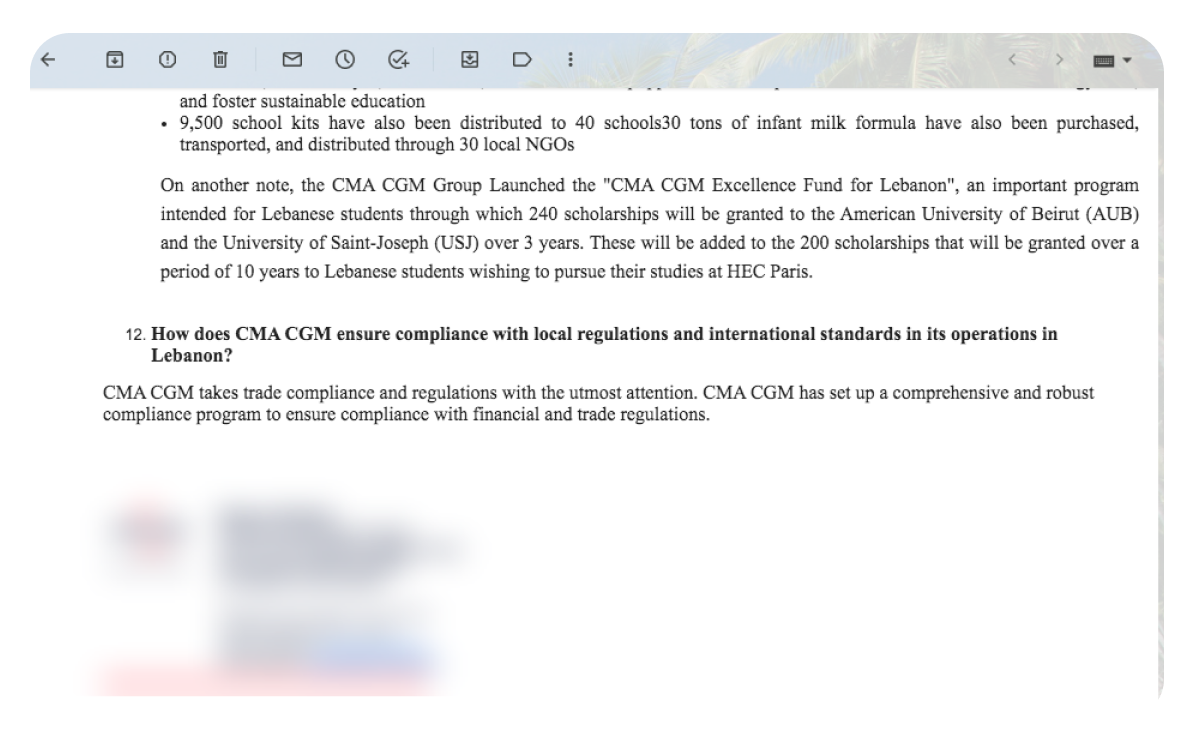
What really caught our eye was the company’s statement about not
receiving any request for a copy of the Beirut Port contract from
“Transparency International-Lebanon”, while the association contacted
the company twice. But the company gave several excuses, perhaps most
notably that it had not received the request from “Liban Post.”
In this investigation, we publish copies of the two requests that were
sent, while noting that Transparency International
Association-Lebanon, has sent a third request to the French company,
this time through a notary. From then on, it had 15 days to respond
with either rejection or acceptance, based on the stipulation of the
Access to Information Law. In the event of rejection, the company was
required to provide a reasonable justification for its decision.
Except CMA-CGM did not do so, and only commented that “everything
related to the activity of the Port of Beirut is published
periodically on the port’s electronic platform, and that there is no
clear motive for revealing its papers to Transparency International
Association-Lebanon”. However, this step is contrary to the law and
raises questions about the transparency of the French company. For his
part, Transparency International Association - Lebanon Executive
Director, Julien Courson, confirmed that he will resort to the
Lebanese State Shura Council to reveal the truth and review the
documents, armed with legal instruments, and in accordance with
Article 28/2017 (the right of access to information), specifically
Article 3(a) of the law, which defined the administrative document
that can be requested from the administration as including all written
and electronic documents, audio recordings, visual clips and videos,
pictures, and all documents that can be automatically read, regardless
of their format or size, which the administration collects regardless
of whether they are its property or issued by it, or whether it is
party to them.
You can find below an overview of the documents and files that prove that the tender for containers in the port of Beirut was carried out in a “suspicious” manner, from the basic loopholes in the operating contract, to the provisions of the law issued by the Public Procurement Authority, or the response to the request of the Transparency International Association - Lebanon and the refusal to clarify after CMA CGM was given the right of reply.
After studying the company’s response to the investigation team’s questions, it became clear that it did not obtain the tender in a legal and transparent manner. Rather, in “suspicious” ways that raise several questions, including: Why does the Ministry of Public Works insist on contracting CMA-CGM exclusively for the container tender, while excluding other applicants, such as the German and Spanish companies? What economic losses will Lebanon incur as a result of this contract? Why did the Ministry of Public Works allow the tender to be completed with its prior knowledge of CMA-CGM owning shares in Gulftainer?
To answer all these questions, and since the Lebanese Ministry of Public Works is the legal body that can clarify everything mentioned previously, we contacted the Ministry by email on August 30, 2023. However, we have received no response as of the date of publication of this investigation.
This investigation was carried out with the support of ARIJ
In partnership with Transparency International Lebanon - No
Corruption.

