The War In Sudan Silences Journalists
Haydar Abdel Karim
 30/01/2024
30/01/2024
This investigation documents how journalists endured hundreds of
violations over a period of six months since the outbreak of war
between the Army and the Rapid Support Forces in Sudan. Both parties
to the conflict systematically violate international law, which
mandates the protection of civilians and journalists as neutral
parties not participating in the war. This comes as the approval of
a resolution to investigate war crimes committed there is delayed.
Day: April 23, 2023
Location: A dark room with light filtering in from gaps in the wall.
Manal Ali woke up from the blow she received to her head and slowly
began to regain consciousness. Despite the confusion she felt from the
impact of the blow; Ali still remembers the last scene of that day; on
her way to the bakery in Al Juneina neighbourhood in West Darfur
State, a car with masked men stopped near her, she heard a voice
calling her name and then nothing.
“This is my end. This is the end,”
Ali repeats these words, as she tries to maintain whatever little hope
she has left for survival.
Manal Ali is an independent journalist, and one of more than a hundred
journalists who were arrested, tortured and threatened by both sides
of the conflict in Sudan, for merely trying to report on the reality
that the Sudanese people are living through. This story did not begin
on April 15, 2023, since earlier signs of war had been looming on the
horizon, and everyone was anxiously awaiting “zero hour” while some
were hoping that the last week of Ramadan would pass peacefully.
On the morning of Saturday, April 15, clashes rang out in the capital,
Khartoum, between the forces of the national army led by Abdel Fattah
Al-Burhan, and forces of the Rapid Support Forces RSF led by Mohamed
Hamdan Dagalo, known as “Hemedti.” They shared power for a while after
the overthrow of Sudanese President Omar Al- Bashir’s government in
the popular revolution that started in 2018, and extended into 2019.
On October 25, 2021, the two generals carried out a coup against the
transitional civilian government, and they stayed in power for more
than eighteen months before they engaged in a open armed conflict that
began in Khartoum and later extended to the Northern State, North
Kordofan, South Kordofan, Darfur, Blue Nile, Al-Qadarif, and Gezira
among others.
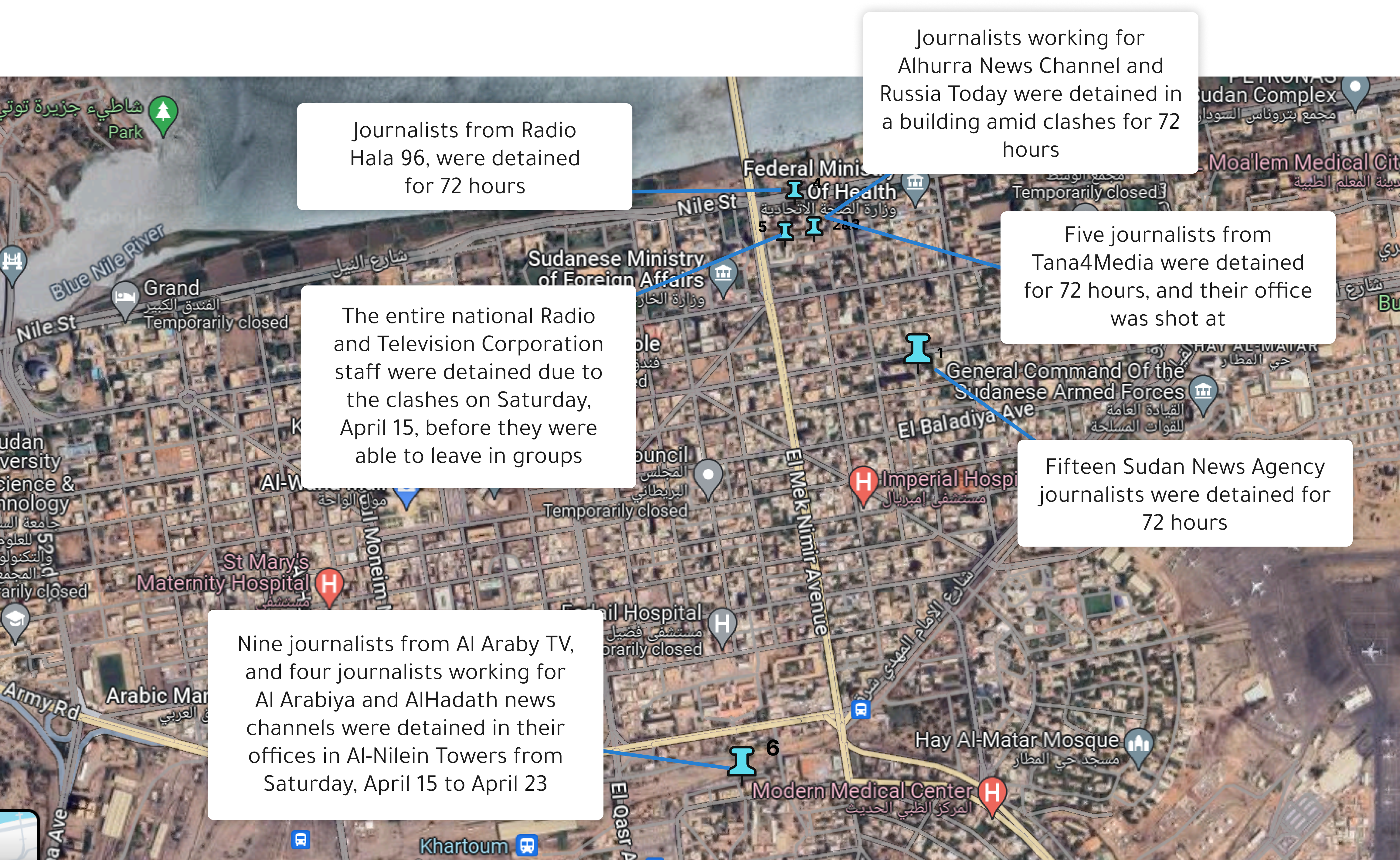
Dozens of journalists and workers at radio stations and satellite
channels in central Khartoum were detained due to armed clashes. Rami
Mohammad (a pseudonym) and more than twenty others, including
journalists working for Radio Hala 96, and Tana4Media agency located
in the Kuwaiti building, went to the parking lot known as the
“Bedroom” and stayed there for 72 hours without food supplies. They
were all able to leave the place after the first truce came into
effect, according to Mohammad, who thought that his death was certain.
Manal Ali says,
“The homes of journalists were targeted; they had a list of our
names, and the Rapid Support Forces were searching for us by name.
They destroyed my house completely.”
On the first day, Manal lost seven members of her family, including
her brother.
As part of her job, Manal Ali received reports of rape incidents that
took place in Darfur State, specifically in Al Juneina where she
lives.
“There were recordings for nine cases of rape, and I was
communicating with the victims before communications were all cut
off.”
Ali says that she received a phone call in which the speaker
threatened to kill her if she published any details about the rape
incidents. However, the real nightmare started on April 23, a day
after the war broke out in her city, Al Juneina, when Ali was
kidnapped by masked men wearing the uniform of the Rapid Support
Forces. When she woke up from the blow to her head, she found herself
in a dark room. Ali remembers some sentences that stuck in her memory,
“This is not the right time to kill you. We killed some of your
family members, and we will torture you by letting you see the rest
of your family being killed: Then, killing you will become easy.”
Ali who resides in the city of Al Juneina in western Sudan spent five
days in an isolated room and was subjected to severe beating, torture
and threats to eliminate more of her family members and relatives.
She said that on April 27, 2023, they beat her until she lost
consciousness. On the same night, Ali was found in an area close to
where she was kidnapped, lying near the neighbourhood mosque in a
critical condition. She was treated and later transferred to her
family's home, after which she began her journey to escape the war as
she crossed into Chad.
Just like Manal Ali received threats because of her coverage of rape
incidents, journalist Issa Dafaallah had a similar experience while
preparing a news report on the looting of shops in Nyala.
Dafaallah explains that while filming business premises and shops on
May 17, a group affiliated with the Rapid Support Forces intercepted
him, prevented him from continuing his work and dragged him to the
airport neighbourhood. Dafaallah says,
“They asked to see my journalist ID card, and they took me to the
airport neighbourhood where I was beaten and kicked, and my phone
was confiscated.”
Dafaallah highlights that the attempts to prevent press coverage of
the events coincided with what he describes as the “doomsday battle”
in the city of Nyala. Moreover, Dafaallah pointed out that both sides
of the conflict issued orders to silence journalists accusing them of
affiliation with one of the warring parties.
Italian journalist Sara Creta, arrived at the Sudanese-Ethiopian
border on May 7. That is, three weeks after the outbreak of clashes.

The Sudanese authorities did not allow her to enter the country; she was detained by the Military Intelligence Department in the border region for a few hours, and she was asked to return to where she came from. The journalist works with several international channels, including Al Jazeera and The Guardian, and she tried to enter again through the Blue Nile region, but she was denied access to Ad-Damazin, and was asked to leave. Sara says, “They told me that they cannot guarantee my safety there, and currently they told me, there are orders prohibiting the entry of foreigners. The situation is volatile, I meant to stay in an area where there was no fighting. Both factions used the same language, so I felt that they were using the security argument as an excuse.”

Sudanese people at the border crossing, arriving at the Ethiopian border of Metemma city (credit: Sara Creta)
From April 2023, until the end of September, the Journalists’
Syndicate recorded several violations, including killings, detentions,
injuries, threats and assaults on property. The head of the
Journalists’ Syndicate Abdel Monim Abu Idris says that Sudanese
journalists are part of civil society, and they suffer just like
civilians do to a large extent, besides enduring violations because of
their work; they are arrested to prevent them from practicing their
profession. Abu Idris says,
“We lost two journalists; our colleague Samaher was killed in
Zalingei after a mortar fell on her house, and our colleague Issam
Morjan was found murdered in his home in Omdurman, which is under
the control of the Rapid Support Forces. He was buried in his house
and not even in the cemetery.”
According to Abu Idris, the violations do not only impact journalists;
rather, their family members and relatives are targeted as well. He
stated that one journalist lost his wife
Abu Idris points out that the majority of public and private media
organizations have been targeted since the beginning of the war, and
have stopped working as a result. The head of the Journalists’
Syndicate attributes this to the proximity of these organizations
offices to the areas of clashes. He added that most of their offices
were attacked and looted.
From the onset of the war, the premises of the national Radio and
Television Corporation were taken over by the Rapid Support Forces,
and have been turned into military barracks since.

On May 11, 2023, the Sudanese Armed Forces, and the Rapid Support
Forces signed the Declaration of Commitment to Protect the Civilians
of Sudan under the auspices of the governments of the Kingdom of Saudi
Arabia and the United States of America, but the treaty failed to put
a stop to the war between the two parties.
A clause guaranteeing the rights of journalists was absent from the
declaration, and the violations committed against male and female
journalists prompted eighteen media entities and organizations to sign
and issue a statement in mid-August calling on the international
community to take action to protect journalists. The statement also
called on both sides of the conflict to stop the war, open
humanitarian corridors, enable journalists to cover events and
facilitate their movement. According to the statement, journalists
were subjected to physical assault, arbitrary arrests and enforced
disappearances. Female journalists particularly experienced
gender-based violence, such as sexual exploitation.
The testimonies of the journalists we interviewed and the analysis of
the data we obtained from the Journalists’ Syndicate confirm that both
the Sudanese Armed Forces and the Rapid Support forces have pressured
journalists.
Ali Tariq, a journalist who works for Al Jarida newspaper, left
Khartoum as the clashes escalated and headed to his hometown in Sennar
State and worked from home. On August 16, he was summoned to the
General Intelligence Service, following a press report he had
published about the conditions of those fleeing Khartoum to the city
of Sinja in Sennar State and documenting the harassment experienced by
the displaced in the shelters provided.
The security authorities rejected the accusations about their
inability to provide a suitable environment in the shelters and
pointed out that these were baseless claims. Tariq was imprisoned, and
his family was not allowed to communicate with him or to know anything
about him.
He was only released when he went on hunger strike on the fourth day
of his detention. Tariq says he was warned against writing about
humanitarian issues related to displaced people and against naming the
General Intelligence Service in future journalistic pieces.
The Rapid Support Forces and the Sudanese Armed Forces tried to
distance themselves from the accusations through their media
platforms. The Rapid Support Forces went as far as indirectly accusing
the Sudanese Armed Forces of committing crimes while disguised as
members of Rapid Support Forces.
Social media platforms were inundated with news promoted by both sides
of the conflict. As journalists shared parts of the news and
narrative, lists were published that affiliated them with one of the
two warring sides. This led to the spread of hate speech against
journalists from unknown entities, and an exchange of accusations
amongst journalists themselves on social media platforms. Female
journalists were subjected to blackmail and exploitation attempts in
order to pass the agenda of supporters of one or the other of the
warring parties by making them financial offers, or they tried to
intimidate them and threatened to prosecute them if they refused to
cooperate.
Hiba Abdel Azim is an independent journalist who was threatened by her
colleague in a WhatsApp group, which includes more than sixty-seven
journalists most of whom are reporters, following a discussion about
who started the war. Abdel Azim says,
“Initially, I brushed off the threat, but what really scared me was
that the person knew where our house is and knew all my family
members. His threat to come to the house terrified me, so we decided
to leave home.”
Abdel Azim says that the presence of members of the executive office
of the Journalists’ Syndicate in the group did not deter journalists
from using hate speech, and neither did the office members condemn the
threats directed towards her.
Samar Suleiman had a similar experience; she received threats through
the Messenger application, including one from a former minister. She
was also asked to broadcast television material on the satellite
channel she used to work for, in return for a financial award. When
she refused the offer, she was threatened that she will be reached and
delt with after the end of the war.
Data indicate that there are about 71 cases in which the home of a
journalist (male or female) were directly attacked. Abdel Monim Adam
is a human rights lawyer and director of the Access to Justice
Project, says that journalists are protected by law, and any violation
of their rights constitutes a blatant violation of international law.
Adam explains that this law is meant to mitigate the effects of wars
and limit their them to the warring parties. The law expressly states
that civilians are covered by legal protection, and they do not
participate in hostilities directly. Adam believes that journalists
and press institutions are not war targets; their journalistic work or
reporting is not considered a participation in war, even if that news
is false or misleading. According to Adam, journalist must enjoy
double protection, once as civilians and then as journalists.
Adam adds that journalists in Sudan have faced pressure to take sides
in the war, which is a clear violation of the text of the law, as they
are not required to provide any information except within a
professional framework, and any violation of the immunity granted to
them under the law is considered a war crime.
The United Nations High Commissioner for Refugees
says, “Around 4.600.000 Sudanese have been internally displaced
since the beginning of clashes, as they seaked refuge in various
parts of the country. Around 1.1 million Sudanese crossed into
several countries, including the Central African Republic, Chad,
Egypt, Ethiopia and the neighbouring Republic of South Sudan until
the second half of October 2023.”
Manal Ali describes her journey out of Sudan which started on April
31. With her father she got into a car to be smuggled out of
Al-Juneina area. She was worries about her father in case her identity
would be revealed. The driver motioned to her to hand him her
possessions, such as her phone and laptop, so these would not be
stolen from her. They arrived at the first checkpoint of the armed
militias, and they passed safely because the driver was “one of them,”
she says. At the second checkpoint, they took the passengers'
possessions, except for what the driver had hidden. At the last
checkpoint, Ali remembers how she and the Nubian passengers were
described by the colour of their skin, and she regretfully recalls the
use of what she describes as hate speech. Then, they finally made it
to the Chadian border.
Abbas Al-Khair who is a field correspondent for the “Sudan Bukra”
channel had a similar experience although with a different culprit. In
late May 2023, he began his journey out of Khartoum towards Madani,
where he was stopped by the army and was asked to show proof of his
identity. Al-Khair says, “My passport shows that I was born in Nyala,
so he said, ‘You are a member of the Rapid Support Forces.’ I told
them I was not a member of the Rapid Support Forces and that I am a
resident of Shambat as my driver’s license shows, so they allowed me
to go through.”
He left Al-Qadarif towards Ethiopia. At Al-Duqa checkpoint, the
Military Intelligence Department charged him with affiliation with the
Rapid Support Forces, just because of his identity papers and the
colour of his skin. He was asked to raise his shirt, and he almost
lost his life because of an old stab wound in his back. He was forced
to take off his clothes. Al-Khair adds, “A member of the Armed Forces
at the checkpoint asked me to remove my belt and pants, so I complied
under duress. Then, they searched me and touched sensitive parts of my
body.”
Later, Al-Khair was beaten and detained for long hours. He was taken
to a blood-stained room to force him to confess to belonging to the
Rapid Support Forces, where he was beaten and abused. While searching
his belongings, journalistic material that focuses on the root causes
of the popular uprising were found. This would have complicated
matters more, but he told them that he had left work for that channel
months ago.
Abbas Al-Khair says he was only released after one of his relatives
who is an officer in the Sudanese Armed Forces was contacted.
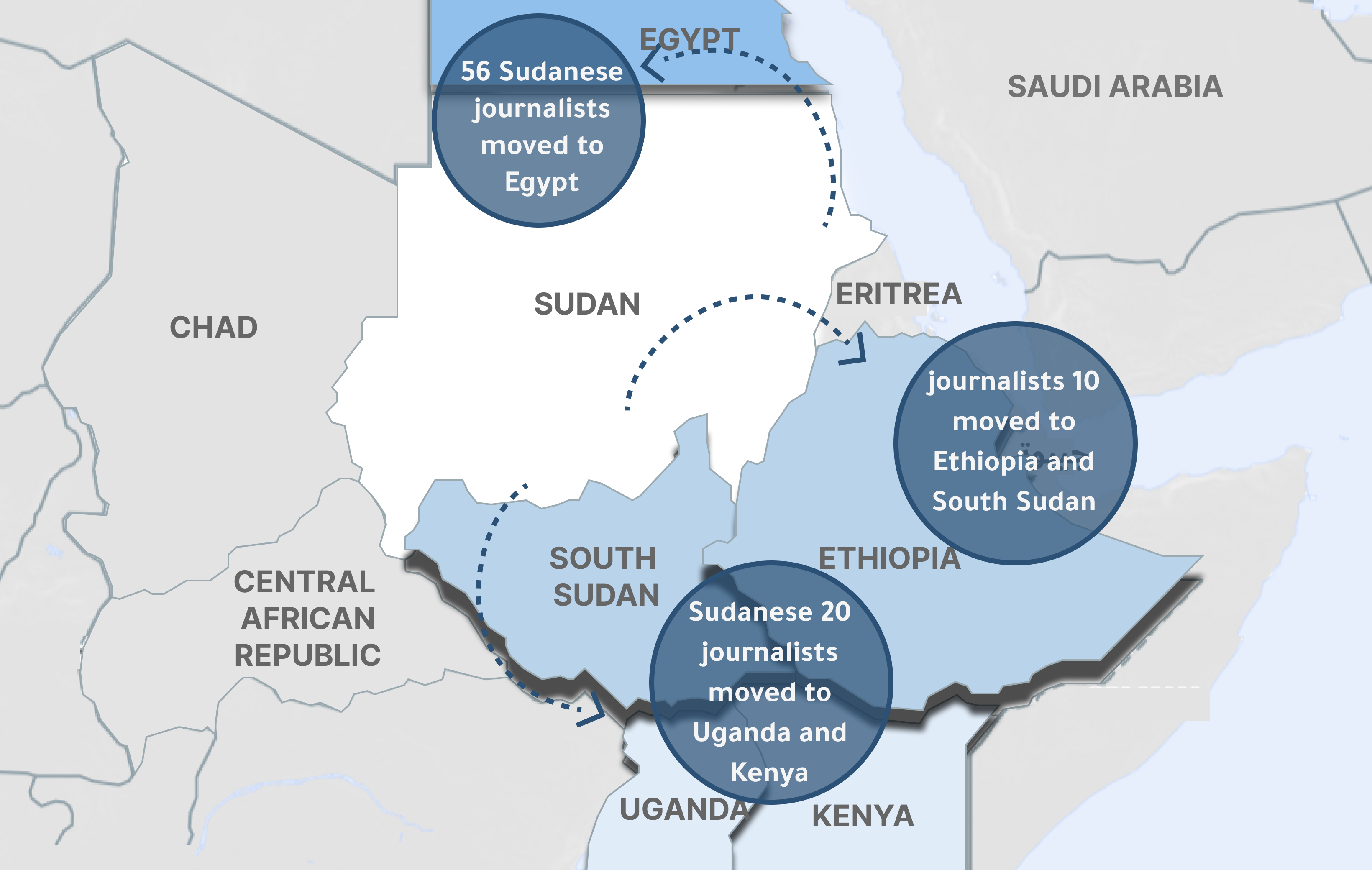
Al-Khair and Ali are among dozens of journalists who left Sudan
seeking refuge in neighbouring countries.
The head of the Journalists’ Syndicate Abdel Monim Abu Idris confirmed
that the International Committee to Protect Journalists, and Reporters
Without Borders have helped evacuate a number of male and female
journalists out of Sudan, and there are ongoing attempts to evacuate
more of them. According to Abu Idris, the majority of journalists left
for Egypt.
On October 11, 2023, the United Nations Human Rights Council adopted a
resolution to form a committee to investigate human rights violations.
Britain had submitted a draft resolution to the Human Rights Council
to investigate violations by both sides of the conflict in Sudan. The
Sudanese government rejected the draft resolution and deemed it
unfair, since it equated the legitimate authority of the Armed Forces
with that of the rebel forces.”
While this war rages on, claiming more than one thousands dead and
thousands more injured, and pushing five million Sudanese to be
displaced, Manal Ali, who recently settled in Uganda, says,
“I am living in dire circumstances; I lost everything, and I lost my
identity because my journalistic work was everything.”
She stressed that like innocent civilians, journalists pay a heavy
toll in this war.
This investigation was completed with support from ARIJ