This investigation reveals an upsurge in inflammatory language on X driven by sectarian fears about internally displaced Lebanese people. The surge coincided with the resumption of the war on March 2, 2024, and the resulting displacement of hundreds of thousands of Lebanese people. It continued until the ceasefire agreement, when displaced people began returning home.
“We don’t rent to women who wear hijab, and you’d be better off looking for somewhere a long way from here.” Zahra never expected to receive such a response when she went looking somewhere safe to stay. This young woman from southern Lebanon had been forced to leave home in Nabatieh with her family at dawn on 2 March 2026 following Israeli airstrikes across the country.
For Zahra and many Lebanese like her, the renewed war came as no surprise. For months they had been living under the strain of continuous Israeli violations of the ceasefire agreement, brokered internationally in late November 2024. The southern front had become active on 8 October 2023, in what became known as the "support front” for Gaza. Confrontations then escalated during 2024 into a comprehensive Israeli ground and air campaign, which caused heavy casualties and material losses and widespread displacement.
After being stuck in traffic for hours with thousands of other displaced people, Zahra reached the Abra neighborhood near Sidon, where her family stayed temporarily in her aunt’s house. Looking for housing large enough for her family, she contacted a landlord who had advertised apartments for rent on social media. But instead of answering her questions about the apartment, he began questioning her about which sect she belonged, whether she wore a hijab, and what her political affiliations were. He said finally: “We don’t rent to women who wear hijab. You know, we’re mainly Christians here, and we don’t want the hijab getting in here. You’re Shia, and we’re scared you might be a target, and then our lives and those of others here will be at risk.”
It was a similar story in Kaifoun, a town near Aley in the Mount Lebanon Governorate, where Mariam – a university student from the town of Tallouseh in the Marjayoun district of southern Lebanon – had taken refuge with her family in a small basement in a house for the duration of the war. But the short-lived sense of safety was shattered when a nearby building was shelled.
In the middle of the night, Mariam and her family were asked to leave the basement quickly, as the owners of the building next door feared having displaced people there might make their building a target. They packed up their things and set off into the unknown. But then one of the family managed to use contacts at the local council, which meant they could go back to the basement with an official guarantee. This agreement, however, meant their daily life was restricted. They were not allowed to wear abayas or have visitors. And such was the level of mistrust that anyone who came to see the family was questioned.
Traumatic displacement was just the start of more suffering, which the displaced faced throughout their months of exile. Zahra’s and Mariam’s stories mirror those of thousands of others who fled the war in search of safety, only to find themselves confronting another war that was no less brutal, one that continued to haunt them even after they had left the battlefield behind.
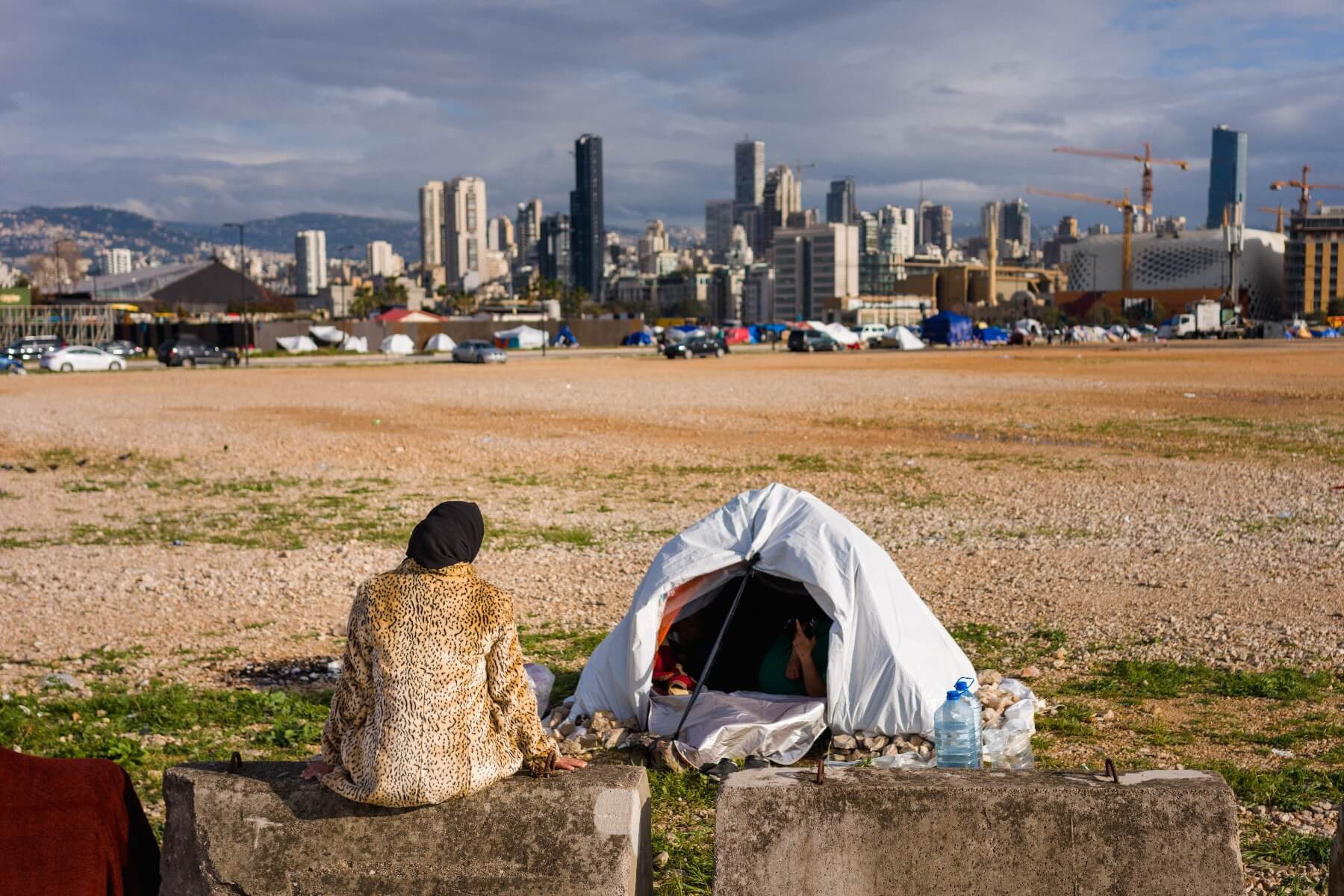
Within a month of the war starting, over a million people had been displaced, according to the daily reports put out by the Disaster Risk Management Unit. They had fled from southern Lebanon, from the southern suburbs of Beirut, and also the western and northern Bekaa. Of these, 136,000 ended up in state-run shelters, but most went to the homes of relatives in different parts of the country, or rented housing. It was this last group who were most often the target of online disinformation campaigns.
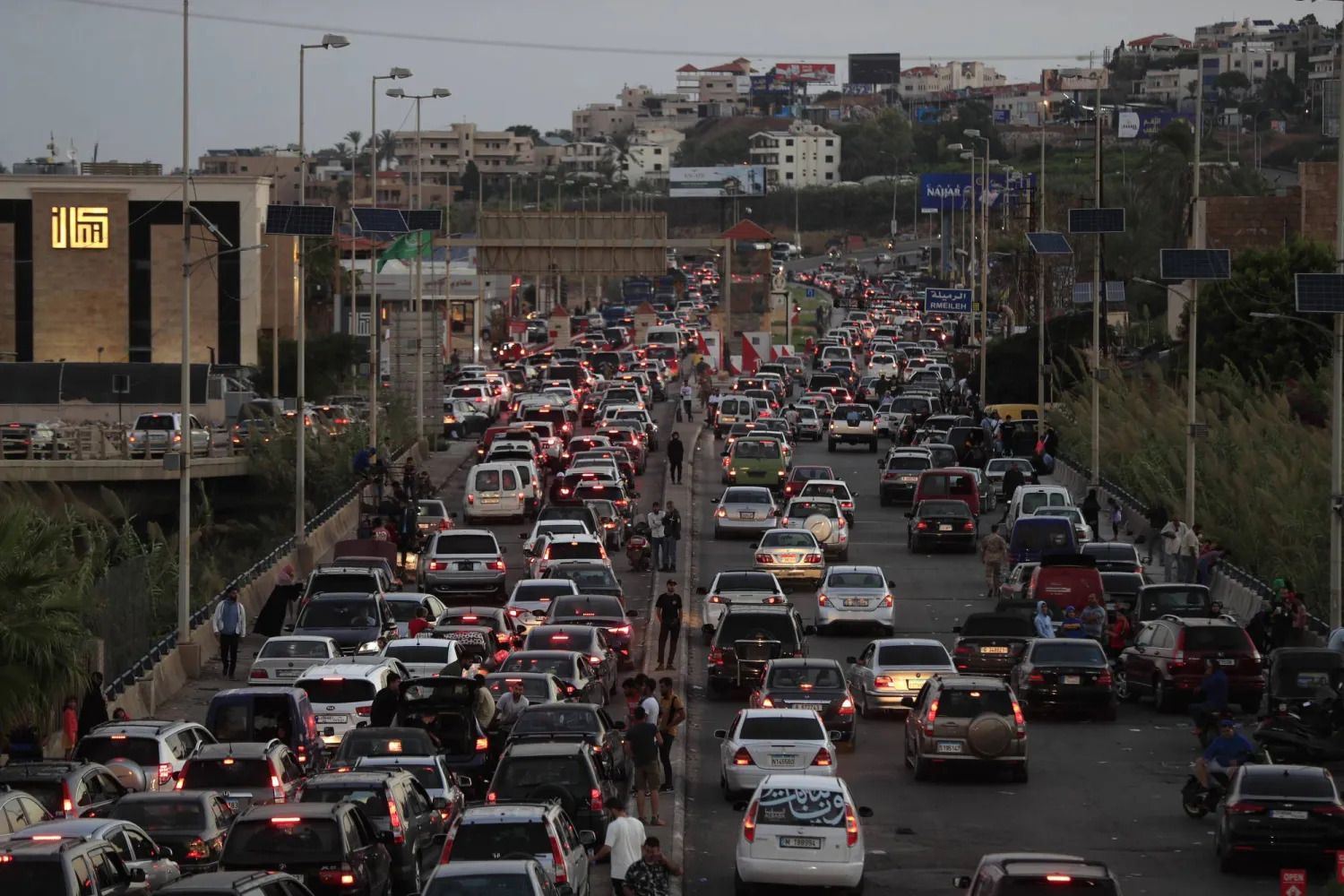 After 2 March 2026 scenes of an exodus from southern Lebanon
returned
After 2 March 2026 scenes of an exodus from southern Lebanon
returned
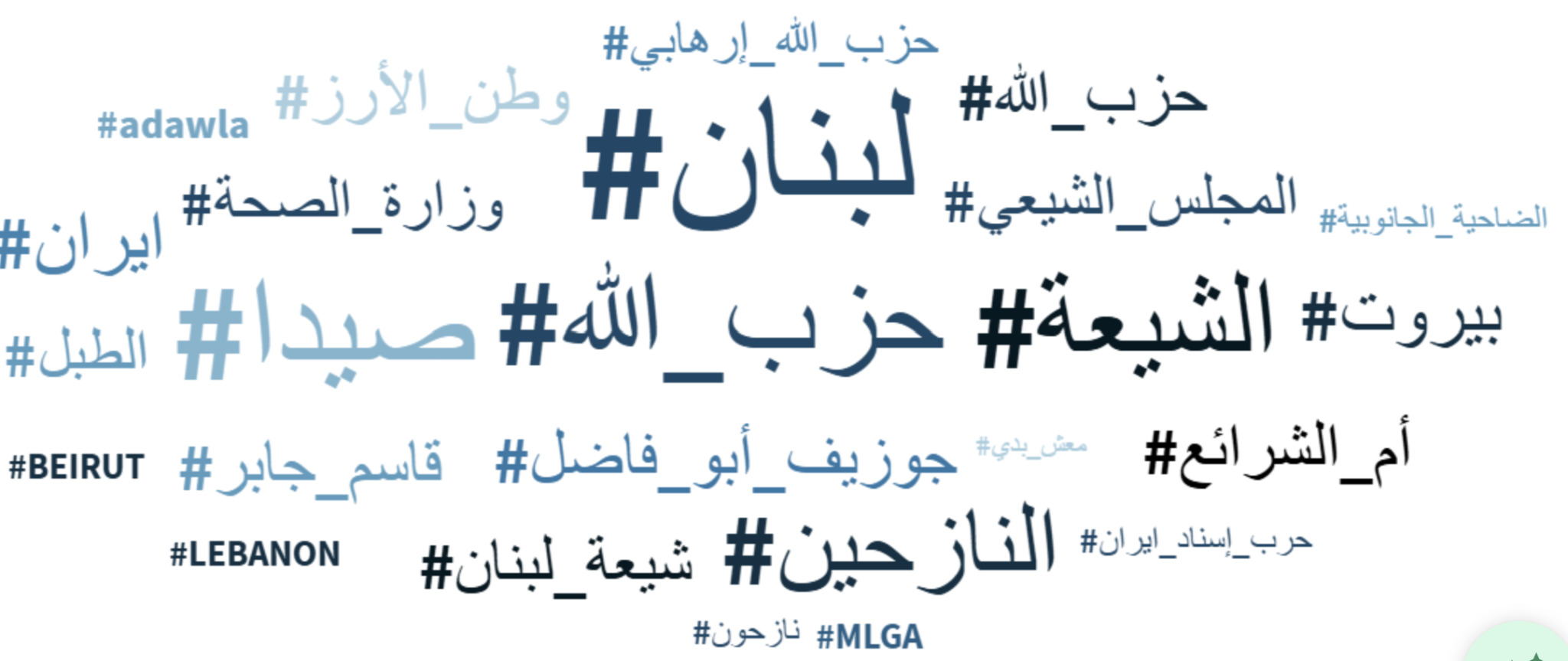
Our investigation tracked all posts about displaced people made from February to July 2026. We analyzed selected posts on X (formerly Twitter) targeting the displaced on a sectarian basis, using the term “Shi’a displaced persons”. These posts were linked to several hashtags, including “Iran_proxy_war”, “Hezbollah_terrorist”, ‘MLGA’, “Hezbollah” and, in particular, “Lebanon”. In the second week of the war there was an upsurge in the number of posts. Most of them—33.5 percent—were from accounts based in Lebanon, followed by Saudi Arabia and then the US.
The language in these posts can be described as sectarian hate speech, because it incites discrimination against the displaced based on their religious affiliation, harming them directly, even if there is no explicit call for murder or physical violence.
The UN defines hate speech as: “communication that attacks or uses derogatory or discriminatory language to refer to a person or group on the basis of their identity; in other words, on the basis of their religion, race, nationality, ethnicity, skin color, descent, gender or any other element of their identity”.
The posts we analyzed for the most part rejected the idea of accepting displaced people and called for them to be deported by sea to Cyprus. They promoted claims that these people were a security risk and a demographic threat, particularly in predominantly Christian areas, sometimes evoking memories of the Lebanese civil war. Posts also included visual and written material alleging that displaced people had vandalized public property or used it to store weapons, in a bid to tarnish their image and turn public opinion against them.
Rhetoric Reused for a New Purpose?
The Office of the High Commissioner for Human Rights and Freedom of Expression
Freedom of expression versus incitement to hatred: The Rabat Plan of Action
The Rabat Plan of Action proposes strict criteria for determining restrictions on freedom of expression and incitement to hatred, and for the application of Article 20 of the International Covenant on Civil and Political Rights. It sets out a six-part test that takes into account (1) the social and political context; (2) the status of the speaker; (3) the intent to incite the audience against a targeted group; (4) the content and form of the speech; (5) the extent of its dissemination; and (6) the likelihood of harm, including imminence.
On May 14, 2024, former Secretary-General of Hezbollah Hassan Nasrallah, who was subsequently assassinated in an Israeli airstrike, called on the Lebanese authorities to allow Syrian refugees who were willing to leave Lebanon voluntarily to embark for Europe from Lebanese ports. He was critical of the ban on them emigrating, saying: “Let us resolve as a nation to say: ‘Dear Syrian brothers who have been displaced, whoever wishes to leave for Europe or Cyprus, the sea is before you; so take to the boats and set sail.’”
Nasrallah’s statement came at a time when the EU and the US were under pressure to help repatriate Syrian refugees and provide them with help once they returned.
While monitoring content posted online, we noticed that an account with the name “Bilal_D75” had the idea of using Nasrallah’s speech and reposting it in a different context—to target the Shia community: “Any of you Shia refugees from the south who wants to leave for Europe or Cyprus, the sea is before you, so make that your ship and set sail.” This was accompanied by offensive remarks like: “To hell with you and anyone who feels sorry for you.”
Research showed that the Bilal_D75 account belongs to someone called “Abu Majd”, who lives in Lebanon and has changed his profile nine times. He previously wrote that he was “a supporter of the rights of the Syrian people until my last breath”, also describing his account as an “online troll”.
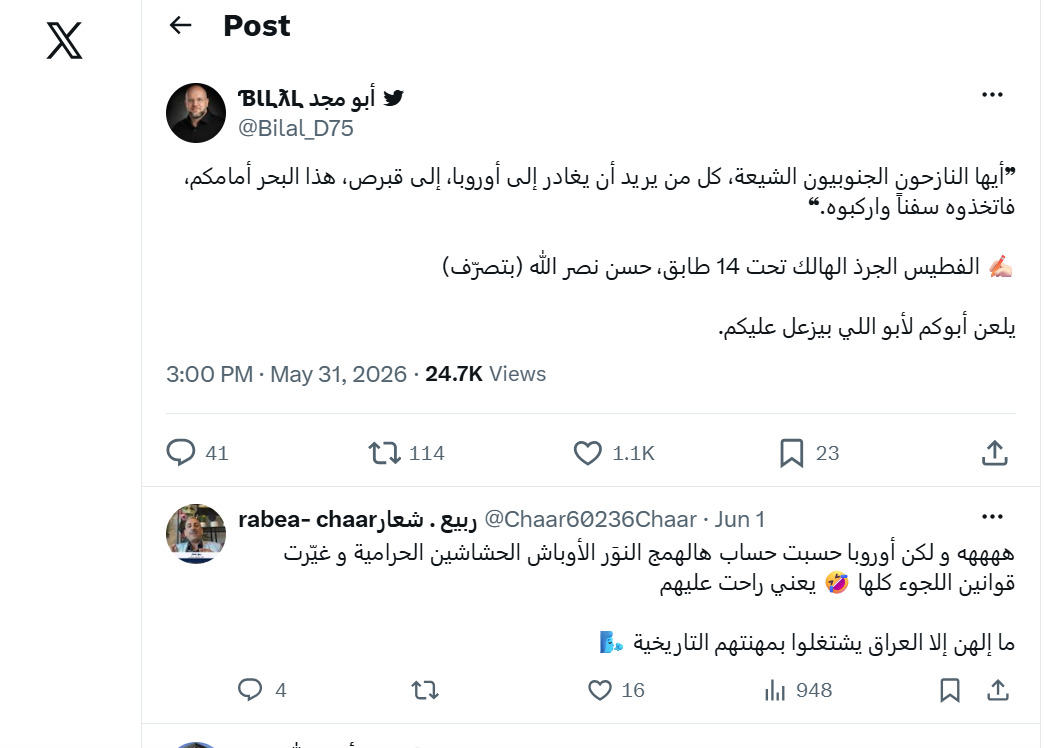 Original post by Bilal_D75 on 31 May
Bilal_D75 was also the most influential account we found, generating 1,300 interactions on X, with a reach of 101,000. Results showed that 84 posts used the exact same wording. Most of these were in late May and mid-June. The peak was in mid-June and coincided with the intensification of Israeli evacuation warnings in southern Lebanon during the first ten days of that month.
Nasrallah’s original language was therefore repurposed as evacuation warnings intensified, triggering large waves of displacement. This also coincided with displaced people being placed in reception centers—134,534 of them on 10 June 2026, according to the Disaster Risk Management Unit.
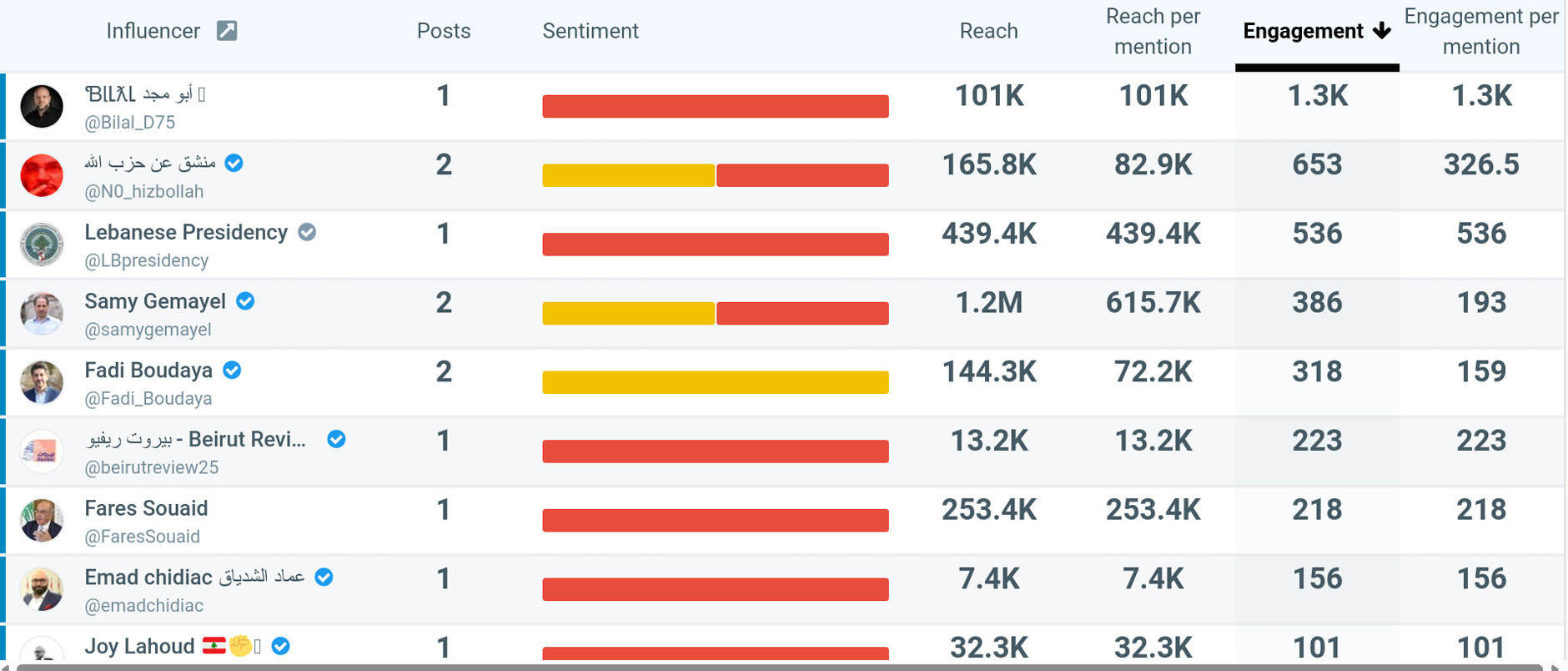 Figures show that the Bilal_D75 account was among the most
influential In the campaign against displaced people in Lebanon
Figures show that the Bilal_D75 account was among the most
influential In the campaign against displaced people in Lebanon
Potential Reach Over Time
82.5K Potential Reach
The results showed that more than ten accounts reposted content verbatim from Bilal_D75, citing it as the original source. The posts were made close together in two specific phases. The first began on 31 May 2026, when the Muawiyah87 account reposted the content at 16:49 that afternoon, followed by two other accounts—MNM20053 and JusticeEyesss from Saudi Arabia—at 16:58. Further reposts followed at 17:44, 18:24, 20:27, 20:30, 20:34, 20:44 and 20:50 via other accounts.
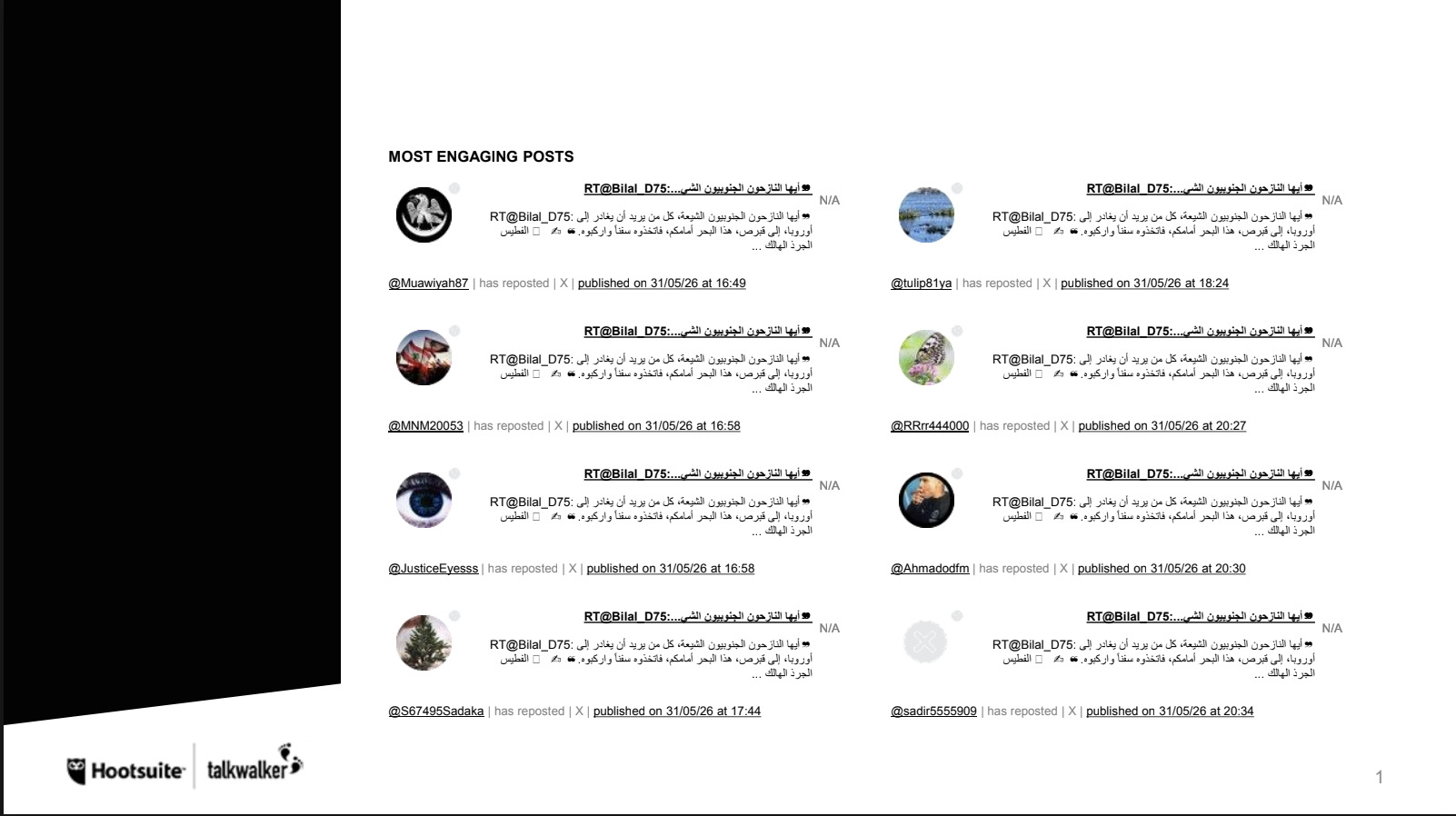
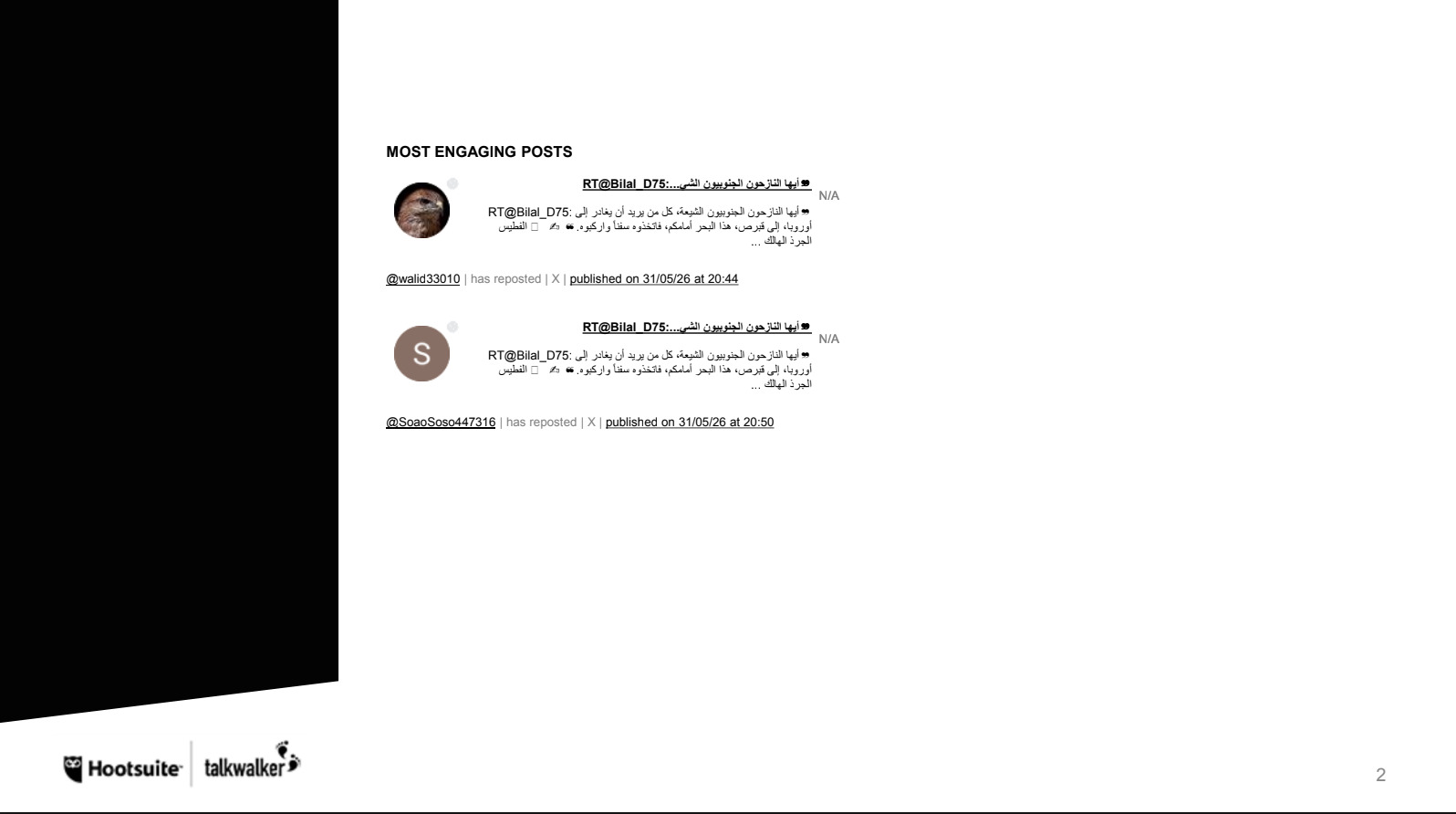
A second wave of posts began appearing at 00:03 on 2 June, with reposts at 00:34 and 00:40. They began again at 05:34, continuing on other accounts through the morning at 09:05, 09:59, 10:04, 10:29 and 11:23 until 14:32.
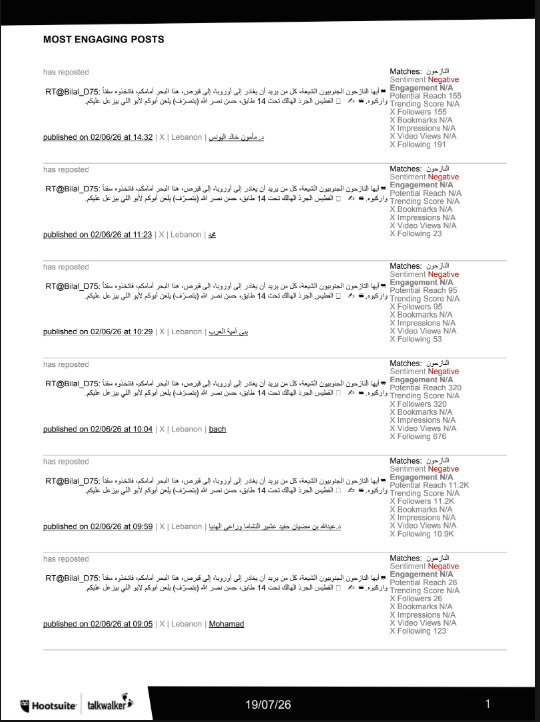
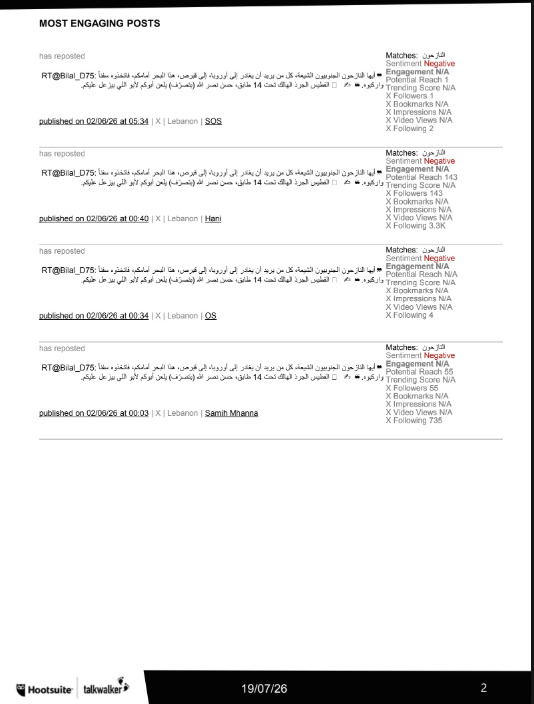
This data shows that there was a coordinated, inflammatory mass mobilization campaign, originating from the Bilal_D75 account. This is evident from the matching wording, its reposting by several accounts within a short period, and the fact that posts came in two separate waves. The Bilal_D75 account was also prominent as a hub for circulating these posts, and its content was predominantly negative.