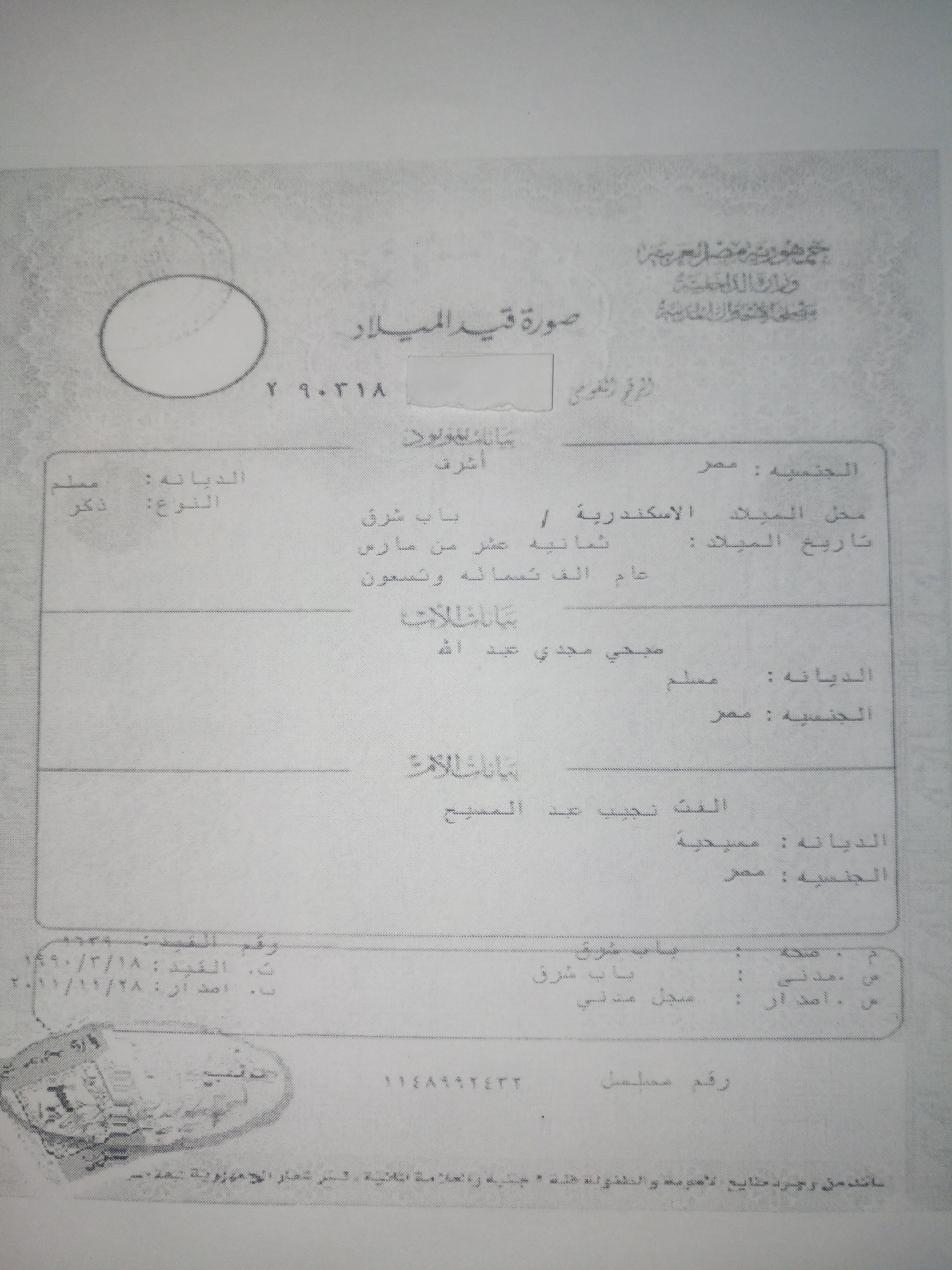
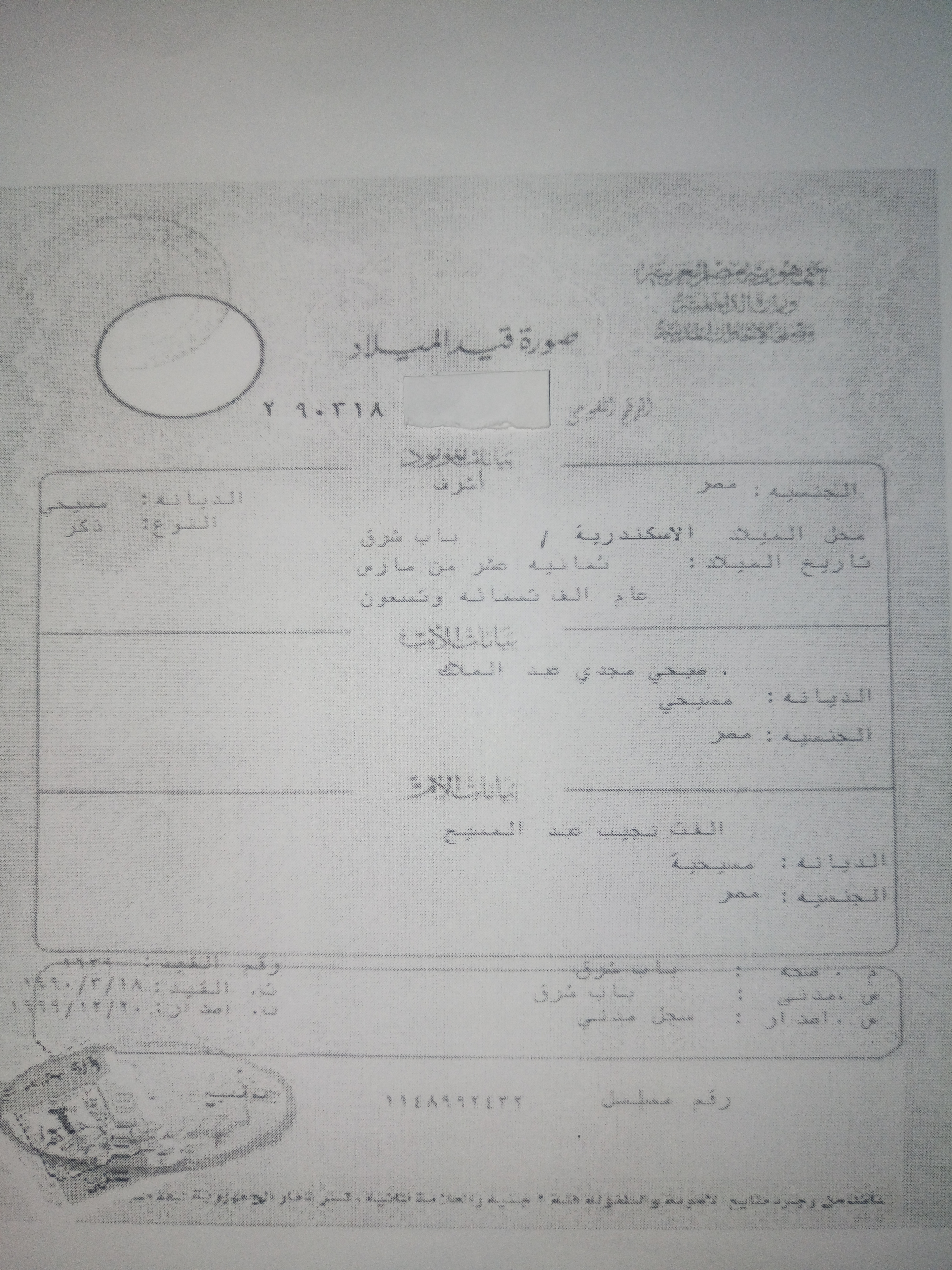
Your husband has converted to Islam, and you must escape with your children so that you will not be deprived of their custody forever, this warning rang through Olft Najeeb* head when she opened the door, in panic, on a summer day of 1996.
Olft (23 years old at the time) packed a small bag and took her three children - Ashraf (6 years old), Karim (3 years old), and Du'aa (4 years old) - in the darkness of the night as she fled to Cairo. I hid there for a month, then resorted to the monastery of St. Demiana in the region of Barari - the city of Belqas, northeast of Cairo.
Meanwhile, a Swiss family that does not have any children, offered to adopt Olft’s three children and arrange for their travel outside of Egypt; however, she has refused.
"Secretly, I returned to Alexandria in March 1997," Olft recalls, having to live in the monastery where she had sought refuge. Then, "I placed (Ashraf-Karim) in a care-house for boys that is associated with the church. As for Dua’a, she was left in another care-house related to a different church." Following which, Olft returned to the monastery to share the monastic order of women to live half a nun and half a normal woman.
Olft's tragedy began when her husband decided to convert to Islam in 1996. "Once the father's religion is converted to Islam, the children's religion automatically changes from Christianity to Islam, being the official religion of the state. This is in accordance with the provisions of Article 2 of the Constitution," explains Olft, who was forced to live in dispersion for 10 years (1996-2006) to obtain custody of her young children after they have passed the statutory legal age for choosing their religion, which is 21 years of age.
In 2007, the Egyptian Initiative for Personal Rights (EIPR) and Human Rights Watch published a report entitled "Prohibited Identities: State Violations of Freedom of Belief". This report included a full chapter on this problem entitled "In the name of the father: involuntary conversion". The chapter includes documenting the files of 89 Egyptians who the state changed their religion in official papers to Islam unwillingly. While the Egyptian Federation of Human Rights receives 60 cases annually related to the change of religion of the father, according to the director of the organization Najib Jibril.
Najib Jibril
For Sound recording translation please Click Here.
According to a statement from Dr. Said Amer, Head of the Fatwa Committee and former official of the Committee for the Declaration of Islam, to the local media, there are six cases that convert from Christianity to Islam, daily. However, the statement by Dr. Said did not specify whether all the cases are from an Egyptian nationality or not.
Counselor Adel Farghali, former head of the Administrative Court, confirms that the issue of converting the religion of children and giving their custody to the father is due to the jurisprudence of judges based on the provisions of Islamic law. Islamic law is considered as one of the sources of Egyptian legislation. This is due to the absence of a specific article in the law that governs converting the religion of children in the event of father's conversion or obtaining custody. Moreover, the lack of legislation on this matter is one of the reasons for the judges' discretion, he explains. In terms of the solution, the judge uses his/her own interpretation of the available legislative provisions, according to Farghali, who asserts that the child remains a Muslim until the child reaches the age of 21 years old (i.e., the legal statutory age per the law). Prior to that age, the domestic law classifies the child as a minor and therefore has no right to choose or convert his/her religion to Christianity before the statutory legal age.
The above extrapolated the right of the father to obtain the custody of the child, although there is no legislative provision nor clear legal guidance on the matter. However, as iterated, this happens according to the jurisprudence of the judges based on the views of religious scholars.
Article 1 of the general provisions of the Civil Code No. 131 of 1948 allows judges to resort to custom first, in the absence of legislation on an issue, and then to the principles of Shari'a for scholars of Islam, as confirmed by the lawyer Peter Ramses Al-Najjar, a specialist in personal status cases. Ramses says most judges ignore custom and resort directly to the Shari’a law. According to Shari’a law “the right to custody is for the Muslim and non-Muslim. Notwithstanding, excluded from this right: an apostate mother, a prostitute (whether Muslim or non-Muslim), and if there is a fear for the child to be familiar to his mother and her family.” This is in accordance with the principles of Abu Haneefah and al-Maliki. The doctrine of Ahmed son of Hanbal and Shafi'i agree on the "non-eligibility for custody by a non-Muslim on a Muslim because he/she does not have mandate over the Muslim may lure the Muslim into their religion."
For Sound recording translation please Click Here.
Dr. Ali Azhari Professor of the Faculty of the origins of religion, Al-Azhar University confirms the validity of the jurisprudential views of the four schools, explaining that the Hanafi jurisprudence came in the book Al-Mabsout Imam Sarkhsi "if any of the parents convert to Islam, the boy becomes a Muslim according to the parent that has converted, as he follows the better religion of the parent.”
Al-Azhari adds that Ibn Qudaamah al-Hanbali says: "The child follows his parents in the two houses. If they disagree, he should follow the Muslim parent in accordance with the scriptures." The is also reaffirmed in Al-Mugani book, one of the most important books of al-Hanbali (whoever converts to Islam from the parents the children should follow).
The Egyptian initiative monitored the cases of 33 similar to Yousef Fendi, who were unable to marry after forcing them to convert to Islam according to the religion of their fathers, while preferring to remain on their religion.
According to Isaac Ibrahim, head of the religious freedom and belief in the Egyptian Initiative for Personal Rights, changing the religion of children because it is the best religion and the inclusion of their custody under the Muslim father is a violation of the principles of equality. The support of the state in the issuance of court rulings changing the religion of children means that the state is biased towards one religion at the expense of another religion. This is a negative message that affect children in the future, especially since sometimes the father converts back to Christianity, and the children remain between interfaith which leads to a stressful life. Many Christians will consider them a "shame" and they will be bullied and persecuted if they consider returning to Christianity. This also violates the International Covenant on Civil and Political Rights, which guarantees the right of the child
Children pay the price of the father’s changing their religion Islam following divorce. This is reflected in their lives for many years. Ashraf Majdi (32 years) – the eldest son of Fatim - says "my mother was afraid of my father's pursuits; therefore, she admitted me to shelter of the church.” Ashraf stayed at shelter from six years until university and saw his mother or sister a few times only, as he recalls.
"I told Mamma ‘tant meaning auntie’ the first time I saw her after a few years of being apart," says Ashraf in sorrow. He adds that he knew she was his mother, but was used to the phrase, which is commonly used to address teachers of the shelter. Moreover, he feared that someone will identify him and inform his father. At home, he took responsibility of his mother’s dismissal, not knowing the whereabouts of his sister, and caring for his younger brother (3 years).
"I was glad to hear about the death of my father," said Ashraf Majdi, recalling the incident when his mother visited him to inform him about his father’s death and telling him that they would finally live in one house together.
Most of the children in the shelter lived in similar circumstances. Ashraf was forced to wait half an hour daily after school to walk around the streets before returning to the shelter, so that his schoolmates would not have doubts. Since it was known that the children at the shelter were facing the same circumstances, he could not say why he was late, which caused him to be reprimanded and hit by the supervisors of the shelter.
When the boy reached the age of conscription, he preferred to escape from military service as he was supporting his family. Moreover, his family name in his birth certificate was different from the family name mentioned in his father's death certificate, according to which he would exempt from military service. The religion of his father in his birth certificate was "Christian” while in the death certificate it was "Muslim". Therefore, Ashraf remained chased until the age of thirty, the age at which the punishment for failing to recruit for military service is withdrawn if a financial penalty is paid.
The president of the Egyptian Union for Human Rights, Najib Gabriel, calls for the establishment of a new article in the Personal Status Law that ensures that the child remains on the religion that he/she was born in until he/she reaches legal age; this is the legal loophole that the father exploits to obtain custody of the children. Najib Gabriel is not afraid of the state's reliance on the principle that "the religion of the state is Islam", which contradicts, in his opinion, Article 53 of the Egyptian Constitution, which equated citizens before the law.
To justify the inclusion of children under his custody, the father based his memorandum on Surah Al-Nisa’a (verse 141): "And never will Allah give the disbelievers over the believers a way [to overcome them.]”. This is what Camellia disdained, accused of being an infidel and unsuitable for custody of her children: "I felt like a fifth-degree citizen!"
Attorney Nabil Jabrail, who specializes in personal status cases, believes that the overturning achieved by the Attorney General in favor of Mrs. Camellia Gaballah was "exceptional", indicating that the provisions allowing for taking away custody from Christian mothers are issued against the law. He demands that "these provisions be stopped." Complaints from the Egyptian judicial system does not give veto power in personal status cases, and therefore, "many families' suffer."
While Camellia Gaballah could take back her children, Amani Nasif was forced to immigrate with her child to the United States after a long process of litigation (from 2013 until 2016) against her husband, who chose Islam as a way to win a divorce. The lawyer had told her that the father his religion was only the beginning of a series of litigations ending with the custody of her children being taken away from her. "What the lawyer told me was almost going to happen," the mother confirms.
For her, "the lawyers of Christian mothers can only attend the hearings to plead a case where “they cannot be heard and the child’s right is not guarded”. Prior to entering the third day of the hearing, the school imposed on her children to study of the Islamic religion; therefore, she went to the United States Embassy to obtain a visa before “my husband pans me from traveling on the basis of custody."
Under the mandate of the government, the Coptic churches in Egypt are preparing a new law on personal status in preparation for submission to parliament. However, the legal adviser of the Orthodox Church Dr. Moncef Sulaiman says that the bill - which has not yet been discussed - will not be applied in custody disputes between the Christian mother and the Muslim father.
In a research paper, Amnesty International criticized "the fragility of legal protection for Christians of the Levant in matters of personal status", the violation of the Arab regimes the principle of "non-discrimination" and religious freedom, whether in legislation or in jurisprudence and court decisions. The organization noted that the absence of legislation in the current law requires the judge to refer to the provisions of the Hanafi school, which in turn includes some aspects of discrimination against non-Muslims.
Meanwhile, Christian families continue to suffer as a result of fathers converting to Islam, facing marginalization and refusal of personal status applications, in the absence of a legislative provision that preserves the right for a Christian mother custody of her children.
(*) Means a pseudonym.
Design and Development: ARIJ team Supervision Hanan Zubais.