Lebanon's forests fall victim to the energy crisis
Badia Sawan and Abdullah Sukkar
11 June 2025
In conjunction with the fuel crisis in Lebanon, illegal logging
operations were active, beginning in 2019, which led to a decline
in tree cover in the forests, especially in the northern regions
of Lebanon, in the absence of any official controls.
“From mortal to owner to grim reaper,” is how Lebanese Bassem
Yassin describes his annual struggle to secure firewood to heat
his home during winter, but this suffering has worsened this year
(2024) due to higher prices of firewood, which affects the ability
of simple citizens to afford to heat their homes.
Yassin's family, consisting of seven members, needs six tons of
firewood throughout the winter, at a price equivalent to $1,000,
an amount he describes as “exorbitant,” but still cheaper than
buying fuel oil to fire a central heating system.
Logging, with its environmental consequences, is one of several
factors that have caused the decline of green spaces in Lebanon
over the past years, along with occasional forest fires.
Since October 8, 2023, more than 3,000 dunams of cultivated land
have burned as a result of the Israeli aggression against Lebanon,
in addition to more than 7,000 dunams damaged by shelling in the
southern parts of Lebanon.
Also, Lebanon has been suffering from a severe energy crisis since
2019, as the country's economic situation deteriorated, resulting
in tripling the poverty rates compared to the past decade,
rendering 44 percent of the total population poor. This economic
collapse resulted also in more severe power and energy poverty and
led to power outages for long hours.
In 2019, Lebanon is said to have lost 390 hectares of forests,
making it the year with the highest tree loss since 2009. Between
2019 and 2023, Lebanon lost 2,644 hectares of trees as a result of
indiscriminate felling, which is a quarter of the trees that
Lebanon has lost since 2001.
The lack of enforcement of laws prohibiting unauthorized logging
has contributed to the decline in tree cover, especially rare
trees with high ecological and economic value.
How do Lebanese get firewood?
Yassin lives in the Chtoura region in the Bekaa Valley in eastern
Lebanon, where the majority of the region's residents rely on
firewood as a means of heating, while the material factor and the
volume of consumption remain the main factor in the amount they buy,
he said.
Yassin expresses his concern about his inability to secure a
sufficient amount of firewood, after its price reached record levels
as a result of the Israeli war on Lebanon: “During this time of the
year, the price of firewood reaches its peak, and the Lebanese
citizen does not care whether the firewood was cut from trees
legally or not; all he cares about is getting firewood at a
reasonable price to last him through the winter.”
Yassin bought only one ton of firewood this winter season for 200 US
dollars, after a ton was sold for about 150 dollars, while energy
prices range between 1 million 325 liras and 1 million 424 Lebanese
pound ($15) per 20 liters of fuel oil gas or ‘mazut ,
according to the
Lebanese Ministry of Energy. Lebanon also suffers from energy
scarcity, making it a challenge to obtain firewood, even for those
who can afford it.
Yassin has been relying on firewood for seven years as a source of
energy, and he gets annually in the same way. He browses the
relevant groups on Facebook, where traders offer prices, and after
agreement, they send the shipment through a delivery service; the
trader and seller do not meet face to face.
The author monitored 20 groups and accounts on Facebook and TikTok,
through which traders announce the availability of firewood
extracted from several trees; most notably pine, cedar, oak, citrus,
eucalyptus and other species , and the prices vary according to the
quality of the firewood, but the price ranges from $70 to $200 per
ton. Merchants post pictures of the firewood and contact numbers,
and hundreds of Lebanese express their desire to buy, in the
comments section.
Ads selling firewood in Lebanon in Facebook groups
This comes despite the fact that the advertised pine and cedar trees
fall within the scope of gum forest trees, which Lebanese law
prohibits felling, except through special technical trimming in
individual cases by the method of technical individualization, and
under a license issued by the Minister of Agriculture.
Logging in one of Lebanon's forests
However, videos circulating in groups dedicated to firewood sellers
show that citizens rely on primitive or dangerous cutting methods,
such as chainsaws and other sharp tools, to cut down tree trunks.
These logs are then transported to workshops with electric cutting
machines to cut large logs into small pieces. GeoGuess, which
specializes in geolocation based on artificial intelligence,
confirmed that one of the workshops is located on the road between
Zahle and Baalbek. One of the firewood storage sites is located in
Qab Elias, in the Zahle district of the Bekaa Valley.
From these workshops, large trucks depart to transport the firewood
to the consumer, or to a local retailer. By following photos of one
of the trucks posted on social media, we confirmed the presence of a
code beginning with the letter “M”, which is placed at the beginning
of the license plates of trucks registered in Lebanon.
The process of selling firewood goes through several stages,
according to a Lebanese firewood trader who prefers to remain
anonymous, starting with a de facto control of a trader over part of
a whole forest. This trader owns usually, a workshop and equipment
that allows workers to cut firewood extracted from forests into
large pieces and sell it to a smaller traders. Those in turn, cut
the wood into smaller pieces to fit domestic types of burners, and
then sell o the consumer.
A TikTok video explaining the process of making firewood
The trader admits that there are species that Lebanese law restricts
cutting, such as oaks, but big influential traders still cut them,
adding that he does not dare to sell oaks unless he is sure that he
will not be exposed to any danger or legal prosecution.
“Most traders do not have a license, and we cannot pass by police
patrols because we know that what we are doing is against the law,”
he said.
Interestingly, videos posted on social media show firewood being cut
in open and public places, without any deterrent, and the logging
operations are usually followed by forest fire types (lit up on
purpose), as happened on October 28, 2024, when Lebanese security
arrested
four people who were logging and charged them with logging without a
legal license in the forests of Nabiyeh, in North Maten, Mount
Lebanon governorate.
The use of wood resulting from the (illegal) logging operation
caused a large fire that burned large areas of forests, trees, and
some houses, forcing many families to evacuate their homes and
neighbouring schools at the request of the Civil Defense to preserve
public safety, and the fire was not extinguished until several days
later.
Unenforced laws
The head of the National Center for Environmental Justice, Dr.
Mohammad Mustafa Ayadat, points out that there are several laws and
decrees regarding the protection and management of forests in
Lebanon, the most important of which is the Forestry Law issued in
1949, with the aim of regulating the management of forests and
preserving them from degradation and over-exploitation.
Article 12 of the law prohibits authorizing the cutting of trees in
state forests except in cases of force majeure, in which case the
authorization must be issued by a decree of the Council of
Ministers.
Law No. 85 of 1991, which aims to preserve forest wealth and
forests, contains several articles aimed at protecting forests from
logging and illegal cutting. The law prohibits cutting down trees or
exploiting forests without prior authorization from the competent
authorities, and specifies penalties for violators.
The law regulates the issuance of logging licenses, ensuring
oversight of forest-related activities, as well as giving local
authorities broad powers to monitor forests and protect them from
encroachment, including implementing legal measures against
violators and ensuring the sustainability of forest wealth.
The CEO of the National Center for Environmental Justice, Dr.
Mohammed Mustafa Ayadat, believes that the lack of environmental
awareness in society is one of the main obstacles to protecting
forests, as many citizens are unaware of the importance of forests.
In addition, existing legislation does not keep pace with
contemporary environmental challenges - such as the impact of
climate change on forests - because most of it, is outdated and has
not been recently amended, which hinders its implementation on the
ground.
The environmental expert emphasizes that Lebanese legislation lacks
legal formulation and long-term strategy, and has not incorporated
the Sustainable Development Goals (SDGs). The laws also have
loopholes that can be used to justify illegal activities, such as
exceptions granted to investors and individuals, which hinders
protection efforts and exacerbates illegal logging.
Dredging the lungs of the Middle East
In 2015, the area of Lebanon's forests and woodlands amounted to
237,000 hectares, equivalent to 23.4 percent of its land area. Since
that year, Lebanon has lost more than 10,000 hectares of these
forests.
The decline of Lebanon's forests is due to fires, 92 percent of
which were attributed to unknown causes, while five percent of the
fires were caused by negligence and two percent were due to arson.
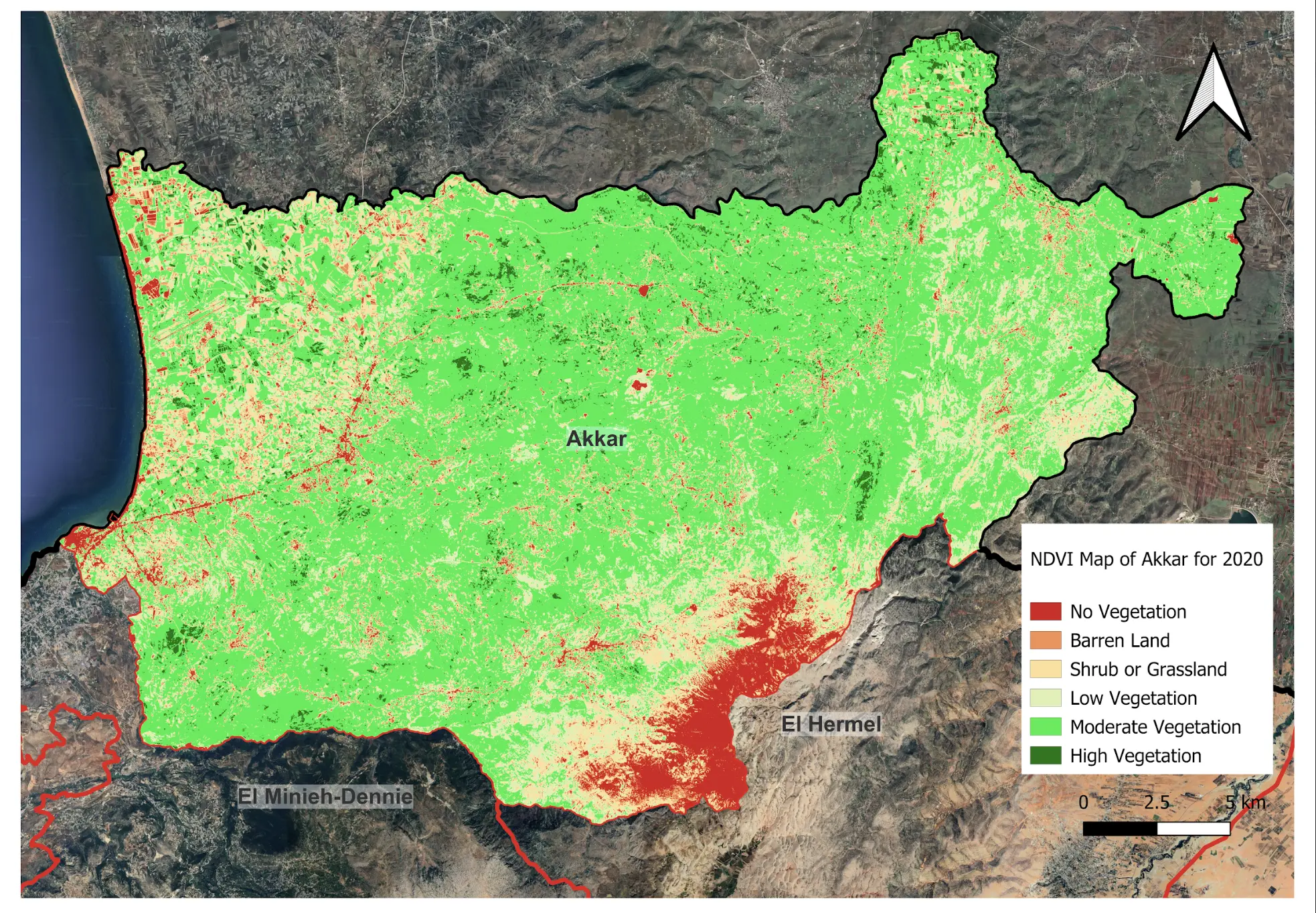
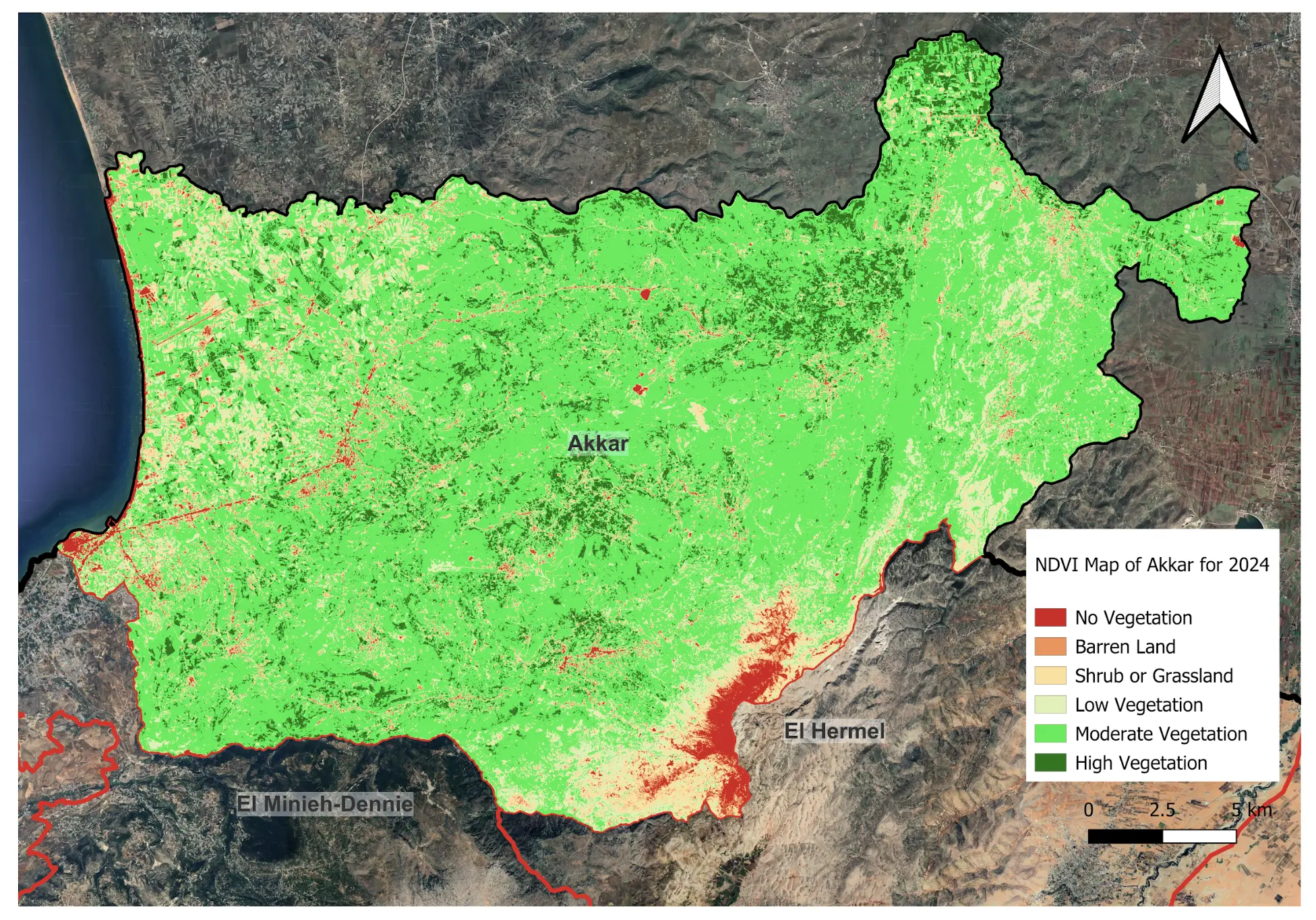
To monitor the extent of the decline in tree cover in Lebanon, we
relied in this report on the European Space Agency's Sentinel-2
satellite imagery, and from these images we produced the vegetation
index (NDVI), which is used in remote sensing science to analyze the
density and vitality of vegetation in a given area. This index
provides vital information about changes in plant health over time,
and is also used to monitor drought and assess crop growth.
In the Akkar region in particular, satellite imagery and vegetation
index maps show a marked improvement in some green spaces in 2024,
but a sharp decline in others, with areas classified as uncultivated
shrinking to about half of what they were in 2020. Areas classified
as open land, grasslands, and low-density forests shrank to their
lowest levels in several years. In contrast, areas classified as
dense forests tripled compared to 2020.
Akkar region
Satellite imagery showing changes in Akkar's forests between 2017
and 2024
Khaled Taleb, a forest management expert and leader of the Akkar
Forest Fire Trail team, believes that logging is an old issue, but
it has worsened as a result of the economic crisis and rising
heating costs, especially in villages and towns.
Logging in itself is not an issue, as long as it is done in
accordance with an integrated forest management plan. Thoughtful
logging operations contribute to the reduction of biomass, thereby
reducing the risk of forest fires. But what is happening recently is
intensive and indiscriminate logging that has affected even high
altitude trees, such as juniper, cedar and fir trees, which do not
regenerate as easily as oak or pine, according to Taleb.
Environmental impact
Logging and deforestation have significant impacts on climate and
human life ,
according to
the second updated report submitted to the United Nations Framework
Convention on Climate Change (UNFCCC) in 2017.
Forests play a key role as “carbon stores”, absorbing carbon dioxide
through photosynthesis and storing it in biomass and soil. When
trees are cut down, the stored carbon is released back into the
atmosphere, exacerbating global warming.
In its 2020 Intended Nationally Determined Contributions (INDC),
Lebanon committed to reducing greenhouse gas emissions by 20 percent
by 2030, setting it as an unconditional target, with a maximum of 31
percent by the same year, with certain conditions.
Yasser Haddad, a climatologist at the Swiss Federal Institute of
Technology (ETH) in Zurich, argues that deforestation leads to
drastic changes in the landscape, as fertile, rain-rich forests turn
into dry, arid lands. This disruption of the natural water cycle
leads to desertification in the affected areas. Trees also help
regulate atmospheric moisture and maintain soil quality; without
them, soil becomes more susceptible to erosion, increasing the
likelihood of flooding.
In an effort to find solutions to the erosion of tree cover in
Lebanon, Darb Akkar has facilitated the planting of more than 11,000
trees from local forests and supported programs to provide
fast-growing trees to community members who can plant them to
provide alternative firewood in a few years.
However, the high cost of energy, and finding a clean alternative
that is in line with citizens' economic conditions, remains a major
challenge to protecting Lebanon's forests.
This report was completed with support from ARIJ
This report was published in Arabic on the following: