We Celebrate International Fact-Checking Day 2026 at Arab Universities
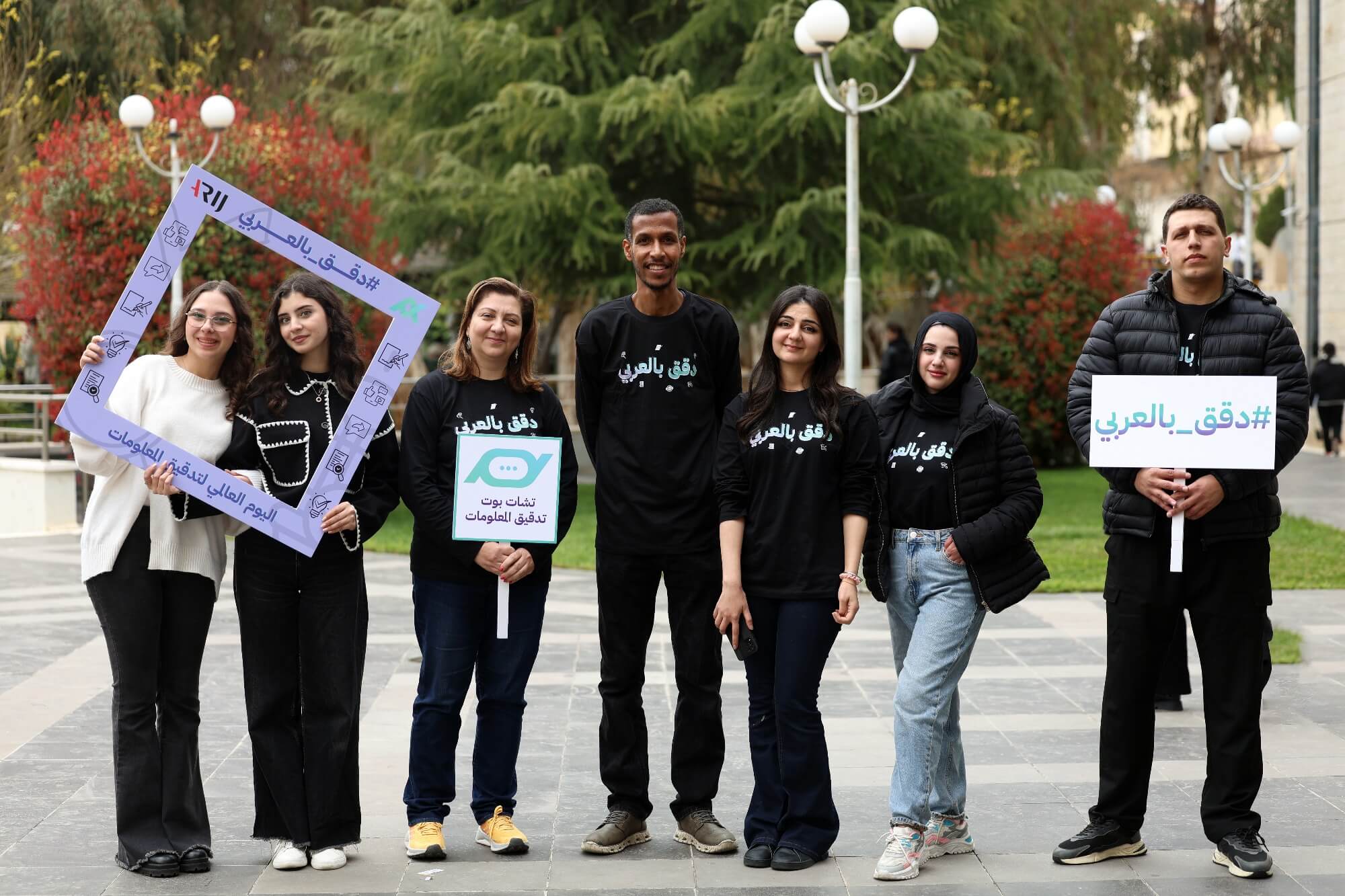
The Arab Fact-Checkers Network (AFCN) from “ARIJ” celebrated International Fact-Checking Day (April 2, 2026) by organizing a series of in-person events attended by university students. These activities are part of its annual campaign to celebrate this International Day under the hashtag #دقق_بالعربي.
The focus this year was on introducing students to the field of fact-checking and the importance of mastering it, particularly given the current challenging environment in the Arab region and the prevalent spread of false and misleading information.
The events attracted a large attendance of students at five universities across four Arab countries:
- 1- Petra University and Yarmouk University in Jordan:
- 2- University of Tripoli in Libya:
- 3- Institute of Press and Information Sciences in Tunisia:
- 4- University of East London in Egypt:
These events exposed the students to a complete practical experience to learn about the field of fact-checking closely, through:
- Organizing interactive activities and enjoyable educational games to simplify concepts.
- Providing live practical experiences using the network’s tools, such as the “Chatbot”.
- Reviewing the learning pathways available through “ARIJ Academy” and the “Fact-Checking Curriculum Guide”.
- Holding open dialogues and rich discussions about the challenges facing journalists in the current information environment.
Abir Jariri, a student at the Institute of Press and Information Sciences (IPSI) in Tunisia, described the open day experience as “a very rich and useful experience, as it enabled me to deepen my understanding of fact-checking methods and discover new tools that help verify news and digital content. The activity also contributed to raising awareness about the importance of combating fake news.”
Sabreen Al-Majbari, a current graduate of Faculty of Media and Communication at the University of Tripoli in Libya, says, “Enthusiasm filled the atmosphere of the open day at the university from the students’ side, where we had the opportunity to learn about the various resources and tools of AFCN, such as the ‘Chatbot’ and the Fact-Checking Guide.”
Habiba, a student at the University of East London in Egypt, advises her colleagues from journalism and media students to engage in the field of fact-checking after getting to know it during the open day, pointing out that: “The field of fact-checking is multipotential, where one can check general information or specialize in specific areas such as human rights, health, and others. This field is also very important in our current era where news and information spread quickly across social media.”
Malak Al-Shihan, a student at Yarmouk University in Jordan, says: “During the open day, we learned about the Chatbot tool, which is a very important tool for both public and the journalist alike in light of the widespread dissemination of misleading and false information. This service allows you to send any information, image, or video you wish to verify, and receive the documented result easily via the WhatsApp application.”
Fatima Al-Zahraa Amasha, a fact-checker from Egypt and a member of the organizing team for the open day at the University of East London, says, “I was slightly surprised by the students’ lack of knowledge about the field or platforms of fact-checking, and this indicates the importance of intensifying awareness campaigns about this field, which is at the heart of journalistic work, especially in light of the information disorder we are experiencing.”
Sara Bawa’neh, a student at Petra University in Jordan, also spoke about benefiting from the open day, saying: “In a world where misinformation proliferates, this experience contributed to broadening my intellectual horizons and gave me the opportunity to interact directly with students and enhance their awareness of the importance of verifying information and checking its sources in the digital era.”
It is worth mentioning that these activities are part of the “Bousolah” project led by ARIJ in partnership with “Journalisme & Citizenship” (J&C), and supported by the European Union, and comes within ARIJ’s continuous efforts to promote the integration of ARIJ’s Investigative Journalism and Fact-Checking guides into the academic curricula of media and journalism colleges in the Arab world, and to support their use as educational and practical tools that contribute to the development and enhancement of the quality of journalistic work.