This investigation reveals how rock phosphate washing plants and the Tunisian Chemical Group governorate of Gafsa are contributing to the depletion and pollution of water reserves in the Gafsa mining basin, resulting in frequent disruptions to the drinking water supply and health risks for the local population.
Maher (a pseudonym) searched desperately for even a small amount of water to help him cope with the summer heat. When he found none, he set out on a 15-kilometer walk from the town of Metlaoui toward the rock phosphate washing plants in the Tunisian governorate of Gafsa. There, desperate for a moment’s respite from the merciless heat, he threw himself into the water.
What Maher initiated began as a silent protest but quickly escalated into a clamorous protest movement as residents of the "Mining Basin" grew exasperated by water shortages.
The city of Metlaoui witnessed a wave of protests starting on July 10, 2026, when locals blocked several roads, demanding equitable water distribution.
In the Gafsa mining basin, tons of rock phosphate are washed daily at facilities operated by the state-owned Gafsa Phosphate Company (GPC). The wastewater and washing residues are then discharged.
Much of the washed phosphate is then transported to the state-owned Tunisian Chemical Group in Mdhilla, where it is converted into fertilizer. This process, in turn, generates large quantities of wastewater, which is improperly discharged.
| Delegation | Population (2024) | Area (km²) | Density (inhabitants/km²) | Annual Growth Rate 2014–2024 (%) |
|---|
Depletion of Water Resources
In the Gafsa mining basin, water cuts can last up to a week. Waiting for water to return has therefore become part of residents’ daily lives. People try to store as much as they can in plastic containers, knowing that a supply sufficient for one day may have to last several.
Maher says: “Water is a basic right. Families in El Metlaoui work day and night to access it. There’s just one thing I don’t understand: how can water be available for washing phosphate all the time, while homes struggle to get any?!”
The Gafsa mining basin comprises four towns: Métlaoui, Redeyef, Umm al-Ara’is, and Mdhilla. According to the 2024 census, the combined population of these towns is over 124,000, and all residents rely on limited groundwater resources.
According to the study ‘‘The Future of Development in the Mining Basin: After or Without Phosphate’’ by Houssine Rehili, published in October 2021 by the Rosa Luxemburg Foundation’s North Africa Office, GPC operates in the mining basin, which comprises eight open-pit mines and 11 phosphate washing plants (laundries). To ensure a steady water supply, the company has established its own water system within the mining basin, independent of the national water company’s (SONEDE) network.
According to the 2018 study on "Water and Social Justice in the Mining Basin of Gafsa," GPC requires 18-20 million cubic meters of water per year to process 12.5 million tons of raw phosphate. This level of consumption makes the company the largest consumer of water resources in the mining basin. It uses around 72 percent of the region’s deep groundwater resources annually-estimated at 25.1 million cubic meters - and utilizes around 48 percent of the region’s total water resources.
The situation is exacerbated in some areas, such as the town of Redeyef, where the company relies on freshwater wells, which it shares with the local population.
According to the environmental and social compliance audit report on the Tunisian Chemical Group in Mdhilla, published in August 2025, groundwater depletion is highest in the aquifer in the southern El Guettar region, where the exploitation rate has exceeded 118 percent.
The report also states that the group relies on water from the South Gafsa aquifer, which is under significant strain due to overexploitation. It also noted an estimated water loss of 105 cubic meters per hour during the processing of phosphogypsum.
Rabeh Ben Othman, coordinator of the Environmental Justice mission (for the Forum Tunisien pour les Droits Économiques et Sociaux (FTDES), says that towns in the mining basin do not all face same problem. In Métlaoui and Mdhilla, for example, phosphate is washed with saline water, whereas in Redeyef it is washed with drinking waterHoussine Rehili, a development and resource management expert who authored the study on ‘Water and Social Justice’, states that GPC operates more than 18 deep wells tapping the aquifier, with a pumping capacity of up to 715 meters per second; he says this means GPC’s pumping capacity exceeds that of the National Water Supply and Distribution Company in the governorate.
The Aqueduct Water Risk Atlas platform, which monitors annual water consumption, classifies the mining basin as an area of extremely high water stress, as 40 to 80 percent of the available annual renewable water resources are used.
Data from the platform show that the mining sector operates in an environment of medium to high water risk, competition over a limited resource between industrial activity and the daily needs of the population.
Wastewater
Maher’s aunt Munia (a pseudonym) is a 60-year-old woman who lives in Métlaoui and suffers from kidney failure. She says: “Water is a perennial problem in the area; there are frequent cuts, and even when it flows from the tap, it’s yellow.”
Hardly a day goes by without Maher knocking on her door, bringing her whatever medicine or food she needs, and checking whether she is able to manage on her own. But on days when the water supply is cut off, he worries more about her, because water is essential to managing her illness. She needs it to clean her home, prepare her meals, and care for herself after dialysis sessions.
Maher watches as she hides her pain, but he cannot hide his own sense of helplessness. His aunt’s house may remain without water for hours, sometimes even days - water that the National Water Exploitation and Distribution Company is supposed to supply. Meanwhile, just a few kilometers away, the phosphate washing plants pump water continuously to wash thousands of tons of the phosphate ore.
Munia no longer feels relieved when she hears the rush of water in the pipes. She sits in her chair, waiting for Maher to turn on the tap, as if she already knows what will come out of it. The water trickles out yellow rather than clear, with an almost muddy appearance. Despite its alarming appearance, she uses it for cooking and washing, and sometimes even drinks it, as she cannot afford to buy an alternative every time.
During a field visit, the investigative reporter observed that the soil at the mouth of the valley, where wastewater from Washing Plant No. 2 in Mdhilla flows, had turned into a layer of dark gray mud. Polluted water, greenish and dark gray in colour, slowly flowed through it. A pungent, overpowering odor emanated from the stream.
A 2022 report by FTDES states that phosphate washing plants discharge slurry-laden wastewater and sludge directly into several valleys stretching for more than 140 kilometers across the mining basin.
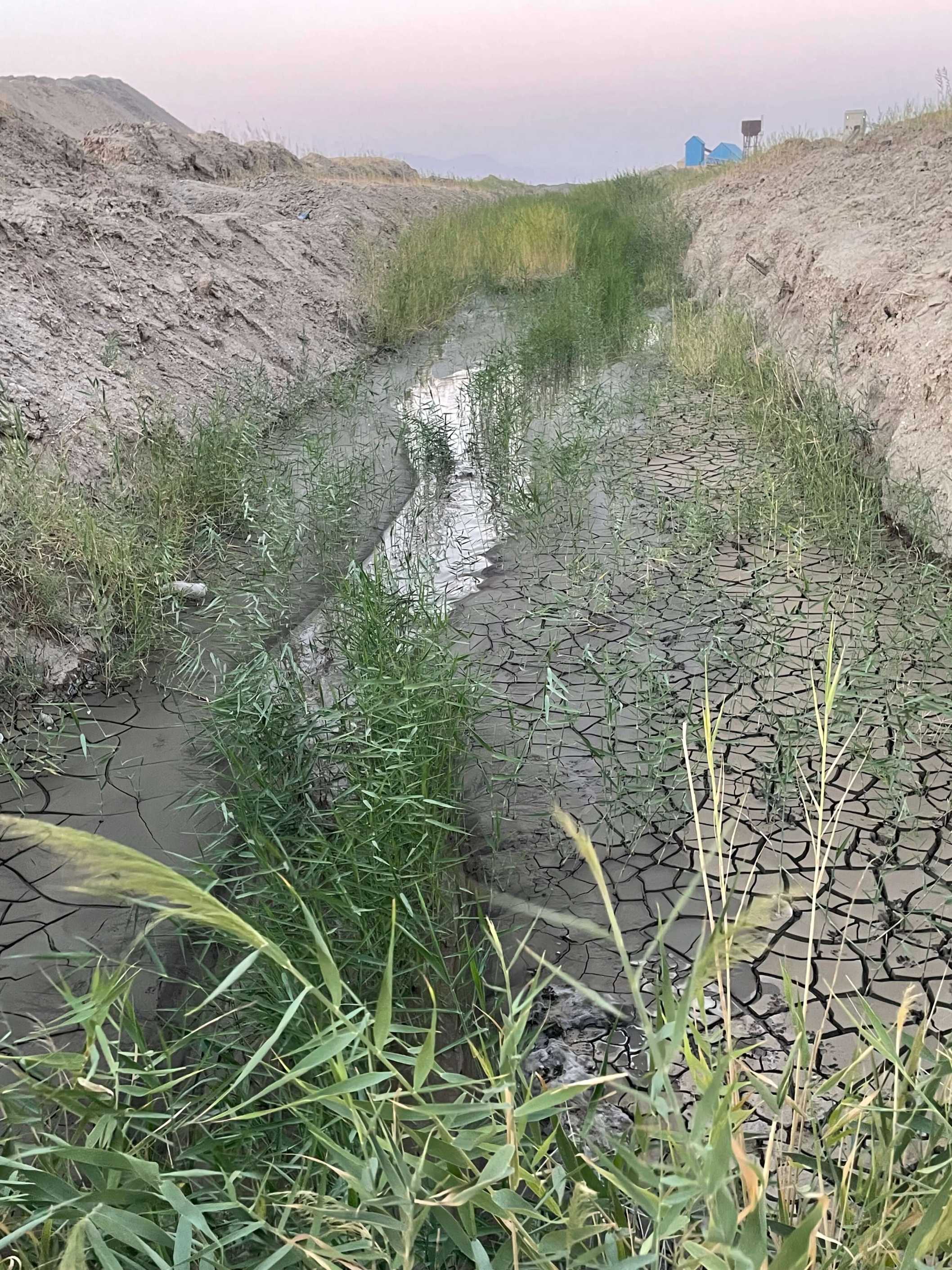
According to GPC data, the volume of sludge discharged via these valleys surpassed 39 million tons between 1979 and 2000. However, as production expanded, the volume increased, reaching an average of around 2.4 million tons per year by 2010. The company has not published any recent data on the discharge of wastewater from its industrial operations.
The ‘Water and Social Justice’ report estimated that GPC washing plants discharge up to 11 million cubic meters of contaminated slurry and sludge annually into the valleys of the mining basin.
The issue is not limited to wastewater discharge. The environmental and social compliance audit report for the Mdhilla Chemical Group revealed a lack of regular monitoring of the quality of water recycled from the phosphogypsum ponds, as well as the absence of a documented plan to manage the risk of soil or groundwater contamination.
An analytical study entitled “Environmental Risk Assessment, And Toxicity-Based Bioassays Of Effluents From Phosphate Fertilizer Industry: A Case Study In Gafsa Mining Basin,” published in 2025, found that the industrial effluent from the Tunisian Chemical Complex in Mdhilla contains a mixture of chemical pollutants characterized by high acidity. The researchers also demonstrated toxic effects on plants and cells, warning against the potential risks posed by these effluents to the surrounding ecosystem in the absence of stricter treatment measures.
These findings are consistent with the conclusions of the study ‘Potentially Toxic Elements in Phosphate Processing: A Comparative Assessment of Solid Wastes and Effluents from Beneficiation and Fertilizer Production in Southwest Tunisia', published in 2026 in the journal Toxics, which detected concentrations of potentially toxic elements in solid and liquid waste resulting from the various stages of phosphate extraction and beneficiation.
Diseases are rampant in the Gafsa mining basin, a fact that studies attribute to water pollution caused by phosphate deposits.
Dental Fluorosis
Rania (a pseudonym) has visible discoloration of her teeth. Whenever she leaves the mining basin and opens her mouth to speak, her teeth can reveal where she comes from before her accent does.
Nisreen Amid, a dentist in Mdhilla, explains that ‘dental fluorosis’ primarily affects children exposed to high levels of fluoride in their early childhood - when their permanent teeth are forming. The condition begins with the appearance of chalky white spots and, in severe cases, progresses to yellow or brown patches. It may lead to pitting and permanent deformities of the tooth.
She stresses that these cases are prevalent in various parts of the mining basin, and that their symptoms persist throughout a person's life, adding: “It now surprises us to see naturally white teeth here.”
Her comments are in line with the study “Dental Fluorosis as a Bioindicator of Environmental and Regulatory Failure in the Gafsa Basin, Tunisia,” which found that phosphate mining operations contribute to increased fluoride leaching into groundwater.
The study found that fluoride concentrations in some water sources ranged from 1.6 to 2.9 milligrams per litre. This exceeds the maximum limit of 1.5 milligrams per liter recommended by the World Health Organization (WHO) for drinking water.
Beyond water analysis, the study found that fluoride concentrations in the teeth of Gafsa residents reached around 6,793 micrograms per gram. It estimated that around 90 percent of adults suffer from dental fluorosis.
Furthermore, a 2022 report by FTDES analyzed samples from drinking water sources in Redeyef and found that the fluoride concentration in some samples was as high as 2.29 milligrams per liter, which exceeds the limit recommended by the WHO.
Waste on Land and in Water
Rania describes dawn in Mdhilla as “emissions hour.”During this time, thick fog with a pungent odor envelops the entire area, from the vicinity of the chemical complex to the residential neighborhoods. Residents find it difficult to breathe and feel as though they are choking.
During a field visit, the investigative reporter observed emissions being released from the Mdhilla chemical complex, located just two kilometers from residential areas. Phosphate washing plants are also located in the heart of Mdhilla’s residential neighborhoods.
Using the air quality map on AccuWeather - a website that specializes in monitoring air quality- the investigative reporter noted that Mdhilla usually appears as an orange-colored area; this, according to the map’s color-coded classification system, indicates “poor” air quality, while towns such as Redeyef appear as “unhealthy”.
The impact of the Tunisian Chemical Group in Mdhilla is not limited to the emissions that residents can see or the polluted water flowing alongside the town; it also includes broader environmental problems, as documented in the Environmental and Social Compliance Audit Report for the Mdhilla site, published in August 2025. The report highlights shortcomings in the industrial waste and water-resource management and air-quality monitoring, as well as to inadequate safety measures and poor communication with local residents.
Stalled Environmental Projects
Despite the environmental report’s findings regarding irregularities at the Mdhilla Chemical Group, the Tunisian government is moving ahead with the expansion of the phosphate industry. In 2025, it announced plans to increase production fivefold. This angered residents of Mdhilla and Gabès. In October 2025, protests broke out in Gabès demanding the relocation of the group, while Gafsa residents protested the state-owned company’s depletion of water resources in their governorate.
An investigation by ARIJ found that the largest proportion of Tunisian phosphate exports goes to India, the European Union, and the United States.
Meanwhile, environmental projects at the GPC and the Tunisian Chemical Group in Mdhilla are stalling. In 2023, GPC signed an agreement with the International Finance Corporation (IFC) to secure a grant of seven million dinars (US$2.025 million, at the 2023 exchange rate) to fund a technical and economic feasibility study for a phosphate slurry pipeline, at a total estimated cost of 1.1 billion dinars (US$354.5 million).
The project aims to reduce groundwater depletion by constructing a seawater desalination plant and a pipeline to supply phosphate washing plants with industrial water.
The project was originally expected to be completed in June 2025, but it fell behind schedule. In July 2026, the government called for accelerating the project’s timeline, but according to the IFC website, such progress remains “pending.”
In October 2025, a program valued at 140 million dinars (approximately $46.73 million) was announced to fund environmental projects at the chemical group, including the construction of a desalination plant and the installation of a barrier layer at the phosphogypsum disposal site.
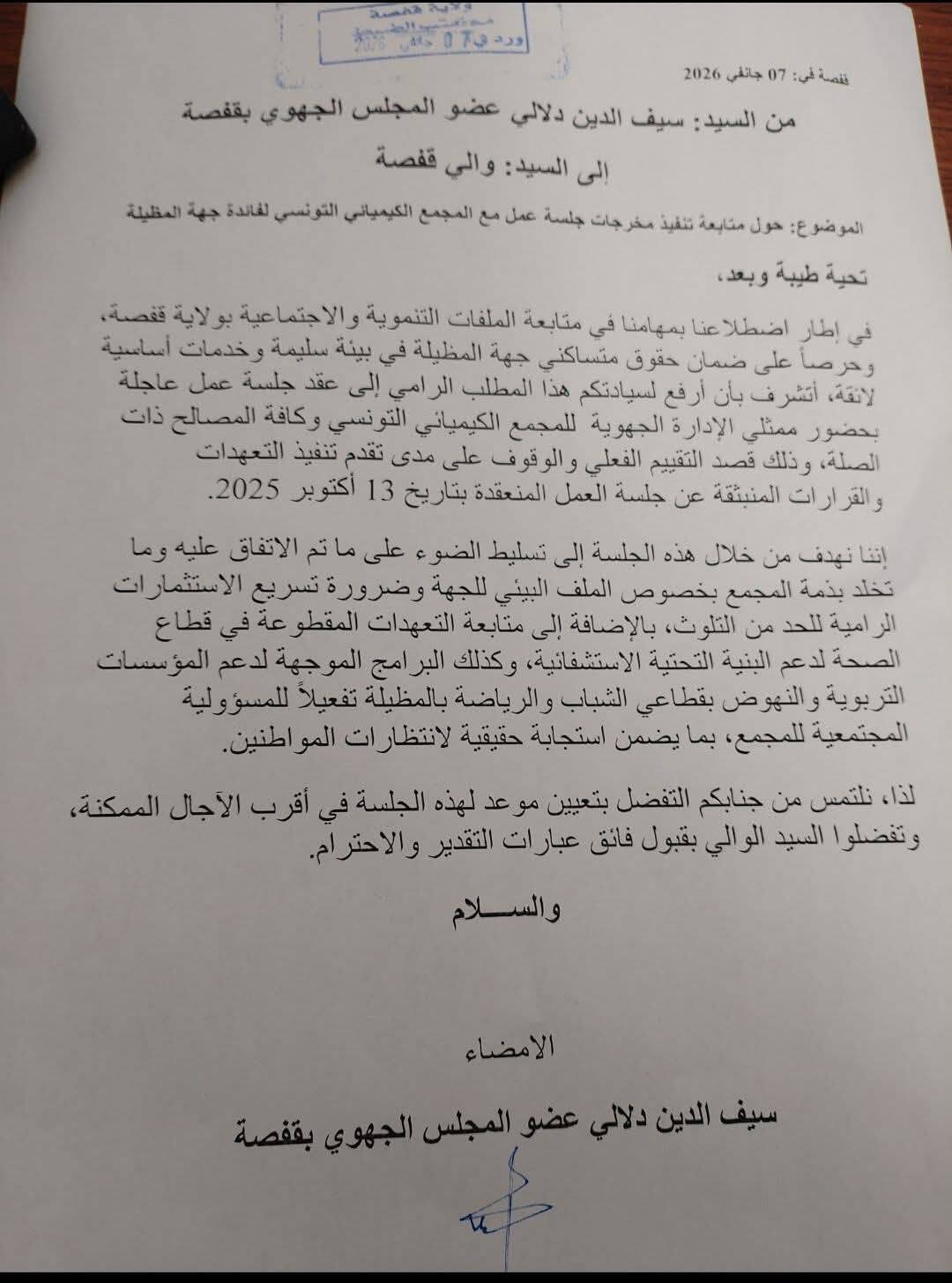
However, a document obtained by the investigative reporter, issued by the Gafsa Regional Council in January 2026, reveals that a number of commitments made by officials during a meeting between the local council, the governor of Gafsa and the director of the chemical group had not been fulfilled.
On April 9, 2026, Saif al-Din Dallali, chairman of the local council of Mdhilla and a member of the Regional Council of Gafsa, confirmed that the environmental projects announced in 2025 had not been implemented to date, adding: “We held several meetings with the group and agreed on a number of points, none of which, unfortunately, have been implemented."
Today, Maher recalls the mining basin he once knew, as he travels between his home and his aunt Munia’s house, carrying medication, food and water for her whenever the tap runs dry. Water, once simply something he carried to his aunt when she needed it, has now become the focus of the protests he joins. He has seen it continue to flow to phosphate washing plants while failing to reach people’s homes.
This investigation was produced with the support of ARIJ.