Coordinated Digital Campaigns Target Dissidents and Activists in Syria
Nardin Al-Rawi (pseudonym) and Sami Sabir
The image was generated using AI.
+8,000accounts we tracked
+40accounts and pages whose engagement data we analyzed
3
cases of targeting we documented
+1,300 interactions on a single post
This investigation tracks online campaigns waged against
dissenting voices and female journalists and activists in Syria
during 2025 and 2026. We conclude that some of these campaigns
originated from a WhatsApp group co-managed by officials in the
Ministry of Information, and that a network of low-activity
Facebook accounts worked in concert to boost engagement with the
campaigns’ content and widen its reach, while hiding who was
behind them Over several months, we tracked more than 8,000
accounts that had published or amplified content linked to the
campaigns we were investigating.
We reviewed chat logs and messages obtained from closed groups and
analyzed engagement data across dozens of posts and pages. We also
interviewed both those targeted by these campaigns and experts on
digital safety.
On April 17, 2026, dozens of civilians, including workers and
activists, gathered in Yusuf al-Azma Square in Damascus in response
to a call by the “Law and Dignity” initiative, demanding action to
address deteriorating living standards and the rising cost of
living, and calling for the protection of individual freedoms and
respect for the rule of law.
The protest did not stay peaceful for long, as it was met by a
counter-rally and the situation then escalated into clashes. Torn
banners and injured protesters told the story of what had happened,
and the protesters were labeled “remnants of the regime.”
But what happened in the square was not the starting point. Days
before people gathered there, another battle was being fought
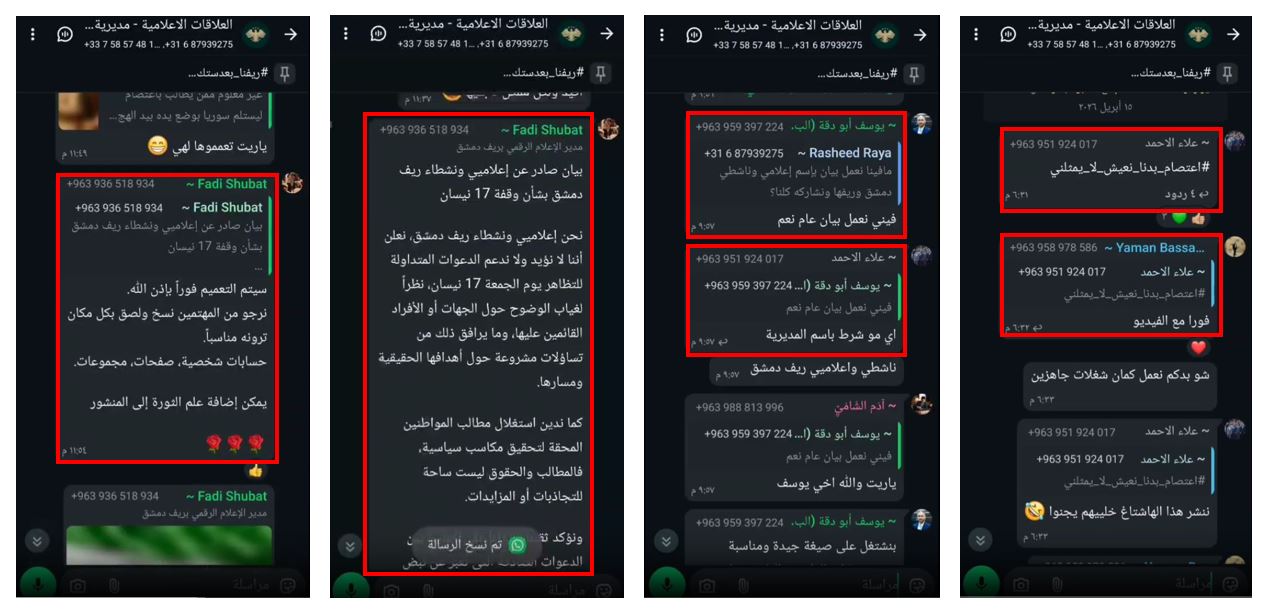
online. Messages and conversations that we obtained show that
mobilization campaigns had been launched from a WhatsApp group
co-managed by officials in the Ministry of Information. Supporters
were recruited, and narratives and messages were drafted and
subsequently shared on social media platforms before these found
their way onto the streets. These conversations show that officials
at the information ministry coordinated with journalists, two days
before the sit-in took place, to mobilize public opinion against it.
The starting gun
The trigger for the campaign was a message posted in the group by
journalist Alaa al-Ahmad, which included the hashtag
#The_We_Want_to_Live_Sit-in_Does_Not_Represent_Me.
Within seconds, messages supporting the hashtag began proliferating
in the WhatsApp group.
Group members were then instructed to draft a statement in the name
of “Journalists and Activists of Rural Damascus,” disavowing the
sit-in and publicly condemning it, and to circulate it widely across
various pages and platforms.
Chat logs show that the campaign went beyond exchanging views or
positions and involved coordination over messaging, content and how
to spread it. By tracing these records, we identified several people
who played pivotal roles in managing the campaign and promoting its
narrative: Yusuf Abu Daqa (al-Bustani), director of the Damascus
Countryside Media Directorate; Fadi Shabbat, head of the Digital
Media Department at the Damascus Countryside Media Directorate; and
journalist Alaa al-Ahmad. The messages show they discussed content
related to the sit-in and decided how it should be published and
circulated.
In response to our questions, Fadi Shabbat, head of the Digital
Media Department at the Damascus Countryside Media Directorate, said
his department’s role was “limited” to highlighting development and
public-service initiatives in the governorate. He added: “Shaping
public opinion is absolutely not in our remit, since we have no
mandate or administrative instructions from the Ministry of
Information to do so.”
Shabbat denied that his department owned or managed “any fake or
pseudonymous accounts,” or that it had “any administrative or
organizational link” to the sit-in. He admitted expressing “personal
opinions” in WhatsApp groups and on social media platforms, but said
it was his “natural right” as a Syrian citizen.
Screenshots of a conversation in the private chat group of the
Damascus Countryside Media Directorate show coordination to
circulateg the directorate’s draft statement opposing the Apri 17
sit-in.
From closed group to public pages
Within hours, dozens of pages and accounts began reposting and
circulating the statement, apparently following instructions from
the WhatsApp group. The statement then moved from this closed space
to a broader network of interactive pages and accounts. At the same
time, we identified a different version of the same statement
circulating under the name “Revolution Coordination Committees”.
This version was not simply a rejection of the sit-in, but also
described participants in hostile terms. They were called “remnants
of the old regime,”accused of being “agents of Iran” and labeled
“Assad’s dogs.” This language framed those who took part in the
sit-in as political adversaries or enemies, rather than citizens
exercising their right to freedom of expression.
Analyzing the network
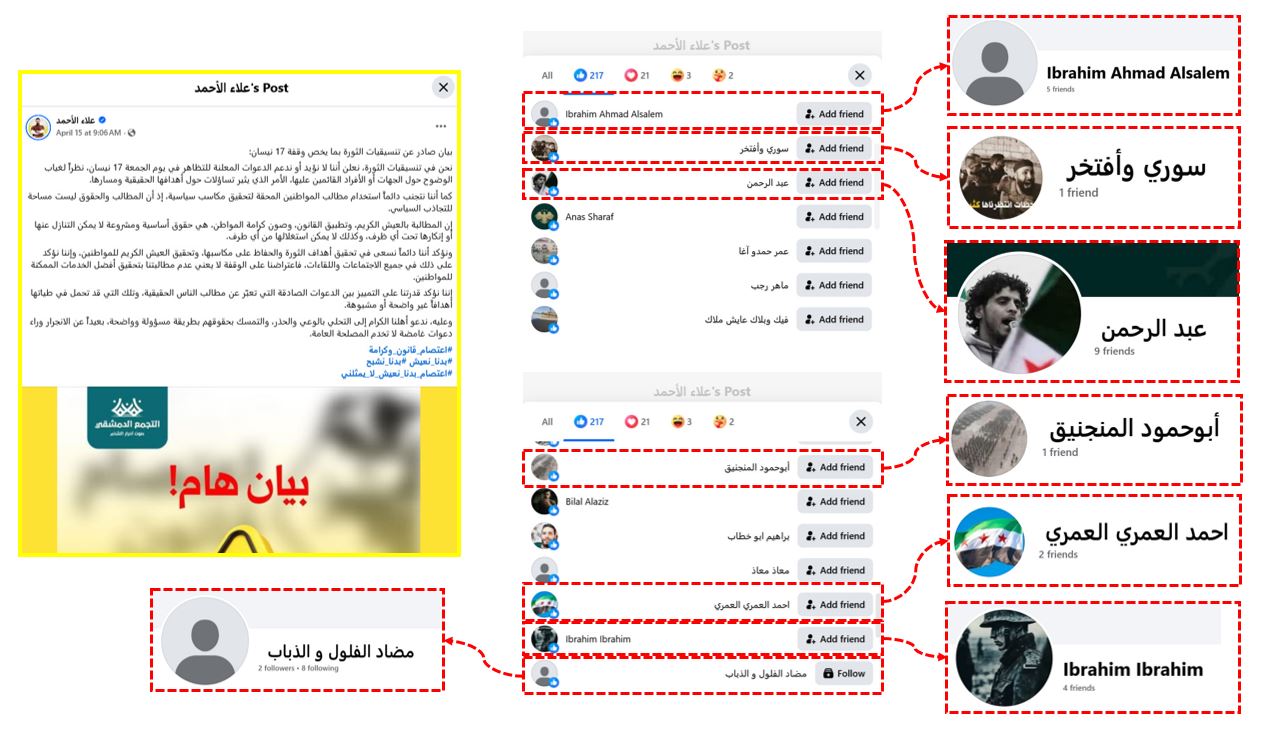
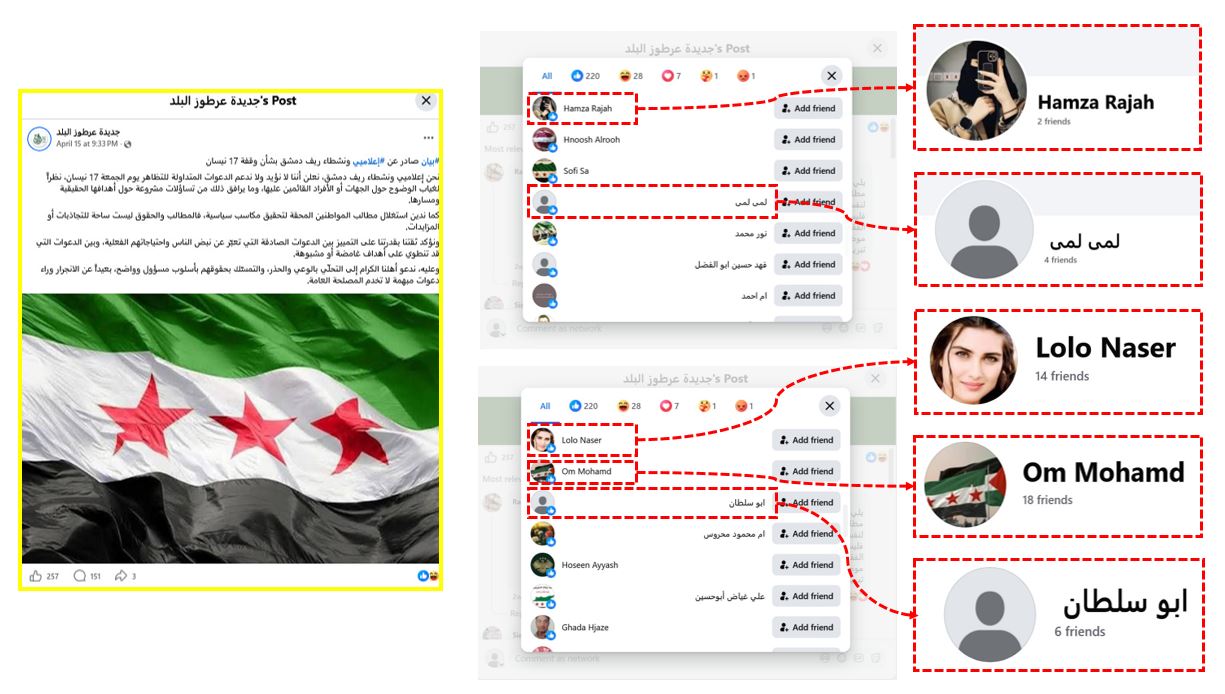
When we analyzed engagement data from more than 40 accounts and news
pages that had shared the two anti-sit-in statements on April 15 and
16, we identified a recurring pattern of accounts that showed no
signs of normal use. Some used generic images or images taken from
the internet. There were accounts with no profile picture or visible
posts; accounts with only one to five friends; and accounts bearing
generic or pseudonymous names, such as “سوري وأفتخر.”
Pages and accounts that reposted the statement
Each dot represents \ a page or account that reposted the
statement from the Damascus Countryside Media Directorate.
Drag the drawing horizontally to read the names
One example account
سوري وأفتخر
61550583094566
Profile PictureNone
Friends1
Public ActivityNot visible
Prominent among these accounts was one called “سوري وأفتخر”,
with the ID 61550583094566. The account has no profile
picture, has one friend, and shows no public activity on
Facebook or in search engine results.
Analysis of its engagement, however, shows that it is
selectively active, liking posts published far apart in time
by various accounts and pages. The common theme across
postings by this account is that the content targets along
with the same misleading claim in Syria.
The same account also appeared repeatedly alongside a group of
similar low-activity ones in previous digital campaigns attacking
dissidents and female journalists. This suggests a recurring pattern
of use that goes beyond the normal, spontaneous activity on the
platform.
A sample of accounts interacting with posts opposing the April
17 sit-in. It shows the account “سوري وأفتخر” alongside a
group of similar accounts with limited activity.
A sample of accounts interacting with posts opposing the April
17 sit-in. It shows the account “سوري وأفتخر” alongside a
group of similar accounts with limited activity.
Tracking this online behavior revealed an interconnected network
operating on two levels: central accounts that generate and
disseminate content, and a second tier of accounts whose job is to
amplify engagement and create the impression of popular support that
may not reflect reality.
Fadi Shabbat, head of the Digital Media Department within the Rural
Damascus Media Directorate, denied that his department owned or
managed any fake accounts.
A two-tiered network
The "red" dots are central accounts that serve as the source of
content. The "card" accounts—which are fake, engagement-driven
profiles with a limited number of friends—connect to these central
accounts and amplify their reach.
central accounts
fake accounts
شبكة المحرر الإخبارية نيوزأخبار الحولة بدقيقةتلفزيون حمصأحمد العقدةMaher Kassabمنار حمشوAhmed El Yasinعلاء الأحمدMohammed Z RatebJorui Al-AliNjomi NJTaym MoAbdulkarim Idrisهه ههعبد رحمن
ابو محمد2 friends
Abdulkarim Saad1 friend
سوري وأفتخر1 friend
Log log (Alnasser)@log.log.405114 · 10 friends
BaRa'a3 friends
Ag Ag5 friends
Reem Ali1 friend
Alkink Ahmad3 friends
Hosain Ali (W)3 friends
Drag the drawing horizontally to read the names
This technical infrastructure was about more than numbers and
account IDs. Our investigation shows that in three cases, it went on
to impact the lives of real people.
From a call for an investigation to a court case
Hiba Ezzedine al-Hajji, chief executive of the organization Equity
and Empowerment, has long been known for her work in Idlib on
women’s empowerment and gender justice.
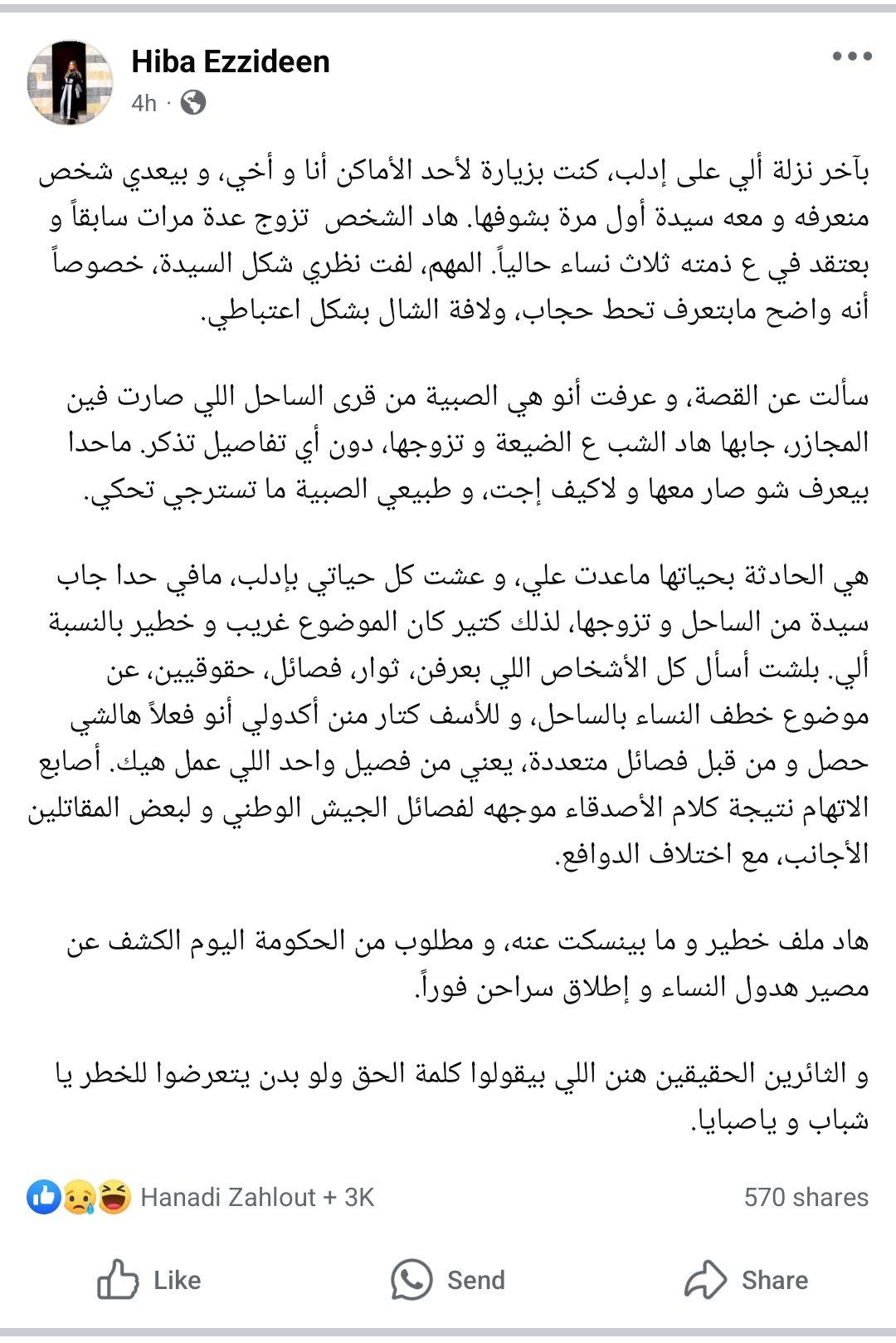
On the evening of April 19, 2025, she wrote on Facebook that she had
come across a girl suspected of being one of those abducted during
the events on the Syrian coast. Hiba said she posted the statement
after her attempts to contact official agencies failed, prompting
her to call on the authorities to launch a serious investigation
into the case.
But her post was not taken as an appeal to look into a serious
allegation. The online discussion soon shifted from asking about the
girl’s fate and the accuracy of the information to focusing on the
author of the post herself. Any discussion of abuses committed
during the events on the coast remains a highly sensitive topic,
often met with skepticism or denial.
Distorting content
It did not take long for the content of the post to become
distorted. Instead of the focus being on Hiba’s call to investigate
what had happened to a girl suspected of having been abducted, her
post was presented to the public as though she were alleging the
existence of a “market in female captives” in Idlib.
In less than 24 hours, a network of news pages and accounts
presented a single narrative—claiming that Hiba had published a post
“alleging that there was a market for female captives in Idlib.”
This description was repeated in similar terms across dozens of
posts.
However, a check of the original post against verified screenshots
and verification of its content showed that these allegations did
not reflect what the post actually said. It made no mention of a
“market in female captives” or any of the allegations later leveled
against her. In fact, it focused on calling on the authorities to
investigate the fate of a young woman suspected of being among those
abducted.
While the initial reaction to Hiba’s post on social media appeared
spontaneous, data analysis revealed a different picture: signs of a
coordinated digital campaign against her across several platforms,
particularly Facebook and Telegram, which sought to reframe the
issue and shift the discussion from the substance of the allegations
to the author of the post.
This campaign was led by a network of accounts and pages, both
inside Syria and abroad, which promote the new Syrian government
using tactics such as “coordinated inauthentic behavior” and “fake
engagement” on Facebook.
Hiba stood by her story and, in a second post, revealed that an
interior ministry official had contacted her, obtained all the
details of the case, and promised to follow up on it personally.
This did nothing to slow the momentum of the campaign, however, and
the accounts and pages involved stepped up their attacks. Monitoring
of the content in circulation showed that false claims about what
Hiba had written continued to spread, along with audio recordings
linked to the case, parts of which had been deleted or presented out
of context.
The Syrian authorities denied these details, saying they had no
knowledge of Hiba’s case and had not dealt with it.
A three-hour timeline
Before 8:00 pm
Hiba Ezzedine al-Hajji’s original Facebook post - April
19, 2025
After 8:00 pm:
(approximate time based on when other accounts shared the
screenshot, as the original post was deleted).
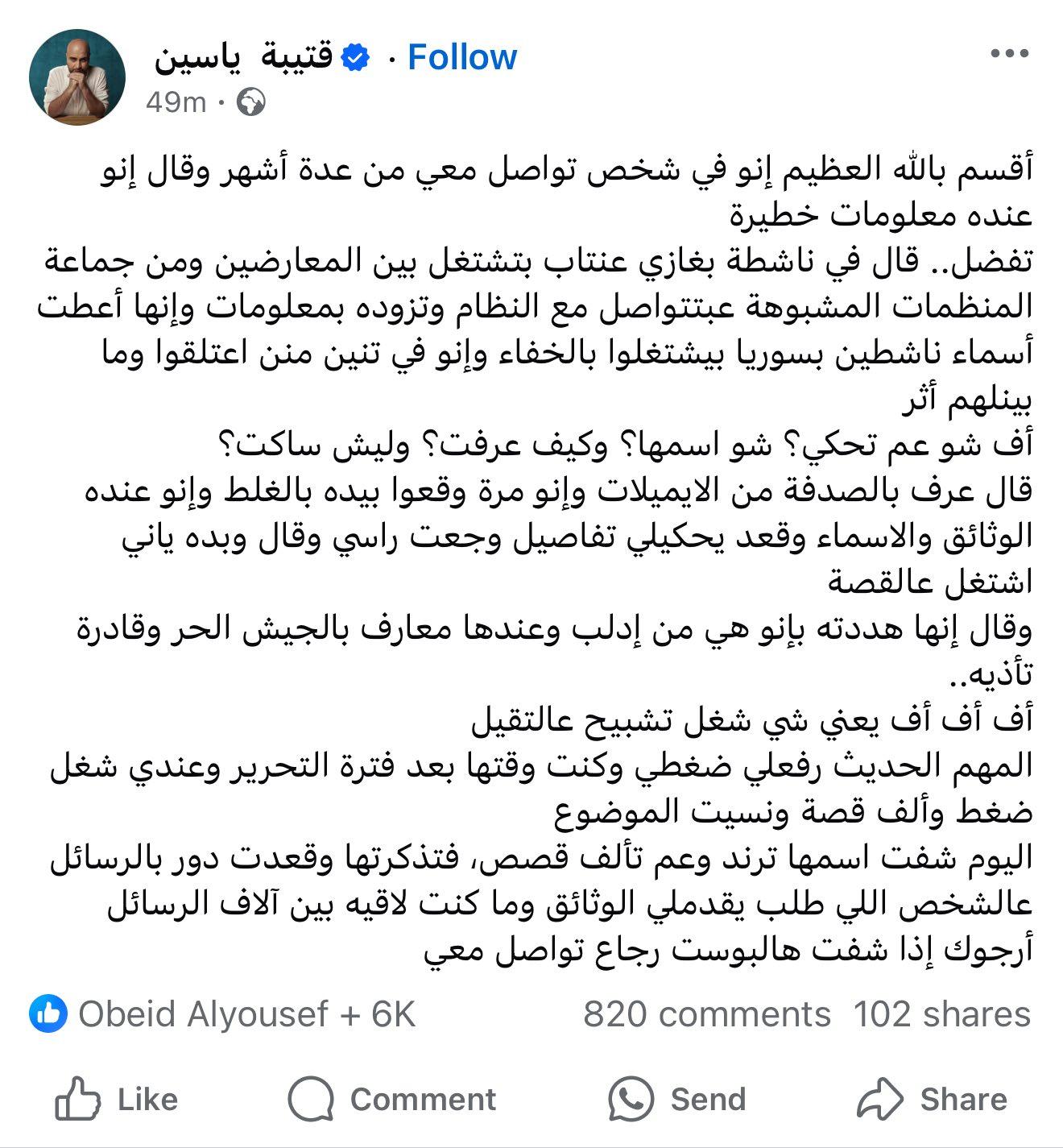
A post attributed to journalist Qutaiba Yassin, April 19,
2025
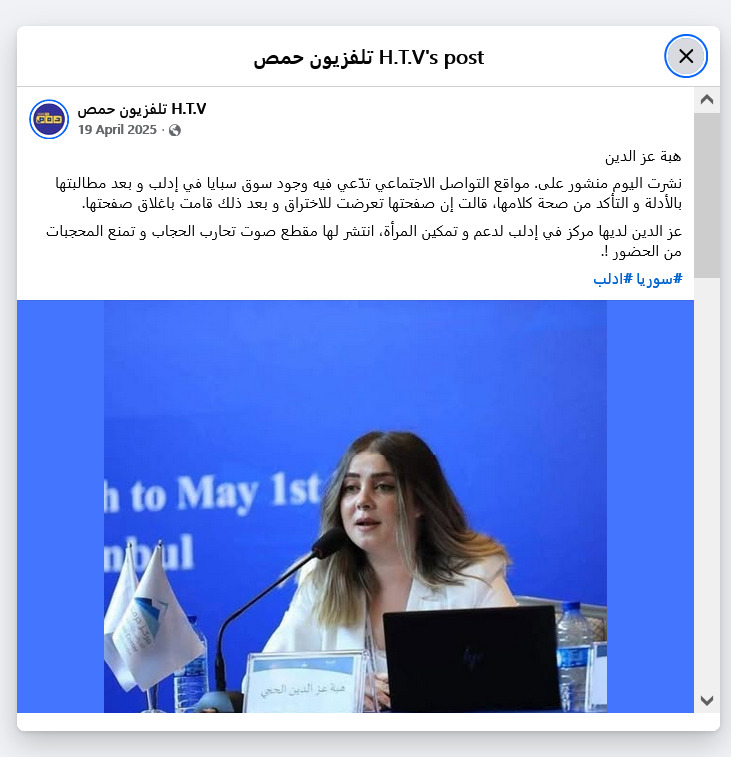
9:00 pm the Homs TV Facebook
page posts a photo of Hiba Ezzedine, along with a false
claim. The page then widens its attack on Hiba, saying “she
has a center in Idlib to support and empower women,” and
attaching an audio clip that claims she “is fighting against
the hijab and preventing women who wear it from coming to
the centre.”
Post by the “Homs TV” Facebook page, April 19, 2025
In the comments section is a post attributed to the Syrian
journalist Qutaiba Yassin, in which he claims to have seen
leaked emails showing she worked as an informant for the
ousted Assad regime.
Nine minutes later, the page
posts a video containing an audio recording supposedly of
Hiba, with comments describing her as a liar. The video is
immediately reposted by a network of Syrian news pages.
10:44 pm:
accounts circulate a video with a screen recording of a
conversation, showing that the audio clips had been forwarded
several times on WhatsApp, with a message saying that “the
first recording has been shared on websites, but the rest are
still to come.” In other words, what was posted was the first
batch of recordings. Other accounts later claimed there were
leaks confirming Hiba had been working for the regime.
Less than three hours later, the
page carries “breaking news” that the governor of Idlib,
Mohammad Abdul Rahman, had ordered legal action against Hiba
Ezzedine al-Hajji, following the circulation of audio clips
attributed to her that “attacked the hijab.”
The following day, the police,
acting on instructions from the Political Affairs Department,
close down the Equity and Empowerment organization in Kafr
Yahmul, “for its own protection,” according to Hiba.
Network of accounts involved in the campaign against Hiba Ezzedine
Hover the cursor over the contact point, or click it, to view
account profile data.
Account included in the sample
Connection node
Account whose profile can be viewed
Drag the drawing horizontally to read the grid.
Click on a highlighted point to view account file data.
Source: Analysis of the network of accounts involved in the
campaign against Hiba Ezzedine. The clusters consist of accounts
with limited activity; the red nodes are connections between them,
not central pages such as “Homs TV”.
From the campaign to the Political Security Branch
Noor Suleiman is an activist and member of the Syrian Democratic
Alliance. On July 26, 2025, she was arrested at the Political
Security Branch in the Mezzeh district of Damascus.
She was arrested after a widespread online campaign against her,
following an angry message she posted on Facebook, which she later
deleted and apologized for. After her home was raided twice and her
father was arrested, she was asked to go to the security branch to
delete a video she had shot during the first raid to document
abuses. As soon as she arrived with her mother, she was detained
without charge for three days.
In a room that Noor recognized, having been there before the fall of
the Assad regime, she sat across from an interrogator who was no
more than thirty. The questioning was not directly about the post
that had provoked the campaign against her, but about “spreading
false news” and “the abducted women.”
“I tried to explain that I was an opposition activist, but the
accusations had all been prepared in advance:: ‘You’re an agent,
you’re an Alawite, you’re talking about the abducted women.’ They
lumped everything under sectarian incitement.”
Noor Suleiman
Minister of Information Hamza Mustafa intervened to secure her
release, following pressure from other activists. The chief public
prosecutor for Damascus, Judge Hossam Khattab, said on July 31 that
she was released because the procedures used to summon Noor were
unlawful. But he added that her release would not affect the ongoing
legal case against her on charges of “sectarian incitement and
spreading hatred.” This prompted Noor to leave the country.
In its response to our questions, the information ministry
acknowledged that the first arrest “had been made without a warrant
or authorization from the proper judicial authority.” Ziad Dioub, a
lawyer and director of the ministry’s Legal Affairs Directorate,
said the minister had intervened to secure Noor’s release because
“she had been detained without legal basis” and in order to “rectify
procedural errors and safeguard the freedom of the press and
journalists.”
He added that the subsequent arrest warrant (No. 3287), “which met
the legal requirements,” had been issued by the Fifth Investigating
Judge in Damascus, and that Noor “was re-arrested on the basis of
this warrant,” which he said was “a new and legally separate
procedure.”
How the arrest was covered online
It is worth examining how the arrest—which the public prosecutor and
the information ministry itself described as unlawful—was reported.
At 7:22 pm on Tuesday, July 29, 2025, an account verified with a
blue check mark, under the name “Manar Hamshou,” reported that “Noor
Suleiman, who once said ‘The shoe of an Alawite is above the most
powerful man in the country,’ has been arrested.” The post also
incited her torture and justified abuses in detention.
By March 8, 2026, the post received more than 1,300
interactions, broken down as follows:
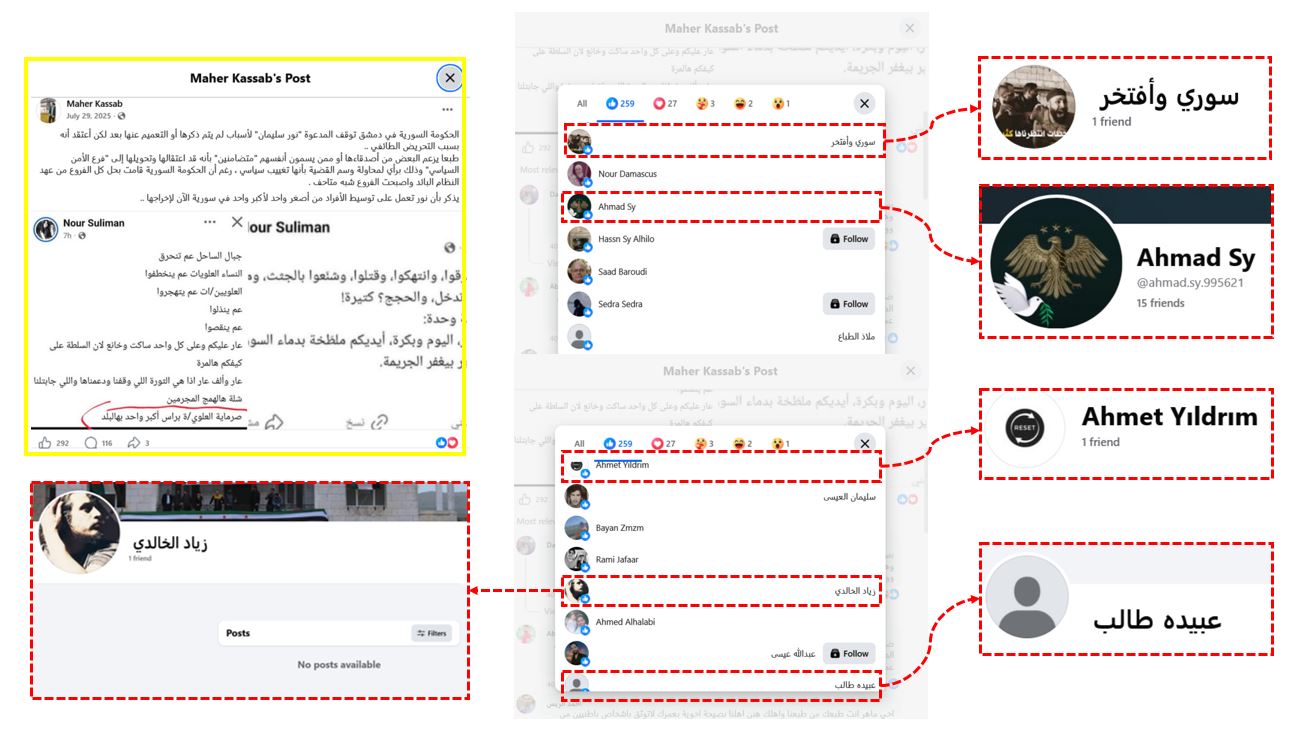
Among those interacting with this post, we identified a group of
“fake” accounts that had also helped inflate engagement with posts
targeting other people These included “سوري وأفتخر”, which we also
identified as part of the April campaign.
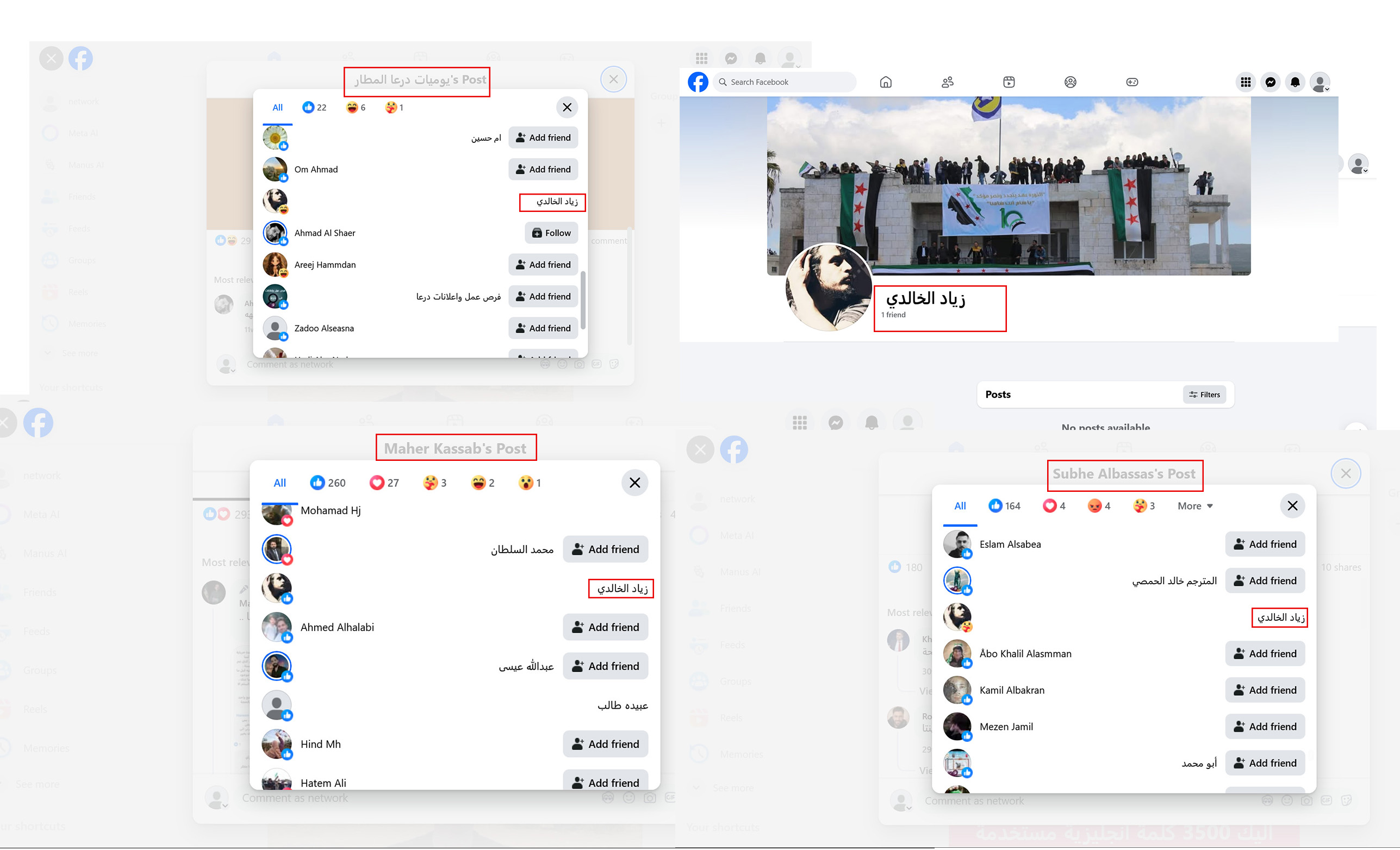
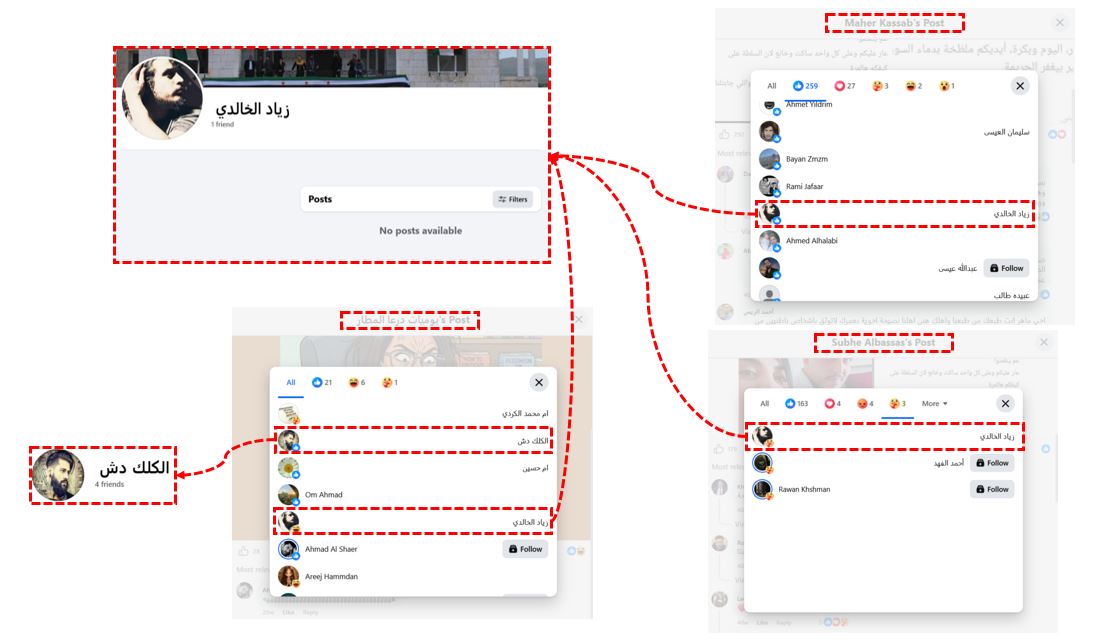
The “Ziad al-Khalidi” account
We detected repeated participation in incitement campaigns by more
than 40 accounts, most of which had only one friend or none at all
and showed no normal activity. One account that stood out was called
“Ziad al-Khalidi,” and we found that it appeared in at least three
posts.
Two posts on April 29 and 30, 2025:
One of the posts carried allegations that “Noor Suleiman
maintains contact with a large number of Syrian revolutionaries
abroad, to gather information about them and hand it to the
National Security Bureau and the Political Security Branch.” The
second post alleged she had links with senior officers in the
former Assad regime, while another dealt with Minister of
Information Hamza Mustafa and his links with Noor Suleiman. A
page named “Daraa Airport Diaries” also appeared.
Post on December 11:
The same account appeared in a satirical post on the “Daraa
Airport Diaries” page - which has more than 224,000 followers—as
part of a campaign against female activist Farah Youssef.
We identified at least three posts in which the Ziad al-Khalidi
account appeared
April 29 2025
April 302025
December 11 Farah Youssef
+224,000 number of followers of the Daraa Airport Diaries page
A sample of accounts interacting with posts as part of an
online campaign following the arrest of Noor Suleiman. The
Ziad al-Khalidi account appears alongside the سوري وأفتخر of
It account as well as a group of similar accounts with limited
activity.
A sample of accounts interacting with posts as part of an
online campaign following the arrest of Noor Suleiman. The
Ziad al-Khalidi account appears alongside the سوري وأفتخر of
It account as well as a group of similar accounts with limited
activity.
A sample of accounts interacting with posts as part of an
online campaign following the arrest of Noor Suleiman. The
Ziad al-Khalidi account appears alongside the سوري وأفتخر of
It account as well as a group of similar accounts with limited
activity.
Fabricated conversations and the complaint process
Alaa Amer, a journalist based in Istanbul, faced another form of
digital violence. Fabricated conversations purportedly between her
and a young woman named “Zainab” were posted in an attempt to damage
her reputation by portraying her as encouraging the “seduction of
Public Security officers.”
Alaa filed a formal complaint together with the Syrian Center for
Media and Freedom of Expression which helps journalists in their
dealings with the information ministry. . She later discovered, from
friends inside the ministry, that the incitement against her came
directly from official WhatsApp groups affiliated with the ministry.
Alaa confronted the ministry with this evidence on the program “Wast
al-Balad” hosted by Zaidoun al-Zoubi, with Omar Hajj Ahmad present.
The ministry gave no clear answers, saying only that those close to
power “are held to greater accountability.”
What the Syrian Center for Media and Freedom of Expression said
We contacted the Syrian Center for Media and Freedom of Expression,
which had monitored a number of these cases, and asked whether it
always followed the same procedure and how the authorities dealt
with such complaints. This was its response:
“Each case is handled according to its specific circumstances, and
referral to the authorities is not a standard procedure. It
depends on several factors, including the wishes of the journalist
bringing the complaint, the nature of the abuse, and whether
official intervention would be worthwhile.”
Regarding Alaa’s case specifically, the Center added:
“In Alaa’s case – given that her situation was being discussed in
WhatsApp groups of media professionals in Syria – the matter was
brought to the Ministry of Information. A complaint was filed
through the official channels, using the ministry’s link for
submitting such complaints. One available option was to follow
this up with the ministry, which was done, but this was not the
only course of action.”
What should we call this phenomenon?
Are we witnessing a new pattern emerging, or is this an extension of
…older mechanisms adapting to a new context without losing their
structure?
To answer this, we turned to Alaa Ghazal, a technical expert working
in digital safety and information security. Before December 2024, he
monitored online campaigns and how they took shape and spread. Some
were run through semi-organized groups Telegram and other platforms,
and others through wider networks that defamed or blackmailed
individuals – particularly women - or used fake content against
them.
Ghazal says that the idea of online campaigns “is not a new
phenomenon, but an extension of methods of influence and
mobilization that predate the internet. But they began to take their
current shape with the spread of the internet and online forums in
the early 2000s.”
He adds: “In Syria, these campaigns emerged on a large scale as
social media spread, especially with the outbreak of the revolution
in 2011. You could say that much of the activity in Syria on
platforms like Facebook and Twitter at that time was more like an
open online campaign aimed at mobilizing people, reporting on
events, and documenting them.”
These campaigns have now become more professional, he says, in
planning, content management, assigning roles and measuring impact.
Why women in particular?
In the three cases we have documented in this investigation, it was
not just what the women said that came under attack. In the case of
Hiba Ezzedine, attacks shifted from the content of her post to her
personal image and her presence as a woman. Her image was a central
element of the content in circulation, not a side issue.
An earlier study on digital violence shows that this type of
targeting is widespread and directed against women, most of whom
have experienced it in some form, mostly defamation, harassment and
blackmail. The same study concludes that such behavior is not
confined to the internet and sometimes amounts to real-world threats
and dangers, amid a lack of effective legal protection and social
environments that perpetuate this violence.
“Alongside the sectarian dimension and accusations that I was a
traitor and an agent, I was also clearly targeted because I am a
woman. They tried to use labels such as ‘feminist’ or ‘activist’
as accusations in themselves, and they tried to link my public
activism to my personal life in a degrading way, not to mention
the obscene language I was subjected to.”
Noor Suleiman
As for how it affected her, Noor says:
“To be honest, at first I felt overwhelmed and furious at the
scale of the injustice and defamation I was subjected to,
especially as these were grave accusations that could have
affected my reputation and personal safety.. There was no
evidence- just people sitting with their phones writing whatever
they wanted.”
* pseudonym
This investigation was produced in partnership between ARIJ and
Women Who Won the War.
This investigation was published in Arabic on the following: