This investigation reveals a coordinated digital influence campaign aimed at reshaping the Lebanese public debate over Hezbollah’s weapons and relations with Israel. It promotes anti-Hezbollah and anti-Iran rhetoric while advocating disarmament, peace, and normalization as the path to stability and prosperity in Lebanon.The campaign uses AI-generated videos of Lebanese officials making fabricated statements. It also uses paid ads and a fixed set of social media accounts to amplify its messages and push them to officials and the general public at politically sensitive moments, while the identities of those running and funding the operation remain unknown.
On April 27, 2026, Lebanese President Joseph Aoun appeared in a video clip shaking hands with Israeli Prime Minister Benjamin Netanyahu. This fabricated scene was created using artificial intelligence and was posted on TikTok by the anonymous account “MLGA”.
The video was posted days after negotiations between Lebanon and Israel in Washington, placing the fake handshake within a political context that made it appear more credible. Reactions were divided, with some users supporting what they saw and others opposing it; at least some treated the video as a real event with political significance.
The video attracted 75,000 views on X, with more than 1,000 interactions, and it was shared 128 times. On TikTok it received 186,000 views and 2,626 shares. These figures are all for the period between the date the video was uploaded through the time of publication, a period of approximately three months
The video was released at a crucial moment, as US President Donald Trump stated on 24 April that Lebanese President Joseph Aoun might meet Israeli Prime Minister Benjamin Netanyahu within three weeks. This led some social media users to believe the video was genuine, or at least to wonder whether it was.
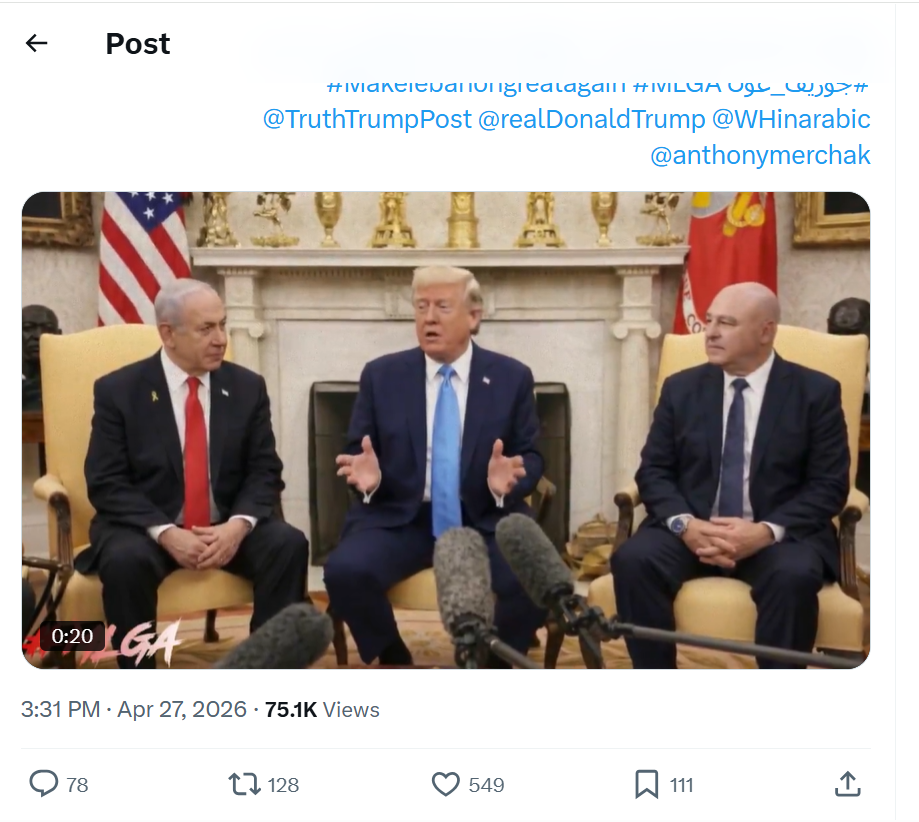
On July 19, while the Lebanese president was in Washington, the MLGA account posted another video showing him with President Trump, signing a peace agreement. Between these two clips, MLGA posted material featuring images and audio of President Aoun, Prime Minister Nawaf Salam and Hezbollah Secretary-General Naim Qassem, attributing to them statements they did not make and views they did not hold.
Archived content shows that the dissemination of these messages followed an organized pattern: The account published the original material, after which a set group of accounts either copied or rephrased it - using the same hashtags and references - and targets officials, institutions and media outlets. The posts appeared within a short time frame, and activity intensified around developments related to the war, Hezbollah’s weapons and negotiations with Israel.
Identical texts repeated word for word across different accounts, similar timing and an apparent division of roles provide strong evidence of a coordinated digital influence campaign. The identity of who is running and funding the campaign remains concealed behind the accounts and platform-held data.
From the “Support Front” to a war of narratives
Since on 8 October 2023, when Hezbollah announced the launch of the “Support Front” for Gaza, social media platforms in Lebanon have been transformed into an arena for political and media campaigns vying to shape the Lebanese public’s stance on the war, running in parallel to the military confrontation. And the hashtag #Lebanon_does_not_want_war emerged as part of a narrative opposing the opening of a front from Lebanese territory.
Some of the messages forming part of this narrative moved from online platforms to billboards along Beirut’s roads. Digital campaigns became more complex and intense after the conflict escalated on 23 September 2024, and after the assassination of Hezbollah Secretary-General Hassan Nasrallah on 27 September, followed by the election of Joseph Aoun as president on 9 January 2025 and the appointment of Nawaf Salam to form a government four days later,
This period saw the growth of anonymous accounts, sponsored ads and AI-generated content, at a time of intense debate over the future of Hezbollah’s arsenal, the extent of state authority, and the possibility of negotiating or concluding an agreement with Israel. It was in this climate that MLGA emerged.
An American slogan for a Lebanese campaign
The MLGA account borrowed its name from Donald Trump’s slogan “Make America Great Again,” replacing “America” with ‘”Lebanon” to create “Make Lebanon Great Again”. The slogan gave the campaign a recognizable propaganda identity, linking its messages to a broader political discourse centered on reclaiming the state and changing its direction.
The account appeared in May 2025 on X, YouTube and TikTok, a few months after the assassination of Hezbollah Secretary-General Hassan Nasrallah and Hashem Safieddine, head of Hezbollah’s Executive Council and Nasrallah’s successor, and after the presidential vacuum ended and a new government was formed.
The account posted its first documented clip on TikTok on May 20, 2025. The video carried the message “the party is finished,” attacked the leadership of Hezbollah and Iran, and called for disarmament and peace with Israel, presenting them as a path to stability and prosperity.
Calls for the disarmament of Hezbollah or negotiations with Israel form part of the Lebanese political struggle. What we documented in this investigation is the attribution of fabricated written and visual material to officials; the funding of its dissemination by an undisclosed party; and the use of interconnected accounts to promote it to the public, officials and the media.
The investigative methodology
In this investigation we collected data on 1,010 posts on X between May 2025 and May 2026, using the “Tweet Exportly” tool, and archived the MLGA account’s videos and posts that were reposted by other accounts. We also analyzed mentions, retweets and replies, as well as the most active accounts, and the ways messages moved through this network of accounts.
Our investigation also reviewed 28 videos posted by MLGA on YouTube and compared their upload times with concurrent political and military events. The network analysis was based on co-mentions and recurring links between accounts.
To assess coordination between accounts we used a combination of four indicators: the use of identical or verbatim text; the publication of the same material within a short period; amplification by the same set of accounts; and the use of the same hashtags and mentions during specific political events.
Monitoring indicators over the course of a year
Compared with the previous year
8.1 million views for a new account
MLGA posted 28 videos on YouTube, which collectively generated around 8.1 million views during the monitoring period. The platform’s interface showed that a number of the videos had been promoted through paid ads.
The cost of promotion on YouTube ranges between $0.003 and $0.015 per view, depending on audience, country and type of campaign, according to the sources we used for this investigation. On this basis, the cost of purchasing 8.1 million views is between $24,300 and $121,500.
This hypothetical calculation is based on the assumption that all views were paid for. Public data does not reveal what proportion of reach was ad-driven and what was “organic.” But the appearance of ads confirms that an unidentified party paid to deliver AI-generated political messages to a wider audience.
We asked YouTube’s legal support team to respond to the findings of this investigation. But we have so far received no reply, other than an initial automated response stating that our request for comment was being looked into.
49 million impressions on X
MLGA content attracted around 49 million views/impressions on X during the period covered by our analysis. The posts examined in our investigation generated around three million views/impressions on X. This figure reflects repeated views of the content and does not represent the number of unique users, since the same post may be viewed by a user more than once and in different locations on the platform.
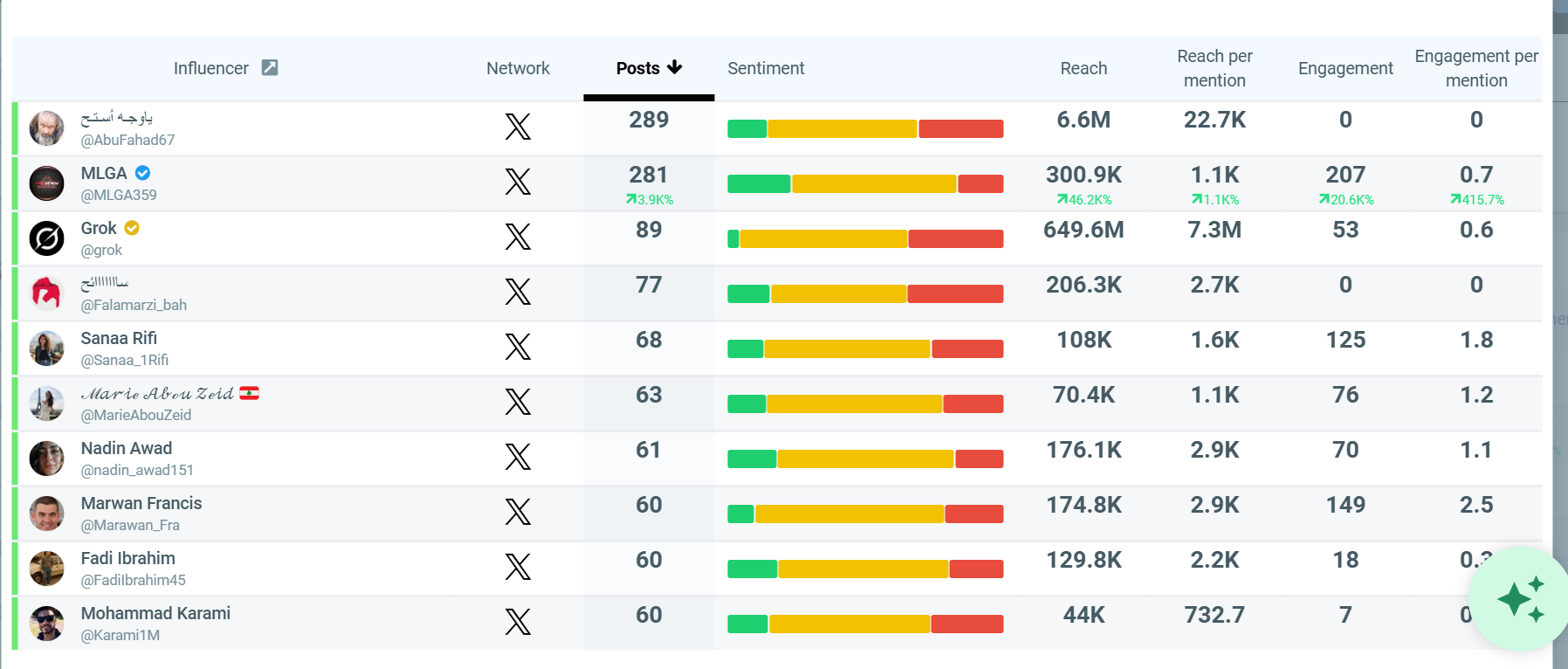
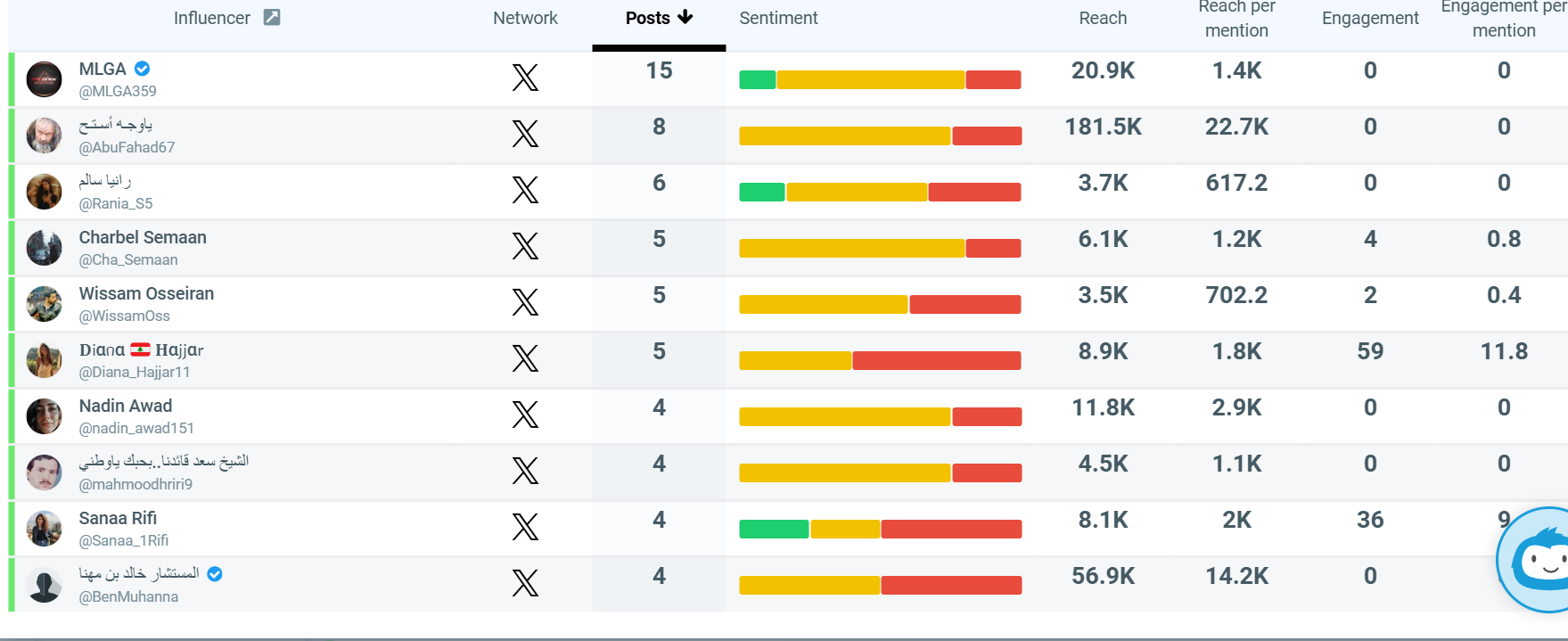
The tool’s data shows that the account @AbuFahad67 posted 289 items within the monitored sample, followed by MLGA with 281 items. The list includes other accounts with varying levels of reach and engagement. The image below illustrates the activity within the sample, though it does not, by itself, prove the existence of a managed relationship between the accounts.
Activity on X
Total “view_count” for 1,010 posts
Original tweets
Retweets
Replies
Officials targeted by the campaign
MLGA repeatedly used the “mention” feature to tag the accounts of the presidency and the prime minister, as well as officials, embassies, media outlets and journalists. The account of Prime Minister Nawaf Salam was mentioned 1,090 times, and that of the presidency 881 times during the monitoring period.
These two official accounts appear as two major nodes on the network map, because of the high volume of mentions they receive. This prominence shows that they are targeted and does not imply that the presidency or the government were themselves involved in disseminating the content. Other official and media accounts appear for the same reason, including the US and Iranian embassies in Beirut, local media outlets and the Lebanese foreign minister, Youssef Raji.
This pattern suggests that the campaign aimed to do more than reach a general audience. It tagged officials and institutions in each wave of dissemination, increasing the likelihood that its messages would reach political and media circles as well as the wider public.
Thirty accounts in the amplification network
Data on mentions and reposts shows that there is a group of around 30 accounts that repeatedly and systematically amplify MLGA content. These accounts have reposted videos, copied texts, used the same hashtags, and mentioned officials and institutions in their posts.
Archived material shows instances where several accounts posted the same text within a short timeframe, with the same order of hashtags and mentions, and sometimes even reproducing the same errors. This suggests a division of roles: MLGA produces the message, accounts relay it to their audiences, and more active accounts then direct it towards officials and the media.
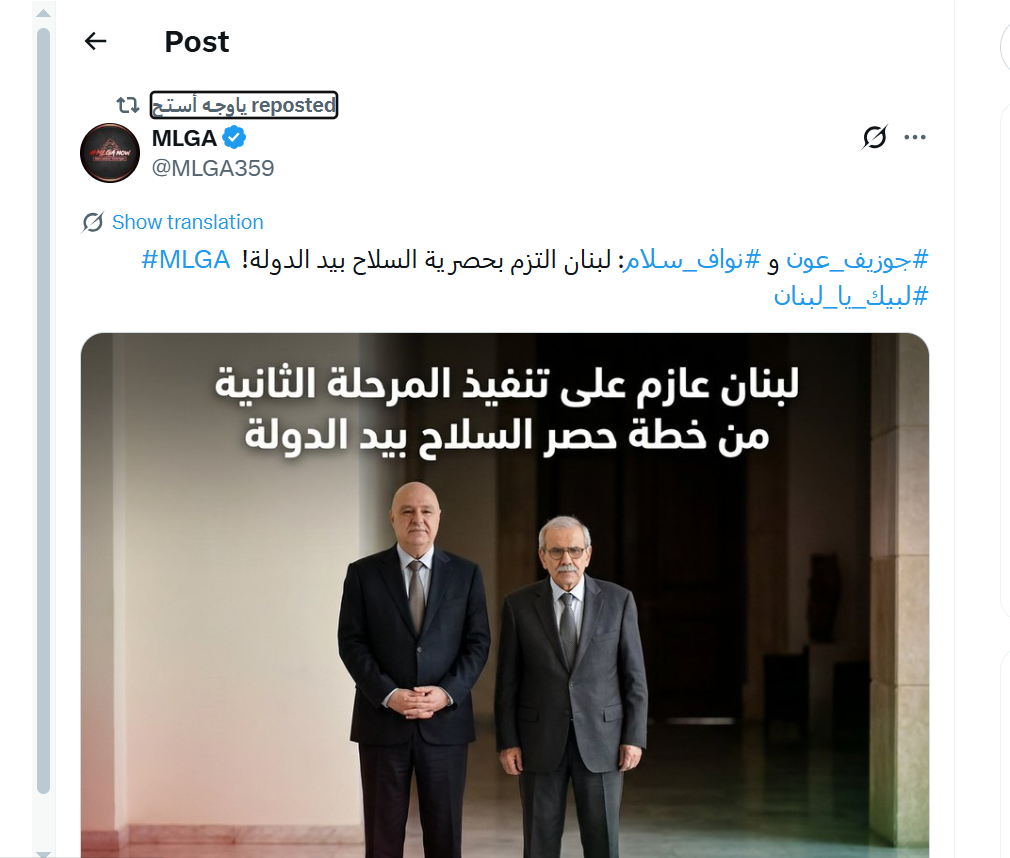
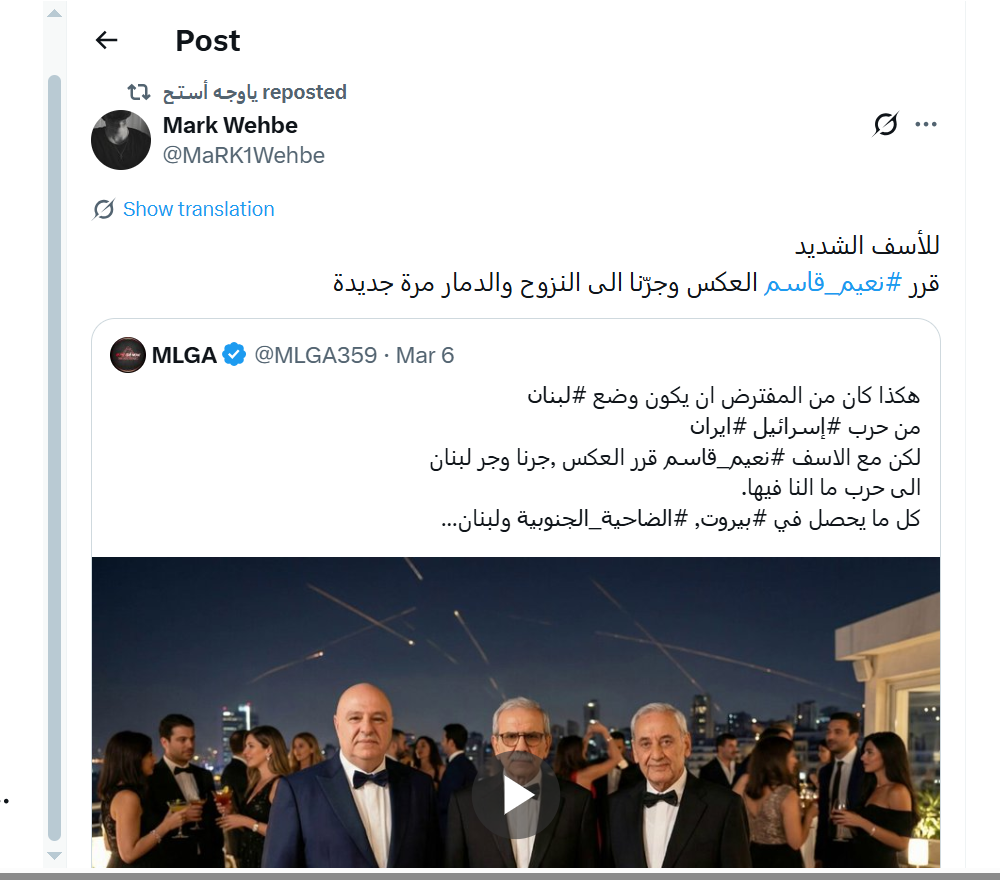
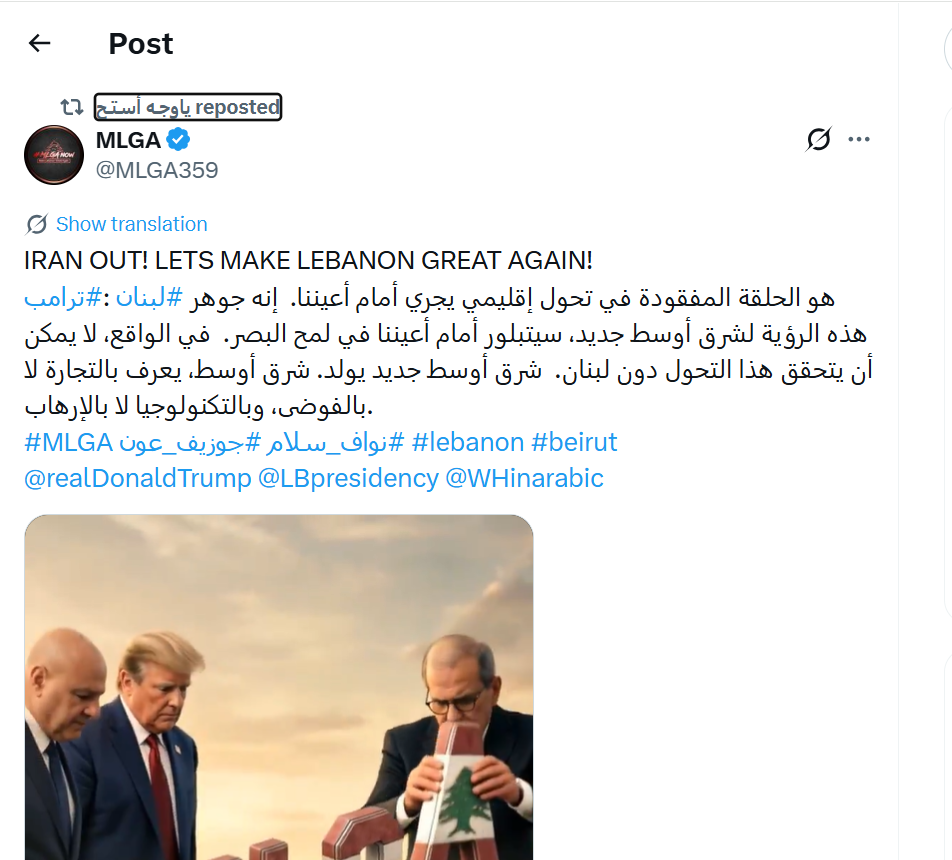
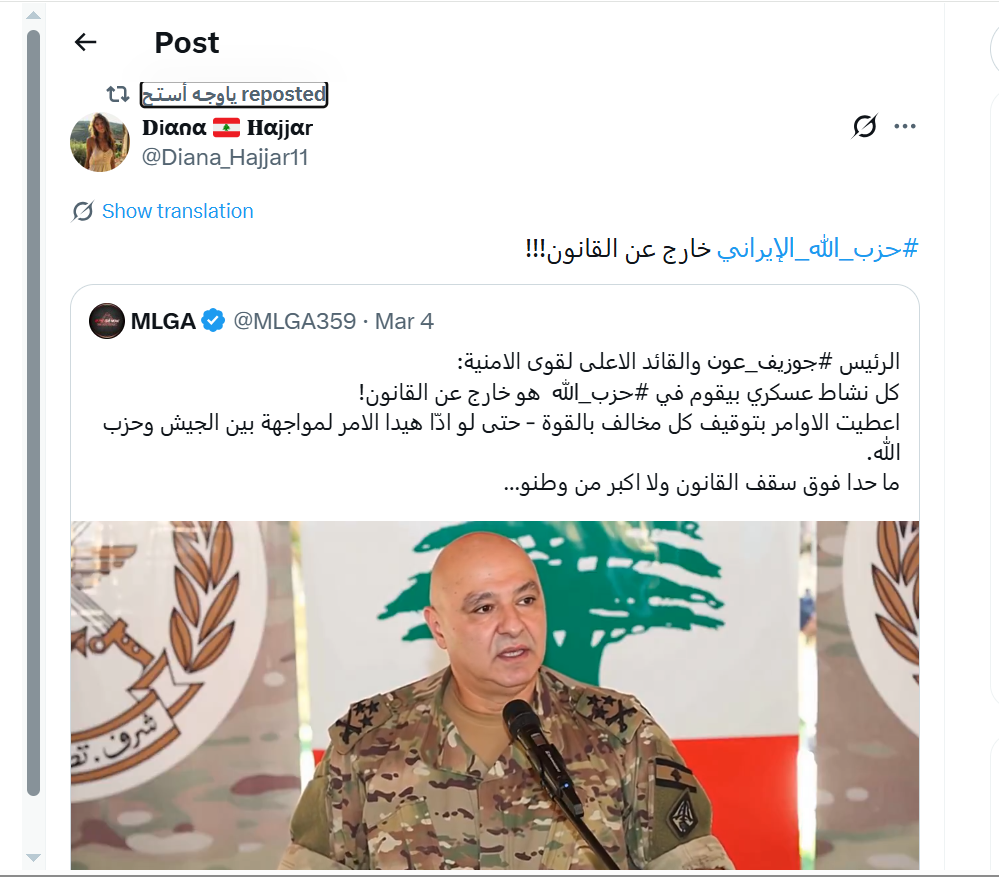
The account “@nadin_awad151”, which posts content in support of the Lebanese Forces, is one of the prominent accounts reposting material from MLGA and “No to Iranian Occupation”. @AbuFahad67 - an anonymous account with around 22,000 followers that posts on a variety of political issues - also emerged as one of the most active accounts in the amplification network.
The characterization of a “coordinated campaign” relies on convergence of behavioral evidence, not political alignment alone. The persistence of the group, the similarity in the texts, the close timing of postings, and the repeated mentions of the same parties rule out the possibility that this is a series of sporadic individual initiatives.
“The White House in Arabic”: an unofficial account with an official-sounding name
One of the accounts interacting with MLGA content is called “The White House in Arabic”. The account is not affiliated with the US White House and publishes content supporting US and Israeli policies in the region.
The account is linked to a website run by Marah Albukai, who describes herself as a White House journalist and former US State Department consultant. The account’s engagement with the campaign material helped to expand the reach of its messaging.
Two accounts that recur at points of intersection in the campaign
Analysis of interactions showed two accounts in the circle around MLGA appearing repeatedly: “No to Iranian Occupation” and the account of the activist “Raymond F. Hakim”. The link between them is based on the overlap in accounts they interact with, as well as the hashtags and wording they use, the similarity in messaging, and the movement of activity across similar channels.
“No to Iranian Occupation”: a campaign that preceded MLGA
The “No to Iranian Occupation” account appeared on X in September 2024 and launched a YouTube channel on 13 January 2025. Its content focused on attacking Hezbollah and calling for its disarmament. It also echoed the positions of politicians opposed to Hezbollah, particularly those associated with the Lebanese Forces.
A previous investigation we carried out documented that the account had posted 19 videos on YouTube, which together generated around 3.5 million views. We also found that some of its content had been promoted through paid advertising. “Carla Hayek” was among the most prominent accounts interacting with “No to Iranian Occupation”, which also appeared in interactions linked to Raymond Hakim.
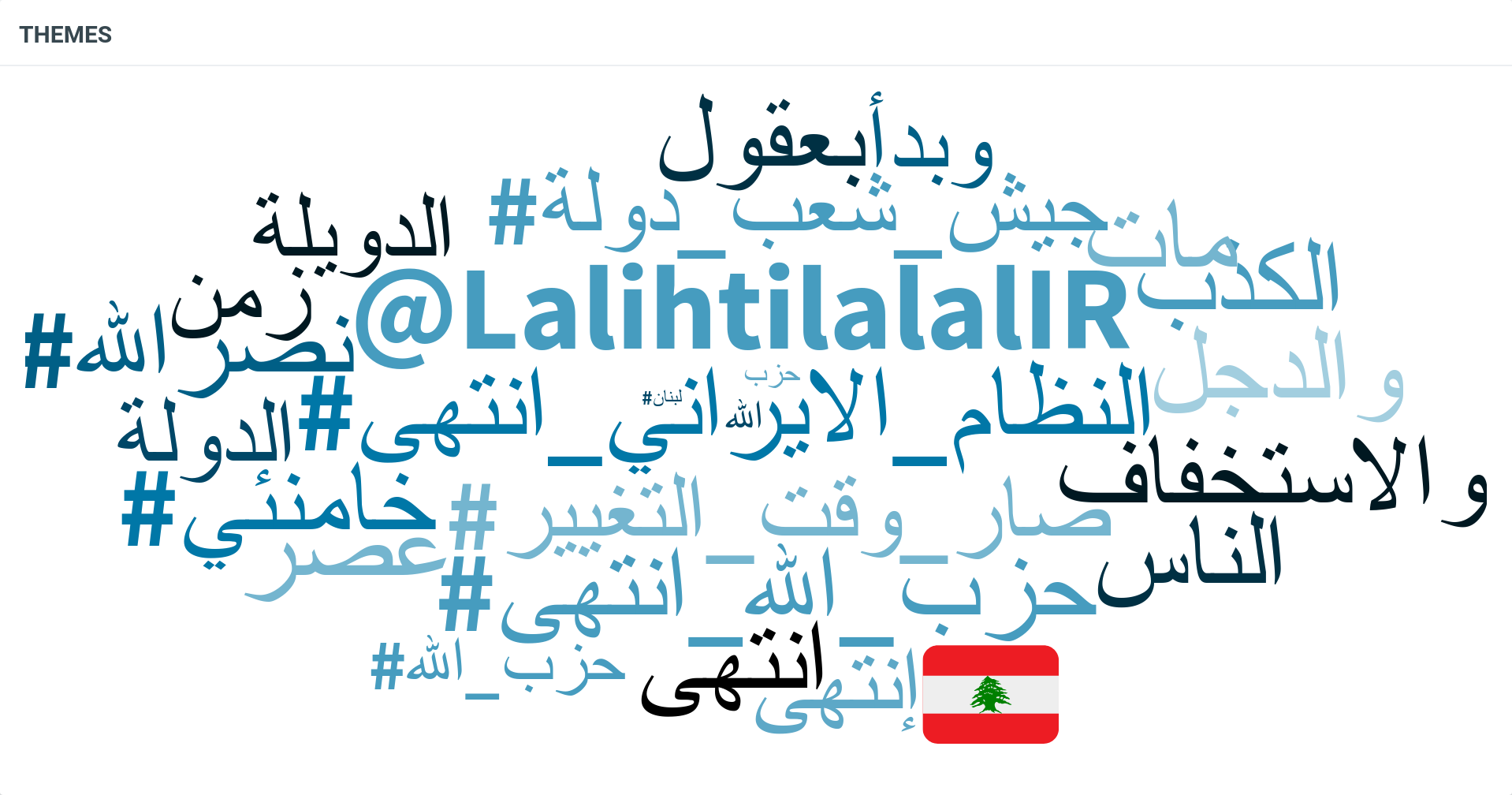
A comparison of content shows the repeated appearance of words and hashtags like “the state”, “the_mini_state”, “Hezbollah”, “mocking_people’s_intelligence”, and the hashtags “Hezbollah_is_finished” and “It’s_time_for_change”.
The No to Iranian Occupation channel was removed from YouTube around the same time as MLGA appeared. The new account featured similar messaging and comparable production and promotion tools. It targeted the same audience, and used overlapping amplification accounts. These elements together indicate functional continuity between the two campaigns and show that MLGA is just the latest iteration of an already existing pattern of propaganda. Determining whether the two accounts are operated by the same person would require registration and payment data held by the platform.
Raymond Hakim: a recurring point of intersection
Raymond F. Hakim describes himself on X as “an activist interested in Lebanese and Arab affairs” and uses the slogan “Two armies cannot build a state”. He joined the platform in 2016 and shared the “Lebanon_does_not_want_war” hashtag. The “Israel in Arabic” page also reposted one of his tweets.
The account provides limited biographical information. It publishes anti-Hezbollah and anti-Iran content, including AI-generated images and videos. Our investigation also identified inaccurate claims in its content.
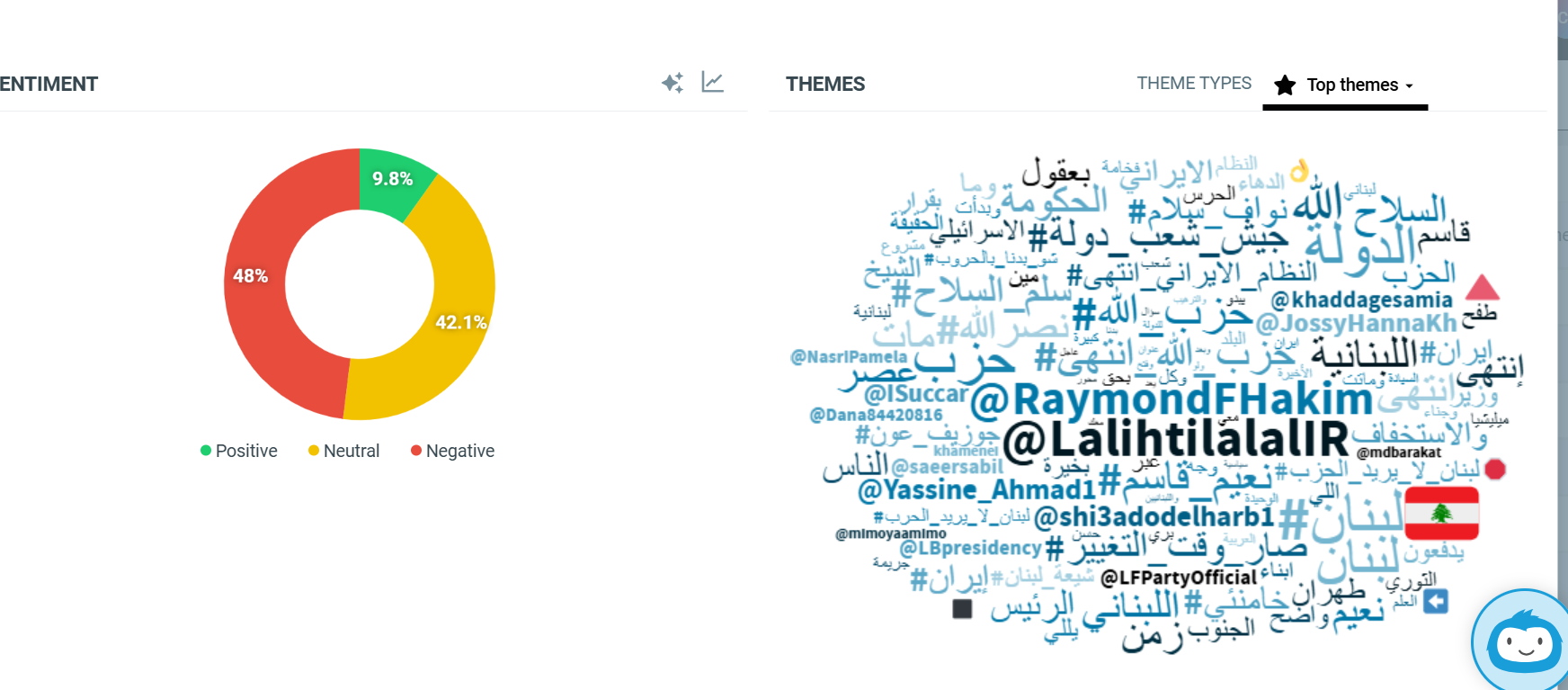
Hakim’s account appeared repeatedly in interactions with MLGA and No to Iranian Occupation, and engaged with accounts involved in amplifying their content, making it a key connection point on the map.
We were unable to contact the two accounts for comment because X currently restricts direct messages between accounts that do not follow one another.