How the Israeli Forces Targeted an Al Araby TV Crew in the West Bank
The Gaza Project is a global collaboration with between 13 media
outlets organised by "Forbidden stories", the project investigated the
targeting of journalists in Gaza and pursued the work of journalists
who have been killed or threatened in Gaza and the West Bank since
By Sofía Álvarez Jurado & Youssr Youssef (Forbidden Stories)
Bullet fragments, alongside damage to Al Araby TV camera equipment,
indicate that it was struck twice by two separate bullets.
Combined trajectory and sound analysis by Doctor Rob Maher and audio
research agency Earshot suggest that the first gunshot that hit the
camera originated approximately 60 meters from the journalists.
Their recollection, as well as video footage from that morning, show
that at least three Israeli forces vehicles were positioned at that
exact location.
Forbidden Stories and its partners examined approximately 60 videos
of the events that took place on that day, including exclusive
footage, and gathered testimonials from eight witnesses. The
consortium found no evidence of any gunfire exchange in the
journalist’s location prior to the shooting. challenging the Israeli
army narrative.
“Since the incident, I keep telling the photographer: I feel like I’ll
be killed.”
Ameed Shehade can still hear the sound of the bullet grazing past his
head. The Al Araby TV correspondent and his cameraman, Rabi
Al-Munayer, found themselves under Israeli forces fire while on
assignment on a gently sloping hill, offering clear visibility. Their
unmistakable identification as journalists – press vests, helmets,
tripods, camera and microphone – wasn’t enough to protect them.
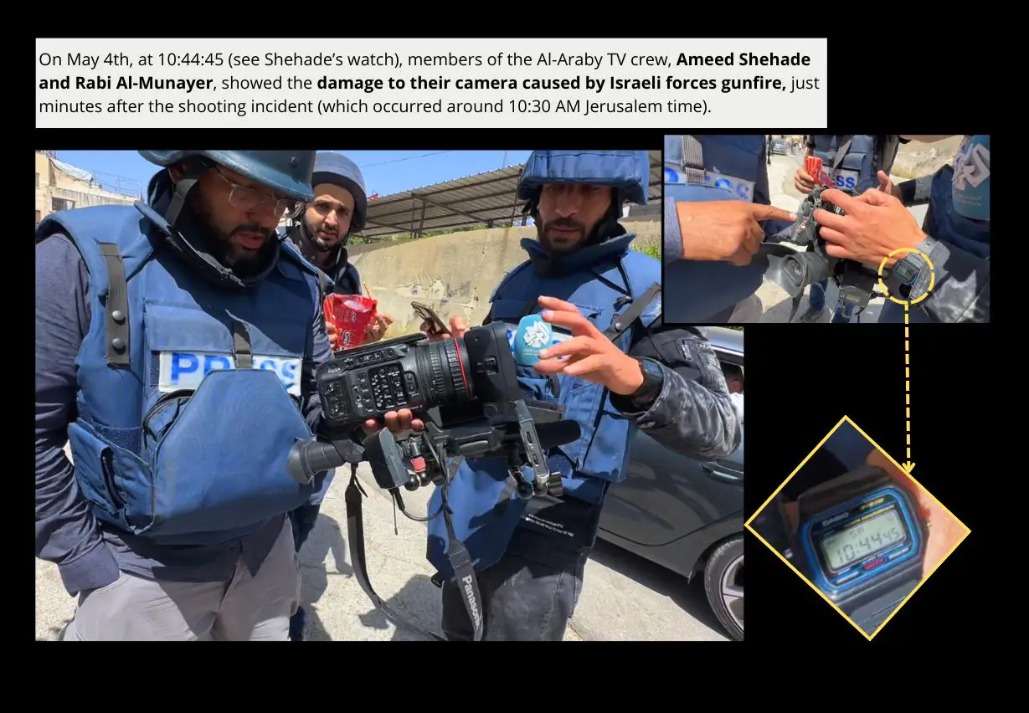
Ameed Shehadeh and Rabi Al-Munayer (Al Araby TV) a few minutes after
the shooting. (Credit: Own elaboration with screenshots from a video
by Issam Rimawi).
The journalist received at least three bullets that were fired in
their direction, two of which struck their camera. According to
Shehade, the camera was positioned approximately half a meter from
him, and no more than 30 centimeters away from Al-Munayer.
“This is a message they are sending to us,” Shehade told Forbidden
Stories, slipping out of the confident voice he uses on TV. His
interpretation of the incident comes from 14 years of experience
working as a reporter in the occupied West Bank.
“Please record what I say in case anything bad happens,” he said. “We
as reporters who are working in the West Bank feel now more than ever
that we could go for a report and never come back.”
In the early hours of May 4, Shehade and Al-Munayer headed to Deir
al-Ghusun, northeast of the city of Tulkarm, in Palestine’s occupied
West Bank, to cover an Israeli raid that had been ongoing over 12
hours. According to the Israel Police Spokesperson’s Unit, the
operation involved counterterrorism forces from the Israel Police,
IDF, and Shin Bet, guided by intelligence from the Shin Bet and the
Military Intelligence Directorate (AMAN), aiming to “thwart a
terrorist cell.”
Israeli forces leveled with a bulldozer a two-story house allegedly
belonging to members of Hamas –designated as a terrorist organization
by the United States, the European Union, and Israel in particular.
Five Palestinians had been killed overnight, according to the
Palestinian Health Ministry and the Israeli forces; Hamas confirmed
that four of them were members of its al-Qassam armed wing.
According to six journalists present on the ground that day – along
with Shehade and Al-Munayer – who spoke to Forbidden Stories and its
partners, there was no military activity, upheaval, or even stone
throwing in their immediate vicinity. The closest fighting would have
taken place around the targeted house, approximately 290 meters away
from them.
Upon arrival, the crew set up on top of a nearby hill for a better
view of the events at the house, they told the consortium.
According to Shehade, the soldiers were aware of their presence as
reporters; they were clearly identified as such and didn’t change
location between the time they arrived on the hill, at approximately 8
a.m., and the moment of the shooting, at 10:30 a.m., (Forbidden
Stories was able to extract the metadata from a picture taken at 9:28
AM, where both journalists can be seen in the same location and
wearing press vests.)
Ameed Shehadeh and Rabi Al-Munayer (Al Araby TV) one hour before the
shooting, working on top of a hill in Deir Al-Ghusun (Credit: Rabi
Al-Munayer/ Al Araby TV).
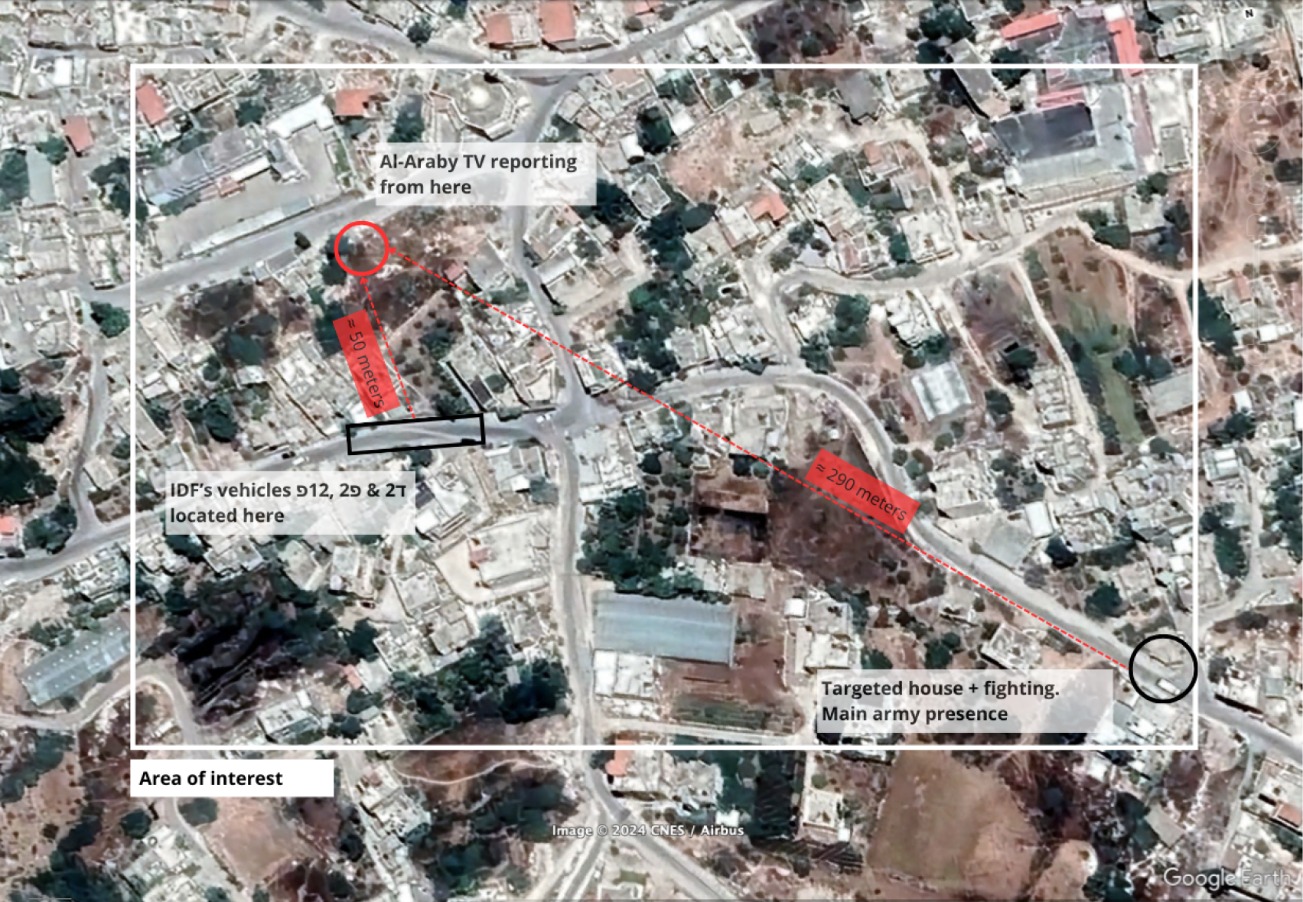
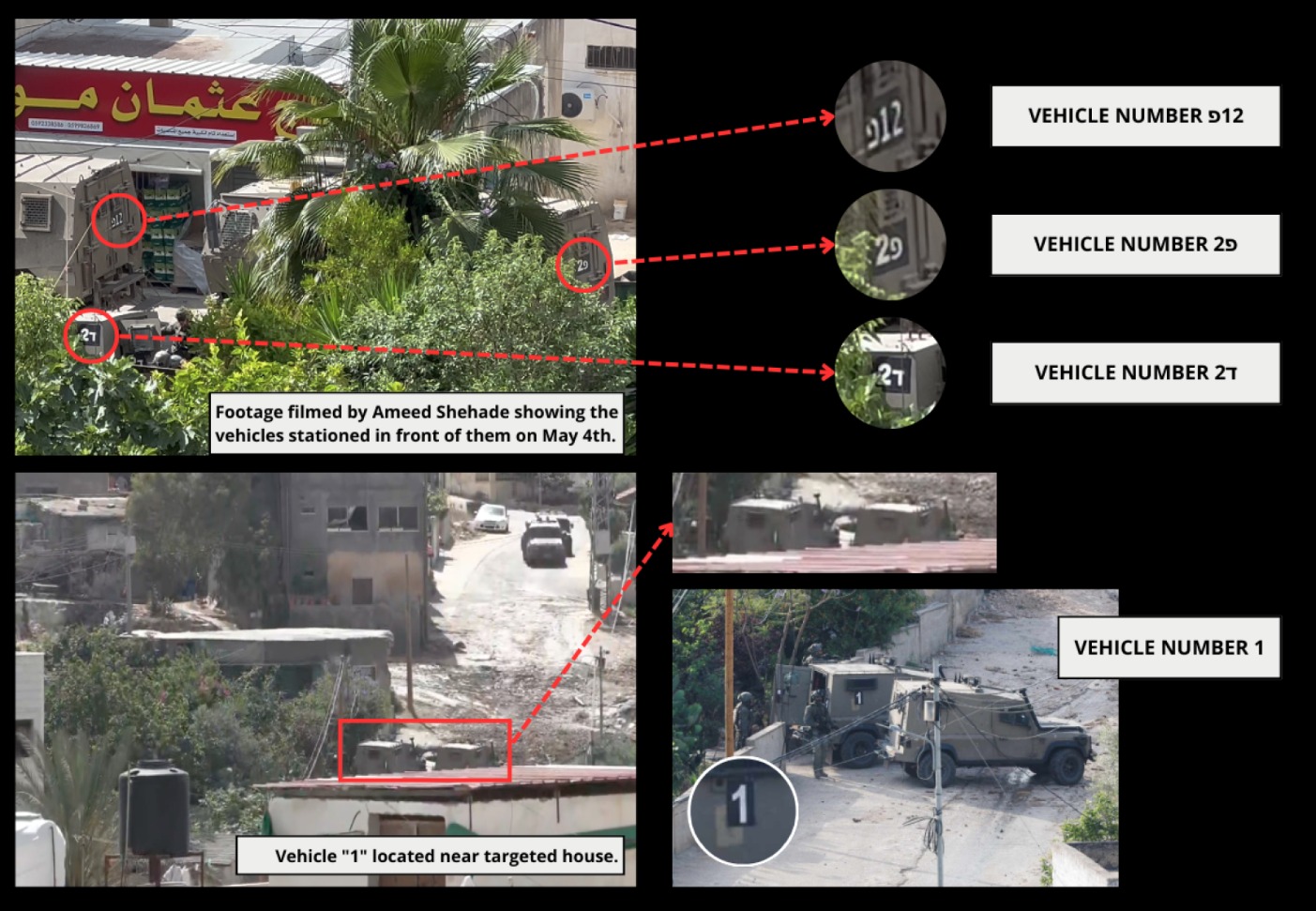
According to footage and open-source intelligence collected by
Forbidden Stories, at least three Israeli military vehicles were
positioned roughly 60 meters from the journalists. Satellite imagery
shows an unobstructed path between the journalists and the soldiers:
no building, only a hill with local vegetation such as a palm tree and
sparse dry grass. It was a clear shot. At that moment, Shehade says
that only he and Al-Munayer were standing on that particular corner of
the hill.
Forbidden Stories reviewed the live broadcast of Al Araby from that
day, starting around 8:20 a.m. until the delayed announcement of the
accident around 10:43 a.m. Shehade and Al-Munayer’s camera feed
appeared on screen for at least an hour and 50 minutes, with no
reported disturbance around them for the length of the broadcast.
Additionally, during this period, the three military vehicles can be
seen in the same spot each time Al-Munayer’s video footage focused
there.
In an excerpt of this live
posted online by Al Araby TV
earlier that morning, the presenter asked Shehade, “Could the
situation escalate in the following hours?” The journalist’s response
was: “The upheaval is focused exclusively on the targeted house … We
are not talking about clashes in the surrounding houses, not even in
the surrounding neighborhoods.”
But at approximately 10:30 a.m., the first of at least three bullets
struck right beside the journalists.
The crew’s camera was recording during the attack, capturing the
journalists’ conversation and the sound of two bullets striking the
equipment. The first one appears to have struck the camera’s cable,
cutting the live signal, and the second one to have hit the camera
itself, causing it to cease functioning immediately.
“Look, he’s shooting at us”
Forbidden Stories obtained this 34-second video from Al Araby TV’s
camera capturing the moment when bullets struck the equipment.
The recording begins with the sound of a gunshot, after which the
camera moves slightly. Shehade explained that they accidentally
jostled the tripod while seeking cover, resulting in the camera
movement seen in the footage. Towards the end of the video, a second
gunshot is heard, and the recording ends abruptly.
Initially, the journalists were uncertain about the source of the
gunfire. Shehade thought it might have come from soldiers near the
targeted house. “Look, he’s shooting at us,” he warned his cameraman,
as can be heard in the video, urging him to focus on the jeep in that
location. But after the initial shock, they realized that the shots
might have come from the army vehicles that had been stationed for
hours at the bottom of the hill with an unobstructed view.
An independent analysis by the audio research agency Earshot explained
that when an intermediate caliber gun is fired towards a recording
device, two distinct sounds are typically captured: the supersonic
sound of the bullet and the muzzle blast. According to Earshot, both
sounds were audible in Al Araby TV’s 34-second video, with a long
enough interval between the sounds to indicate the recording device
was in the line of fire.
Earshot’s analysis suggested that, for the second gunshot (the first
one that hit the camera), a shooter firing the standard Israeli forces
issued ammunition would have been about 62 meters away – consistent
with the location where eyewitnesses and video footage from that
morning placed at least three vehicles belonging to the Israeli
forces, and with the bullet’s entry angle.
Audio forensic consultant Rob Maher, offering the caveat that his
comments were made in a personal capacity, also reviewed the sounds of
both gunshots. “Assuming the material provided was authentic and made
available under the circumstances described,” his analysis concluded
that “if the identified sounds are, in fact, a shock wave and muzzle
blast combination,” the time lags would correspond to a distance of
62.1 meters for the second gunshot.
The consortium was not able to determine the exact origin of the first
gunshot, but both experts agreed that it was fired from a different
–and closer –location.
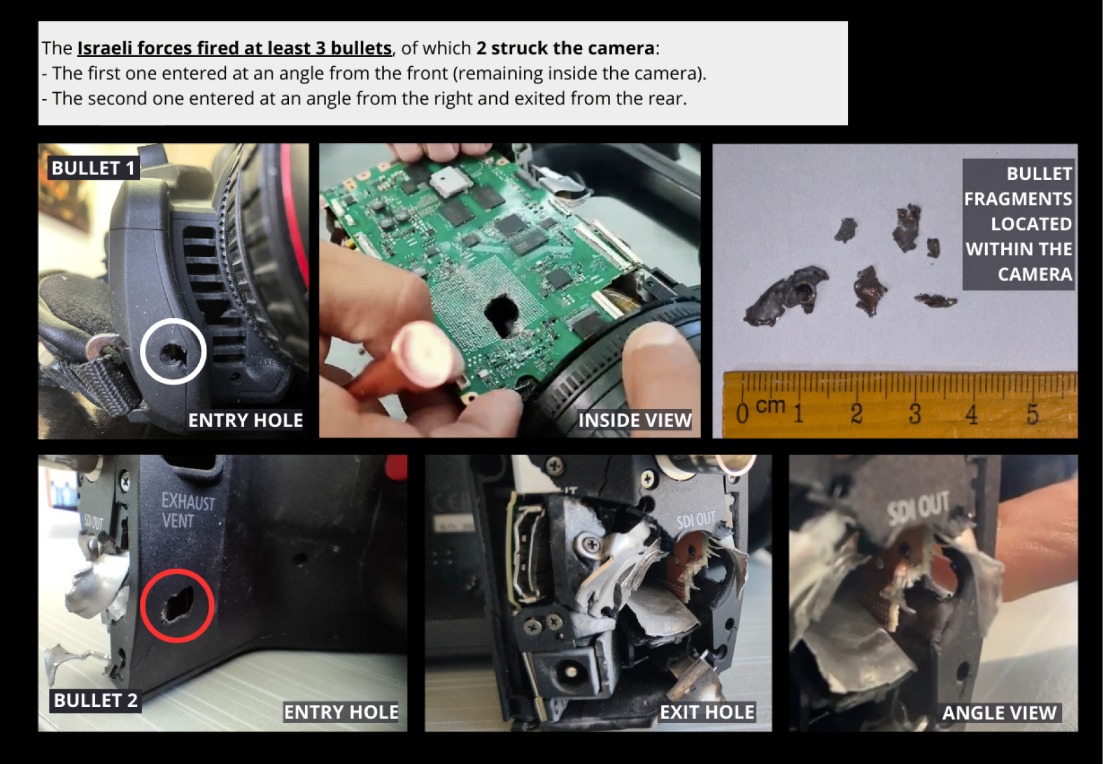
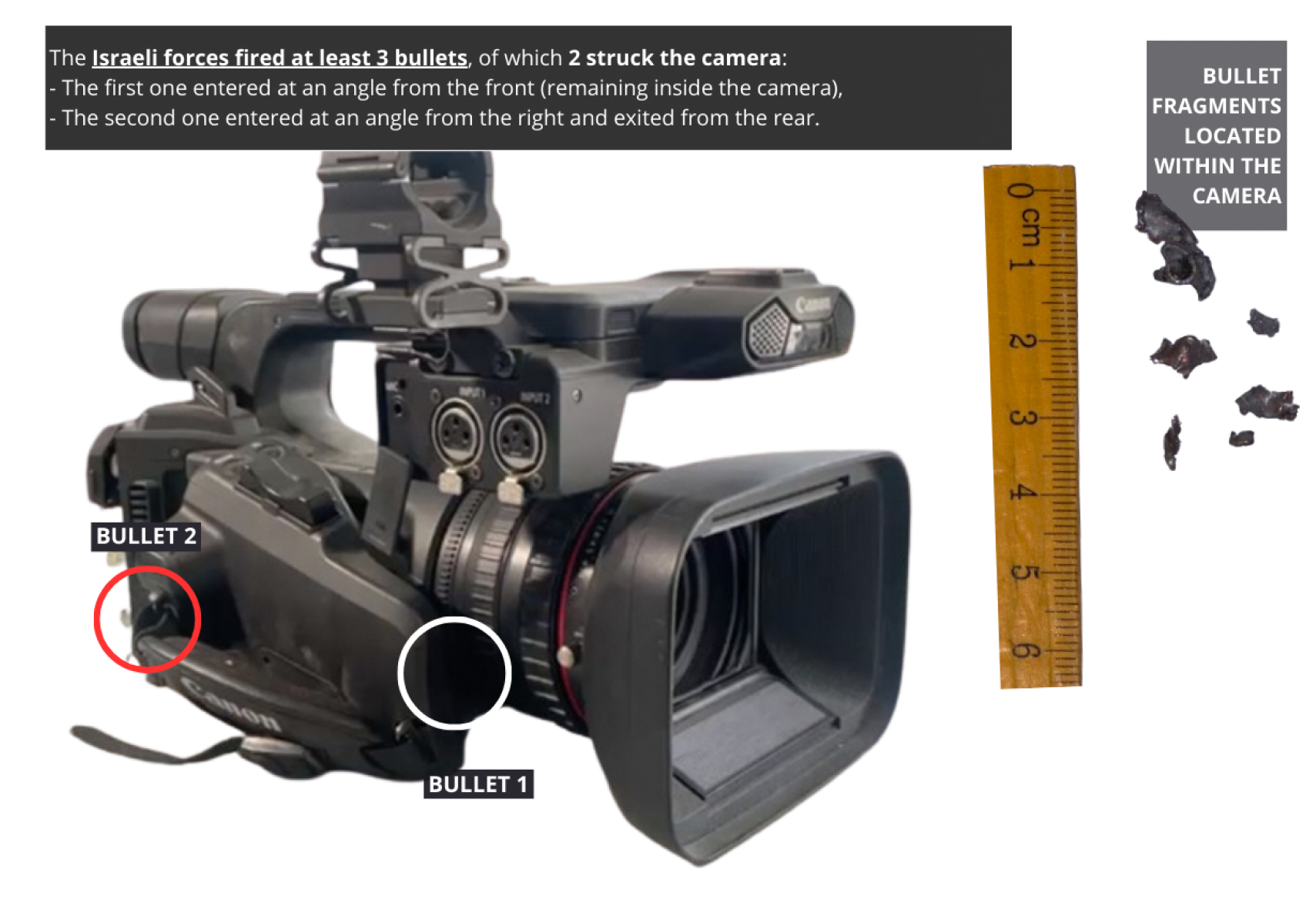
Damage to the Al Araby TV camera sustained during the shooting
(Credit: Own elaboration with pictures from Ameed Shehade).
Damage to the Al Araby TV camera sustained during the shooting
(Credit: Own elaboration with pictures from Ameed Shehade).
A forensic examination of the camera carried out by the consortium
confirmed the impacts of two bullets: one penetrated the camera from
the front at an angle and was lodged inside, while the other
penetrated the camera from the right side, also at an angle, and
exited from the rear.
Speaking on the condition of anonymity, a weapons expert consulted by
Forbidden Stories said that, given the distance between the soldiers
and the journalists, and considering the presence of entry and exit
holes, as well as the bullet fragments found inside the camera, the
likelihood of them being stray bullets was “extraordinarily
improbable.”
In a May 7 response to CPJ about the case, the Israeli military North
America Desk said “at no point was there any deliberate shooting by
IDF forces at journalists.” According to them, Israeli forces in the
area fired weapons in response to gunfire from “terrorists.” When
presented with the results of this investigation roughly two months
later, the Israeli military declined to comment and redirected the
consortium to the Israeli police, which according to them, conducted
the operation. The Israeli police did not reply to our specific
questions, but stated they “take all claims of injury to journalists
seriously,” and referred us to the “IDF Spokesperson’s Unit” for
“questions about jurisdictions or specific military activities.”
Area of interest for the events of May 4 in Deir Al-Ghusun (Credit:
Own elaboration).
Vehicles of the Israeli forces in Deir Al-Ghusun the morning of May
4, 2024. (Source: Own elaboration with pictures from Ameed Shehade
and Wafeya Abed Ulhadi).
“Soldiers don’t see journalists, they see targets”
Since October 7, 2023, following Hamas’s terror attacks on Israeli
soil, and the beginning of the war on Gaza, several journalists
working in the occupied West Bank have reported heightened risks
associated with the exercise of their profession, citing an increase
in violence against reporters all over Palestine.
Former Israeli soldier Joel Carmel, now a member of
Breaking the Silence (BTS)
– an Israeli NGO established in 2004 by Israeli military veterans to
allow them to confidentially recount their experiences in the Occupied
Palestinian Territories – explained to Forbidden Stories that the
rules of engagement have become very loose, and this has become more
pronounced after October 7.
The Israeli military told the consortium that “The RoE [Rules of
Engagement] complies with Israeli law and international law” and that
“due to their classification, they cannot be disclosed.”
“Ultimately, if the soldier knows they can always justify shooting [at
civilians] by saying they felt threatened, that’s what happens,
right?” Carmel said. “They only need to say they felt under threat;
they don’t need to prove it. And soldiers walk around with the feeling
they’re under threat all the time … the training that you get in the
army gives you the feeling that the Palestinians are a threat.”
“Soldiers in the West Bank today walk around [and] when they see
Palestinians, they see enemies. They don’t see journalists, they see
targets,” he added. In a video filmed by freelance journalist Issam
Rimawi around fifteen minutes after the incident, which circulated on
social media, colleagues can be heard congratulating Shehade and
Al-Munayer for escaping death a second time. The first time was less
than a year before: in July 2023, Shehade and Al-Munayer found
themselves in the line of fire during their coverage of an Israeli
military operation in the Jenin refugee camp. According to Shehade’s
own report of the incident, as well as those of other international
media [see
1,
2,
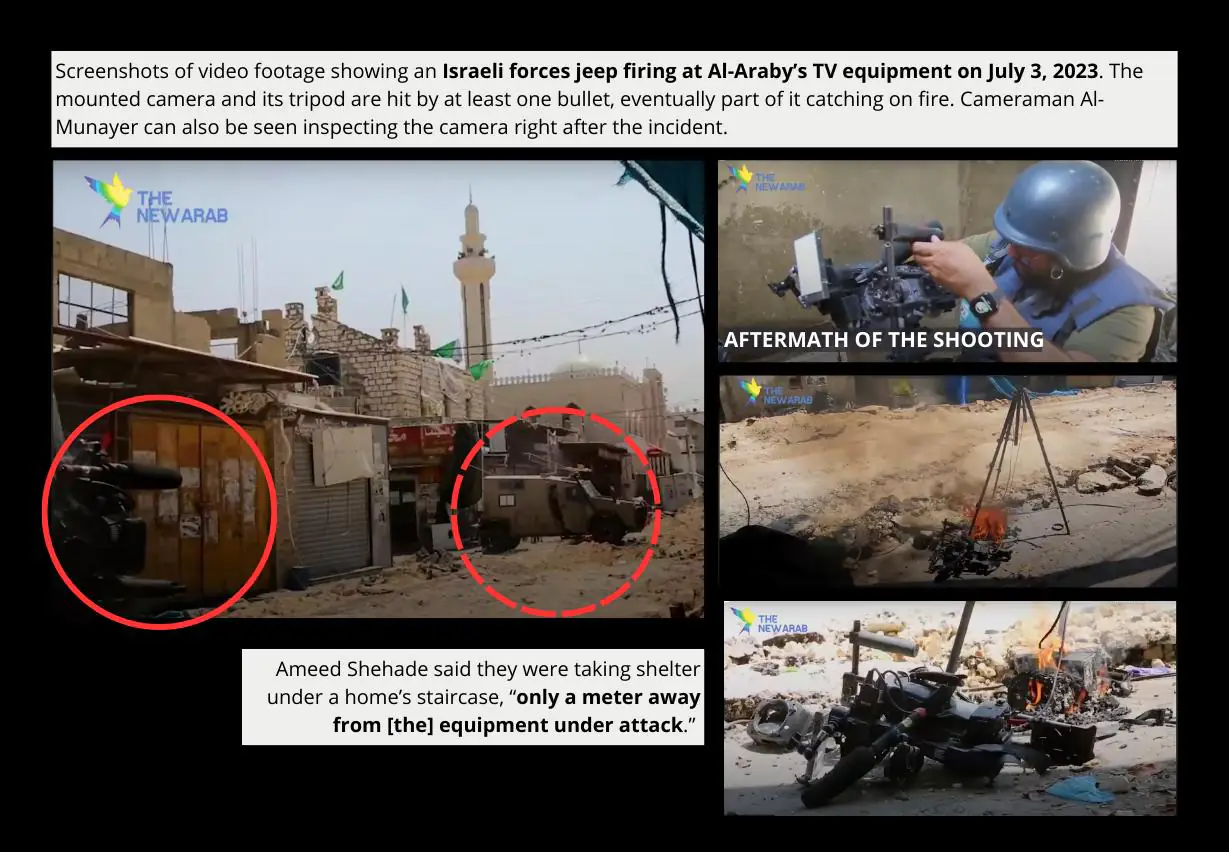
3] , soldiers in a military jeep fired at their equipment repeatedly. In
a video published by The New Arab at the time of the incident, shots
are heard, the camera is jolted and the crew’s transmitter is seen in
flames.
Attack suffered by Al Araby TV crew on July 3, 2023, by the Israeli
military, while reporting in Jenin (Source: Personal documentation
with screenshots from the video published by The New Arab).
The Israeli military told the consortium that July 3, 2023 marked the
beginning of an “IDF and Israel Border Police operation in the Jenin
camp” during which “there were heavy exchanges of fire with
terrorists.” They added that “the IDF has no intention of harming any
civilians, including journalists.”
This incident held particular significance for having occurred in the
same city where renowned journalist Shireen Abu Akleh was killed by
Israeli military sniper fire while on assignment on May 11, 2022 [see
1,
2].
“I lost [hope of obtaining] justice after our colleague Shireen was
killed,” Rimawi, who also worked as a journalist in the West Bank for
16 years, told the consortium. “The whole world was with her, talking
about her. There was no October 7th, no nothing. And what was the
result?” As of today, no one was convicted for Abu Akleh’s killing.
“They fear the cameras. That’s why they target the journalists,
because they don’t want the world to see the crimes.”
Issam Rimawi
FREELANCE JOURNALIST
Testimonials of six journalists, as well as pictures and video footage
collected by Forbidden Stories and its partners, confirm that at least
14 journalists were present in Deir al-Ghusun covering the raids,
including Shehade and Al-Munayer. Some of them were not far from where
the crew came under fire.
Although no one else witnessed the incident, most of them became aware
of the shooting right after it occurred: a bystander who witnessed the
immediate aftermath, and who asked to remain anonymous, said that she
saw, minutes after the shooting, the team lying on the ground for
cover.
Khaled Bdair, a correspondent for Al-Ghad TV, was standing with
journalist Wafa Awad of Wafa News Agency at a different location on
the same hill where Shehade and Al-Munayer were filming. When Israeli
forces first started to shoot, Bdair and Awad thought they might
themselves be targets, but they soon realized that the bullets had
struck Al Araby’s equipment (
in this video
Bdair can be seen reporting on the incident in the immediate aftermath
for Al Ghad TV, visibly affected by the shooting). An Al Jazeera
correspondent also announced
during his broadcast
that the Israeli military had shot at the journalists.
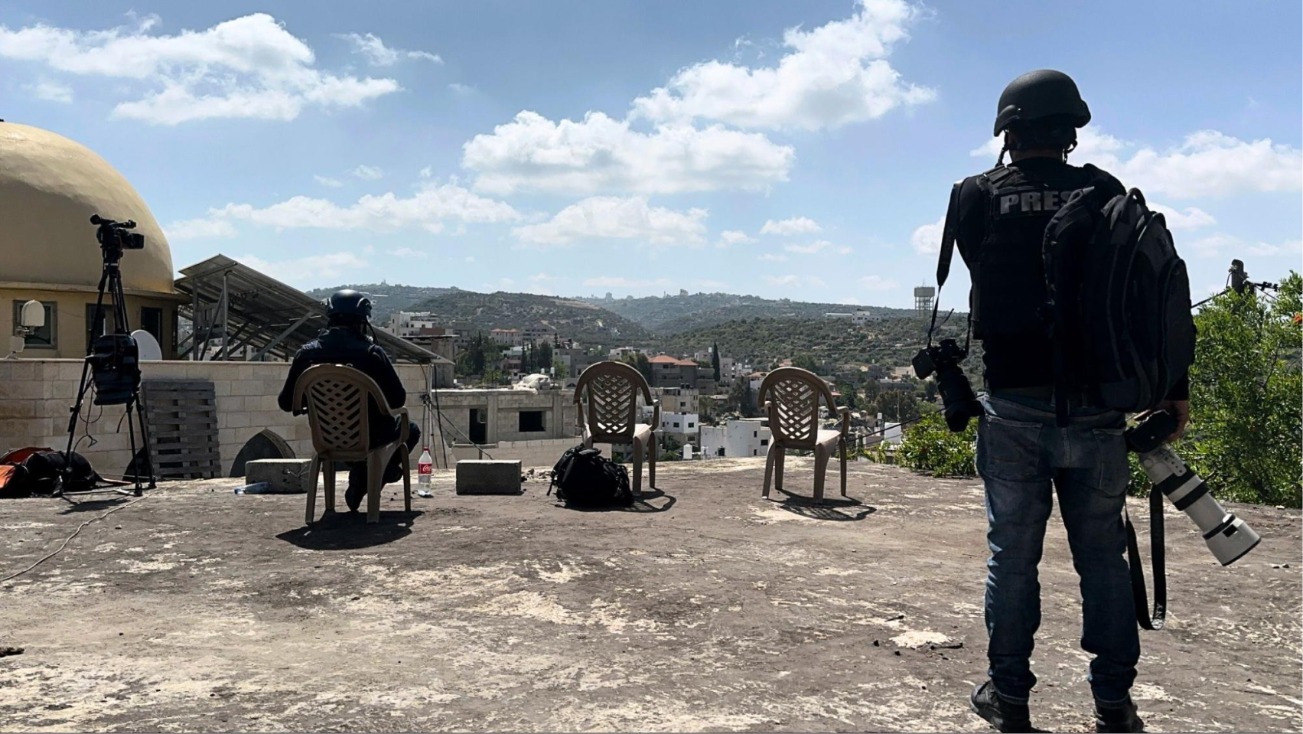
Journalists reporting from a rooftop in Deir Al-Ghusun, the morning
of May 4, 2024 (Source: Issam Rimawi/ freelancer).
The journalists said they got no warning from the Israeli military
about risks at their site. “We would have moved away. But we were in
an area that was relatively far from the army. There was no [warning
of] danger at all,” Bdair said.
For Rimawi, the freelancer, the Israeli military’s motivation for
targeting journalists is clear. “They fear the cameras,” he said.
“That’s why they target the journalists, because they don’t want the
world to see the crimes.”
“That’s why they fire directly at the lens or at the journalist’s
eye,” he added. “Even if they are wearing press vests … they no longer
have red lines after October 7th.”
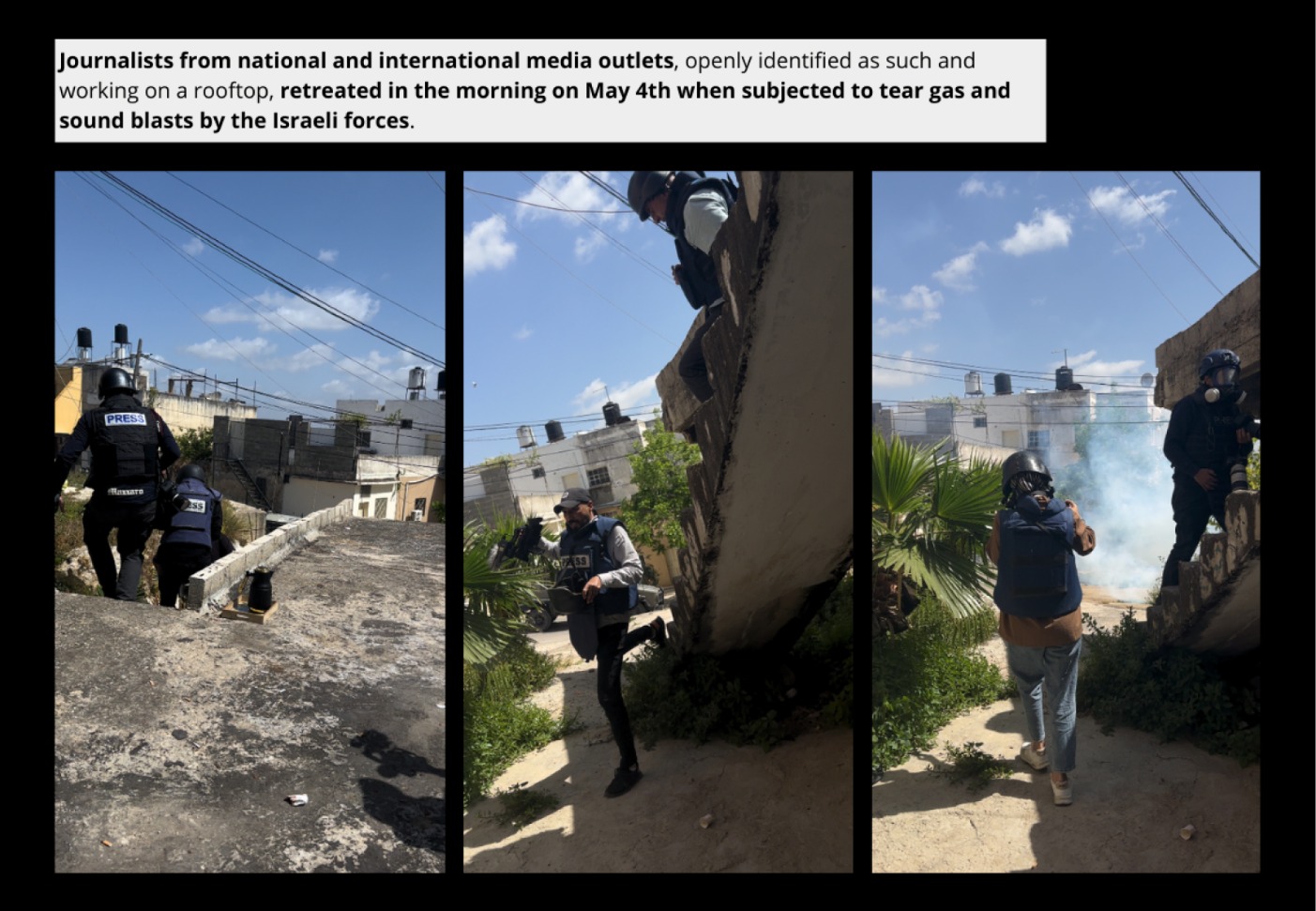
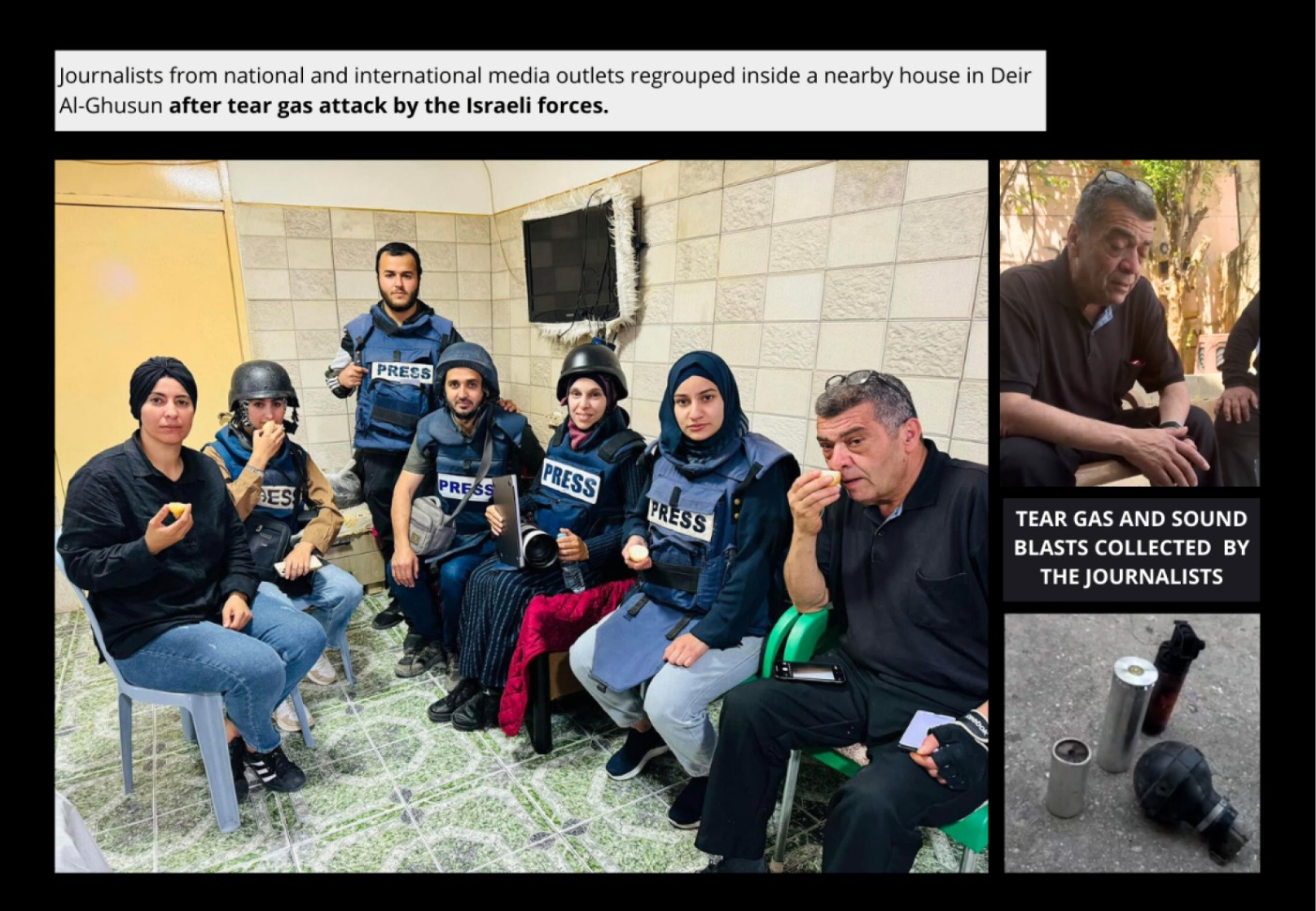
A few minutes before the shooting against the Al Araby TV crew,
Israeli forces also threw tear gas and stun grenades at a group of
around ten journalists – Rimawi among them – who were likewise on
assignment and clearly identified with press vests.
Journalists trying to escape tear gas thrown by the Israeli forces
the morning of May 4, 2024 in Deir Al-Ghusun (Credit: Own
elaboration with screenshots from a video by Raghad Salameh).
Journalists recovering after being attacked by the Israeli forces
with tear gas and sound blasts, the morning of May 4, 2024, in Deir
Al-Ghusun (Credit: Personal documentation with pictures by Raghad
Salameh and other journalists present).
In a climate of rising violence against journalists, this second
episode of targeting by the Israeli military just a year after the
shooting in Jenin has taken a toll on Shehade’s morale. “I think about
it every day,” he said. “Why did they do that to us for the second
time?”
Shehade told Forbidden Stories that since the incident, he often tells
his cameraman that he fears being killed while on assignment. “If we
were to be killed by the Israeli Army, we said several times that we
were being targeted and didn’t feel safe,” he said.
Despite these concerns, Shehade and Al-Munayer continue to report
every day, clad in press vests and camera in hand, doing their best to
bring stories from the West Bank to the rest of the world.
This investigation was published in Arabic on the following: