The Gaza Project is a global collaboration with between 13 media
outlets organised by "Forbidden stories", the project investigated the
targeting of journalists in Gaza and pursued the work of journalists
who have been killed or threatened in Gaza and the West Bank since
By Léa Peruchon (Forbidden Stories)
Arthur Carpentier (Le Monde), Gaëlle Faure, Sarah Benhaïda, Benoît
Toussaint, Jean-Marc Mojon, Marc Jourdier (AFP), Hoda Osman, Farah
Jallad (ARIJ), Maria Retter, Maria Christoph, Dajana Kollig,
Frederik Obermaier (Paper trail media), Christo Buschek (Der
SPIEGEL/Paper trail media), Walid Batrawi (Forbidden Stories) and
Manisha Ganguly (The Guardian) have contributed to this article.
27 June 2024
Since October 7, the Israeli military seems to have deliberately
targeted cameras filming live from the Gaza Strip. Buildings housing
press organizations – crucial refuges for journalists in the Gaza
Strip – have been destroyed, with the apparent objective of stifling
information and preventing the reality of the ongoing war from being
broadcast to the world.
Key findings
Forbidden Stories and its partners have demonstrated that the tower
housing the AFP’s offices in Gaza was the target of two direct
strikes on November 2, 2023 – despite assurances from the Israeli
military that it had classified AFP premises as “not to be
targeted.”
The same day, the premises of the Palestinian Media Group, a
production company that broadcast live images from the Gaza Strip,
were also targeted by the Israeli military. A journalist was injured
in the attack.
The Press House, a sanctuary for Gazan journalists, was destroyed
last February by the Israeli military. Its director was killed by
shrapnel while trying to flee to the south of the Gaza Strip with
his family.
It was 2 a.m. on October 10, 2023, when Adel Zaanoun, a journalist
with Agence France-Presse (AFP), made a worried call to his superiors.
The AFP team had just received an order from the Israeli military to
evacuate its offices in the Hajji Tower at the heart of Gaza City, a
sign that the building might be bombed.
Only a few hours earlier, AFP Chairman and CEO Fabrice Fries had
shared the address of the building with the Israeli military spokesman
in a letter, in order to avoid any possible targeting.
“Should we evacuate or remain in the building?” Zaanoun asked Marc
Jourdier, AFP’s Jerusalem bureau chief, on the other end of the line.
“Don’t waste a minute – evacuate,” Jourdier responded. “I’ll call the
army and get back to you as soon as possible.”
In the end, the building was spared that day, but an Israeli strike a
few hundred meters away killed three Palestinian journalists who had
come to cover the expected attack. The Israeli military called Marc
Jourdier back later that night to say that the premises were now
classified as “not to be targeted.”
This is not the first time journalists have been ordered to evacuate
their offices in Gaza due to the threat of Israeli bombing, Carlos
Martinez de la Serna, program director at the Committee to Protect
Journalists, said in an interview. “The Israeli military has a history
of attacks on media structures,” he explained. In May 2021, a tower
housing the Qatari media organization Al Jazeera and the American news
agency The Associated Press (AP) was destroyed by three missiles, on
the basis, the Israeli military claimed, of an imminent threat posed
by Hamas’s presence in the building. When questioned publicly, Israel
provided no evidence to support this claim.
Since October 7, 2023, the phenomenon has taken on unprecedented
proportions. In response to the Hamas terrorist attack on Israeli
soil, the Israeli military has relentlessly bombarded the Gaza Strip,
a 365-square-kilometer territory barely larger than Malta. News
coverage in the Gaza Strip has become extremely limited.
“When you look at the conflicts around the world … you would usually
have the international media on the ground,” said Irene Khan, UN
Special Rapporteur on the promotion and protection of the right to
freedom of opinion and expression. “None of them have been allowed
access. Or they’re embedded within the IDF.”
Only Gazan journalists can report on what is happening in the Gaza
Strip. They struggle daily to survive and find places to take refuge.
In many cases, their places of work no longer exist. According to the
Palestinian Journalists’ Syndicate (PJS), around 70 press
organizations, including local radio stations, news agencies,
transmission towers, and journalist training institutes, have been
partially or completely destroyed since the start of the war.
Forbidden Stories has carried out this investigation in collaboration
with AFP, Arab Reporters for Investigative Journalism, Le Monde, Paper
Trail Media and other international media outlets as part of the Gaza
Project. Supported by the analyses of experts in ballistics and audio,
it illustrates one of the many strategies used by the Israeli military
to stifle information in Gaza: the destruction of press
infrastructure.
A broadcast goes dark
On October 13, 2023, the Israeli military ordered one million people
to evacuate the north of the Gaza Strip. Three days after having fled
their offices in the middle of the night following the army’s phone
call, AFP’s employees abandoned the Hajji Tower, located in the
upscale neighborhood of Rimal in the northwest of Gaza. The team of
eight reporters, photographers, video journalists, and other staff
members are Gazans who have worked for years with AFP, one of the few
international agencies to have offices in the Gaza Strip.
“Inside Gaza, there isn’t foreign media,” Shuruq As’ad, a PJS
spokesperson, told the consortium. “[International press agencies]
work with locals.”
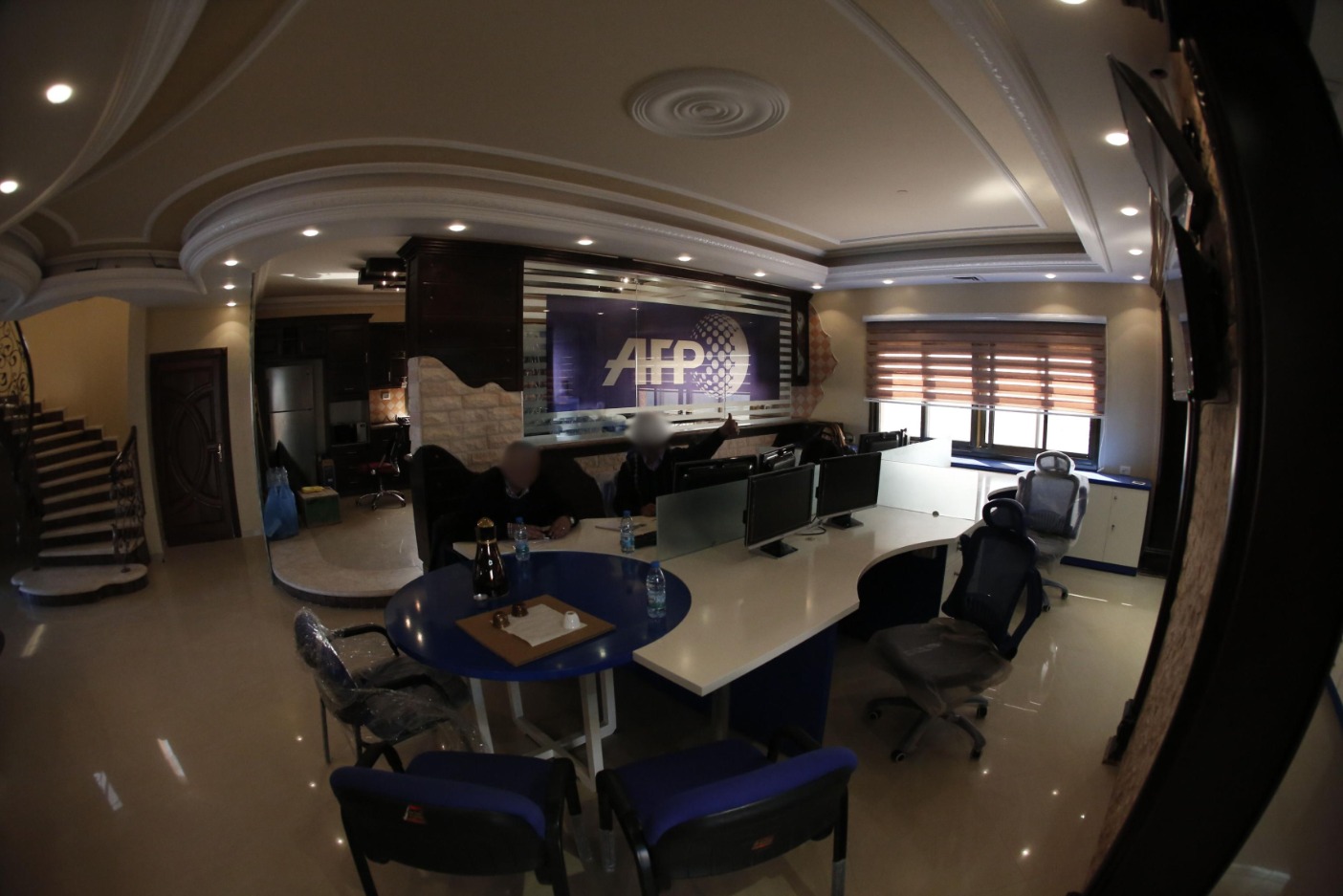
Inside the AFP offices located in the Hajji tower, Gaza City, 2015
(Credit: AFP)
Before leaving, AFP left a camera filming from a tripod on the 10th
floor of the building. Now hooked up to solar panels, the camera was
initially connected to a generator, which was occasionally refueled by
an AFP employee. The aim was to broadcast images from Gaza 24 hours a
day, seven days a week. Although occasionally interrupted by technical
problems, the broadcast was one of the last sources of live images of
the Gaza Strip. As such, it was monitored constantly by global media.
On November 2 at 12:09 p.m. local time, as the camera was capturing
the hum of aircraft and the plumes of smoke emanating from buildings
in the north of Gaza, the video shook suddenly and smoke blocked the
lens. A strike only a few meters away had just been recorded live —
footage that would be seen around the world.
“The location of this office is known to all and [the Israeli
government] has been reminded of it multiple times over the past few
days, precisely to prevent such an attack and to allow us to continue
providing images on the ground,” Fries, the AFP CEO, was quick to say
on X (formerly Twitter).
The coordinates of the building had been passed on to the Israeli
military on several occasions, as have those of multiple other media
offices, hospitals, and humanitarian sites in the Gaza Strip. AFP had
been assured by the Israeli military at the start of the conflict that
the building was classified as “not to be targeted.” Questioned by AFP
at the time, the Israeli military denied any strike on the Hajji
Tower. “It appears there was an IDF strike near the building to
eliminate an immediate threat,” a spokesperson said in a statement.
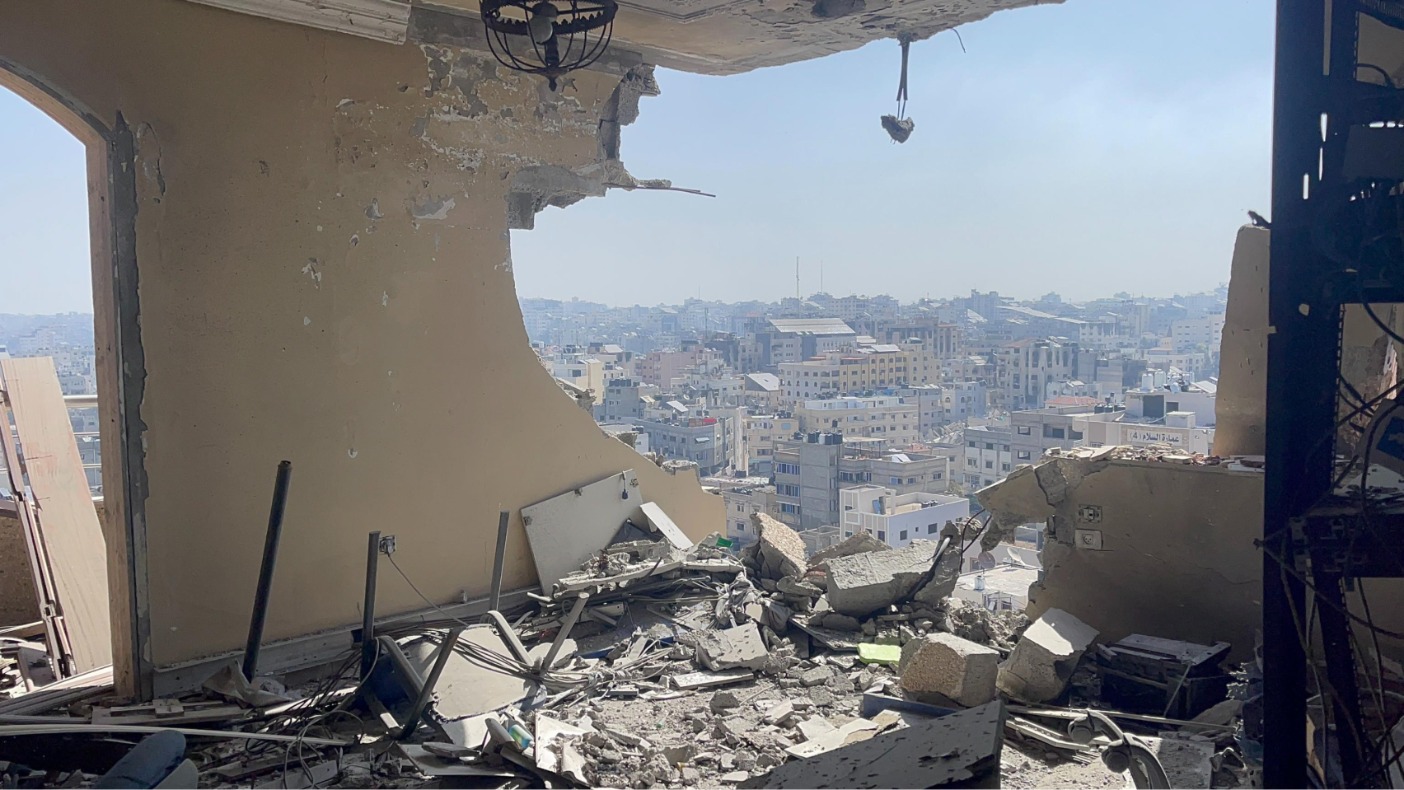
The building was significantly damaged. Exclusive images shot by AFP,
a partner in the Gaza Project, illustrate the scale of the
destruction. Throughout the agency’s dust-covered premises, shards of
glass litter the floor. In a room where computer servers balance
precariously on a shelf, a gaping hole in a wall reveals a glimpse of
the southeastern Gaza Strip.
AFP server room located on the 11th floor of the Hajji Tower
partially destroyed by a strike carried out on November 2, 2023
(Credit: AFP)
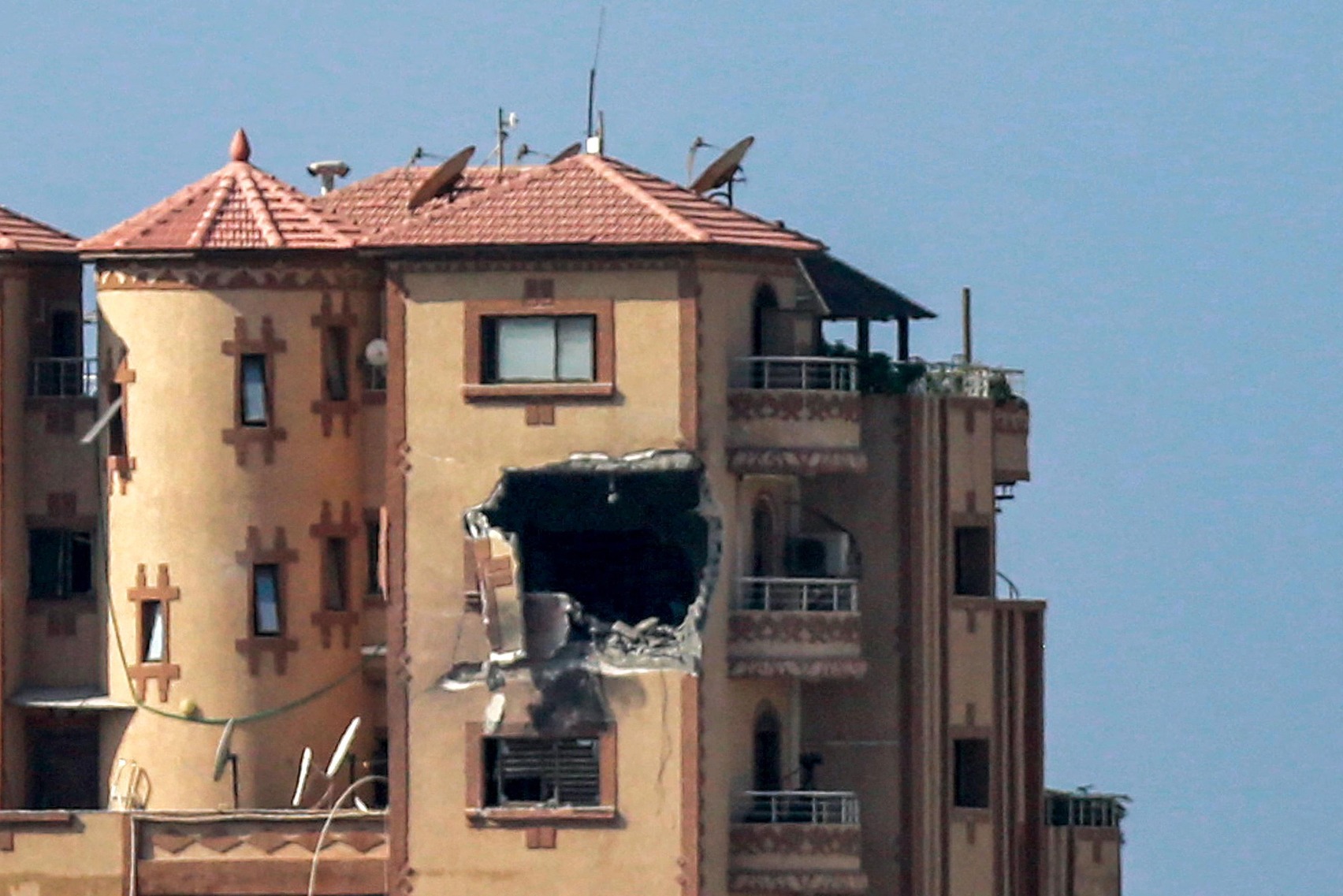
The Hajji Tower the day after the strike, showing (1) a gaping hole
on the 11th floor and (2) the camera facing north, on the 10th
floor, positioned underneath the hole (right hand side)
When contacted as part of this investigation, the Israeli military
spokesman reiterated that “The offices of the AFP agency were not the
target of the attack, and damage to them could have been caused by the
shock wave or shrapnel.”
While the Israeli military denies having bombed the tower, several
strikes hit the building, some only a few meters from the camera. This
is what an analysis of the live images recovered by the consortium
reveals.
Are live feeds targeted?
Forbidden Stories and its partners discovered that on November 2,
2023, there were at least two direct hits on the building housing the
AFP offices between 11:55 a.m. and 12:09 p.m. local time.
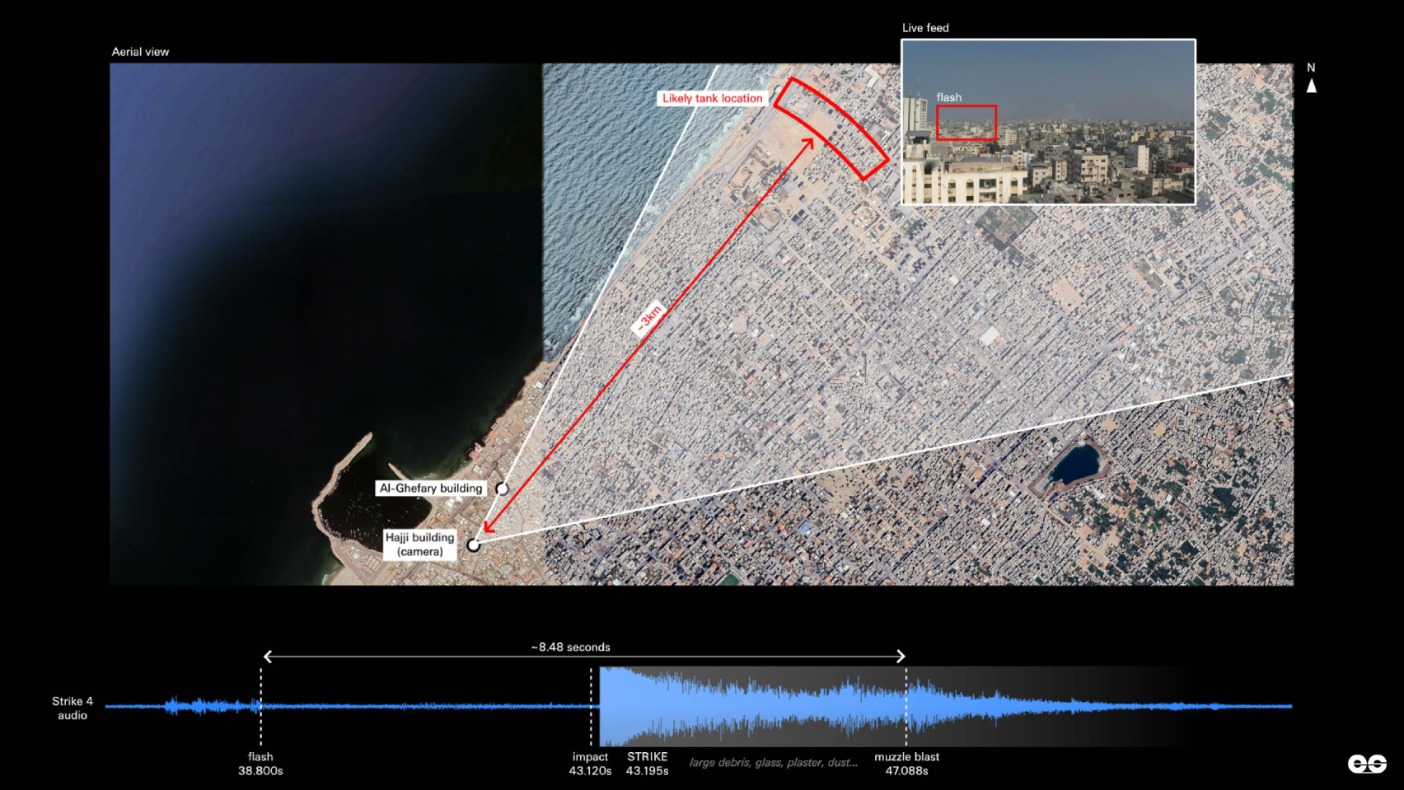
The live footage of both strikes shows the lightning-quick flash of a
shot on the horizon and an explosion nearly four seconds later.
Zoom in on the flash visible on the skyline, 4 seconds before impact
(Credit Le Monde / AFP)
Thanks to the open-source investigative work of our partners Le Monde
and Paper Trail Media, supported by Earshot, an organization
specializing in the production of audio investigations in defense of
human rights, we were able to pinpoint the origin of the shots: A
deserted area approximately three kilometers away, with a clean line
of fire to the tower. Further analysis of the speed and features of
ammunition concludes that it was most likely a tank that fired them.
Adrian Wilkinson, a forensic explosives engineer who regularly works
for the United Nations, says “it is almost certain that the AFP office
was shot at by an Israeli tank.” He rules out the possibility of
accidental hits. At least five other experts, including independent
weapons and conflicts researcher War Noir and former US Army explosive
ordnance disposal technician Trevor Ball, agree.
Estimated position of the tank 3 km away from the camera on November
2, 2023, geolocated by our partner Le Monde and corroborated by
Earshot’s analysis (Credit: Earshot)
Analysis of two satellite images from October 31 and November 3 shared
by Planet Labs confirms the presence of tank tracks in the area at
that time. Another satellite image dated the same day exists. It
belongs to Maxar Technologies, a company also specializing in
satellite imagery, but it did not wish to share precise information
enabling us to locate the Israeli tanks. Maxar declined to comment at
the time of the publication.
But the analysis of the live footage led to another discovery. A few
minutes before the two strikes on the AFP offices, another explosion
took place at a neighboring building: the Al-Ghifari Tower, which also
houses cameras.
On the 16th floor of this tower, one of the tallest in the Gaza Strip,
are the offices of the Palestinian Media Group (PMG). Notably, this
media production company supplies outlets with an unobstructed view of
Gaza through the footage recorded by its cameras. Just before 10 a.m.
on November 2, 2023, several cameras positioned at the office’s north,
south, east, and west windows were sending live images to several
international news services, including Reuters and Al Arabiya, when an
explosion sounded.
That morning, Ismail Abu Hatab was preparing his coffee and finishing
a download of yesterday’s footage. A freelance journalist, he had
slept in the offices of the PMG and was ready for a new day of work.
“I grabbed the camera, and then I didn’t see anything. I couldn’t hear
anything. All I remember is a yellow line of light,” Hatab said in an
interview with the consortium.
Another journalist filmed the scene: thick smoke flooded the offices,
through which a camera tripod, still standing in the distance, is
vaguely visible. Hatab was wounded in the leg and quickly transported
to the Al-Shifa Hospital, which was still operational at the time. He
did not return to the PMG offices.
Video shot by journalist Abed Shanaa after the strike on the premises
of the Palestinian Media Group, November 2, 2023 (Credit: Abed Shanaa)
Asked about the possible motives behind the strike on the 16th floor
of the tower, the very heart of the PMG, CEO Hassan Madhoun explained
in an interview with the consortium that Israeli tanks had arrived in
the north of Gaza on October 31, 2023. According to Madhoun, the
Israeli military wanted to begin its operations and prevent the
dissemination of any images showing the crimes and destruction it
committed.
“So, they targeted us,” said Madhoun. “We broadcast the image as it
is. We don’t comment on it, we report it as it is. But the image seems
to bother the Israeli military.”
When contacted about this potential strike, the Israeli military
spokesperson replied that they were not aware of a strike in the
location and date provided.
Though not formal proof of a deliberate strategy on the part of the
Israeli military, this series of strikes, occurring at the exact
location of PMG’s cameras and just meters away from the AFP camera in
the Hajji Tower, provides a number of clues. An administrator for the
Hajji Tower asked AFP to stop its live stream for a while, for fear of
further strikes. With no one able to return to the offices to restart
the broadcast, it shut down for good on November 12 at 10:31 a.m.,
ending any live transmission of images from Gaza.
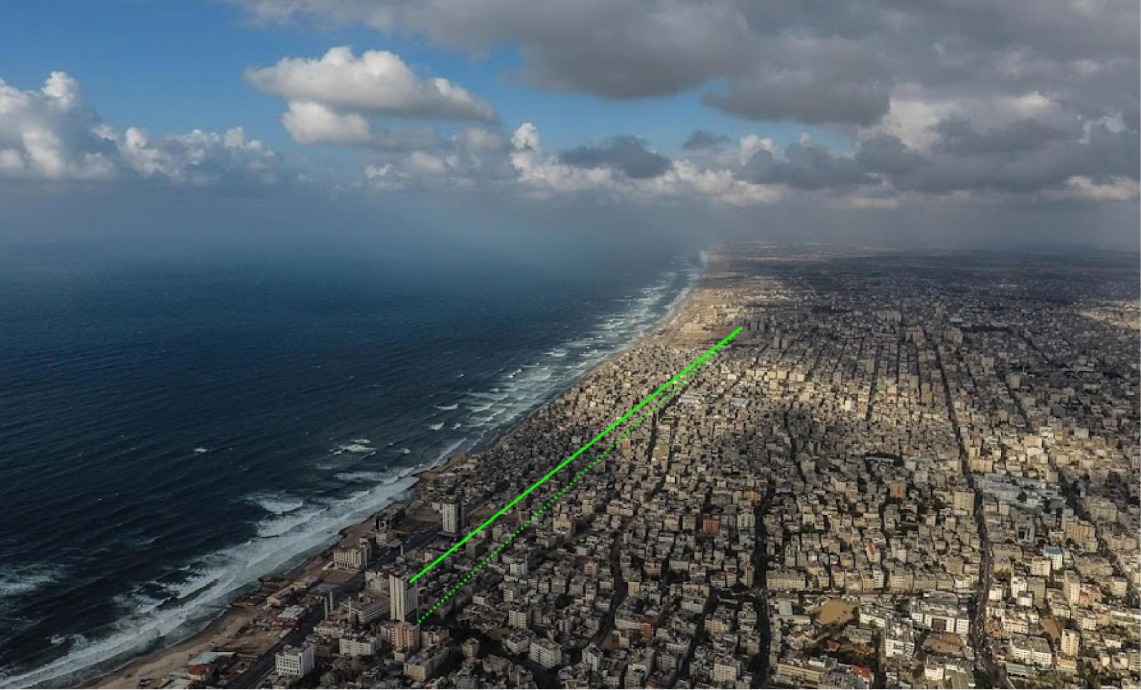
Photo montage showing the possible positions of the tanks that fired
on Hajji (dotted line) and Al-Ghifari (solid line)(Credit: Ain Media
/ Le Monde)
“We really need Israel to come back and explain what their policy is
around live feeds in different locations,” Phil Chetwynd, AFP’s chief
of information, said in an interview with the consortium. “And if in
any way they are seen as legitimate targets, because there’s enough
circumstantial evidence to make us suspect that is how they are
working.”
“Where there is strong potential for a war crime being committed,
obviously, the live stream becomes critical evidence,” Irene Khan, UN
Special Rapporteur on the promotion and protection of the right to
freedom of opinion and expression, added.
The Israeli government’s tactics do not just impede strictly
journalistic activities in the Gaza Strip. On May 21, the authorities
seized equipment belonging to an Israel-based team from AP on the
pretext that the journalists had violated a new media law by providing
live images to Al Jazeera. Shortly before the equipment was seized,
the journalists had simply been filming and broadcasting a general
view of northern Gaza from Sderot, a city in Israel less than a
kilometer from the Strip.
“By intentionally destroying media outlets, the IDF are not only
inflicting unacceptable material damage on news operations,” Reporters
Without Borders said on its website, back in 2021 when the tower
housing Al Jazeera and the AP was destroyed. “They are also, more
broadly, obstructing media coverage of a conflict that directly
affects the civilian population.”
The destruction of the offices of AFP and PMG represent a significant
loss for journalists who were hoping to return one day. The AFP
offices were “a place where really [staff] were able to go without
fear,” Chetwynd said. Describing the team’s feelings, he added, “if
they are able to hit our place, our office. Our place of safety, we
have no other place of safety in the whole of the Gaza Strip.” The
psychological effect on their team is enormous. Yahya Hassouna, a
journalist with AFP since 2009, described the Hajji Tower in an
interview with the consortium as “the place where all my dreams were –
my future, my life, my office.” Considered by many of them a second
home, this base of operations provided journalists in Gaza with
crucial logistical support.
A refuge for journalists
The Press House, located a stone’s throw away from a
telecommunications tower in Gaza City’s Rimal neighborhood, was once a
sanctuary for journalists. An obligatory stopover, it was a place to
meet up with colleagues, as well as find food, a network, and
protective vests. For Shuruq As’ad of the PJS, “it was really one of
the safest places for journalists” in Gaza before the latest Israeli
offensive began.
After Hamas consolidated power in 2007, following election victory
which led to fratricidal clashes with Mahmoud Abbas’ Fatah-led
Palestinian Authority, journalists in Gaza were seen solely in terms
of their political allegiance. It was difficult to obtain
accreditations or even cover a press conference for anyone who didn’t
belong to one faction or the other. That’s how the Press House was
born in 2013.
“They call him the sheikh of journalists”
Hikmat Yousef
BILAL JADALLAH’S FRIEND
Ibrahim Barzak, former correspondent for the AP in Gaza and member of
the organization’s board, recounted the genesis of the project. “There
was no place or structure for independent journalists, people who are
not affiliated at all,” he said.
Bilal Jadallah is the man who had the idea for this refuge from
political pressures. “Jadallah made a huge breakthrough” in creating
this place, said his friend and Editor-in-Chief of Sawa News, an
independent media outlet housed at the institution, Hikmat Yousef.
“That’s why journalists love him. They call him the sheikh of
journalists. He’s the spiritual father of journalists because he never
failed anyone in his entire journalistic career.”
From the start, Jadallah wanted to make the Press House an independent
place where anyone could meet. He was allegedly killed by shrapnel on
November 19, 2023, as he was trying to rejoin his family in the south
of the Gaza Strip by car.
Jadallah and the Press House were known beyond Gaza. Pictures of
German, French, and Danish diplomats published on the Press House’s
social media accounts testify to the institution’s international
recognition. According to its website, the Press House’s donors and
partners include Canada, UNESCO, and the EU, as well as Norway – which
formally recognized the Palestinian state on May 28 – and Switzerland.
“We finance activities linked to capacity building for young
journalists who have just graduated from higher education
establishments in Gaza … And fund the procurement of protective
equipment for journalists,” said Ruben André Johansen, who oversees
the grant awarded by Norway.
“The Norwegians and the Swiss gave our coordinates to the army” to
avoid any targeting, said Rami Abu Jamous, acting director of the
Press House. But it was to no avail.
“It was like a hive”
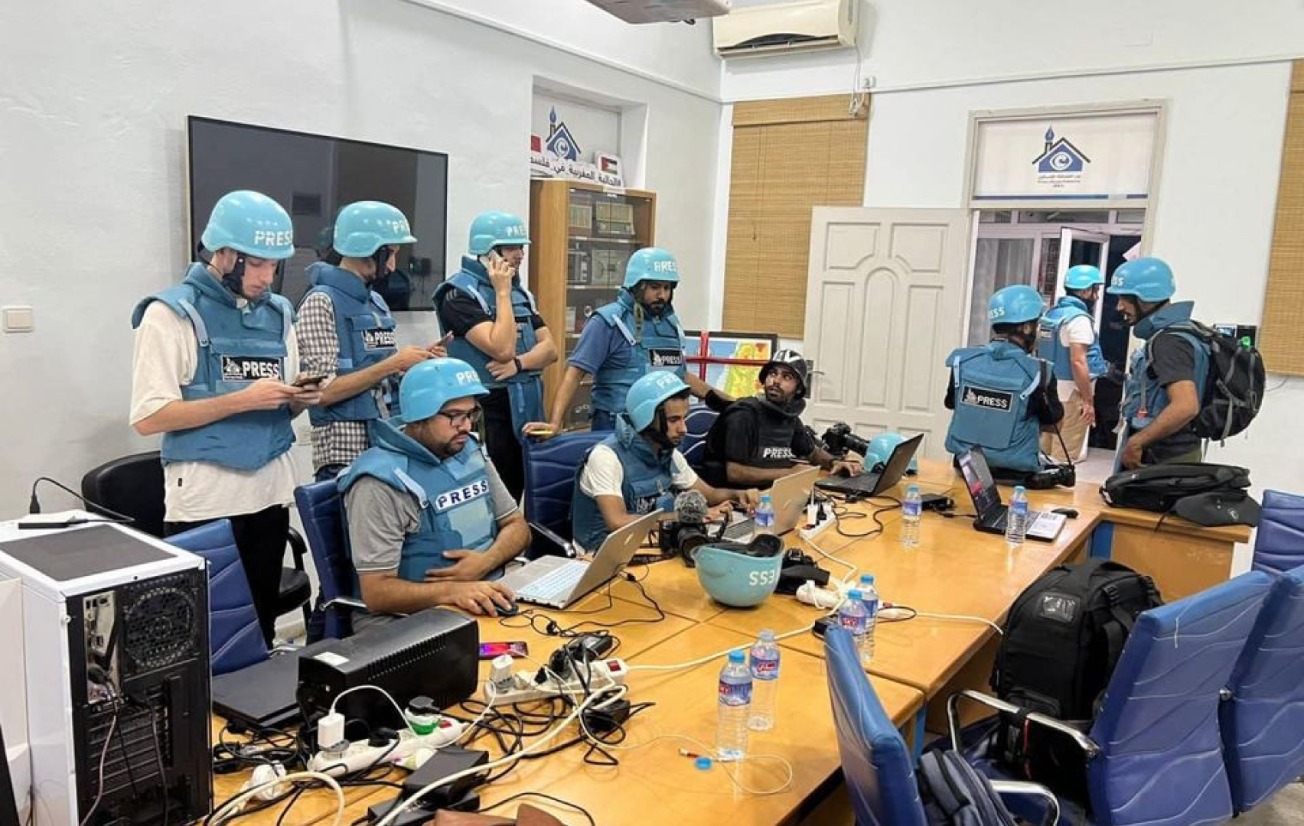
On October 9, 2023, panic was palpable among Gazan journalists. That
day, dozens of them took refuge at the Press House to equip themselves
with protective gear and gather at the shelter. “Jadallah decided to
turn the Press House into a workstation for journalists,” said Barzak.
“They could come and use the generator and have free internet access,
of course.”
In total, around 80 flak jackets stamped with the Press House logo and
the word “press” were distributed. “It was like a hive,” said Yousef.
Busy meeting room in the Press House, October 9, 2024 (Credit: Press
House – Palestine / Facebook)
A few hours later, a strike destroyed the neighboring building housing
Paltel, one of Gaza’s main internet providers. The Press House was
also hit, and the internet connection was permanently cut off.
Journalists there lost contact with the outside world.
Four days later, on October 13, 2023, the Press House journalists –
like those at AFP a few streets over – evacuated on the orders of the
Israeli military. They migrated in a forced march towards the south of
the Gaza Strip, following the same movement as the displaced
populations coming from the north.
Since then, this “hive” of journalists has become a temple of silence.
Along with Jadallah, two other employees of the Press House, Ahmed
Fatima and Mohammed Al Jaja, were killed. Out of 80 journalists who
received flak jackets from the Press House, 11 have lost their lives;
according to Hatem Rawagh, a Press House photographer who is also in
charge of emergency operations, Fatima and Al Jaja are among those 11.
“The Press House was my pen, my tongue, my eyes, my ears”
Ahmed Qannan
ONE OF THE PRESS HOUSE’S FOUNDERS
We were able to track down the last person to have slept in the Press
House offices. Mohammed Salem, former financial manager for the
institution, promised Jadallah that he would take care of the place if
he was killed. He took refuge there with his family for several months
and described the anguish of that period in multiple interviews with
the consortium. On January 29, 2024, he discovered that Israeli troops
were a mere 100 meters from the Press House.
“A tank stood in the street at 5 a.m., with the gun barrel pointed
toward the Press House, right at us,” he said. “The three days I was
trapped [there] I saw death.” In the morning of the fourth day, on
February 1, Salem took advantage of a brief moment of calm and managed
to leave the offices in extremis with his family, unsure of what would
become of the Press House.
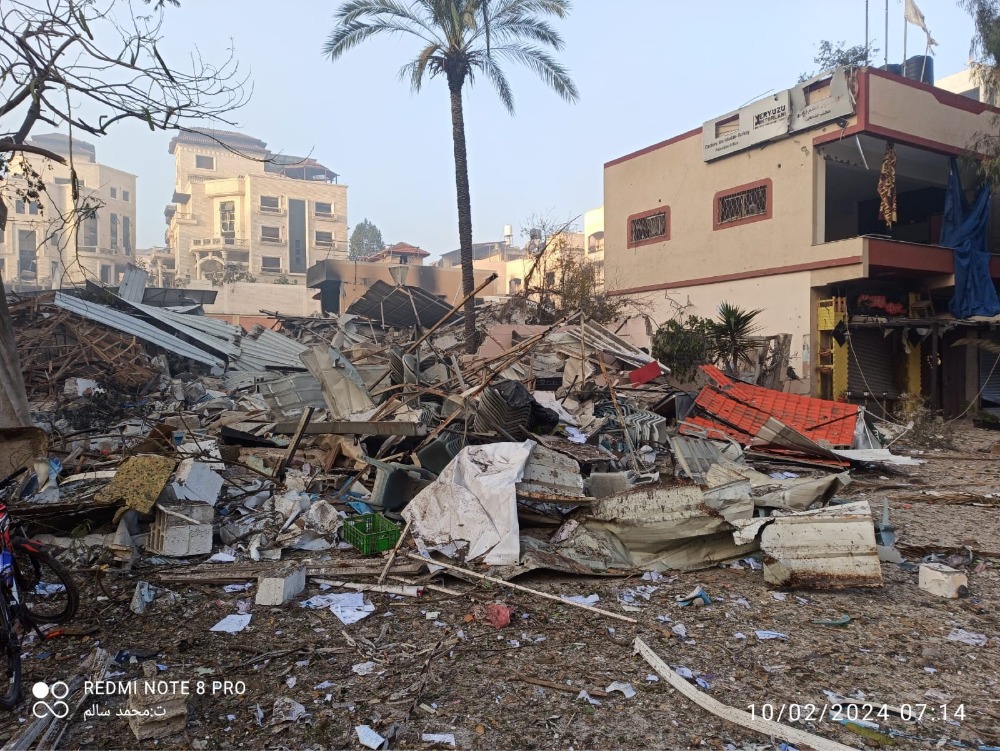
After 11 days of occupation, the Israeli military withdrew from the
area. Salem returned to the Press House by bicycle on February 10.
Computers, desks, and radio equipment had all been destroyed.
According to him, the building had been intentionally ravaged by the
use of explosives. “None of the buildings around the Press House were
damaged,” he said. “If there had been an air strike, everything would
have been obliterated.” We were unable to independently confirm this
analysis.
The Press House in ruins on February 10, 2024, after the departure
of the israeli army (Credit: Mohammed Salem / provided by ARIJ)
By targeting all press facilities and equipment, the Israeli military
not only cuts off any source of images and information in Gaza, but
also compromises the logistics journalists need to carry out their
mission.
“The Press House was my pen, my tongue, my eyes, my ears … I am now an
amputee,” said Ahmed Qannan, one of the organization’s founders, who
is today unemployed.
Before the war broke out, an exhibition on the beauty of Gaza City –
its roads, parks, gardens, and coastline as seen through the eyes of
Gazan photographers – was inaugurated in the Press House garden. Nine
months later, these photos are buried under rubble.
This investigation was published in Arabic on the following: