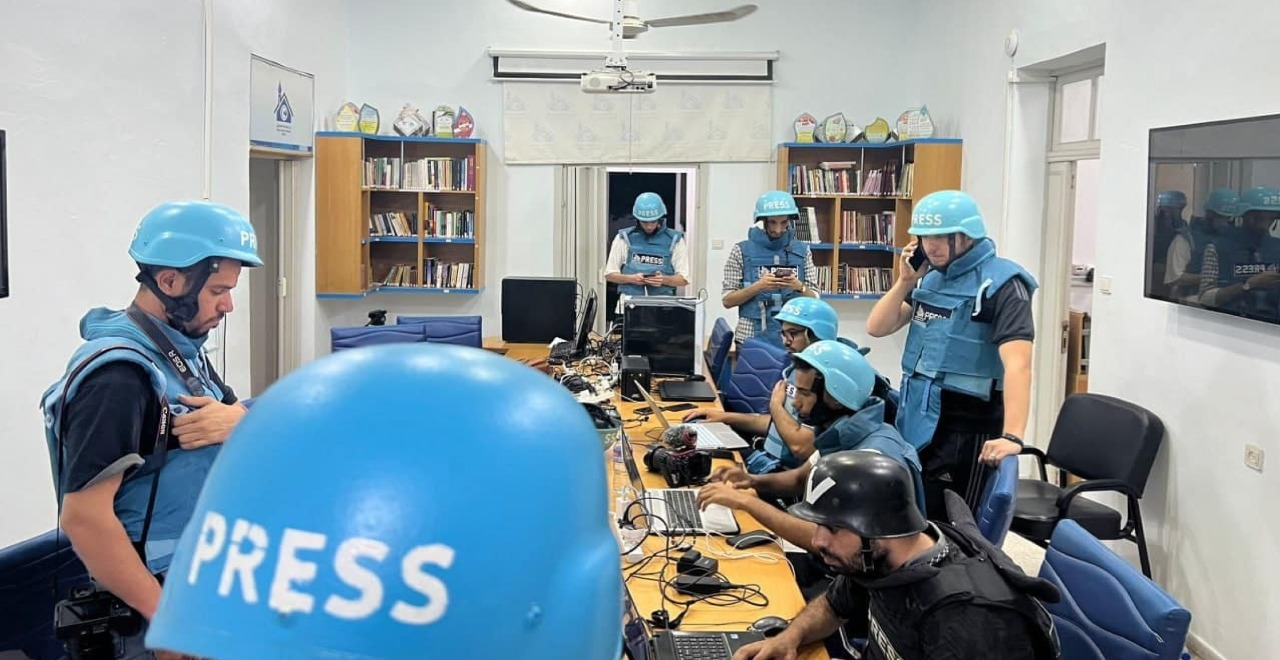
In the centre of the activity was Bilal Jadallah. Tall and thin with a
severe expression that masked a dry sense of humour, Press House’s
founder had for 10 years nurtured his vision of a politically
independent incubator for Palestinian journalism.
It had survived conflict before. In the back garden were 17 olive
trees, planted in memory of reporters killed during an escalation in
2014. This time Jadallah felt it would get worse. “We are headed
towards war,” he told Rawagh. “A major war.”
Atef Abu Saif, 50, a Palestinian culture minister usually based in the
West Bank, had been in Gaza on a short trip. When Hamas launched its
assault, he turned up to Press House.
He watched as Gaza’s journalists prepared to cover the war. “The only
thing we can agree on is that we have no idea where this is going,” he
wrote (Abu Saif declined to be interviewed, but provided journalists
with a copy of his diary and permission to quote from it).
Eight months on from the 7 October attack, a reported 37,000
Palestinians have been killed in the Israeli offensive. Foreign media
are banned by Israel and Egypt from entering Gaza to cover the war.
Palestinian reporters such as those trained by Press House are the
only journalists reporting from the ground.
This investigation draws on 15 interviews with current and former
Press House board members, staff, financial or diplomatic backers, and
widows or other surviving family members. Photo or video evidence of
incidents circulating on social media were verified with witnesses.
The Guardian worked with Arab Reporters for Investigative Journalists
to tell this story, part of a collaboration coordinated by Forbidden
Stories, a Paris-based non-profit.
The Committee to Protect Journalists, an American press freedom
charity, describes the Israel-Gaza war as the deadliest period for
media workers since it began collating its figures three decades ago.
As of June it was tracking 108 killings, including two Israelis killed
on 7 October.
Many of those who gathered at Press House on 8 October are among that
number. Four months after Rawagh handed out the 84 flak jackets,
almost a dozen of them had been killed.
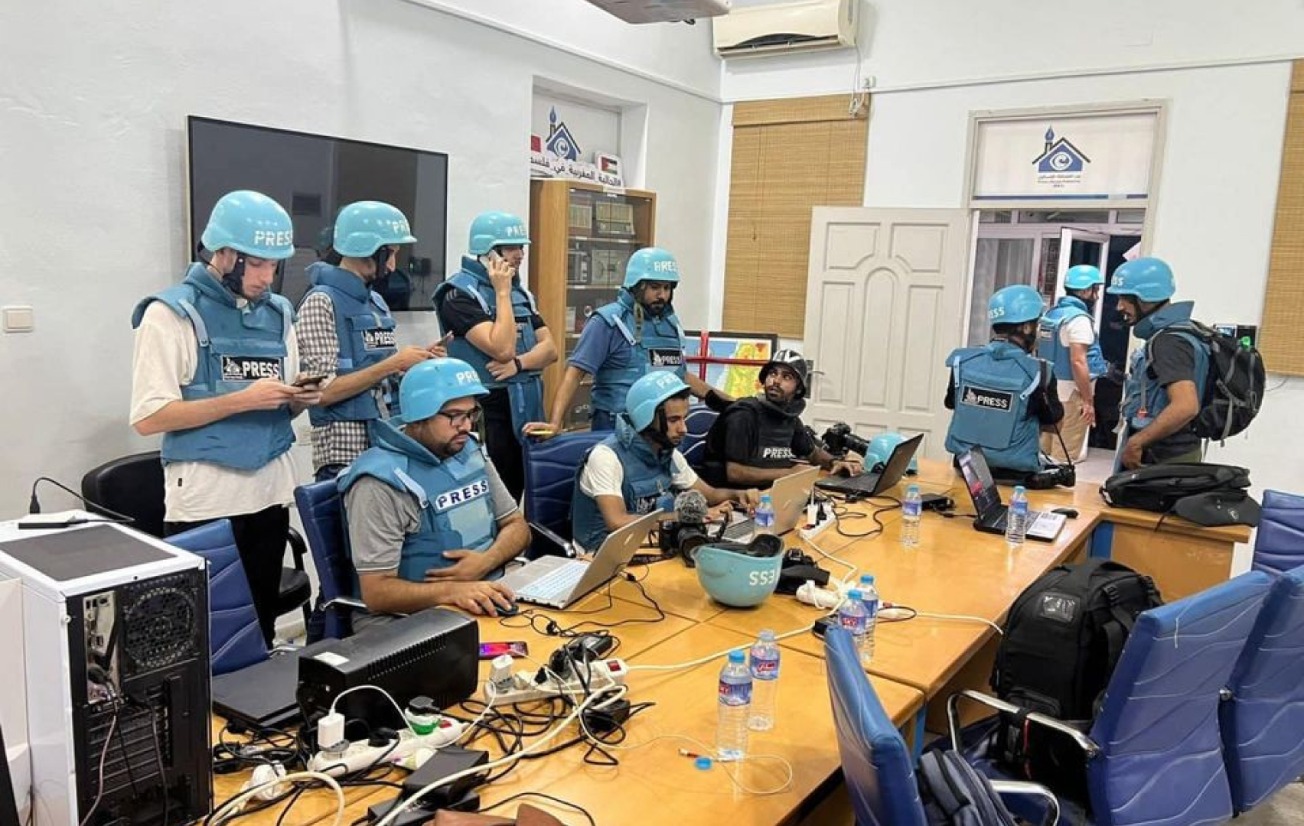
Busy meeting room in the Press House, October 9, 2024 (Credit: Press
House – Palestine / Facebook)

7 October
Before he founded Press House, Jadallah had been a senior press
officer for the Palestinian Authority, the putative government of the
Palestinian people set up by peace talks in the 1990s and run by the
largely secular Fatah party. In 2007, the Islamist party Hamas seized
control of the Gaza Strip. Having lost his job, Jadallah followed his
three brothers, each of whom worked for Reuters, into journalism.
But he was frustrated by Gaza’s fractious politics. Like many
Palestinians in Gaza, reporters had begun clubbing together into
separate politically aligned camps. Supporters of Fatah or Hamas even
joined different unions.
He grumbled his frustrations to his friend Ibrahim Barzak, an
Associated Press reporter: “No one was taking care of young media
practitioners, no one was taking care about what the future of
journalism was going to be in Gaza.”
Barzak did not disagree, but when Jadallah suggested they set up a
journalists’ club, expressly without connection to any political
faction, his first reaction was that the idea was hopeless. “I said to
him, ‘It’s a long shot, Bilal.’ This kind of idea is like walking in a
minefield,” Barzak recalls.
Nonetheless, together with Yossuf and three other founders, they
scraped together a few thousand dollars of their own savings as
startup capital, and began the delicate task of persuading Gaza’s
political factions to back the idea of a non-partisan journalists’
group.
They held meetings with journalists, human rights activists,
businessmen and diplomats. They requested their advice, tested their
reactions, slowly brought them on side. Jadallah had always been a
“very social person”, Barzak said. But during this period he seemed to
possess an almost chameleonic ability to adapt himself to whoever he
was talking to.
By the time of Press House’s opening ceremony in 2013, Jadallah had so
adeptly navigated the political landscape that both Fatah and Hamas
sent congratulatory messages.
Press House became a hive of activity. It ran training programmes to
give young reporters a taste of political interviewing. Nabil Shaath,
Palestine’s former top international negotiator, was their first
interviewee.
The olive trees were planted in the back garden to commemorate fallen
journalists. A celebrated Palestinian author, Tawfiq Abu Shomar,
donated a collection of antique radios, which Jadallah arranged into a
small exhibition.
“Press House is like a fixture on the itinerary for diplomats visiting
from Ramallah or Jerusalem,” said Ruben Johansen, a first political
secretary at the Norwegian government office in the West Bank, one of
Press House’s main financial sponsors. Photos on the group’s Facebook
page show diplomats from Britain, Germany, Denmark and elsewhere, all
smiling for a photograph with Jadallah in his office.
Yossuf was appointed editor of an in-house press agency, Sawa. He
would dart into Jadallah’s office for advice – “updates, ideas,
planning, how we should work, what we should accomplish, how we should
cover something, even what should be the headline”, said Yossuf.
Jadallah also encouraged new ideas. One day, Plestia Alaqad, a
21-year-old trainee bored out of her mind on an editing course,
marched into his office. She reeled off her suggestion for a Press
House social media manager – a position that had not previously
existed, let alone been assigned to a trainee. Jadallah listened then
said yes. “That’s something I love about Bilal,” she said. “He gives
people chances to grow.”
9 October
Hamas slaughtered 1,139 people on 7 October, most of them Israelis.
More than 200 were taken hostage. A shocked and traumatised Israel,
reeling from the biggest national security lapse in its history,
declared a state of war.
Hundreds of thousands of reservists were called up to the Israel
Defense Forces (IDF). Warplanes began bombing Gaza City in an effort
to eradicate Hamas. Three Palestinian journalists were killed in
gunfire near border crossings. Another died, reportedly alongside nine
of his family members, when a bomb struck his home.
Two young photographers, Mohammed Sobh and Hisham Nawajha, were among
those who came to collect their light-blue flak jackets. Saeed Taweel
had a friend pick one up for him. Later that day all three went to the
Ghifari building, Gaza City’s tallest tower and a decent vantage point
for night-time filming (their movements were pieced together through
conversations with 11 sources, including others camped at the tower).
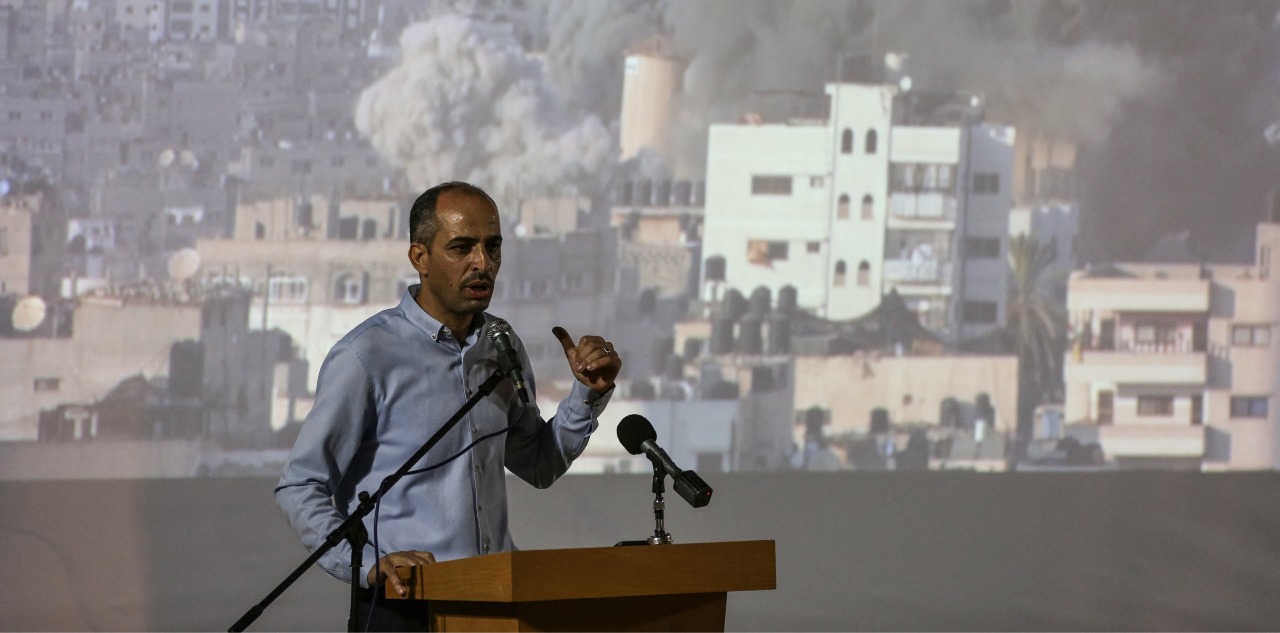
Bilal Jadallah (AFP)
Shortly after midnight, word spread that the Israelis had phoned in an
order to evacuate Hajji tower, an 11-storey building a few blocks
away. Several media offices were housed there; journalists with the
Agence France-Presse news agency were already rushing out of the
building.
Another journalist in the Ghifari building woke to discover that
Taweel had gone; he, Sobh and Nawajha had left to cover the strike
closer to Hajji. Taweel posted a video about the impending Israeli
strike on his Facebook page. Nawajha sent a selfie in his flak jacket
and helmet to his wife.
At about 2.25am, as they stood waiting for the strike on Hajji tower,
a missile landed almost directly on top of them. Taweel is believed to
have been killed instantly. Sobh’s widow said she was told that when
rescuers found him, his finger was raised in a gesture of Islamic
prayer.
Nawajha’s widow at first read on Facebook that he had died, only to
later discover that he was initially unconscious but still alive.
Rescuers dragged him from the rubble and rushed him to nearby al-Shifa
hospital, where he died.
Later that same day the light-blue flak jackets, stained with dry
blood, were returned to Press House. Alaqad posted a video of them on
Instagram: “No matter if you’re wearing them or not, you get killed,”
she said.
Rawagh took one and laid it over the reception desk in full view of
the journalists still there. “They are coming in to see that their
friend was killed,” he said. “They have to be very careful because it
could be them next.”
11 October
Press House quickly fell empty. Most journalists vanished a few days
in, after an Israeli airstrike took out the internet.
Those who remained were Jadallah, Rawagh, Abu Saif, Yossuf’s colleague
Ahmad Fatima, a photographer so devoted to Press House that he had
effectively become Jadallah’s full-time assistant, and a recent
recruit, Mohammed al-Jaja, a young English-speaking fundraiser.
Abu Saif’s diary describes how they came and went, leaving to check on
worried family members, returning for a shift keeping up Sawa’s
coverage of the war. Occasionally they slept on mattresses laid
between desks, surrounded by walls of computer cables.
More and more journalists were killed, bombed in their homes or in the
field. The IDF began issuing blanket orders to civilians: move south,
or risk being considered a terrorist. A stream of refugees headed
south, away from northern Gaza.
Rawagh went with them, as did Yossuf, Sawa’s editor, who dreaded the
thought of being injured and taken to one of Gaza’s hospitals. But
Jadallah chose to stay put. “Press House remains open for any
journalist in need,” he told Rawagh.
6 November
Almost one month after the beginning of the war, the home of Jaja, the
fundraising manager, was destroyed. He, his wife and his two daughters
were killed. A video on Facebook shows the obliterated apartment, the
stairs in the hallway transformed into a slope of crumbled concrete.
(The incident was widely reported as an Israeli attack. The IDF said
it was not aware of a strike at the location.)
After he was pulled from the rubble, rescuers placed Jaja’s shrouded
body on the ground. A video on social media shows him lying next to
the corpses of his little girls, his Press House flak jacket and press
card resting on top of his body.
Before the war broke out, he had been scheduled to give a talk at the
Council of Europe’s headquarters in Strasbourg that day, on the
importance of an independent press. Instead a shocked organiser
announced Jaja’s killing to the delegates, his voice audibly cracking.
Jadallah was distraught, but stoical. “I am just going to continue
doing our noble work, as I used to do,” he told Barzak. On Facebook,
Fatima posted a picture of the last WhatsApp message Jaja had sent
him, asking him to find out if anyone nearby was selling bread.
One week later, Fatima was dead too. His wife told journalists that as
they lay in bed, an explosion hit the roof of their building. A blade
of shrapnel, probably from one of the solar panels on the roof, struck
their six-year-old son in the face. Fatima carried him outside to get
him to a clinic.
She later discovered he had made it about halfway down the street
before another strike hit him. Incredibly, his son survived, his leg
riven with shrapnel.
Rawagh became a broken record: “Mr Bilal, you have to go to the south.
You have to come here. Everyone needs you. You have to be here with
us,” he would say. Those who spoke to Jadallah around this time say he
was still opposed to evacuating; that abandoning the house would have
felt like leaving Palestine’s journalists behind.
But three people described conversations with him that suggested he
had begun to ruminate on his own mortality. “I don’t really see myself
making it out of this one,” he confided to Abu Saif one day. He sat
down with Mohammed Salem, a former finance manager at Press House,
handed him a set of keys and asked him to promise that if he was
killed, Salem would do two things: bury his body and take care of
Press House.
19 November
In mid-November the IDF ordered civilians to leave Gaza City through a
designated safe route; a map posted on Facebook with a major highway
highlighted in yellow announced a “temporary tactical suspension of
military activities” for six hours in the middle of that day.
Two days later Jadallah rang his sister and told her he had decided to
leave with his brother-in-law Abdulkarim.
First, they would head east until they reached Salah al-Din street,
the main road south out of the city and the IDF’s designated safe
route. Then they would drive for about 3 miles (5km) until they
reached the Kuwait roundabout. Cars were not permitted to go any
further, so Jadallah would walk south for another 3 miles. That would
take him to the Wadi checkpoint, the final stop on the way to the
refugee camps, where his family was waiting for him.
They made it as far as Salah al-Din street.
Exactly what happened is not completely clear and probably never will
be. According to a witness, a tank shell came from the east and landed
a few metres away from the Kia they were driving.
(The witness only heard the shell and did not see it, but is adamant
that he recognised the sound. He is equally insistent that there was
no gunfire. Photographs of the Kia seem to back him up; a former US
army weapons technician said the splatter of tiny indentations in its
chassis resembled the fragmentation blast of an Israeli tank shell.)
The car came to a halt near a mosque. The witness rushed over and
opened the door. He said Jadallah was still breathing. A piece of
shrapnel was embedded in the back of his head.
Shortly after arrival, Jadallah died.
Even seven months later, most of those who knew Jadallah describe his
death disbelievingly. “I ran like crazy. Where is he? I had to find
out where he was, to fulfil his request, to bury him,” said Salem.
Rawagh said he thought a friend was joking when he rang him with the
news. He collapsed when he discovered it was true.

Bilal Jadallah's car (Source: Hamza Abu Eida)
Others describe the grief of losing a mentor or friend. “My wife is
the one who knows the most about how much I broke down, how much I
suffered,” said Yossuf.
“I climbed the stairs and sat on my own and wept. How dare death take
such a man! How dare such an undignified act, like this war, take such
a dignified man!” wrote Abu Saif.
Alaqad had been waiting for an opportunity to show off to Jadallah:
“‘See how many followers I have! See the work I did!’ Because he was
with me in the journalism journey since the beginning,” she said.
Johansen discovered Jadallah was dead when he saw the news on social
media. “It’s a huge loss, a personal loss for the Norwegian
representative office,” he said. “But also an incredible loss for
Palestine.”
20 November
After Jadallah’s death, the war continued to eat away at Press House,
and the journalists who had relied on it. On 1 December, 33-year-old
Montaser al-Sawaf, a camera operator with the Turkish press agency
Anadolu, and his brother Marwan were killed when an Israeli airstrike
hit their house.
On 28 December Ahmed Kheireddine was bombed in his home. Mohammad
Yaghi, a 29-year-old photographer, was killed along with 36 relatives
on 23 February in an airstrike in the al-Zuwaida neighbourhood.
Abu Saif returned to his home in the West Bank. Alaqad left Gaza and
is now living in Melbourne, Australia; she continues to publish
online. Rawagh, who believes the Israelis are deliberately targeting
Press House journalists, refuses to shelter with his family. Today he
sleeps in a tent outside al-Aqsa hospital.
Salem, the finance manager, went to al-Sahaba clinic; they confirmed
Jadallah’s body had been claimed and buried. Then, together with his
wife and children, he moved into the deserted Press House.
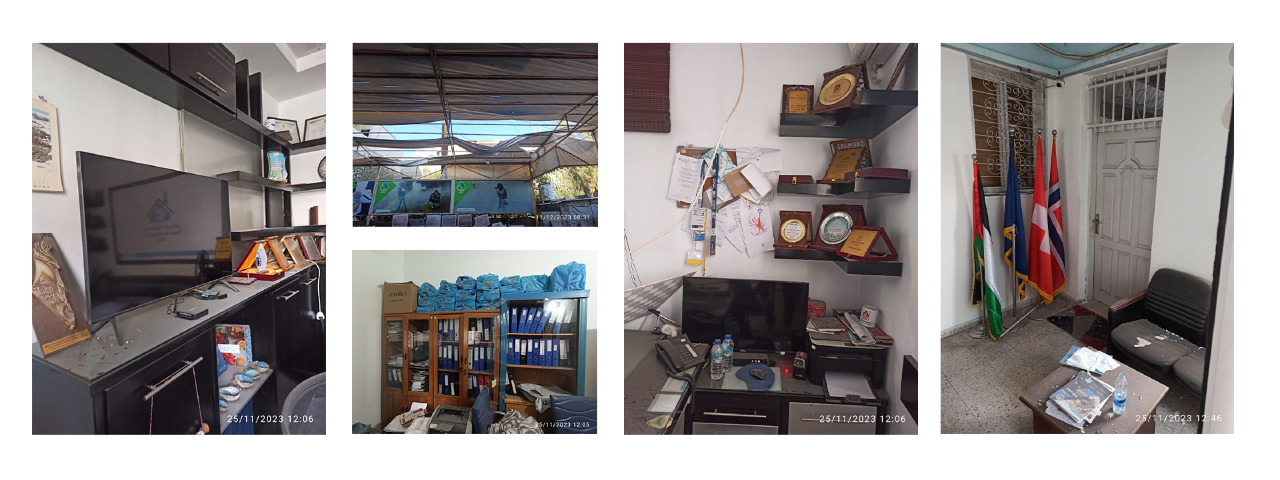
(Credit: Press House)
The impact of nearby explosions had caved in the ceiling panels.
Laptops and cameras were scattered through the building. Dust lay
everywhere.
Towards the end of January, he said, tanks and soldiers operating in
Rimal started firing bullets and shells at the building. “They were
targeting the Press House, 100%,” he said.
For three days, he and his family cowered in the building. (Satellite
imagery shows tank tracks on roads adjacent to the building. Three
temporary depots for Israeli armoured vehicles can be seen within a
500-metre radius; the images do not show detailed information about
operations.)
On the fourth morning he realised the tanks had gone. “It was quiet,
there was no firing, there was nothing,” he said. “We packed our bags,
I took them and I locked the doors.”
The war continues, 262 days after 7 October. “The narrative that the
IDF is intentionally targeting journalists is utterly unfounded and
fundamentally false,” a spokesperson for the IDF said.
“Civilians who are harmed, including journalists harmed during the
conflict, are a terrible tragedy,” they said. “This tragedy is caused
by Hamas intentionally embedding itself within the civilian
population.”
They added: “The IDF did not target Bilal Jadallah deliberately,” and
suggested he may have been killed by Hamas fire.
10 February
At about 6am, a little over a week after he and his family had fled,
Salem took a bicycle and returned to where previously Press House had
stood.
The entire building had been demolished, a mound of rubble in its
place. A leafless tree jutted disjointedly out from the cracks between
chunks of smashed masonry.
Salem took out his phone and silently started to film. He clambered on
to the debris, capturing the extent of what had gone. No cameras,
laptops or notebooks could be seen among the wreckage. Like the olive
trees, the antique radios and all the other relics of Jadallah’s
vision of Palestinian journalism, they were buried under the rubble.
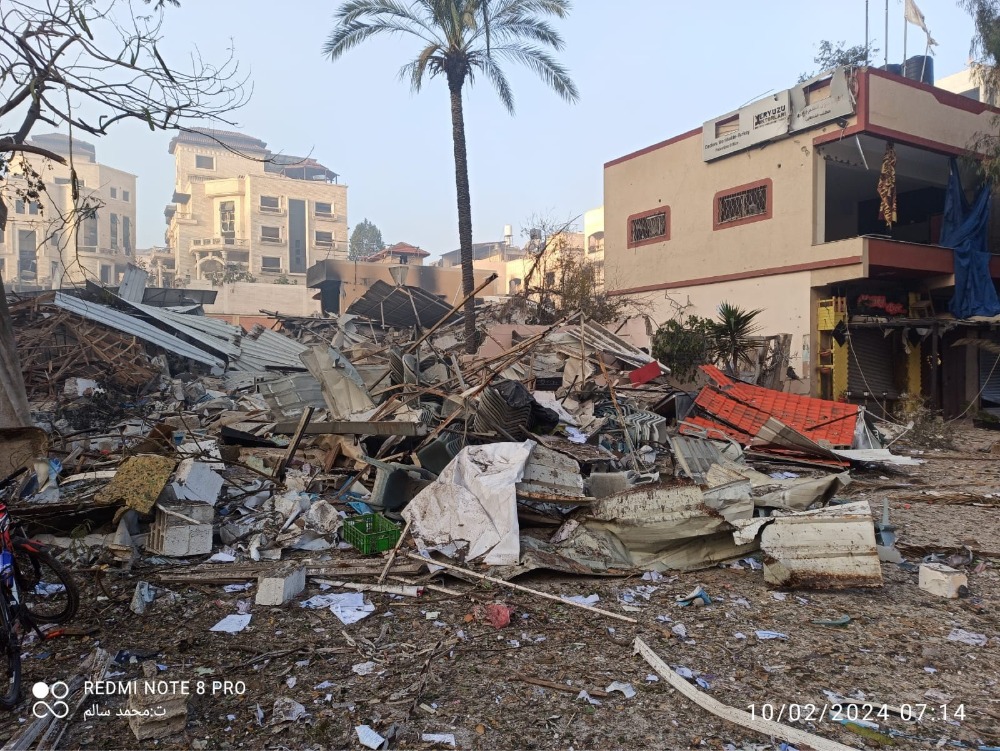
The Press House in ruins on February 10, 2024, after the departure
of the israeli army (Credit: Mohammed Salem / provided by ARIJ)
This investigation was published in Arabic on the following:
This investigation was published in English on the following: