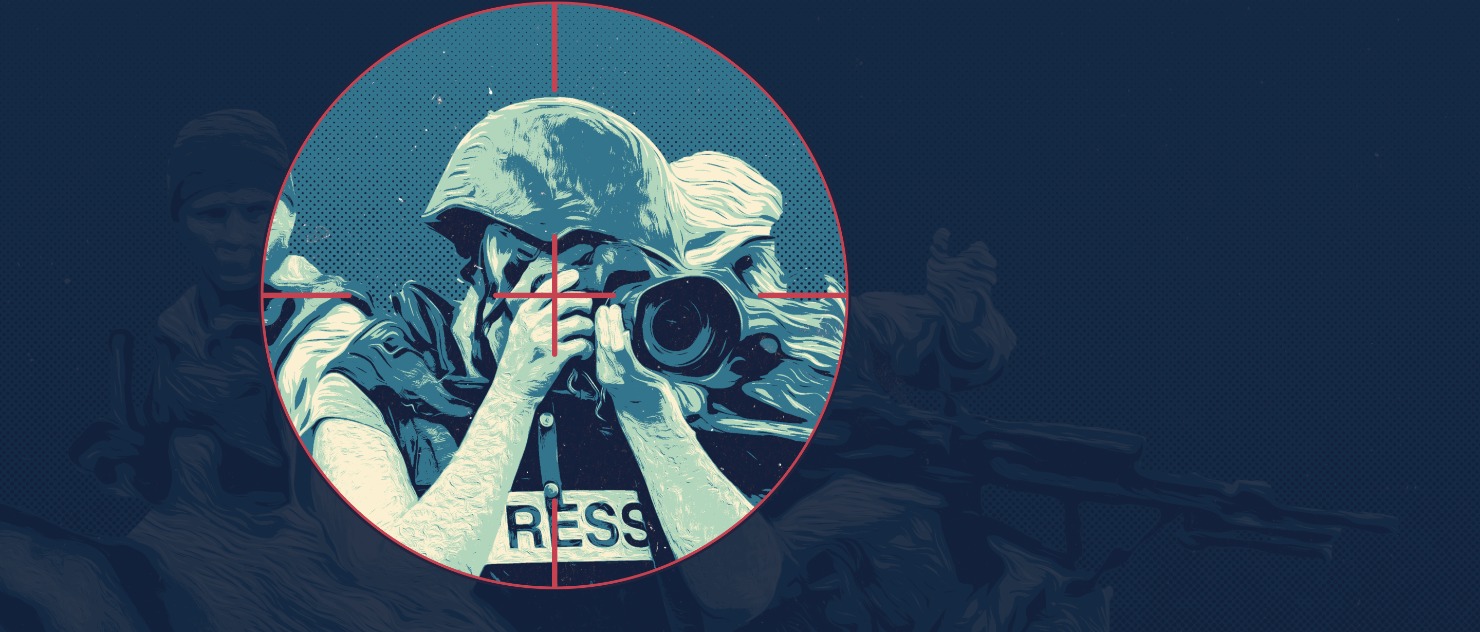
The Gaza Project is a global collaboration with between 13 media outlets organised by "Forbidden stories", the project investigated the targeting of journalists in Gaza and pursued the work of journalists who have been killed or threatened in Gaza and the West Bank since
By Mariana Abreu (Forbidden Stories)
with Aïda Delpuech and Eloïse Layan (Forbidden Stories)
Additional reporting by: Walid Batrawi; Phineas Rueckert, Sofía Álvarez Jurado, Youssr Youssef (FS); Hoda Osman (ARIJ); Yuval Abraham (+972); Arthur Carpentier and Madjid Zerrouky (Le Monde); Maria Christoph, Maria Retter, Dajana Kollig, Christo Buschek (PTM);
25 July 2024
At least 18 journalists have been injured or killed by alleged drone
strikes since October 7; four were wearing press vests and clearly
identifiable as journalists
Lavender, an artificial intelligence–based program used to generate
a kill list, has served as a blueprint for signature drone strikes
since October 7
Drones provide technological means to avoid civilian casualties but
are being used in a larger strategy of disproportionate response
against civilians, including journalists
On the afternoon of January 22, four journalists climbed a small hill
in Tal Al-Zaatar, in northern Gaza. Anas Al-Sharif, Mahmoud Shalha,
Emad Ghaboun and Mahmoud Sabbah – some of the few remaining
journalists in the region – had been reporting on the famine that has
gripped Gaza since the Israeli offensive began last fall, following
Hamas’s October 7 terrorist attacks on Israeli soil. They were
searching for an internet signal to transmit videos to their editors
when a blast knocked the group to the ground.
In a cloud of smoke, Al-Sharif, who was wearing a press vest and
suffered minor injuries to his back, bolted toward his colleagues, now
lying in the blood-stained rubble. Ghaboun had to be carried to a
nearby hospital in the scoop of a bulldozer. (A civilian lost his life
in the same attack.)
Journalists present said they recall a “surveillance drone” targeting
them; although we were unable to obtain real-time footage of the
strike, a video Al-Sharif took in the aftermath of the attack, which
was analyzed by experts, corroborates the presence of a drone.
For four months, a team of 50 journalists coordinated by Forbidden
Stories investigated the wounding and killing by Israeli forces of
more than 100 media personnel in Gaza. While the Israeli military
claims that it doesn’t deliberately target journalists, our findings
suggest that at least 18 media workers were reportedly killed or
wounded by precision strikes likely launched from unmanned aerial
vehicles (UAVs), in violation of the laws of war.Four were wearing
press vests and were identifiable as journalists. Tal Al-Zaatar is
just one case in what appears to be part of a pattern.
Under international humanitarian law, armies must distinguish between
combatants and noncombatants, and direct attacks only at military
targets. Intentionally targeting civilians, including reporters, is a
war crime. Even if a military objective is legitimate, the attack must
not cause excessive civilian casualties, injuries, or damage out of
proportion with the expected military gain.
Drones, experts agree, have the technological capabilities to minimize
casualties. During an 11-day Israeli military campaign against Hamas
in 2021, for example, UAVs enabled “real-time cancellation” of air
strikes that endangered civilian lives, according to an analysis
published by Israeli military researcher Dr. Liran Antebi in 2022. The
current pattern, therefore, raises a central question: how could so
many journalists be killed by UAVs?
James Rogers
DRONE EXPERT AT CORNELL UNIVERSITY
Drones carry smaller explosives than fighter jets and can hit a target
surgically, “within a foot of wherever we’re shining our laser,”
Brandon Bryant, a former U.S. Air Force Staff Sergeant said. “You can
take a look around, check there are no civilians nearby … and avoid
the backlash that comes with blowing up too many civilians,” a French
drone expert, who asked to remain anonymous, told Forbidden Stories.
Still, that day in Tal Al-Zaatar, something detonated “in the middle
of our group,” Al-Sharif said. Analyzing the footage for Forbidden
Stories, Bryant concluded the distinctive buzzing sound in Al-Sharif’s
video is "definitely a drone. I'll never forget that sound."
More precisely, he said, it’s a “prop engine, low flying, slow-moving”
vehicle. Bryant’s assessment was backed by a German drone and defense
researcher, who spoke to the consortium anonymously. “The sound in the
background does resemble the one made by UAVs using piston engines, or
turboprops.”
Forbidden Stories worked with audio research agency Earshot, to
conduct forensic audio analyses of videos collected by the consortium;
our findings indicate that the Israeli military currently uses both
turboprop and piston engine drones in Gaza for reconnaissance and
strikes.
The blast’s aftermath, Bryant added, suggests the use of a low-impact
missile, which drones usually carry. “If they were dropping bombs
through fighters or F-16s, they would be obliterating these people.
There would be no survivors,” he told Forbidden Stories. “I'm very
confident that this is a drone strike.” (According to open-source
intelligence collected by Forbidden Stories, all surrounding
infrastructure had been destroyed before the strike, ruling out the
possibility that the missile was aimed at nearby buildings.)
(The Israeli military according to a spokesperson, said it is not
aware of any strikes made at these coordinates in January.)
While some experts praise drones for their precision, others argue that striking a target surgically doesn’t always mean hitting a legal or appropriate target. “Precision could mean avoiding civilian lives, or it could mean targeting civilians; a precision strike just means the guaranteed destruction of a target you hit,” James Rogers, a drone expert at Cornell University, said. “We live in a very proliferated drone world with a range of state and non-state groups, some who want to reduce the costs of war and some who want to maximize damage.”
Wael Al-Dahdouh
AL-JAZEERA’S GAZA BUREAU CHIEF
Signals are an essential part of drone target acquisition; online
activity can be intercepted, revealing a person’s location, according
to experts. Drone strikes are then often aimed at phones. “Drone
warfare operates in an ecosystem of signal intelligence and
communications infrastructure, so the IDF… strike targets with a
strong degree of knowledge of who it’s killing,” Khalil Dewan, lawyer
and drone warfare researcher, explained. “For drone warfare, mobile
phones, cell-SIM cards, using certain social media apps with
locational settings, and live-streaming exposes one to the mapping of
targets,” he added.
In the same way that people have senses – they hear, see, and smell –
a drone has onboard sensors and a radio link that transfers the
collected data to a ground station, which then identifies the target.
Infrared cameras and electro-optical sensors also allow for visual
confirmation of the target, provided the weather conditions are
favorable, or the drone is flying low enough.
Bryant, who used to operate the now-retired MQ-1B Predator drone,
points out visibility was already clear in the early 2010s. While it
isn’t possible to make out facial details, “we definitely got in close
enough where we could see detail on clothing. I would say camera
definition has gone up since,” he explained. “You can see the size of
a person, you can tell from his walk whether it's male or female,
whether he's fat or thin," said an Israeli military source who worked
with UAVs.
With some drone models used by the Israeli military, visibility is
clear enough that a drone operator could see a press vest, experts
told Forbidden Stories. “Under no condition could one imagine soldiers
having permission to shoot at a person who clearly carries the sign of
press … and did not take part in any hostilities,” said Asa Kasher,
who drafted the 1994 IDF Code of Ethics.
On December 15, Samer Abu Daqqa, a 45-year-old Al Jazeera cameraman
and father of four, was filming the destruction in central Khan Younis
with friend and colleague Wael Al-Dahdouh, one of Gaza’s most revered
journalists. Abu Daqqa and Al-Dahdouh, both wearing press vests,
accompanied a Civil Defense crew – a unit of first responders and
firemen. As they finished reporting and returned to the crew’s
vehicles, they were hit by what witnesses, independent organizations
and Al Jazeera alleged was a drone strike. “I fell to the ground,”
Al-Dahdouh told Al Jazeera Arabic from his hospital bed. “I could
barely stand, I felt dizzy, and I was expecting a second missile to
hit at any moment.”
When he looked around, he saw that three members of the Civil Defense
crew had been killed. A little farther lay a wounded – but alive – Abu
Daqqa. Bleeding from his right arm, Al-Dahdouh managed to reach the
Civil Defense vehicles hundreds of meters away. "I asked the ambulance
men to go back for Samer, but they said we had to leave immediately
and send another car to avoid being targeted," Al-Dahdouh told Al
Jazeera. Drones, he said, were all around them.
After ambulances were blocked from reaching Abu Daqqa for over five
hours, rescuers arrived on site. Bilal Hamdan, a first responder,
recounted how a colleague “found Samer Abu Daqqa’s body torn to
pieces.” Civil Defense rescuers concluded that he was hit by at least
two strikes. They also found Abu Daqqa’s press vest leaning against a
wall. “For us, this was evidence he was alive at first, that he took
off the jacket because it was heavy.”
“I’m sure that he filmed until the end” Ibrahim Qanan, a colleague and
friend of Abu Daqqa’s, said. “He was such a professional, and the
sweetest person,” adding that his camera was totally destroyed in the
attack. (An Israeli military spokesperson said Abu Daqqa’s case is
being examined internally.)
Al Jazeera confirmed it is presenting Abu Daqqa’s case to the
International Criminal Court (ICC), requesting the prosecutor probe
the case as a possible war crime and crime against humanity. Lawyer
Rodney Dixon said Al Jazeera has seen no evidence of military
necessity to target the group, and that “therefore it amounts to the
deliberate targeting of civilian journalists.”
Funeral of Al Jazeera cameraman Samer Abu Daqqa, killed while on assignment on December 15, 2023
For lawyer and researcher Khalil Dewan, Israel’s drone warfare is
highly troubling. “It’s a legal obligation to exercise distinction
between combatants and non-combatants,” he said, “and while the IDF
claim to be the most moral army in the world, that is subject to
debate given the media reporting on a colossal level of civilian
casualties.”
Reporting by the consortium, backed by several drone experts, found
that the Israeli military has all the technological and military
capabilities to avoid collateral damage when targeting, “But right
now, that’s just not the political will. The political will is
actually a strategy of disproportionate response.”
As revealed by +972, a partner in this project, the Israeli military
has expanded authorization for bombing nonmilitary targets and
loosened constraints on civilian casualties since October. It is also
using several artificial intelligence systems to generate targets.
Lavender, an artificial intelligence–based program used to generate a
kill list of over 37,000 people, has served as a blueprint for
signature drone strikes since October 7, the consortium found.
Reporting by +972 and Local Call found that Lavender’s method of
identifying targets for assassination involves rating almost the
entire Palestinian population in Gaza based on certain characteristics
that supposedly make them more likely to be a militant. According to a
book written by the head of Israel’s elite intelligence division Unit
8200, who pioneered the army’s use of AI, relevant characteristics
could include being in a Whatsapp group with a known militant,
changing cell phones and addresses frequently.
An Israeli military intelligence source, who asked to remain
anonymous, told the consortium that while he has no proof of Lavender
marking journalists as targets, it is “possible” that the program
would mistakenly identify journalists as Hamas operatives. In one case
the source had personal knowledge of, he said, a journalist was
“almost killed.” Several other sources said they were not aware of the
Israeli military having a list of Palestinian journalists in Gaza to
vet and filter out any who appear in AI-generated kill lists.
“There are journalists who talk a lot with Hamas officials or
militants,” another Israeli military source told the consortium. “It
is likely for a journalist in Gaza to be in [Hamas] WhatsApp groups,
and that the journalist would call them. So it makes sense that
Lavender might label him as a Hamas militant.”
Such mistakes have happened in the past. In the early 2010s, a leaked
NSA document revealed the U.S. government mistakenly labelled Ahmad
Muaffaq Zaidan, Al Jazeera’s Islamabad bureau chief, as an Al-Qaeda
courier, placing him on a list of alleged terrorists. The document
referred to SKYNET, an AI system that analyzes people’s metadata to
detect suspicious “patterns of behaviour.” Identified targets were
then allegedly executed in signature drone strikes.
Like the Israeli military, the U.S. government insisted there was
always a human in the loop. But according to Jennifer Gibson, a human
rights lawyer familiar with Zaidan’s case, the system is so flawed
that “whether the human hits the button is irrelevant if the computer
picked the target.”
(When asked if any of the journalists hit by drone strikes were on the
Lavender kill lists, an Israeli forces spokesperson said, “The IDF
does not use artificial intelligence systems to identify military
operatives.”)
On November 13, Ahmed Fatima, a photographer for Al-Qahera News who
worked for Press House Palestine, a nonprofit supporting independent
Palestinian media, was shot dead by an Israeli drone while holding his
wounded 6-year-old son 50 meters outside his house, according to
witnesses. Fatima was trying to rush his child to the hospital after
their house was bombed, his widow said.
A few months later, on February 24, Abdallah Al Hajj, 34, was the
victim of a drone strike that killed two other people. A
photojournalist for UNRWA and the Jerusalem-based Al Quds, Al Hajj was
one of the first journalists to document large-scale destruction in
Gaza, thanks to his small quadcopter drone. His pictures were shared
worldwide.
That day, he said, after filming in a displacement camp called
Al-Shati, "I put my drone away and headed towards some fishermen. The
second I asked for the price, I was targeted.” Now, he is undergoing
treatment in Qatar, where members of the consortium interviewed him.
“I was unconscious for three days,” he said from his hospital bed in
Doha. Both of his legs were amputated above his knees.
(An Israeli military spokesperson said the attacks, respectively, were
targeting “a Hamas terrorist infrastructure and military operative,”
and “a terrorist cell using a drone.”)
“It shouldn't happen, even a single one,” Kasher, the author of the
Israeli military code of ethics, told Forbidden Stories. “No member of
the press should have been killed under normal circumstances of
hostilities in Gaza. It's illegal. It's unethical. The person who does
it should be brought to court.”
Accountability, however, is unlikely with drone warfare, Lisa Ling,
former U. S. technical sergeant on drone surveillance systems, told
Forbidden Stories in an interview. "There's a diffusion of
responsibility, where people have so little information, and there's
so many pieces that come into firing a drone, that, who is actually
responsible would be hard to ascertain"
An Israeli military spokesperson said, no airstrikes are “conducted
without oversight, approval, and final execution by IDF officers,” and
that “The IDF directs its strikes only towards military targets and
military operatives and carries out strikes in accordance with the
rules of proportionality and precautions in attacks. ”
When drafting the rules for targeted killings in the early 2000s, the
IDF International Law Department stipulated that only individuals
taking direct part in hostilities could be targeted. "The logic was,
‘I’m going to use it sparingly, against the most high-level people,
only when I have no alternative,’" Gabriella Blum, who was involved in
drafting these guidelines, told The Intercept in 2018. "That doesn't
seem to be the case anymore."
“I find it kind of nauseating to think that people could actually get
used to” the constant presence of drones overhead, Ling told Forbidden
Stories. “In the air, when you have a weaponized drone flying over you
for an excessive amount of time, that is terror.”
Since being hit, several journalists have told the consortium they're
now afraid to wear their press vests. Some keep them concealed in
their bags, wearing them only when the cameras are rolling. And
Ghaboun, now recovered, feels “the protective vest itself has become a
means to target you, more than a means to protect you.”