After eight months of drone attacks and bombardments in Gaza by the
Israeli military, brothers Basel and Moumen Khair Al-Din, both
Palestinian journalists, recount how they were nearly killed while
reporting. After a brush with death, they’ve been forced to reduce
their coverage in the north of the enclave. Forbidden Stories and its
partners have continued their work on the mass starvation hitting
residents of northern Gaza.
“We were filming in Beit Lahia, specifically in Sakanet Fado’us area,
the occupation targeted us with two drone missiles,” Khair Al-Din told
the camera.
In late morning on February 18, 2024, Khair Al-Din and his brother,
Moumen Khair Al-Din, traversed Beit Lahia’s abandoned fields in the
agricultural zone of the northernmost Gaza Strip. The two journalists
were only five kilometers from the Erez border post, the main crossing
point to Israel. Closed since October 7, 2023, following Hamas’s
terrorist attack on Israeli soil and the beginning of Israel’s war on
Gaza – it was reopened by Israel early May.
That morning, the sky was ashen. The two brothers had been sent by
Qatari media channel Al Jazeera (Al Jazeera Mubasher) to document the
starvation hitting residents of northern Gaza, who are cut off from
the rest of the territory. On October 13, the Israeli army had ordered
the population to evacuate the zone, but since has isolated it from
the rest of the Gaza Strip, leaving more than 300,000 people trapped
there. Residents face severe food insecurity, and many families have
resorted to gathering shoots of khobiza, or mallow plant, a resilient
wild grass that has survived the airstrikes on the fields.
“The fate of anyone who doesn’t eat it is death,” Khair Al-Din said,
in a call with Le Monde and Forbidden Stories.

A report silenced
On this day Khair Al-Din and his brother had already visited this area
of northern Gaza several times as reporters. Now, they were
documenting the daily life of a single family, who had decided to
collect khobiza in spite of the dangers associated with life so close
to the border.
The journalist recalled that he spent an hour with the family before
they started filming.
“We made a small fire and prepared tea,” he said.
The two brothers then started recording background shots, including a
child collecting khobiza amid the debris. They pointed the camera away
from the border to avoid suspicion from the soldiers stationed at the
checkpoint.
“We started filming. Eight seconds later, we were targeted by the
first drone strike. Thank God it did not explode,” Khair Al-Din said.
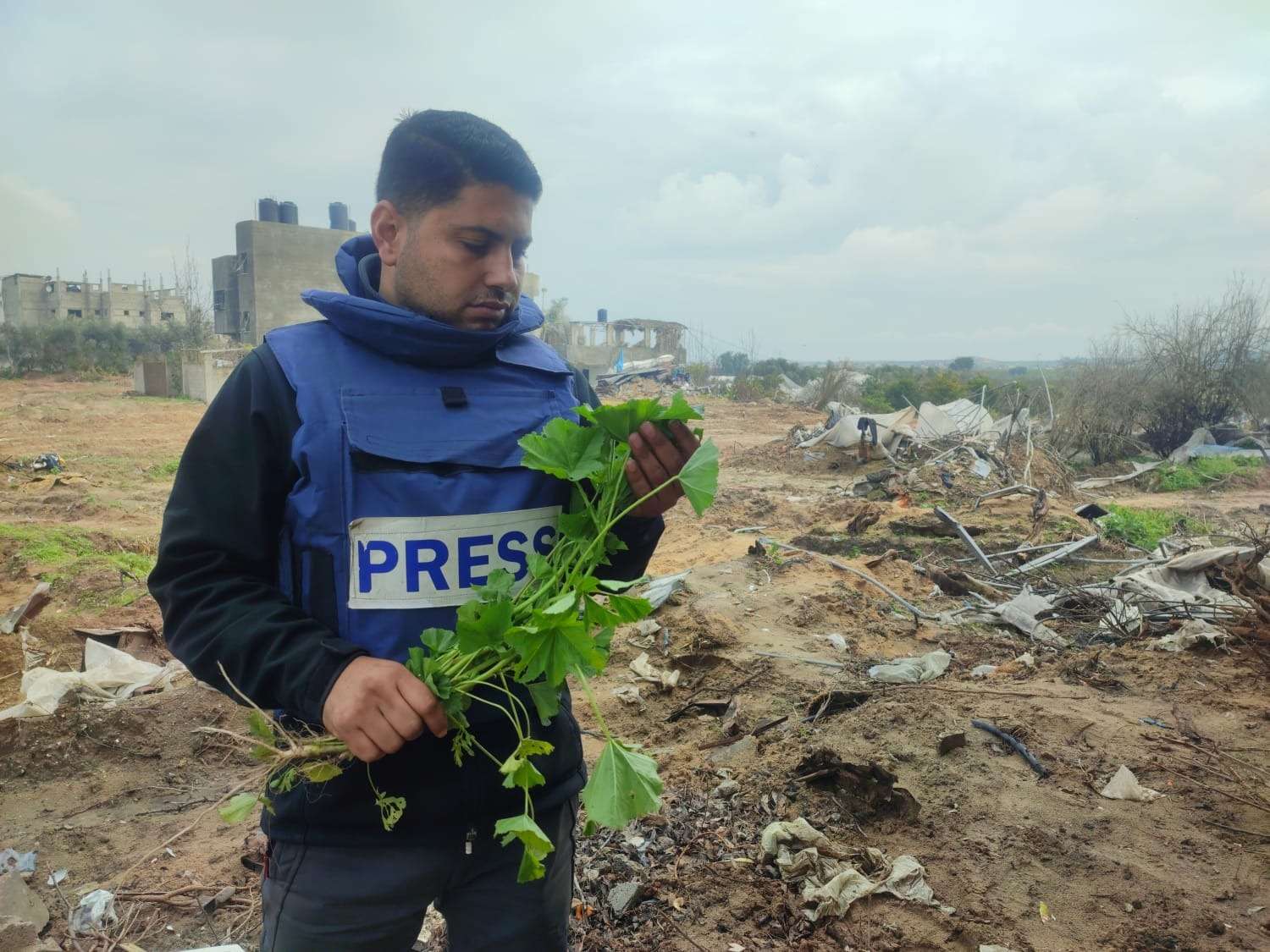
Basel Khair Al-Din’s instagram post from February 18, 2024: “I didn’t
know this photo would be the last one until we were targeted by a
drone strike in the residential area of Sakanet Fado’us north of the
town of Beit Lahia, while preparing a report on collecting herbs to
stop child hunger. Thank God, we survived this time too.” (Credit:
Moumen Khair Al-Din)
The two journalists only had time to shelter behind a low concrete
wall before the second missile was fired, one minute after the first.
They took off, running three kilometers without stopping before
removing their press vests and hiding them beneath their jackets.
With an analysis from Earshot using a video that Basel Khair Al-Din
shared, Forbidden Stories and its partners identified the type of
drone that was “moving in a circular motion directly above the camera”
of the two journalists, and that potentially targeted them: the IAI
Heron drone, which was developed by the Israeli company Israel
Aerospace Industries. However, it is not possible to confirm whether
this drone carried out the strike.
“These jackets are supposed to identify and protect us. But they
nearly got us killed”
Basel Khair Al-Din
PALESTINIAN JOURNALIST IN GAZA
Although physically fine, the two brothers were shaken. Less than two
months had passed since their family home in Beit Lahia was leveled,
killing 23 of their family members and neighbors, including their
brother Ahmed, who was also a journalist.
In response to the consortium’s inquiries, the Israeli military said
that on “February 18th, the Israel Defense Forces struck Hamas
military infrastructure, roughly 300 meters away” from where the two
journalists were. (Hamas is described by the United States and the
European Union as a terrorist organization.)
Although it is difficult to say whether they were targeted or not, the
fact remains that the two brothers dramatically decreased their
workload: Basel estimates they take on around 10% of the work they did
previously. They were also very cautious about when they wore their
press jackets, keeping them under their clothes right until they
started filming.
“These jackets are supposed to identify and protect us,” Khair Al-Din
said. “But they nearly got us killed, which has happened to many of
our colleagues.”
Four months after the attack, the humanitarian situation in Gaza is
desperate. Forbidden Stories and its partners decided to pursue Basel
and Moumen Khair Al-Din’s story, looking into the deprivation suffered
by inhabitants of northern Gaza and the survival mechanisms that the
population is using to stay alive.
“The situation is tragic”
Northern Gaza has been under siege for eight months—cut off from the
rest of the territory.
“There is famine — full-blown famine in the north, and it’s moving its
way south,” UN World Food Programme Executive Director Cindy McCain
said on May 3.
The health system in the north of Gaza is also in a desperate
situation. On May 21, 2024, Israeli forces attacked the Al-Awda
hospital, one of the biggest complexes in the area, which had already
been damaged. Two days later, Kamal Adwan—the only pediatric hospital
in northern Gaza—was also bombed.
But on top of the war itself, starvation has also been deadly. Just
feeding oneself is a daily challenge.
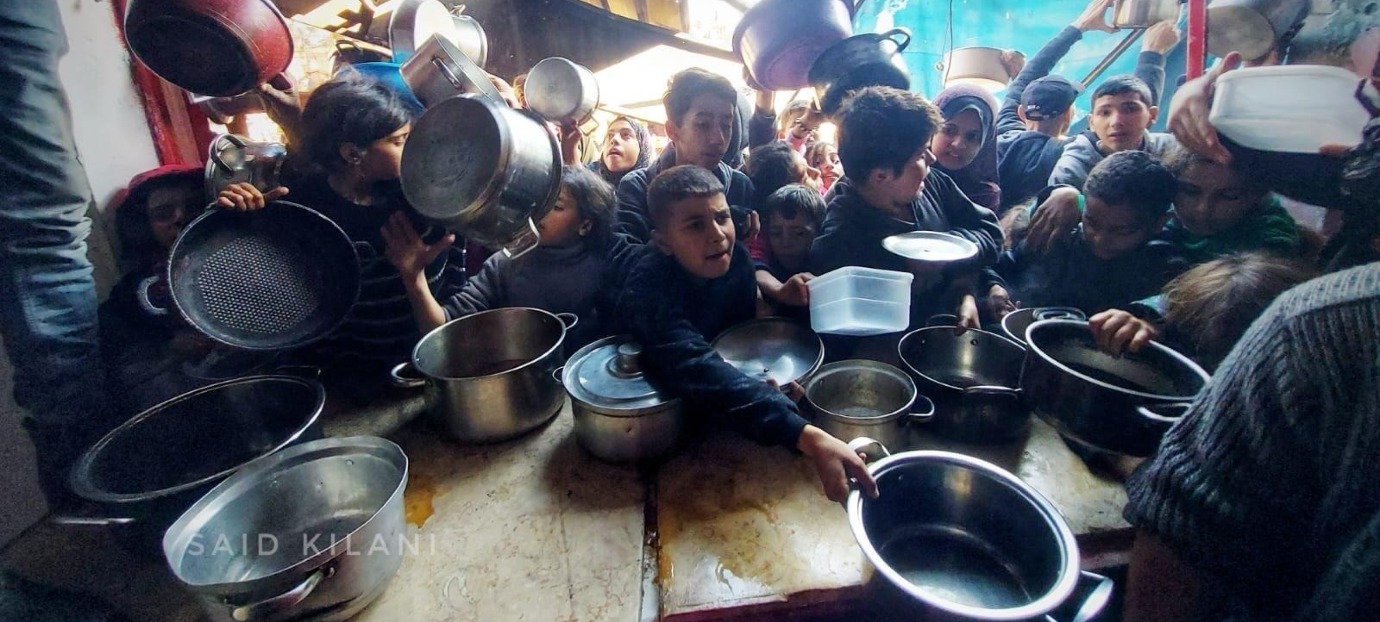
Children gathered in Beit Lahia waiting for khobiza-based bread
distribution (Credit: Saïd Ahmad Kilani)
Doctor Hussam Abu Safiya, who directs Kamal Adwan hospital’s pediatric
wing, told Human Rights Watch in April that 26 children had died due
to complications from starvation. Nine children out of ten already
face severe food insecurity, according to a UNICEF report based on
data collected from December 2023 to April 2024. The World Health
Organization reports the outbreak of diseases such as hepatitis A.
“The situation is tragic,” said Ahmed Abu Qamar, a journalist from the
Jabalia refugee camp who was forced to leave his home with his family,
along with more than 150,000 people, following the Israeli army’s
ground invasion on May 12, 2024. “We do not have potable water … Bread
with a bit of ‘zaatar’ [thyme] or favas are meals that we consider
hearty, and that we can have only on the best days.
“Any plant that the earth gives us, we turn into food”
Saïd Kilani
PHOTOJOURNALIST AND RESIDENT OF NORTHERN GAZA
Near food distribution sites, the scenes of recurrent massacres,
prices for food staples have skyrocketed. Any wheat flour that people
manage to find is sold for exorbitant prices—1,000-1,500 shekels for
25kg, more than 40 times its usual price. Some inhabitants have
resorted to eating animal feed.
Others have had no choice but to throw together the plants growing out
of the rubble into makeshift recipes. “Any plant that the earth gives
us, we turn into food,” Saïd Kilani, a photojournalist and resident of
northern Gaza, told Forbidden Stories.
In April, the north of the Gaza Strip had been assessed on the
Integrated Food Security Phase Classification (IPC) as Phase 5, the
highest stage, by the Famine Early Warning Systems Network (FEWS NET),
founded by the United States Agency for International Development
(USAID).
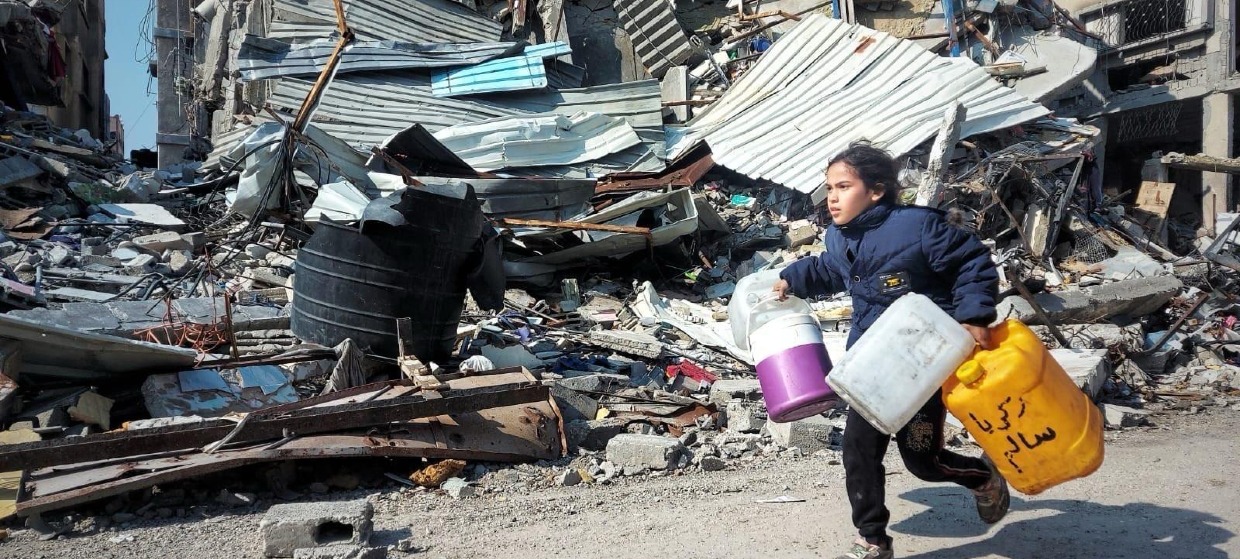
A little girl runs looking for drinking water amid the rubble of Beit
Lahia (Credit: Saïd Ahmad Kilani)
However, the Famine Review Committee (FRC), a United Nations body,
recently refined this finding, stating on June 17 that it did not have
sufficient data since the beginning of April – due to lack of access
in the field – to be able to classify northern Gaza as a famine
situation. This in no way “changes the fact that extreme human
suffering is without a doubt currently ongoing in the Gaza Strip … All
actors should not wait until a Famine classification for the current
period is made to act accordingly,” said the FRC.
Eating at the risk of death
“Khobiza has helped the Palestinian cause more than any other country
in the world,” young Gazan video journalist Abboud Battah, posted on
his Instagram channel with 3.4 million followers.
Khobiza, which grows after the first winter rains, can be found in
fields and on street corners. It was appreciated before the war for
its nutritional properties and spinach-like taste. Usually cooked in a
soup, the plant has saved many families from starvation in the Gaza
Strip over the past several months.
But collecting plant leaves can be dangerous and even deadly. Navin
Anan Mustapha, a 27-year-old mother seven months pregnant with her
fifth child, remembers the day in late March, in the middle of
Ramadan. Like every morning, her husband had gone out to glean khobiza
leaves to feed his children.
“While I was preparing food for the children,” Mustapha said, “I
learned of the martyrdom [death] of my husband, after an Apache
helicopter from the occupying army opened fire on everyone in the
area.” According to Mustapha, the attack left one person dead and
around thirty injured.
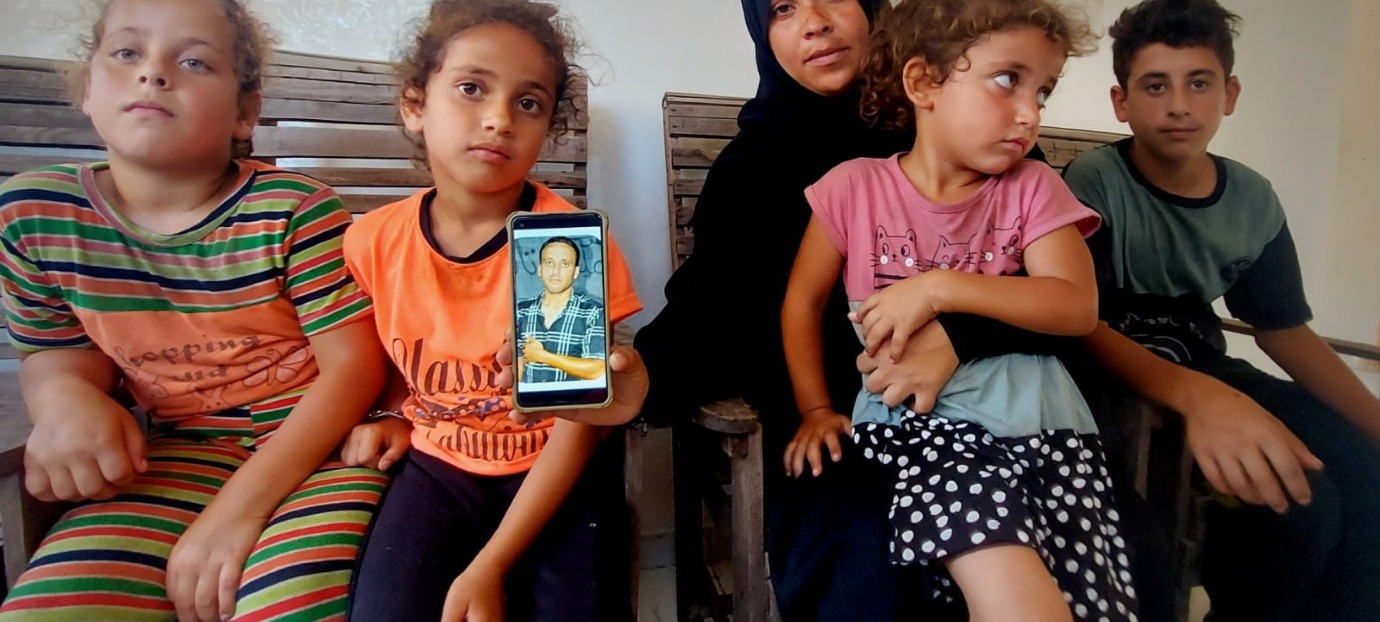
Navin Anan Mustapha and her four children, showing a photo of her
husband killed by the Israeli army while harvesting khobiza leaves in
Beit Lahia (Credit: Saïd Ahmad Kilani)
Despite the danger and the grief, the young mother returned to the
fields the very next day, hoping to find something to feed her
children: “I haven’t had time to mourn, the grief in my heart is
immense,” she said.
In Beit Lahia, the last city before Israel’s security barrier in the
northern Gaza Strip, the Israeli army’s bombings and bulldozers have
razed most agricultural lands. The few parcels spared are essentially
inaccessible to farmers and are systematically targeted by Israeli
forces. Once known for their strawberries during the “red gold”
season, these formerly fertile lands are destitute.
Since, the winter rains have dried up and the population of Gaza can
no longer count on the wild plants to survive. “It’s the final
judgment day,” Kilani, the photojournalist, said “We’ve lost
everything.”
This investigation was published in Arabic on the following:
This investigation was published in English on the following:
This investigation was published in French on the following:

