UAE company leaves Egyptian seafarers unprotected in pirate-infested
waters
Engy Abdelwahab
The image was created using AI
This investigation traces the journey of the hijacked oil tanker
MT Eureka from the United Arab Emirates to the moment it was
seized. It reveals that adequate security precautions were not
implemented, despite the vessel operating in a region known for
its high risk of maritime threats.
The sound of engines grew gradually louder - a sign of danger
drawing closer . No one took any notice at first, but within minutes
several small boats appeared carrying pirates armed with
Kalashnikovs. They boarded the MT Eureka oil tanker on the morning
of May 2, 2026, shortly before it anchored off the coast of Yemen’s
Shabwa province.
Moemen and the rest of the 12 crew on board, four of whom were
Indian nationals, were petrified when they found themselves held
hostage at gunpoint.
The pirates were intimidating – they shouted at them, made death
threats, and pointed guns at their heads.
The crew herded together in one place, while one of the pirates went
to the bridge to force the ship change course. Gradually, the tanker
began to veer away from its previous course and head towards Somali
waters.
The tense silence was broken when the pirates ordered the crew to
select someone to speak on their behalf and convey their demands to
the ship’s owner.
All eyes turned to Moemen. In an instant, he found himself the voice
of his fellow sailors, who had no idea if they would ever escape.
Moemen immediately grabbed his phone and called his father, Akram
Mokhtar. His voice trembling, he told him briefly that the ship had
been hijacked, and that pirates had taken him and the rest of the
crew hostage and were demanding a ransom.
That phone call marked the beginning of a long and agonizing wait.
Nearly two months later, the hostages’ families have received only
sporadic and troubling updates: reports that the crew has been
subjected to repeated abuse and forced to work, while tensions
continue to rise among the pirates over delays in receiving the
ransom they are demanding.
The families of the hostages feared that every phone call might
bring even worse news.
While the pirates roamed through the ship and used its cabins to
sleep in, the crew were crammed together in a single cabin. With
time, the supplies, water and medicines have run out while some of
the hostages have diabetes and high blood pressure.
The crew have nothing to drink but the few drops of water falling
from the air-conditioning units. Gradually, the MT Eureka has
changed from a commercial vessel into a “floating prison,” - a place
of fear, hunger, thirst, and endless waiting.
A voyage that was supposed to last a few days has turned into a
never-ending nightmare, as they wait for the ransom to be paid.
Contracts Without Protection
On May 5, 2026, the wife of Adam Salem, the ship’s cook, went into
labour with her first child. As she prepared to give birth to a baby
girl, her husband was a hostage hundreds of miles out at sea. She
had no idea what had happened, as Adam’s brother Ahmed had kept his
abduction secret, worried that it might jeopardize her delivery and
that their elderly mother would not be able to bear the news.
“It was a really difficult pregnancy,” says Adam’s wife. “My husband
had sailed in the last few months before the birth. We had agreed
where I’d give birth on April 30, 2026. So I was shocked to hear
that he’d been kidnapped.”
Adam’s mother Fahima says her son had been working on ships since
2023 and had gone to the UAE looking for work.
We obtained the work contract of one of the crew on the hijacked
vessel and compared it with the terms of the Maritime Labour
Convention, the International Convention for the Safety of Life at
Sea, the International Ship and Port Facility Security (ISPS) Code ,
and guidelines on best practice for managing risks of piracy.
These legal frameworks provide specific safeguards for mariners
working in high-risk areas. These include pre-voyage risk
assessments, appropriate preventive measures, training of crews on
how to deal with piracy and other emergencies, as well as ongoing
legal and financial protection for seafarers who are detained or
face incidents related to their maritime duties.
The ordeal faced by the crew of the MT Eureka, however, raises
questions over how far these safeguards were adhered to, and whether
they were implemented before the vessel headed off into one of the
world’s most dangerous shipping lanes.
Marine engineer Mohammed Al-Abyad says that the contract of one
of the MT Eureka’s crew does not meet the technical standards
for regular maritime contracts. This, he explains, is because it
contains no clear provision for protection and indemnity (P&I)
insurance, or insurance against risks of war, hijacking or
ransom demands. It also has no detailed mechanisms for managing
crises and communicating with the families of mariners, nor does
it set down the rights of seafarers who are held captive or
subject to piracy. These are “normal safeguards that are part of
contracts issued by major shipping companies and of
international collective agreements,” according to Al-Abyad.
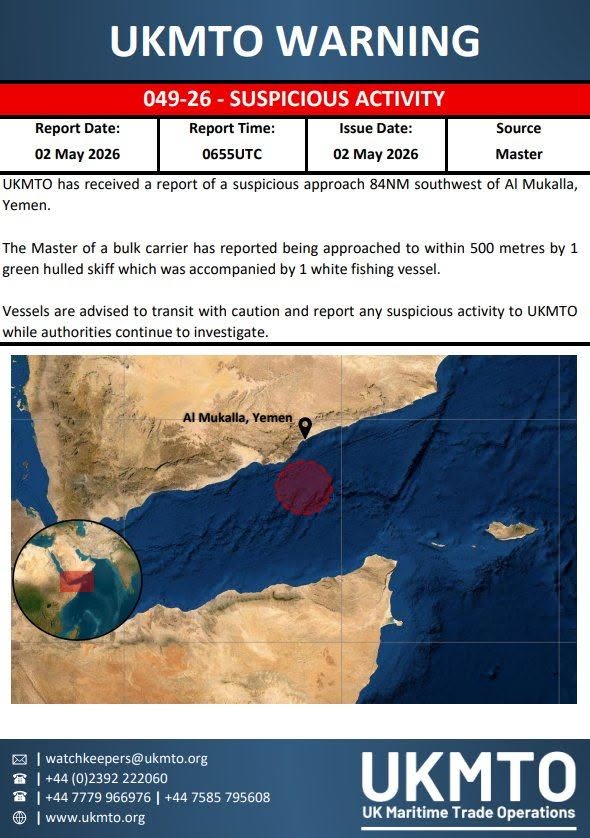
Report of the attack on the tanker
We entered the registration number of the MT Eureka into the
database of the International Group of Marine Insurance and
Indemnity Clubs, and found no record of any insurance covering its
crew members. This leaves open the question of whether any
guarantees were given to the ship’s crew should they face detention
or piracy.
How Did the Ship Reach Somalia?
The tanker MT Eureka set sail from the UAE port of Fujairah with its
cargo of crude on a course taking it through the Arabian Sea and the
Gulf of Aden – one of the region’s maritime corridors most
vulnerable to piracy.
Data from the MarineTraffic ship tracking app shows that the vessel
left Fujairah at 03:43 UAE time on March 24, 2026 and was due to
arrive in Bosaso in Somalia on March 29, but the voyage was
interrupted midway.
Data from the Automatic Maritime Identification system (AIS) shows
that the last signal from the tanker was recorded at 18:58 UTC on
April 30, 2026. At that time MT Eureka was virtually stationary,
travelling at a speed of no more than 0.1 knots off Mukalla on the
southern coast of Yemen.
Since then, no data has been received from the ship and its status
on the tracking app has changed to “out of range.” This means no new
AIS data has been received and it is not possible to locate the
vessel using via satellite or ground stations.
The tanker has therefore disappeared from electronic charts and
remains untraceable. To this day, no authority has specified exactly
where the tanker is being held. The Egyptian Ministry of Foreign
Affairs has said only that the incident occured in Yemen’s
territorial waters, before the tanker was taken into Somali
territorial waters near the Puntland region.
Approximate course of the tanker
Source: MarineTraffic — AIS
EUREKA
Eureka – IMO 1022823 Togolese flagged
Port of departureFujairah
Declared destinationBosaso
Actual time of departure 4 March 03:43
Estimated Time of Arrival 29 March 21:57
Last AIS signal30 April · 18:58
All times in Coordinated Universal Time (UTC)
The hijacking of MT Eureka was not the first incident of this kind in
this region in recent months. Data from the EU’s Operation Atalanta
shows that the European Maritime Safety Agency recorded 84 maritime
security incidents between May 2025 and June 2026. These included
confirmed hijackings, attempted piracy, suspicious activities linked
to armed groups, and incidents of unauthorized boarding of commercial
vessels.
84
maritime security incidents recorded by the EU’s Operation Atlanta
between May 2025 and June 2026
The media and public information section of the EU’s anti-piracy
mission, Operation Atalanta, which operates within its strategic
communications branch, reported that the EU Naval Force issued regular
threat assessments and security alerts concerning piracy and
suspicious approaches to commercial vessels.
These assessments include, according to Operation Atalanta, detailed
weekly maps of piracy risk in the Gulf of Aden and the Somali Basin,
which are updated continuously to reflect the evolving regional
security picture.
Operation Atlanta says it has continued to strongly recommend to
commercial vessels that they adhere to standard maritime security
procedures and immediately report any suspicious activity.
International law professor Dr Mohammed Abdullah Badr says that
dealing with areas at risk of piracy is not a haphazard process but is
governed by a set of security rules and procedures established by the
International Maritime Organization. These include conducting a prior
risk assessment, identifying the safest routes, and increasing
preparedness on board through measures known as “ship hardening.” This
means reinforcing points of entry, activating emergency plans, and
making sure there are areas where the crew can shelter.
Badr points out that the protection of mariners in areas classified as
high-risk is no longer something left to the discretion of operating
companies, but is now a legal obligation set out in international
conventions and standards. Chief among these are the Maritime Labour
Convention, the Convention for the Safety of Life at Sea, and the
International Ship and Port Facility Security Code.
A video released by the pirates, however, casts doubts on the level of
security was actually in place on board the Eureka. The vessel appears
to have none of the barbed wire that is supposed to be in place along
its sides to prevent attackers from boarding. It also set out without
an armed security team, and there are no signs of any alarm systems or
other proactive measures to alert the crew to the approach of
suspicious boats.
Marine engineer Mohamed Al-Abyad thinks that the absence of such
measures leaves crews at direct risk of piracy and makes ships easy
prey for armed gangs.
Stalled Negotiations
Nearly two months have now passed and, for eight Egyptian families,
life is no longer measured in days, but in the few phone calls and
rare messages coming from their relatives at sea. Akram Mokhtar says
that the pirates used his kidnapped son Moemen’s mobile phone to
contact the owner of the tanker and the authorities and demand a
ransom for the release of the hostages.
Akram Mokhtar tells of an arduous negotiation process to secure the
release of his son and his 11 fellow sailors: “The day after the
hijacking, the pirates demanded a ransom of three million dollars and
I just didn’t even know where to start.” One of Moemen’s colleagues
advised him to contact the families of the ship’s crew.
Mokhtar then began tracking down the sailors’ families one by one,
until he had brought them all together in a WhatsApp group. Starting
May 3, 2026 seeking help wherever it mighty be found.
Working in parallel, the families approached both official and
unofficial bodies. They made social media appeals, and pursued
international organizations, trade unions, and maritime authorities,
hoping for a single lead that might guide them to their sons who held
captive at sea.
Mokhtar says that the ship’s owner, who lives in the UAE, at first
ignored any attempts to contact the pirates and that, once the
families had managed to find his phone number, he refused to answer
their calls. Mokhtar says that he even refused to take calls from any
Egyptian number that might be linked to the sailors’ families. Mokhtar
says this was “because of the high ransom the pirates demanded in
early May - three million dollars – which he thought was more than the
ship itself was worth”.
This enraged the pirates, who threatened to withhold food and water
from the crew, and then increased the ransom demand from three million
to ten million dollars. They put more pressure on the hostages and
even assaulted the captain.
A few days later, on May 18, 2026, three of the crew members appeared
in a video kneeling on the deck, their hands bound, with armed men
around them firing repeatedly into the air above their heads. The
sound of gunfire mixed with the men’s cries for help: “Come and get
us, come and get us, Hajj Khalid!”
Khalid is the owner of the MT Eureka, which flies the flag of Togo and
bears the international IMO number 1022823.
May 18, 2026 — A video circulating online showing the pirates
threatening the sailors
An Offshore Company and Emirati Ownership
The sailors’ contracts indicate that the vessel is owned by a company
called Gulf Marine Shipping, registered in the Marshall Islands, a
well-known location for registering offshore companies.
However, our review of company records told a different story. The
address listed in the contracts indicates that the company is based in
the United Arab Emirates, while its email domain links it to another
Emirati firm, Gulf Fuel for Fuel & Oil Derivatives Trading. These
findings cast doubt on the company’s stated structure and raise the
question of who ultimately owns it.
We found evidence linking the two companies in an official document -
Decision No. (2) of 2024 - from the UAE Ministry of Energy and
Infrastructure. This forbids two vessels from entering the UAE’s ports
and territorial waters, including its Exclusive Economic Zone. The
ships are Hana 1 and Dahab - later renamed Eureka - both linked to
Gulf Fuel for Fuel and Oil Derivatives Trading.
The document states that the vessels were banned due to violations
involving maritime activities and the transport of petroleum products
without the required licences. It also cites concerns that inaccurate
or misleading documentation had been submitted regarding the vessels’
arrivals from ports in neighbouring countries.
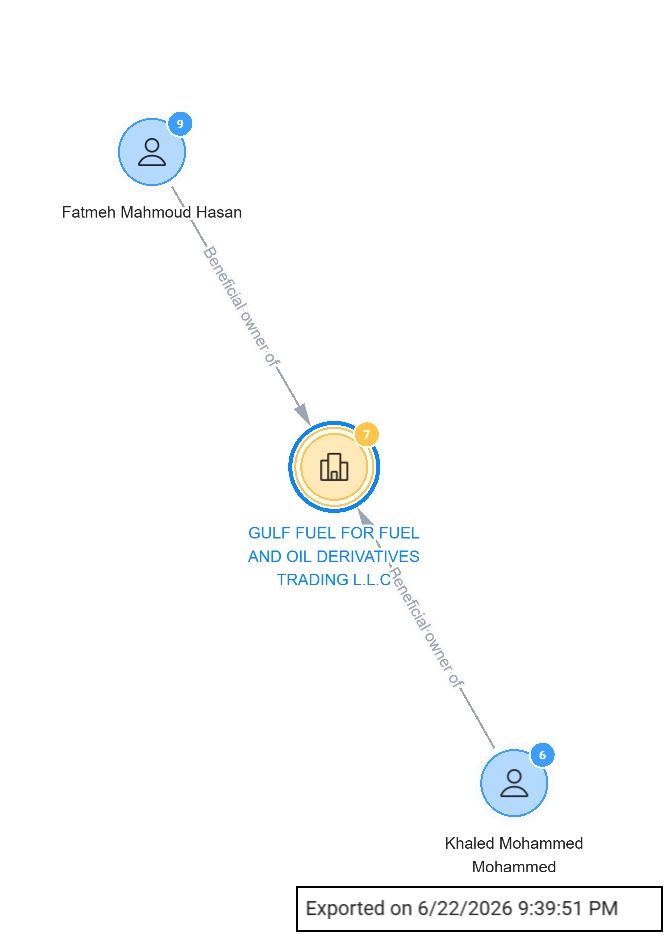
When we looked into Gulf Fuel for Fuel & Oil Derivatives Trading LLC,
we found that it is owned equally by Egyptian national Khaled Mohammed
Al-Ashri and Emirati citizen Fatmeh Mahmoud Hasan.
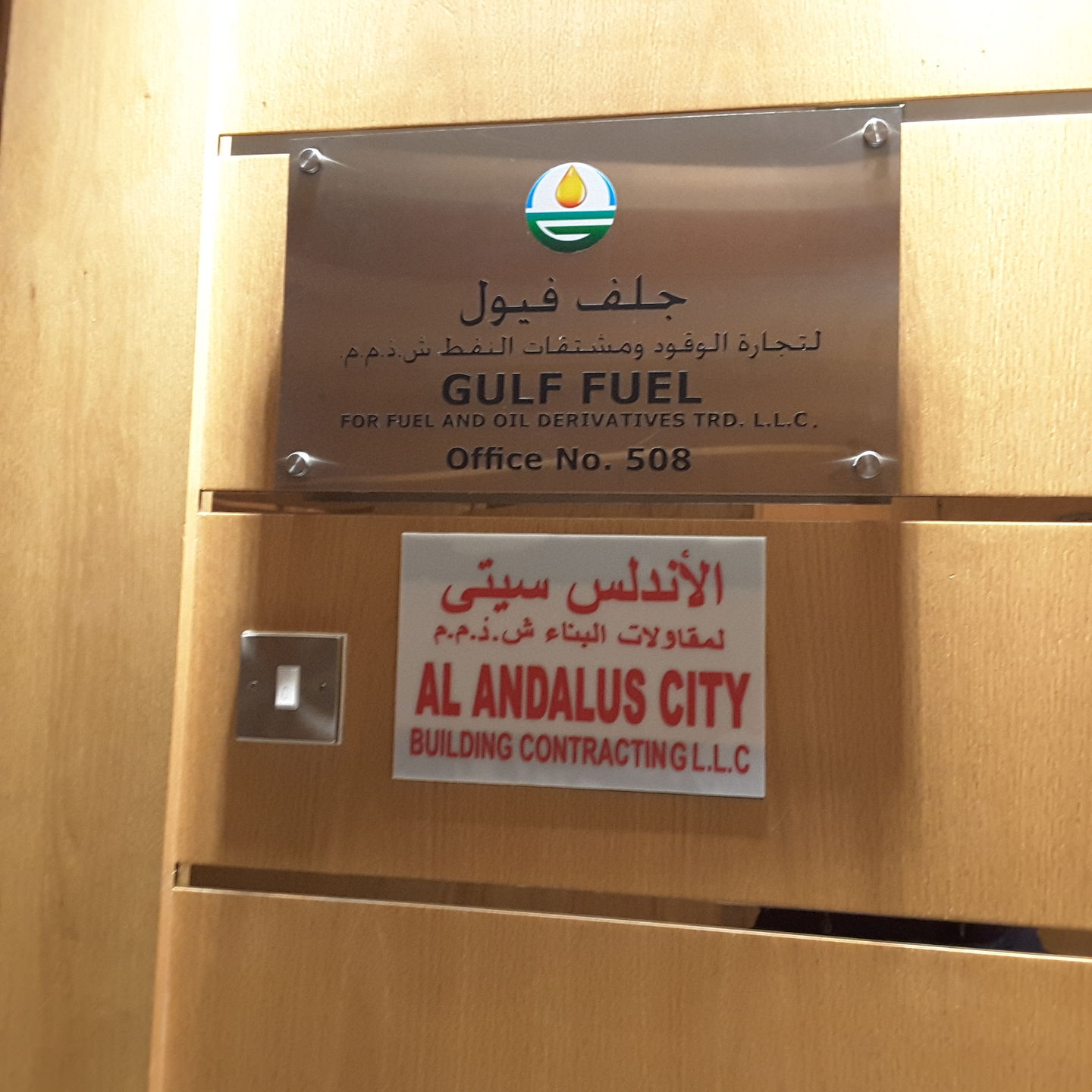
Documents also revealed that the two partners jointly own a property
company called Al-Andalus City Building Contracting, which carried out
developments in the UAE and is registered at the same address.
Headquarters of the company that owns the Eureka
We contacted the UAE Ministry of Energy to ask if the ban on the
Eureka was still in force.
We also contacted the ship’s owner, to give him the chance to reply to
accusations that the tanker, fully laden and crewed, had headed
towards a high-risk area with inadequate safety measures in place. We
have yet to receive a response.
Ownership of Gulf Fuel for Fuel and Oil Derivatives Trading
Waiting for the Ransom
On June 12, 2026, for the first time in weeks, it seemed that an end
to the crew’s ordeal might be in sight. After more than forty days of
stalled negotiations, the hostage families received the news they had
waited so long to hear.
“The ship’s owner finally responded,” says Moemen’s father Akram
Mokhtar. “After we’d contacted him countless times, he finally got in
touch with the pirates. And they accepted his offer and cut the ransom
from ten million dollars to two million.”
Reducing the ransom did not mean that the hostages were any closer to
freedom, however. Akram Mokhtar explains that the pirates then imposed
an additional condition: a helicopter had to fly the ransom money to
where they were, out at sea, and airdrop it.
“It looks like they wanted to avoid any financial transfers that could
be traced and reveal their identities or open them up to prosecution,”
says Mokhtar. “And at the same time they wanted to steer clear of
areas where international forces were deployed.”
While the families struggled to come to terms with this new condition,
they were confronted with another development that complicated matters
further.
According to Mokhtar, whose account was corroborated by other
hostages’ families, the ship’s owner told them that he had initially
considered transferring the ransom through the United Arab Emirates.
However, he later abandoned that plan and suggested sending the money
through Yemen instead, adding that he was still awaiting confirmation
from the Egyptian authorities on whether they would facilitate the
transfer.
After some two months of negotiations, the stumbling block was no
longer the size of the ransom, but the more difficult question of how
two million dollars could be delivered to pirates hiding out in the
middle of the ocean.
After that, contact with the ship’s crew was lost once again. Their
families received just the odd message from Moemen, pleading for the
ransom to be paid and telling of the harsh conditions he and the other
captured crewmembers were having to endure. To this day, those
involved have been unable to agree on a way to deliver the money to
the pirates.
But then, on June 25, came the most terrifying message Mokhtar had
received since the crisis began.
The pirates gave the captives and the authorities a three-day deadline
to meet their demands. “They told us we had 72 hours to get them the
ransom the way they wanted, or they’d start shooting the crew.”
They also threatened in the message to move half the crew to a
mountainous area and hold them there to ensure the ransom was actually
delivered.
Amira, wife of the kidnapped sailor Mohammed Rady, says: “My husband
and his companions have lost all hope… we’re scared they might commit
suicide.”
And Moemen sent his wife Amnia a short voice message saying:
“I’m done… I’ve no hope of ever getting home.”
Somewhere out on the ocean the ransom money is waiting to find its way
to the pirates, while 12 seamen wait endlessly to return home. Their
families remain in limbo, waiting for a call to bring either news of a
rescue – or news they cannot bear to contemplate.
This investigation was produced in collaboration with Al-Masry
Al-Youm.
This investigation was published in Arabic by the following: