Abuses in the disbursement of allocations for environmental projects in Jordan
Compensation “Going Astray”
 29/07/2023
29/07/2023
 Hazem alsayaheen
This investigation uncovers abuses in the way funds have been disbursed by the Governing Council of the UN Compensation Commission (UNCC) under an environmental compensation programme for livestock breeders in the Jordanian desert. Allocations that were intended for use in constructing agricultural roads, to make it easier for breeders to move their livestock to pasture, have instead gone on constructing roads to private farms.
“If you’re in a good position and well connected, you can get a road that reaches your farm and you’re fine,” said Hamad Al-Tawafsheh as he crossed over a paved road that leads to private farms. He was driving, alongside his livestock herd, on the way to an area of pasture in the Al-Mishanshala area of Northern Badia District of Mafraq Governorate (northern Jordan). As the paved road came to an end, he turned right onto a bumpy dirt road. Hamad, who owns a herd of livestock, said: “This road is worn out, and even the animals won’t walk along it with you. This is just the kind of desert road that should be paved.”
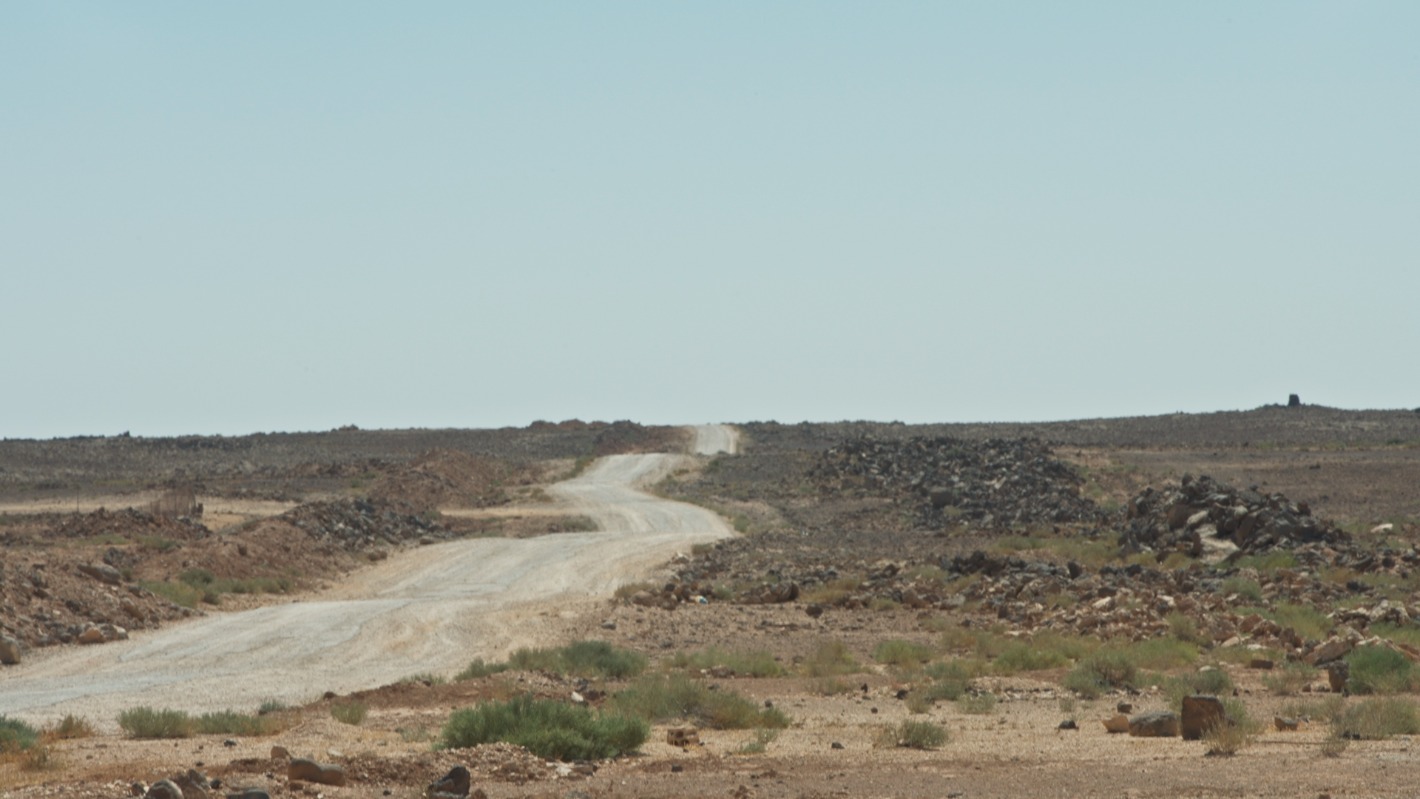
The environmental compensation scheme included constructing agricultural roads that would make it easier for livestock breeders to move around in the desert
Hamad was determined to keep driving, though we feared the car would
come to a stop at any moment, defeated by the many rocks and potholes
on the road. Our fears only increased when he said: “Every time I go
to fetch water for my sheep, or a bag of fodder, I get a puncture on
the road and the car breaks down.”
A few minutes further on, dozens of Bedouin tents started to appear on
both sides of the road. As soon as we stopped, local people began
gathering round and talking to Hamad, as if they were continuing a
previous conversation.
Voices were raised as they complained about the unevenness of the
road, and the difficulty of reaching a nearby spring to provide water
to their livestock, or grazing areas for their “halal”, as they call
their livestock.
The discussion between the men became heated, but Hamad cut in: “Go to
the official, and get him to look into your complaints, guys. No-one
knows about you.”
Hamad told us that the road serves more than two hundred families in
the desert, who use it to fetch water. “This has long been the hardest
thing about being in the desert. And there are no officials who know
about it,” he says sadly.
“All the agricultural roads are worn out. They all need work done on
them, they all need to be paved. But they are still all dirt roads,”
he adds, pointing out that these roads are used by wheat and barley
growers as well as livestock breeders.
 Click here to watch the video investigation
In 2005, Jordan received compensation from the Governing Council of
the UNCC for environmental damage in the Eastern and Northern Badia
[desert] regions, caused by the Gulf War. Programmes included
construction of agricultural roads, to facilitate access by livestock
breeders to grazing areas.
This war in the 1990s, caused huge numbers of livestock herds to move
from Iraq to Jordan’s Eastern and Northern Badia, adversely affecting
the area’s vegetation and pastureland. The Jordanian government
submitted claims to the UNCC Governing Council, to seek compensation
for environmental damage in these areas, caused by the Gulf War.
The environmental compensation scheme, overseen by the Jordanian
Ministry of Environment, included the building of agricultural roads,
to make it easier for livestock breeders to move around the desert,
and to reach water catchment areas, and also for the rehabilitation of
the area’s ecosystems. The water catchment areas are stretches of land
that drain water from rainfall and snowmelt and directs it into
streams and rivers.
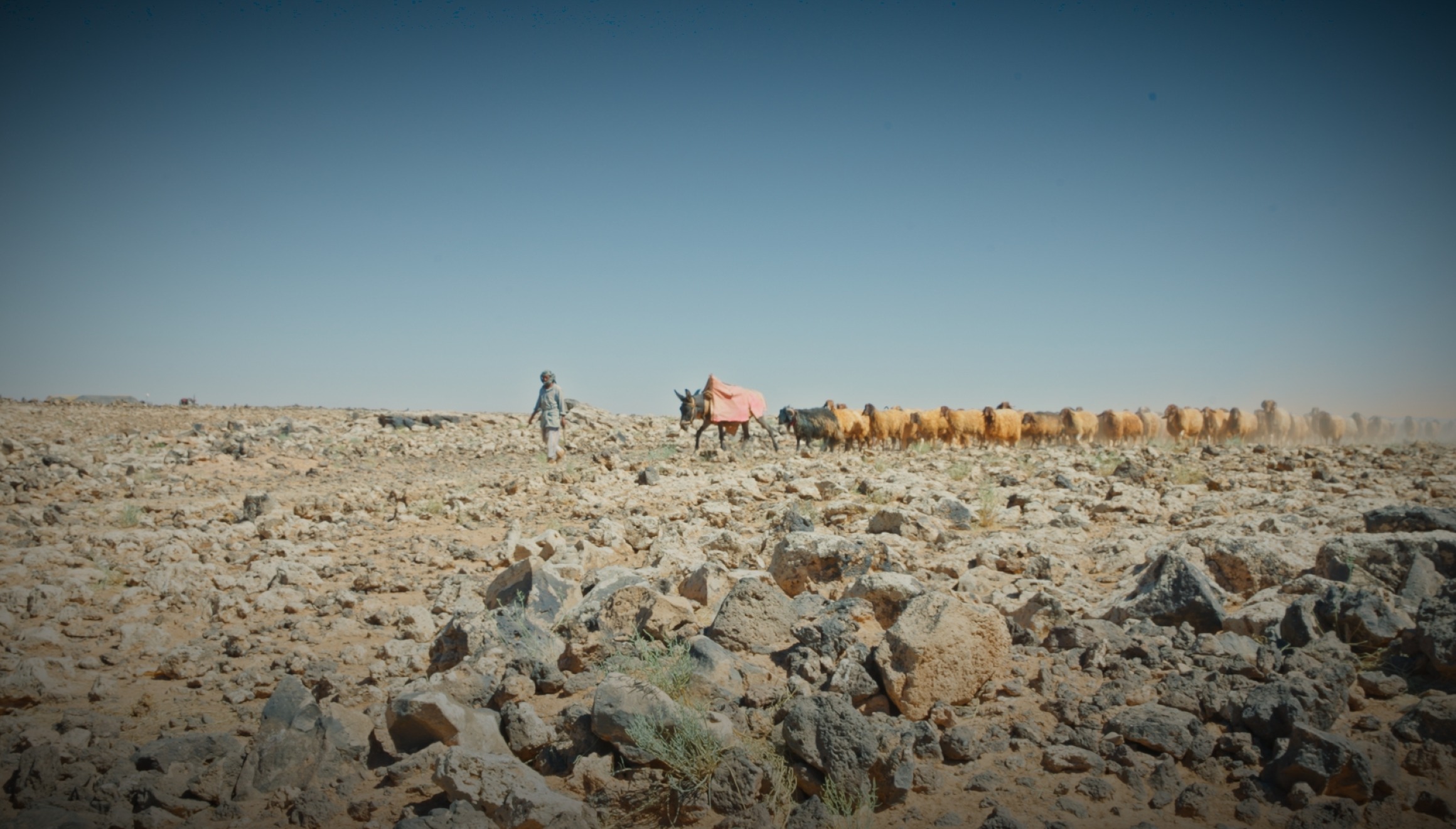
“The lack of suitable agricultural roads is the main obstacle facing livestock farmers”
The government began implementing the agricultural roads project in 2014. The Ministry of Environment signed an agreement with the Ministry of Works to construct agricultural roads worth 1.4 million Jordanian dinars [$1.97m], as part of the environmental compensation programme. About a quarter of this amount was earmarked for the building of two roads in the Al-Mashinshala area of Northern Badia District, Mafraq Governorate.
Mohsen Al-Shanabla, who lives in the locality of Umm al-Quttayn in
Northern Badia District, explains that livestock breeders derive no
benefit from the roads that have been paved in the region, which also
lacks proper infrastructure.
Mohsen, who is the head of an agricultural association, thinks that
the lack of suitable agricultural roads is the biggest obstacle facing
livestock breeders, who seek out grazing areas to cut down on their
use of animal fodder. He points out that one herd generates income for
more than one Bedouin family.
According to Mohsen, many livestock breeders in Northern Badia resort
to selling their livestock at a loss. This being their only source of
livelihood, they then migrate, because of the lack of appropriate
infrastructure. He says that the absence of agricultural roads fails
to gain the attention of government officials.
Pastoral reserves cover an area of nearly 280,000 dunams in Mafraq
Governorate, and about a quarter of Jordan’s registered livestock live
on this land. The Northern Badia District holds about 40 percent of
the livestock in the governorate.
A report by Jordan’s Audit Bureau for the year 2021, shows that about
half a million (539,000) Jordanian dinars ($759,000), from allocations
made under the environmental compensation programme, were spent on
roads used by “owners of large private farms” in the Al-Mishanshala
area of Mafraq Governorate. This amount is equivalent to one third of
the total fund earmarked for the construction of 70 kilometres of
agricultural roads in the desert region.
The report also makes clear that these roads in Al-Mishanshala,
provide no access to water catchment areas or other bodies of water.
Instead, they go to private reservoirs, dug by farm owners within the
boundaries of their property.
The Jordanian government allocated about 5 million Jordanian dinars
from the compensation fund, to construc agricultural roads, most of
which was spent by 2021. The project included the construction of the
16-kilometre-long Al-Mashinshala-Al-Khalidiyya road, according to
information from the minister of environment, given in response to
questioning in 2021, by a Jordanian parliamentarian.
The Al-Mishanshala-Al-Khalidiyya road runs parallel to the Baghdad
International Highway,
which leads to the Iraqi border. The road connects two areas, and at
one end it runs past privately owned farms.
When you travel along this highway, you have no problem reaching the
end. But the trouble comes when you turn onto the nearby agricultural
roads, used by livestock breeders.
Mohsen Al-Shanabla says: “There are farms that belong to influential
men, government men.. we do not know who they are. These farms are
served by roads that are even better than those in western Amman. The
people of the Northern Badia would dearly like to have the use of such
roads.”
Hamad does nothing to hide his resentment as he drives over the paved
road: “Now you’ve seen the asphalt road for one lucky farmer, while we
poor farmers have to drive on dirt tracks.”
ARIJ has obtained data confirming that certain businessmen and others
- who hold prominent positions in the state – own farms located on
this road.
This investigation was completed with support from ARIJ