Main Banner Image

“I can’t see you”

In Egypt, village youth centers are forcing athletes with disabilities out of sports

User Icon
Ahmad Assar
Clock Icon
16 November 2025

This investigation reveals how village youth centers across Egypt lack the necessary equipment to accommodate athletes with disabilities, something which goes against the principle of “inclusion” laid down by law and guaranteed by the constitution. This is causing disabled people to avoid taking part in sports.

Abu Bakr Mohammad, a man in his twenties, stands on the main road leading out of his village, a cane in his right hand and a bag of sports equipment on his back. He hears the bus coming, but does not rush to get on. His visual impairment means he cannot jostle his way aboard, so he waits for a hand to guide him gently to a seat. Then he is off on a journey of over 100 kilometres, leaving behind the youth center in Al Kuddaya, his home village, which had no facilities of any kind for athletes with disabilities.

It takes Abu Bakr about three hours to get from his remote village in the Atfih district south of Giza to a sports center in the Helmeyat El Zaytoun area east of Cairo. He has to use four different means of transport and does not know how much longer he can put up with this long and arduous journey. But nothing closer to home exists that can fulfill his “constitutional right” to play sports and make integration a lived reality, not just text written into the law.

Goalball, a sport designed for the visually impaired, has been Abu Bakr's chosen game for about ten years, during which time he has faced daily hardships. He was optimistic when, in April 2017, a presidential initiative to make 2018, the Year of the Disabled was announced. He thought this will end his suffering, but nothing changed.

Many Facilities with Missing Requirements

What Abu Bakr has to go through is familiar to thousands of others in Egypt, where people with disabilities account for 11 percent of the population. That amounts to almost 12 million people, over half of whom live in rural areas, according to the Central Agency for Public Mobilization and Statistics (CAPMAS).

At the same time, village youth centers provide three-quarters of all the sports facilities in Egypt, an indication of how important they are in developing the largest base of the country’s athletes. And yet these centers fail to meet the standards needed for people with disabilities, which are laid down in the Egyptian Code for Design of External Spaces and Buildings for Use by Persons with Disabilities, issued under Ministerial Decree No. (303) of 2002 by the Ministry of Housing, Utilities, and Urban Communities.

This ministerial code published by the Ministry of Housing, Public Infrastructure and Residential Clusters, lays down a set of standards for public spaces and sports centers to ensure they can be used by people with disabilities.

To check on how far village youth centers are complying with these standards, we visited six of them. We also made phone contact with male and female sports people to gather their experiences of 14 other youth centers. These 20 centers were in villages across nine governorates. And we chose them based on their geographical distribution across governorates in the north and south of the country, as well as in the cities of the canal zone. Nineteen of them failed to fully comply with any of the required standards and regulations. One center only came close to doing so. It had been recently renovated and fulfilled seven of the eight main criteria.

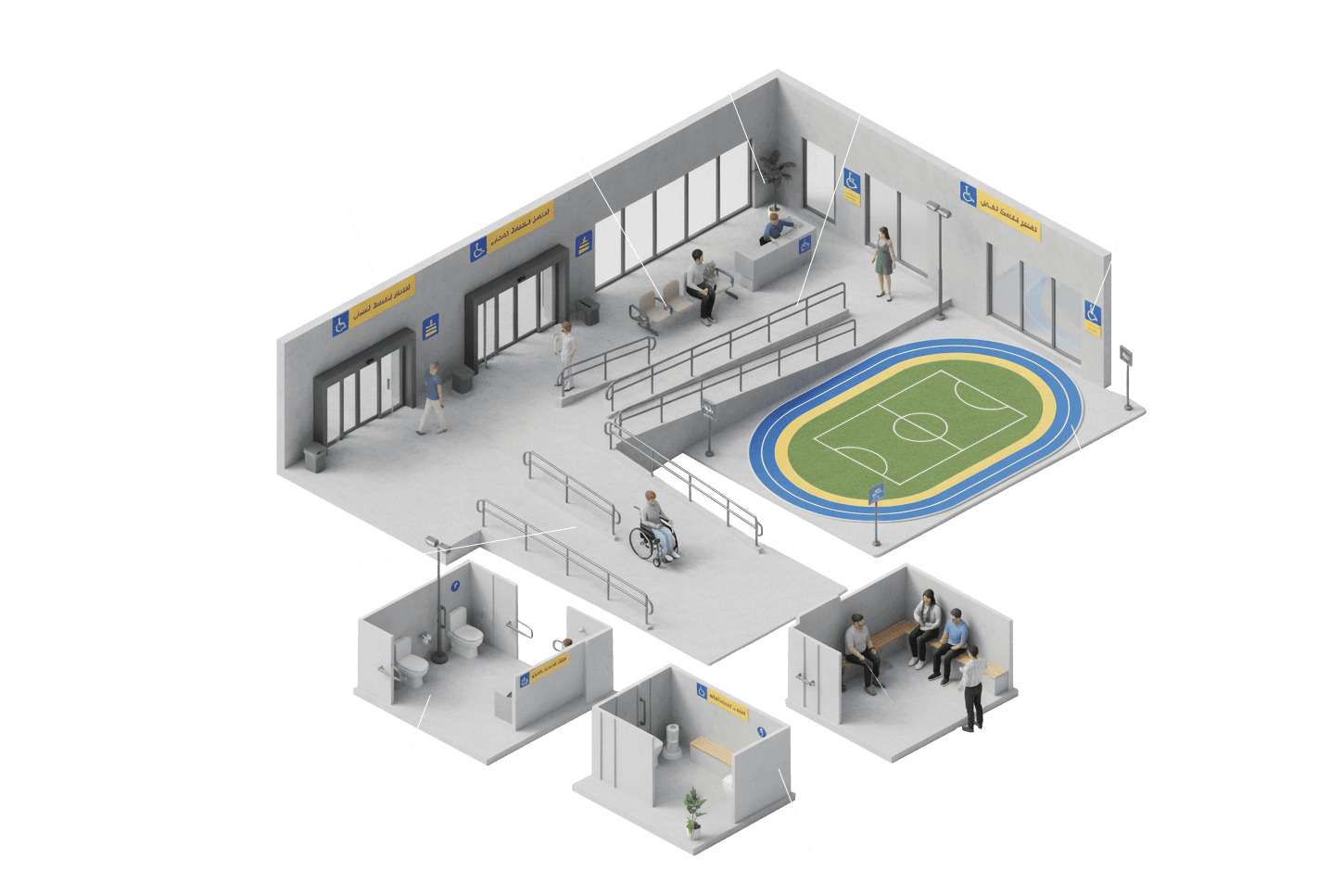
Village youth centers have no facilities and signs for athletes with disabilities

Image: Village youth centers have no facilities and signs for athletes with disabilities

Source: Egyptian Code for Design of External Spaces and Buildings for Use by Persons with Disabilities

Special entrance

The sports facility must have a special entrance for the disabled.

Special walkway

The building must include a special walkway for people with disabilities to use, beginning at the entrance.

Ticket office

The facility must have a ticket office specifically designed for the disabled.

Fixed seating

Next to the entrance there must be fixed seating for people with disabilities to use while waiting.

Wheelchair ramps

Ramps are required for wheelchair users at the entrance and at various locations around the building.

Signage

The facility must have signs installed which clearly mark walkways for the disabled.

Even walkways

Flat and even walkways are required for disabled users inside the sports facility.

Walkways for athletes

Walkways are required in the building to enable disabled athletes to reach the different sports areas.

Changing rooms

The facility must provide separate changing rooms for use only by people with disabilities.

Toilets

Special toilets for use by the disabled must be available - one for males and one for females.

Image: People practicing different sports

Source: Egyptian Code for Design of External Spaces and Buildings for Use by Persons with Disabilities

Image: Stadium background

Integrating people with disabilities into sports activities in village youth centers appears to be difficult to achieve. For Dr. Mahmoud Yassin, a goalball coach for the blind, it is still only a theoretical notion. He says these centers have no equipment or trained staff, and that those in charge have no understanding of the “psychology” of dealing with disabled athletes.

Yassin points out that these facilities fail to meet even the minimum requirements of people with disabilities, from the design of the entrance to the lack of appropriate training equipment. This means thousands of people living in villages across Egypt are being denied one of their most basic rights: access to sport. It is not only a form of social exclusion, but a violation of both the constitution and the law, which guarantee equality for all in the right to practice sport.

Article 82 of the Executive Regulations of Law No. 10

The ministry responsible for youth and sports commits to taking necessary measures to facilitate the participation of persons with disabilities in sport and recreational programs and activities.

Article 84 of the Constitution

Everyone has the right to practice sport. State institutions and society shall work together to discover and nurture talented athletes and take the necessary measures to encourage the practice of sport. The law shall regulate both sports affairs and civil sports bodies in accordance with international standards and the manner in which sports disputes are settled.

Article 81 of the Constitution

The state shall guarantee the health, economic, social, cultural, recreational, sporting and educational rights of people with disabilities or dwarfism. The state shall provide work opportunities for such individuals, allocating a percentage of these opportunities to them, and equip public utilities and their surrounding environment. The state shall also enable them to exercise all political rights, and facilitate their integration in society in order to achieve the principles of equality, justice, and equal opportunities.

Article 42 of Law No. 10

The state is committed to: making sports and recreational activities available to people with disabilities and to taking steps to make sport and recreational facilities accessible to them; providing them with means to access training and take part in these activities; and making available trained staff, equipment and stadiums to enable them to participate in national and international competitions, activities, and forums.

An Unadapted Environment

Such an environment, which is unfit to accommodate athletes with disabilities, drives many of them away from village youth centers, and even to give up sport altogether. One such person is Mahmoud Selim, who took up athletics about ten years ago in his small village of Tukh al-Kheil in Minya Governorate. But he says that before long he was faced with the reality of a village youth center completely lacking the facilities, coaching staff, and even the most basic equipment to suit his disability.

Mahmoud had no choice but to travel to the youth center in the city, 18 kilometres away from his village. The distance made regular training nearly impossible, and his chances of achieving qualifying scores for the national team continued to slip. Eventually, it became too much. After only a short period of practice, he decided to quit the sport altogether.

Khaled Hassan, head of the technical committee for swimming in the Egyptian Blind Sports Association and a former board member of the Paralympic Committee, maintains that the failure to adapt village youth centers to accommodate people with disabilities is an “injustice”, and a significant cause of the decline in the number of disabled athletes in Egypt in recent years.

In a survey of 66 athletes from different governorates and sports, conducted to assess how inadequate facilities at youth and sports centres affect the participation of people with disabilities, more than 80 percent said the centers near their homes had no facilities suitable for their needs. About 73 percent said they faced difficulties accessing suitable sports facilities.

When asked why they stopped participating in sport, more than 80 percent cited the lack of properly equipped sports facilities close to home as the primary reason. The second most common factor was the high cost of practicing sport, followed by the low financial return it offered.

Background Image

A Sharp Decline

Data from the Central Agency for Public Mobilization and Statistics (CAPMAS) shows that the number of disabled athletes attending village youth centers fell by 67 percent over the last decade. This amounts to a drop of two thirds of disabled athletes.

Village youth centers lost two thirds of their disabled athletes over ten years

Source: Central Agency for Public Mobilization and Statistics

This data covers the period from 2012 to the end of 2023, and is the latest CAPMAS bulletin. The agency issued no annual bulletin for 2022.

While working on this investigation, we excluded data from the years 2016, 2017, and 2018, as it showed what appeared to be an “illogical” drop in the number of sportspeople for those years.

When we went back to CAPMAS, an official who preferred to remain anonymous explained the situation. In the three years starting in 2016, the agency had followed a different methodology to collect data. However, it later emerged that data collected using this methodology was inaccurate. This prompted the agency to return to the old methodology from 2019 onward.


The Story Continues

In the southern Egyptian governorate of Minya, Mahmoud Selim's story did not end when he retired from athletics. For him, sport is more than just a hobby. It is a way of life that can stave off complications caused by his disability. This made him refuse to give up. After some years, he took up individual triathlon, and resolved to pay for the equipment and training himself. He went to look at every youth center in the province, hoping to find one that was both good for sport, and suitable for his disability, but to no avail.

Mahmoud had the financial means to resume his sporting activities, but others are not in that position. He says many people in the provinces end up abandoning sport altogether.

This suffering reflects a broader reality. The rural parts of Egypt have experienced over the last decade successive waves of inflation that have had directly impacted the lives of citizens. Figures show there has been a clear hike in prices, with the annual inflation rate reaching 32 percent in 2017. It then continued to rise at varying rates, reaching 37 percent in 2023 and 27.6 percent in 2024. The price index rose by 63.1 points in 2016 and 231.6 points in 2024, reflecting a cumulative inflation of approximately 267 percent. This means prices are now about 2.7 times higher, significantly increasing the cost of living.

Rural Egypt is experiencing a cumulative inflation rate that has roughly tripled prices in eight years

Source: Central Agency for Public Mobilization and Statistics

Action in the Senate

The state claims to prioritize athletes with disabilities, but no concrete steps have been taken on the ground to achieve real integration.

In March 2023, the Egyptian Senate debated an information request from Senator Hesham Suweilam regarding the Ministry of Youth and Sports’ policies. The senator asked how the ministry was implementing Article 82 of the executive regulations of Law No. 10 of 2018, which deals with the rights of the disabled. He also questioned what the ministry was doing to promote youth centers and provide suitable places for disabled people to practice sports.

Senator Hisham Suweilam questioned the value of free youth center memberships for people with disabilities when the facilities themselves are inaccessible. He emphasized the need to improve these facilities.

Suweilam explained that his parliamentary action was prompted by what he had witnessed in villages in his home governorate of Menoufia. He had seen a complete lack of equipment for people with disabilities in village youth centers and a failure to provide for their needs. His arguments are backed up by official CAPMAS figures. According to its latest annual report on sports activity in Egyptian sports centers, Menoufia is listed as one of nine governorates where no sport is played by people with disabilities in village youth centers.

Governorates which have lost the most disabled athletes 2012-2023

Source: Central Agency for Public Mobilization and Statistics

Around 91 percent of the participants in our survey agreed that providing suitable facilities for people with disabilities would be a strong incentive for them to continue with or return to sport.

Ali Mahmoud, a disabled competitor in modern pentathlon, a sport comprising five different disciplines: swimming, fencing, horse riding, pistol shooting, and running, at a private club in the capital Cairo, had a different experience. His experience shows clearly what can be achieved by people with disabilities in sports facilities, given the right equipment.

Ali has had the benefit of living in the heart of the capital and of having a family able to afford the costs of his sport. Consequently, he was able to join a well-known private club, where he found what is lacking in many state-run sports organizations. This made things easier for him and enabled him to forge ahead in his career.

A More Complex Crisis

For disabled women, it is even more difficult to practice sport in rural youth centers. Aside from the lack of equipment and resources, they lack privacy or safe spaces.

The statistics are striking. Women account for almost half of Egypt's population with disabilities, yet they make up only 11 percent of disabled athletes.

Source: Central Agency for Public Mobilization and Statistics

Mona (“Minnie”) Rashid Bayeet, a blind weightlifter from the village of Shata in Damietta Governorate, says that the youth center in her village has neither the equipment for her as an athlete nor facilities for her as a girl. It has no suitable changing rooms or female toilets, she says, which makes things more complicated for women than for men.

The lack of provision for girls in village youth centers is not limited to facilities alone. It also extends to the absence of female technical staff. Mona points out that her village's youth center has no female trainers, which discourages girls from participating in sports.

Official CAPMAS figures support Mona's observations. The agency’s latest annual report on sporting activity shows that the country’s more than 4,000 rural youth centers have only 1,203 changing rooms in total. These must serve all athletes, able-bodied and disabled, male and female.

On the technical side, CAPMAS reports that there are only 40 female trainers for people with disabilities in all the country’s rural youth centers.

The geographical distribution of these trainers shows a clear imbalance between governorates, with 30 of them – 75 percent of the total - in Giza Governorate alone. By contrast, the governorate of Qena has four trainers, and Qalyubia, Ismailia, and Minya have two each. The rest of the governorates, including Damietta, where Mona is from, have no female trainers at all.

An Incomplete Journey

Mona began her athletic career in 2018, and in just four years achieved remarkable success. She won a silver medal at the World Championships, gold at the African Championships, and was named the continent's best female weightlifter in 2019.

In achieving so much, she had to overcome many obstacles. With no facilities at the youth center in her village, she was forced to regularly travel the 137 kilometres to Ismailia for training sessions.

Mona says that she faced considerable opposition from her family when she started out, because of the lack of privacy at the youth center. But she was able to gradually win them over, especially after she began gaining championship titles.

She highlights the privacy issue as a major barrier. It has prevented many women from taking up sport in the first place. For others, it has forced them to give up entirely. Their environment failed to provide even the minimum level of privacy that girls need to practice sport.

Despite the remarkable achievements she made in a short career, Mona decided to retire. In fact, she was forced to, because the “discouraging” reality she had to cope with put out the hope inside her. The absence of any sports center near her home that could cope with her disability was enough to end her athletic career: “I wanted to continue my career... but I couldn't.”

For every ten male athletes, there is only one female doing the same sport

Source: Central Agency for Public Mobilization and Statistics

Village youth centers are devoid of equipment for athletes

Several years have passed since the Egyptian state declared the Year of Persons with Disabilities and passed the law setting out their rights.

But the law was shelved and had no tangible impact on the lives of disabled athletes, whose circumstances have not changed over this period. Disabled athletes in rural Egypt, therefore, face a bitter choice: either to go on suffering, or be forced to give up their sport.

Following the principle of the right of reply, we repeatedly attempted to contact Egyptian Ministry of Youth and Sports officials to comment on our findings, but received no response.


This investigation was published in Arabic on the following: