The situation in the village of Al-Mubattan is similar to that in
other villages in the north-eastern Hama countryside. Musa from
Al-Zaghba was forced to leave his land and flee to a safer place.
“I left the village on December 2, 2024,” says Musa. “After our
families had departed, the men remained in the village to keep an
eye on what was happening, but then we were all forced to leave,
abandoning our land, which was left deserted and uncared for.”
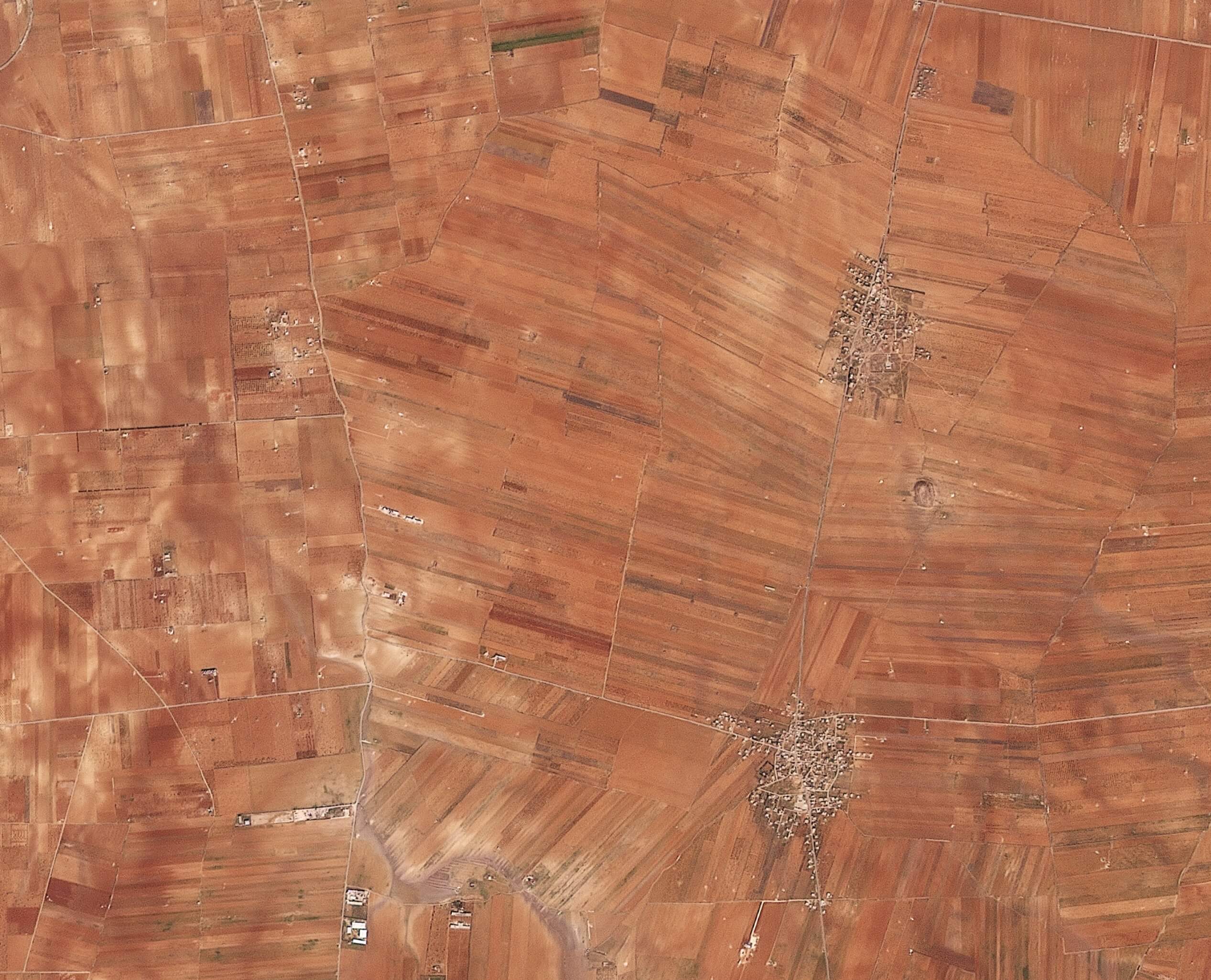
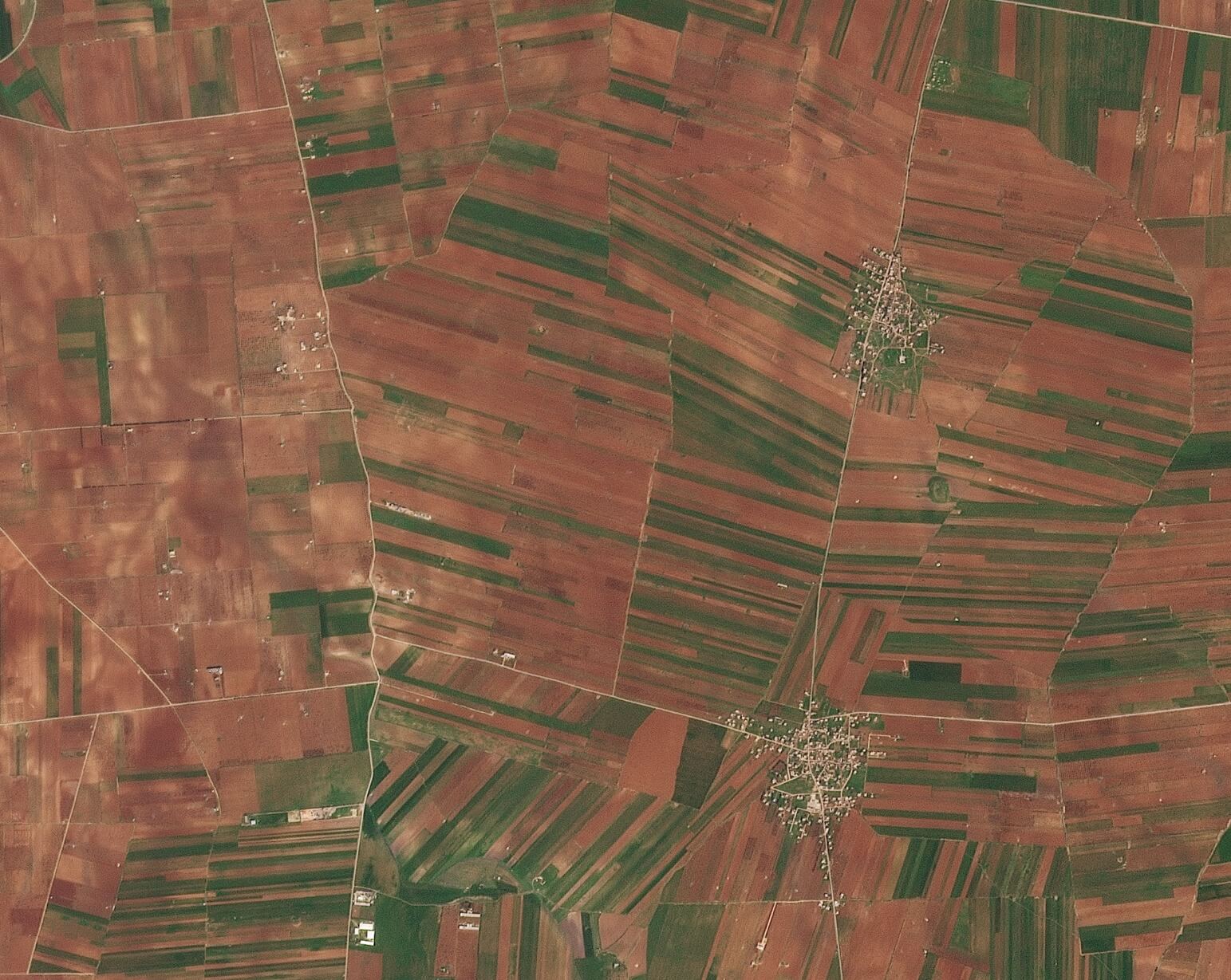
According to the Normalised Difference Vegetation Index (NDVI),
the average monthly vegetation cover in Al-Zaghba declined
throughout 2025, in contrast to 2024, which saw peak vegetation
cover during the winter season.
Months later, Musa heeded the Governor of Hama’s advice and signed
a preliminary investment contract with an investor from Morek, a
village in the Hama countryside. The investor was a trader in
Aleppo pistachios and the contract terms were identical to those
that Mu’tasim had agreed to.
Musa later learned that the same investor had also invested in a
large area of land in Al-Zaghba; which he described as having the
most abundant pistachio groves, where trees are over 40 years old.
We obtained preliminary contracts, signed by the investor or
members of his family with displaced people from Al-Zaghba.
However, the final legal validation process had not been
completed, according to the landowners.
In order to discover who is behind the land division in Al-Zaghba,
we obtained a video in which a farmer, at the end of the video,
thanks “Sheikh Abu al-Baraa” for distributing the land among “the
poor coming from the north,” noting that they had been displaced
since 2017.
“Abu al-Baraa” and Ties to Iktifaa
The name Abu al-Baraa is frequently mentioned by those who were
forced to sign investment contracts. So who is Abu al-Baraa?
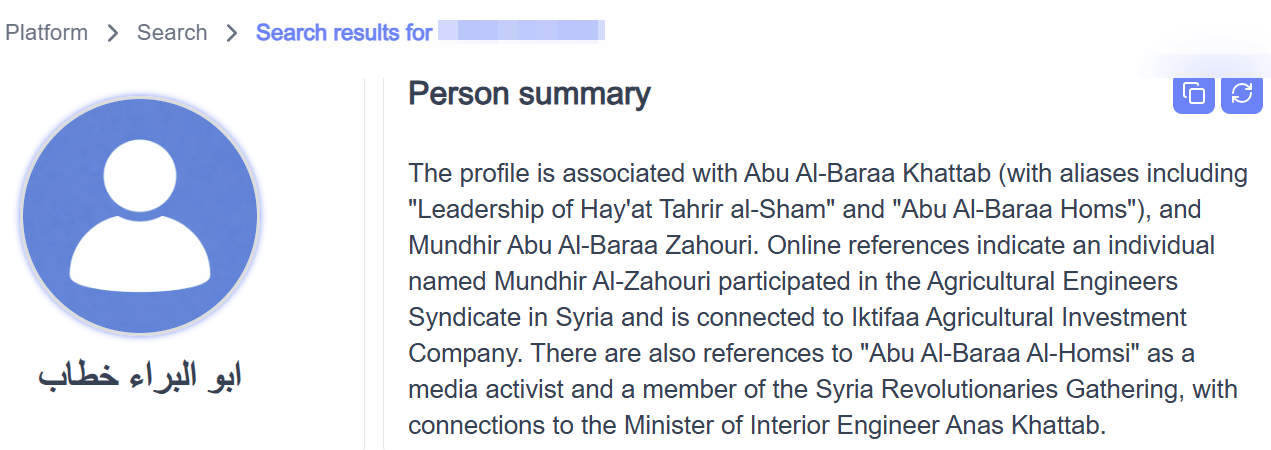
Abu al-Baraa is the nickname of Munthir al-Zouhouri, an engineer
and a member of the Agricultural Engineers’ Syndicate Board. The
Hama Governorate’s Facebook page published a post describing
al-Zouhouri as the head of agriculture for the central region of
the governorate.
The Iktifaa page lists al-Zouhouri as the “manager of the
company’s Hama branch.” When we contacted him, he denied having
any ties to the governorate, stating instead that he is the
manager of the ‘Iktifaa’ Hama branch.
He also appears in photographs from private seminars organised by
Gheras Agricultural Investment Company, before it changed its name
to Iktifaa Agricultural Investment and Development.
Our findings are consistent with reports released by Syrians for
Truth and Justice, the Syrian Observatory for Human Rights, and
other organizations, who have stated that Iktifaa has been
facilitating investment operations involving the land of displaced
persons, who have effectively lost the ability to manage their own
land.
Iktifaa Agricultural Investment and Development Company was
established in Idlib in October 2024. On its official website
-which does not disclose information about its owner- it presents
itself as a company operating in agricultural production, food
security, agro-processing and smart farming.
Iktifaa is linked to Gheras for Agricultural Development and
Investment”, formerly managed by Bassel Sweidan - the former
director of Iktifaa - and the Sovereign Wealth Fund for the
Agricultural Sector. Sweidan now serves as head of the
Anti-Corruption Commission and as Minister of Agriculture in the
current Syrian government. Furthermore, the current director of
Iktifaa, Mohammed Hanouf, was in charge of the mushroom project at
Gheras.
We carried out a telecom network analysis of 60 unique telephone
numbers linked to three main entities: Iktifaa Agricultural
Investment Company, Gheras Agricultural Investment, and Al-Khadra
Agricultural Investment, all of which were also established in
Idlib. Our analysis revealed that the three companies are all
linked to an international number.
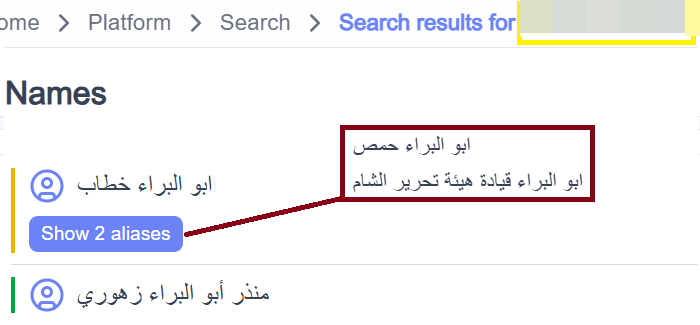
Analysis of Iktifaa numbers also revealed that Abu al-Baraa’s
number was linked to one of the company’s numbers. This number was
registered to Abu al-Baraa Homs, Abu al-Baraa Hay’at Tahrir
al-Sham, and Munthir Abu al-Baraa Zouhouri. This name matches that
of the individual through whom some investors claimed to have
acquired plots of land belonging to displaced persons from Hama.
ARIJ contacted the Hama Governorate via the email address
published on its official pages to forward the displaced persons’
testimonies. We received a reply from a man named “Abu al-Baraa
al-Hamawi”, who informed us that he was in fact Munthir
al-Zouhouri, the manager of the Iktifaa branch.
Al-Zouhouri described the testimonies of the displaced people we
met as “false,” and urged us to visit his office along with our
sources “to respond to their false allegations.”
We contacted al-Zouhouri again by telephone and email, and
stressed that we could not reveal the identity of our sources. We
reiterated our request for a response, which we said would be
published in full. However, we received no reply from him by the
time of publication.
The hopes of people displaced from the northern villages of Hama
to return home are slowly fading. Nearly a year and a half after
the fall of the regime, their connection to their land hangs by a
single tenuous thread: the investment contracts.
“I lost everything I owned when I left my village. At that moment,
I felt I was about to lose something far greater than material
possessions. I would lose my land and the place where I grew up,
raised my children and buried the most precious person in my life
- my father.”
A sense of anxiety gripped Mu’tasim as he spoke. He clasped his
hands over his chest as if permanently on guard, and his gaze
wavered as he wondered: “Could that glance I cast upon my home and
my village truly have been my last?”
This investigation was produced with support from ARIJ.
This investigation was published in Arabic on the following
websites: