“Coffins” on wheels:
Israel Floods West Bank with “Totaled” Cars
Asmaa Masalmeh
 09/03/2024
09/03/2024
This investigation uncovers the Israeli and Palestinian involvement in
the illegal smuggling of “totaled” (non road worthy and destined for
the scrap yard) cars from Israel to the West Bank, taking advantage of
the weakened security grip of the Palestinian Authority, on the one
hand, and Israel’s turning a blind eye, on the other.
On the surface, Palestinians may seem to benefit most from the low
cost of these cars, but in reality they pay the highest price
economically, environmentally, and socially.
Ahmad sits patiently in his car near the checkpoint of Bitar (Hosan),
which separates the ‘67 Occupied Territories from the Territories
Occupied in ‘48. He waits for a freight carrier with five “totaled”
cars, to pass through the barricades, and spends hours checking his
phone while keeping an eye on the road heading towards the village of
Hosan west of Bethlehem.
Ahmad’s job is to communicate with the driver of the freight carrier
truck, telling him when the road is clear and free of Israeli police.
The driver can then safely pass through the checkpoints which,
according to Ahmad, turn a blind eye to the “smuggled” cargo of junk
cars.
On days when Israeli police forces are absent, passing through these
checkpoints is easy. According to those we interviewed, the Israeli
Army turns a blind eye to cargo and commodities entering the West
Bank, but maintains a much tighter grip on those exiting towards
Israel.
Ahmad drives his car in front of the freight carrier, only to be
suddenly stopped by an Israeli police car, which quickly lets him
continue on his way because this time, according to Ahmad, they were
searching for freights of stolen cars. The carrier reaches its final
destination in the town of Beit Awwa, after a six hour journey, from
12 AM to 6 AM. It is one of several car freight carriers that arrive
at Beit Awwa on a weekly basis.
These car freight carrier trucks have flooded the town of Beit Awwa,
which lies to the southwest of Hebron, with “totaled” non road worthy
cars, whose yellow license plates almost outnumber the regular
Palestinian license plates of the governorate.
Colonel Bashir Al- Natsheh, Director of the Public Relations in the
Police Department of Hebron, estimates that there are around ten
thousand “totaled” cars roaming the streets of Hebron. These cars have
been written off the registries of the Israeli Ministry of Transport
only to roam the streets of Hebron, and other governorates in the West
Bank, without being subjected to any vehicle safety inspection.
Al- Natsheh says that these cars are present mostly in Areas (C),
which lie outside the jurisdiction of the Palestinian Authority,
according to the political classification of areas within the West
Bank. He adds that also they are mostly found in areas far from the
city center, where there is reduced police presence, and hence, no
regular control or inspection. According to official public
statements, there are more than 150 thousand unlicensed vehicles in
the West Bank. Statistics show that, at the beginning of 2023, the
total number of registered vehicles in the West bank was 378,861,
which means that 35% of all vehicles on the road in the West Bank are
unlicensed.
So, how did so many Israeli cars illegally enter the West Bank despite
the presence of checkpoints and barricades along the borders
separating the West Bank territories, and those Occupied Territories
of 1948, now called Israel?
A simple Facebook search for “Totaled vehicles for sale” will show tens of pages and posts that not only sell totaled cars, but also fake Palestinian license plates. These transactions take place not only among Palestinians, but also between Palestinians and Israelis.
Under his real name which we will not reveal here, a twenty year old
youth places ads promoting the various models of “totaled” cars for
sale. When asked about the specifications of the cars, he provided
us with intricate details of the available “totaled” cars and
licensed Palestinian cars. However, as soon as we informed him that
we were journalists working on an investigation, he politely ended
his communication with us saying: “We want to live and make a
living.”
We tried contacting a number of “totaled” car dealers in the cities
of Tulkarem, Ramallah, Nablus and Hebron, none of whom agreed to be
interviewed for fear of legal prosecution.
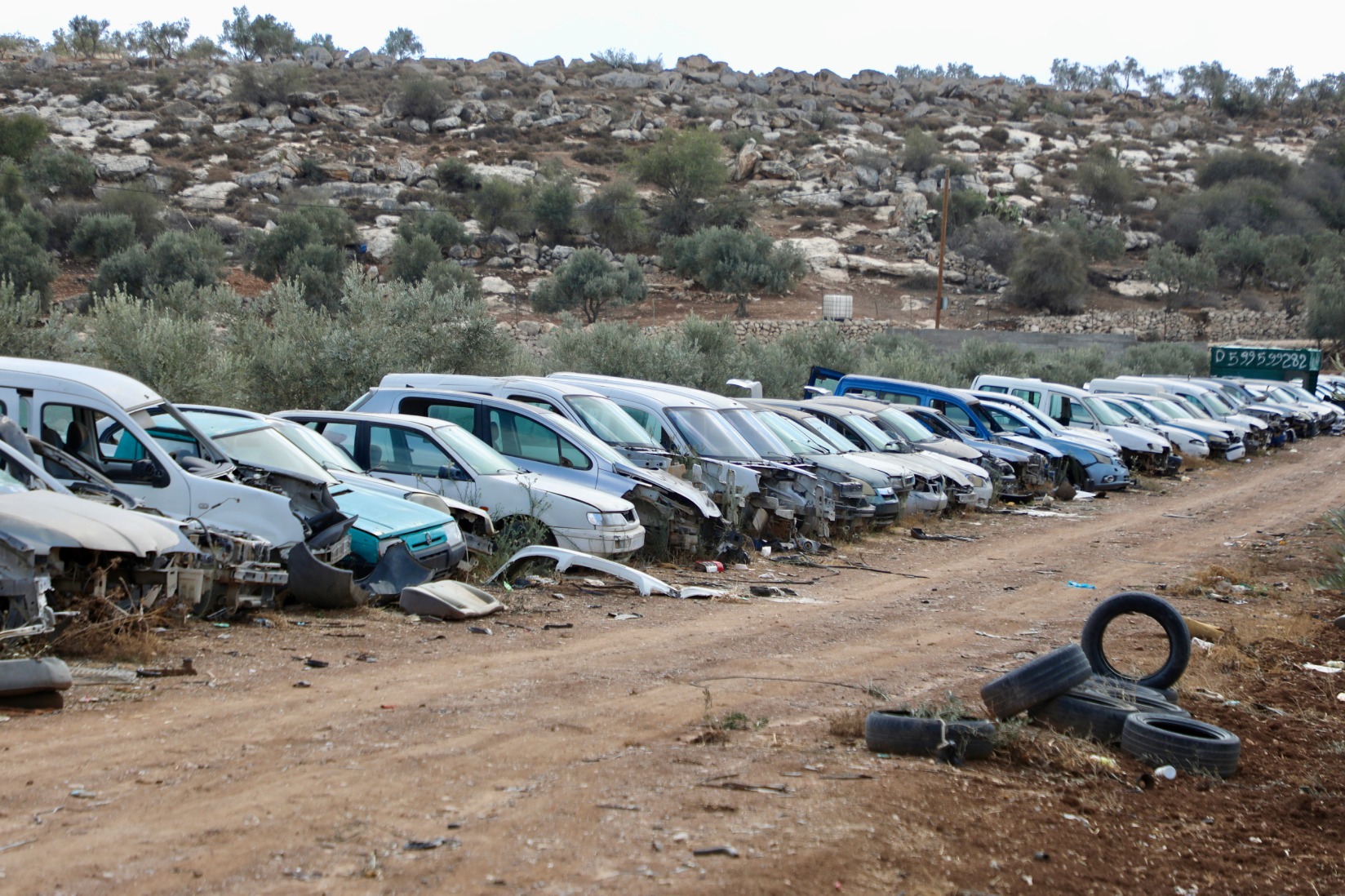
We also visited inspection areas south of Hebron where “totaled”
cars are parked along the streets and even on rooftops, and where
there is an abundance of shops for car repair, vehicles dismantling
workshops, and spare parts.
Eyad Al- Rajabi, owner of a car dealership in that area said that he
buys “totaled” cars and dismantles them to sell as spare parts only.
Mahmoud Tawfiq (alias), another car dealer, admitted he sells “full
body” vehicles, adding: “our profit could range from 100 to 1000
Shekels, to nothing at all.”
This statement was shared by other car dealers we interviewed in the
same area, who all agreed that bringing used (and totaled) cars into
the West Bank was not easy, but that there were some “blind
spots”one could use to smuggle the cars, according to them.


According to official documents, the Palestinian Ministry of Transport
officially issued in 1997, orders that prohibits the import of used
cars from Israel whose customs duty has been paid by Israel which is
still applicable today.
Lawyer Amro Amro states that the law prohibits the buying and selling
of totaled vehicles, but allows trading in their spare parts. We
searched for the decision but could only find what was published on
the web page of the Ministry of Transport.
The decision to prohibit the purchase of duty paid vehicles from the Israeli side became effective in 1997 and is still effective today. The Palestinian Territories and Israel are subject to the same customs coverage, but the Israeli side refuses to transfer any tariffs to the Palestinian Authority Treasury in the event of purchasing Israeli duty paid vehicles. However, no law prohibits the sale of vehicle spare parts, and this constitutes the first loophole used by traders to transfer vehicles into the West Bank.

Yet, the Palestinian Authority still allows the import of certain types of vehicles.
Forty year old Abdulla (alias) spent more than fifteen years working
as a used furniture salesman. He himself is not a trader of “totaled”
vehicles, but through his occasional work as a middle man and due to
his competency in Hebrew, he knows many of the trade’s secrets.
Abdulla explains how a trader comes across totaled cars: “A dealer
will go regularly around neighborhoods and put stickers on totaled
vehicles parked on the side of the road. The stickers include phone
numbers that owners can call if they are interested in selling their
cars.” Abdulla showed us some stickers that he carries himself,
confirming that those cars are often bought to be later dismantled for
their parts to be sold as spares.
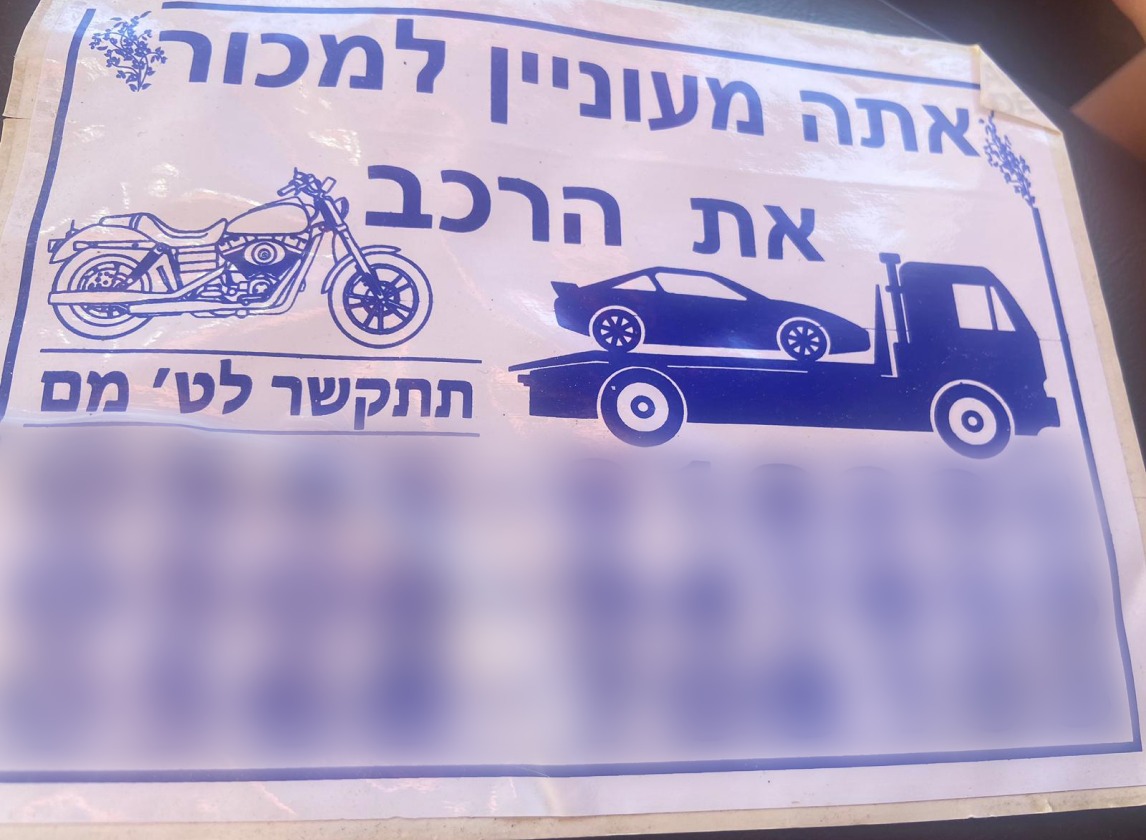
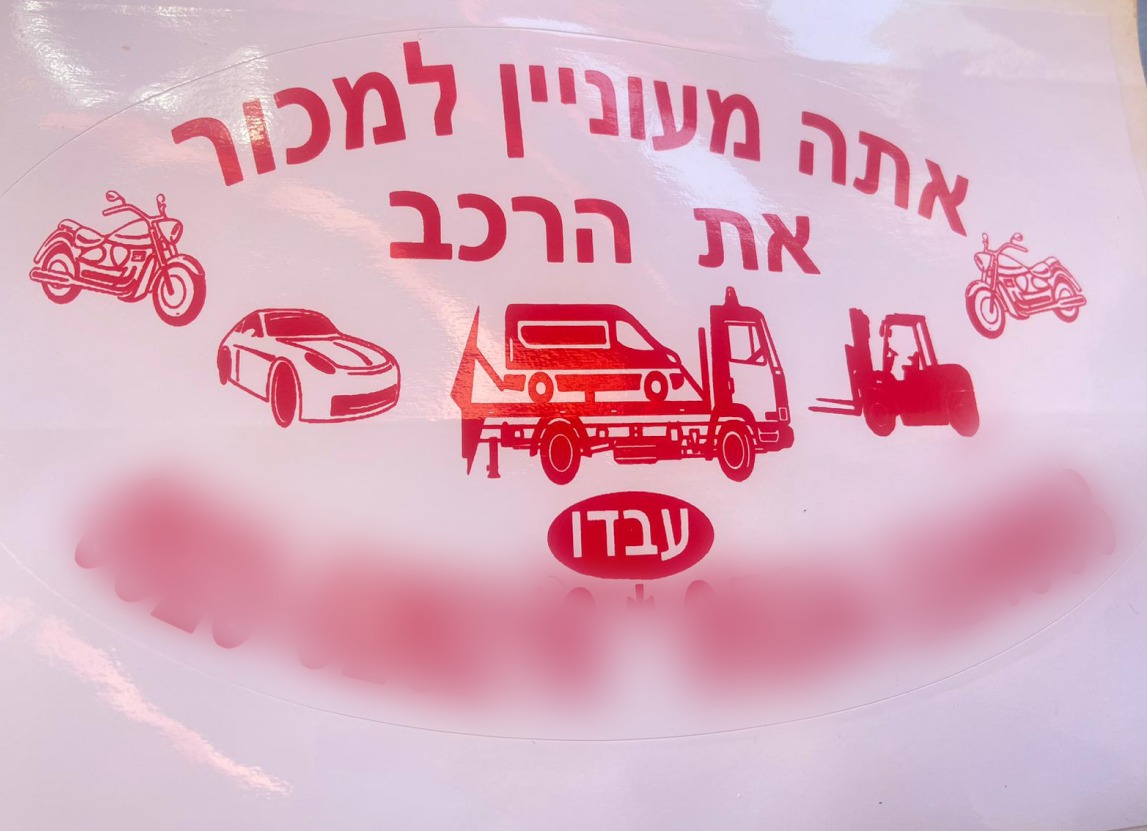
Stickers were written in Hebrew and had Israeli contact numbers. Abdulla translates their content: “Are you interested in selling your car? If so, call this number.”
According to Abdulla, vehicle owners normally remove their license
plates to protect them from illegal use, but some owners choose not to
remove them. He adds that “totaled” vehicles include stolen cars, and
cars which are repossessed by banks due to their owners’ failure to
make the required payments on their loans.
Abdulla explains: “Most “totaled” cars enter on foot; meaning that
their original owners drive them here themselves,” adding that, this
way, the owner receives compensation from the insurance company, after
filing a claim that his vehicle was stolen, and he confirmed that
trade in “totaled” vehicles is quite common in Israel as well.
He continues: “Once when I was walking around the Sabe’ area in
Israel, another dealer was also walking around accompanied by a little
boy. If he comes across a totaled car with a sticker other than his
own, he would send the boy to remove it and replace the sticker. He
would then buy the car, and if the car is in functioning order, he
would drive it himself into the West Bank.”
Traders we met in the inspection area confirmed Abdulla’s account.
Some of these traders receive their cars directly through individuals,
while others receive them through traders who bring them in via
freight carriers.

Click to view the data

To better understand the process, we contacted Baseem, owner of a garage in Israel, who informed us that any trader who wishes to purchase a car to sell as spare parts has to apply for a “clearance” invoice from an Israeli licensing office, which sends the invoice to the Tarqumia checkpoint used specifically by traders. There, approval is given for the entrance of the shipment of vehicles. Baseem adds that violations regarding the sale of these cars as spare parts are usually committed by the Palestinian side since car shipments do not pass without a clearance invoice.
An invoice pertaining to the payment of the value added tax (VAT)
between the Israeli and Palestinian tax authorities. After the
completion of a commercial transaction subject to VAT between an
Israeli party and Palestinian party, the seller issues a special
invoice named a “clearance invoice” which he hands over to the
buyer. Israeli authorities provide the Palestinian side with the
value added tax (VAT) only, which does not include any custom fees
or tariffs.
All shipments transferred from the Palestinian Authority to Israel
or vice versa should have a clearance invoice, and any merchandise
without such an invoice is subject to confiscation and seizure,
according to the law.
Jihad’s heart skips a beat each time she passes by a Palestinian
police car. She tries to hide her anxiety, stays within the speed
limit and always wears her seat belt. Jihad bought her car, a
Volkswagen Polo, for 3000 Shekels (around 780 USD between
August-October 2023). The car is all that she owns, which makes her do
everything possible each time she leaves her home to prevent being
caught by the authorities who confiscate cars with yellow license
plates. She holds her breath as the police officer smiles at her and
allows her to pass, ignoring the yellow Israeli license plate. It is
not the first time this happens and it will not be the last, but she
is afraid that things will not always go as smoothly.
Jihad admits that the high prices of licensed cars made her resort to
buying something “totaled” through some of her acquaintances.
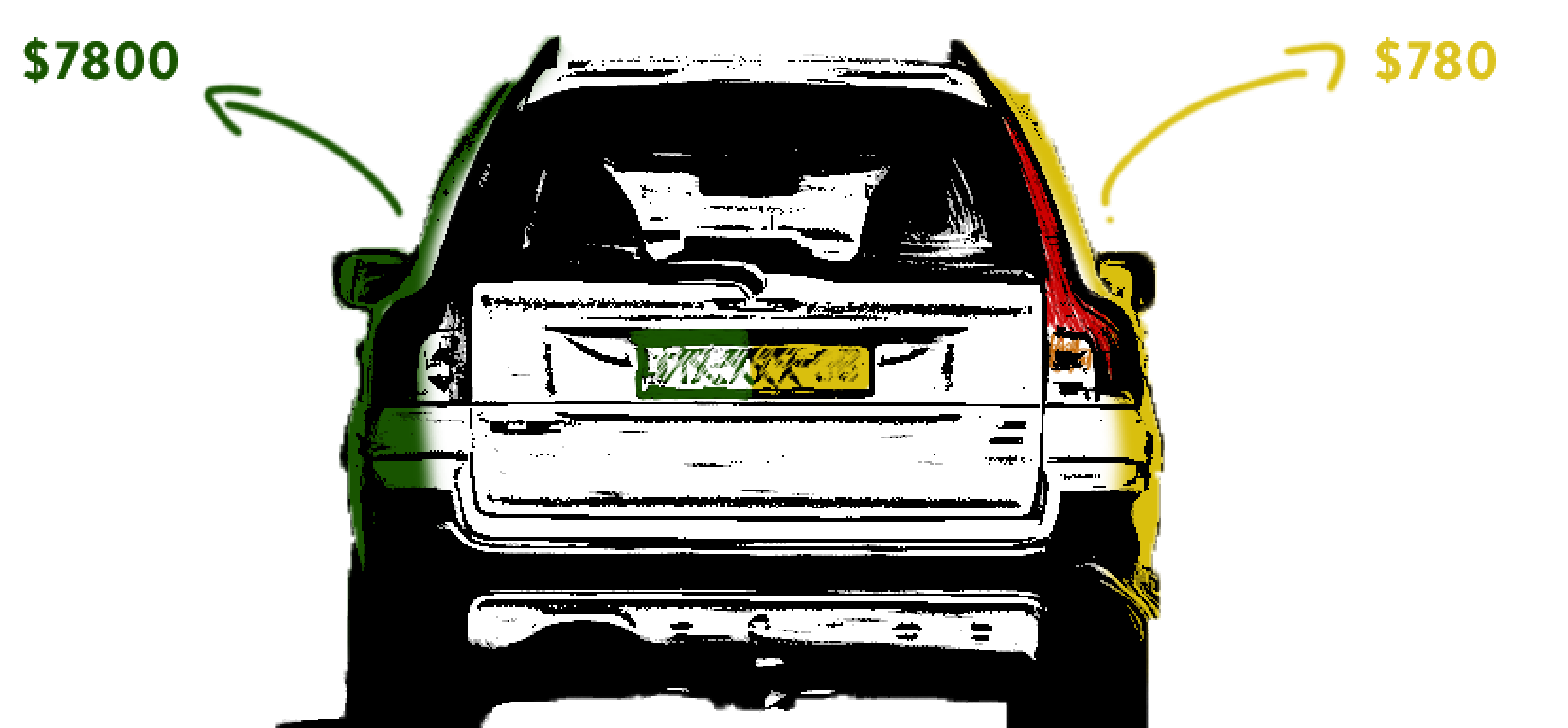
According to the car dealers we interviewed, the starting price for a
“totaled” vehicle is 3000 Shekels (780 USD at the time this report was
prepared). They are quite popular with customers due to their low
price compared to their “licensed Palestinian” counterparts.
Rami Al- Qawasmi, Manager of a customs clearance company confirms that
vehicle prices in Palestinian areas (under the Palestinian Authority)
are much higher than other countries. Musa Rahhal, spokesperson for
the Palestinian Ministry of Transport, agrees with Al- Qawasmi in that
the price of licensed vehicles is much higher than the global market.
In a previous television interview, Rahhal spoke in details about the
value added tax (VAT) imposed on vehicles stating that a tax ranging
between 50% and 75 % is added for gasoline vehicles, after which a
value added tax of 16% is also added. Simply put, a car that sells for
5000 USD globally, will incur an extra 2500 USD, import tax if its
engine capacity is below 2000cc, bringing its price up to 7500 USD.
Add 16% for VAT and its total price becomes 8700 USD.
The Paris Protocol was the agreement that regulated economic relations between Israel and the Palestinian Authority during the interim period, and was signed in May of 1994, and incorporated into the Oslo agreement. According to the Protocol, Israel and the PA agreed to the presence of shared external borders during the interim period with regards to imports from other countries. The Protocol gave Israel sole control on the collection of import taxes and VAT, after which it transfers to the PA the import taxes on goods intended for the Palestinian territories. Also, according to the Protocol, Israel may unilaterally establish and change the taxes imposed on imported goods. As for the VAT, Israel transfers to the PA the collected tax revenue for goods and services sold in Israel and intended for consumption in the Palestinian Territories. All transfers are to be carried out on a monthly basis.
During the past five years, the rate of traffic accidents in Palestine rose from 2.6% to 17% according to the annual reports of Palestinian Police between 2019 and 2022. According to estimates by Colonel Bashir Al- Natsheh, Head of the Police Public Relations Department in Hebron, 50% of these accidents involve “totaled” cars carrying yellow license plates.
The coffins of death (“totaled” written off cars), as Al- Natsheh and
others like to call them, are behind the daily traffic accidents that
cause death and injury given the fact that they do not go through any
inspection to guarantee their safety.
Twenty one year old Mohammad lost his life after the brakes of his
“totaled” car malfunctioned causing his immediate death and serious
injuries to the passengers accompanying him. It is worth noting that
two of Mohammad’s friends who were with him on the day of the accident
still choose to drive “totaled” vehicles. Mohammad’s friend, Al-
Suwaity, who preferred not to answer many of our questions, says:
“Although we still ride “totaled” cars, we remain afraid, and if
someone’s speed surpasses 60 km/h, I immediately get out of the car.
The horrific accident that took the life of Al- Suwaity’s friend is a
recurring scenario in Beit Awwa, and all over the West Bank. Our
investigation examined several traffic accidents that took place in
the town during the past three years, involving the loss of many
lives. They all had one common denominator as they all involved a
“totaled” vehicle with a yellow license plate.
Engineer Mahmoud Manasrah, Deputy Director of the Department of
Vehicle Inspection in the Governorate of Hebron states that “totaled”
vehicles do not pass inspections for technical and legal reasons.
“They have very low safety standards, and have been “totaled” either
because of a bad accident, or due to severe damage to their steering
or braking systems, all of which cause much harm in the event of an
accident. These cars do not undergo annual safety inspections that
guarantee their eligibility to be on the roads.”
Manasra adds: “It is well known that drivers of “totaled” vehicles are
mostly reckless young adults. So, we are dealing with unsafe vehicles
both technically and legally, in addition to unqualified drivers.”
This substantiates an analytical study on traffic accidents in Israel,
which showed that traffic accidents involving older vehicles had
double the rate of mortality than those involving other newer
vehicles. Add to that the higher levels of pollution caused by these
cars compared to newer models. In the past, Israel had put into effect
a program to eliminate car models older than 20 years, in return for a
financial compensation paid by the government.
Colonel Bashir Al- Natsheh points to another problem, stating that
some of these cars are used for theft, drug trafficking and other
forms of crime, since their license plates are unregistered and,
hence, difficult to track.
Lawyer Amro Amro confirms that there is no legal stipulation, like the
traffic law, for dealing with unlicensed “totaled” vehicles.
Therefore, traffic and road safety authorities either confiscate
violating vehicles, fine their owners, or refer their cases to court
according to their discretion.
Amro adds that there is no defined legal punishment for a driver or
dealer caught using a “totaled” vehicle, only a fine which does not
exceed 180 Dinars (250 USD) set according to a judge’s discretion.
Palestinian Traffic Law allows a police officer to arrest the driver
of a vehicle with no license plate, which applies to drivers of
“totaled” vehicles. It also allows the confiscation and seizure of any
vehicle with no license plate.
As for the role of the Ministry of Transport in dealing with “totaled”
vehicles, Musa Rahhal says that the ministry demolishes “totaled” cars
after their confiscation by the police according to customs law, since
they are considered to be smuggled goods.
Who is responsible then for allowing these types of vehicles to pass through checkpoints?
Israel controls all checkpoints leading to and from the West Bank.
This means that it is solely responsible for controlling who and what
passes through, yet it continues to turn a blind eye.
Rami Al- Hroub, legal researcher and political science professor, says
that Israel has long been using the territories of the West Bank as a
dump yard to dispose of its garbage and any surplus it has. He sees
the problem of “totaled” cars as “detrimental to the national
economy.”
Although this investigation could not reach any conclusive evidence to
prove Israel’s involvement in facilitating the entrance of these
vehicles into the West Bank, Al- Hroub states that Israel has an
interest in transferring these cars to the territories as a means to
directly and indirectly harm the national economy, especially when
people stop buying imported cars and stop paying licensing and
insurance fees.
Finally, Jihad’s car could end up in the demolition machine, the
freight carrier truck carrying totaled cars could return right where
it came from, or its cargo simply seized and confiscated. Nobody can
tell. But what is for sure, is that the cost of purchasing a “totaled”
vehicle, or say five even, will always be cheaper than purchasing a
new licensed car in Palestine.
This investigation was completed with support from ARIJ