This investigation shows how Saudi Aramco is using social media to promote its efforts to reduce emissions, while the company’s own reports show an increase in carbon emissions, a rise in carbon intensity, and a surge in the volume of gas flaring from oil production and extraction.
When Ferran Torres scored the goal this year that gave Spain its second World Cup title, the stands at the MetLife Stadium in New Jersey were a sea of red, as Spanish fans cheered their team’s goal - and sky blue, as Argentina bade farewell to their title. What seemed out of place in this scene was not a color but a name: that of Saudi Aramco, the world’s largest oil company, which featured on green hoardings all around the pitch, and blended in with the color of the grass they stood on.
During the tournament, around 10,000 minutes [166 hours] of matches were broadcast internationally. Throughout that time, the name of the world’s largest oil producer was blazoned across ads as the tournament’s “main and exclusive global energy partner” - not “oil partner”. This choice of wording was no coincidence.
Oil is a negative brand, said Tim Calkins, a professor of marketing at Northwestern University, on the US economics program Market Place, “but everyone values energy”. Kristian Coates Ulrichsen, a Middle East affairs specialist at Rice University’s Baker Institute, thinks that what Aramco and other brands are doing “is what’s normally called sportswashing”.
The message is not confined to football pitches. A more formal version is presented at international conferences, using statistics and promises.
Increasing Carbon Intensity and Emissions
“We must make systematic transformations in our operations, integrating three key elements: affordability in energy economics, security of supply, and reduction of carbon emissions and sustainability.”
With these words, Fahad Al-Abdulkareem, Executive Vice President of Exploration and Production, reaffirmed Saudi Aramco’s commitment to reducing carbon emissions in the energy sector. He was speaking at the annual Baker Hughes meeting in Florence in February 2025.
The Aramco executive’s speech was one of a number of statements and public relations campaigns run by the company between 2020 and 2026, using international conferences and sponsored posts on social media, to “highlight its efforts to reduce emissions”.
Yet in contrast to these claims, the company’s sustainability reports show an increase in carbon emissions, a rise in carbon intensity, and a surge in gas flaring; all as a result of the company’s increased production.
 Aramco’s sustainability report indicates an increase in the
intensity of carbon emissions
Aramco’s sustainability report indicates an increase in the
intensity of carbon emissions
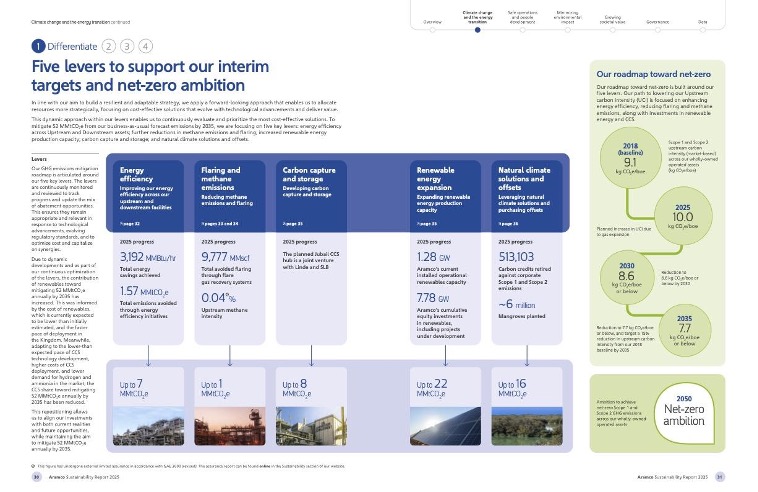
A promotional video posted in March 2026 on Aramco’s official page on ‘X’ – which garnered 16,000 views – showed that the carbon intensity for each barrel of oil extracted by Aramco in 2025 was 10 kilograms of carbon dioxide (CO₂) equivalent per barrel of oil equivalent. Aramco called this figure in its 2025 Sustainability Report “one of the lowest upstream carbon intensities per barrel of all the world’s major oil and gas companies”.
The company also promoted itself via a paid ad on Meta in 2026, saying it “produces energy at scale, with low upstream carbon intensity”.
Aramco failed to mention in its sponsored ad on X that the carbon intensity per barrel produced had gone up from 9.1 to 10 kilograms of CO₂ equivalent between 2018 and 2025.
The company’s carbon intensity is still well above the levels it has promised to achieve. Aramco has previously announced that it aimed to bring down its carbon intensity to 8.6 kilograms of CO₂ equivalent per barrel of oil equivalent by 2030, and then to 7.7 kilograms by 2035, and that the company’s operations would produce net-zero emissions by 2050.
We tried to compare carbon intensity per barrel between Aramco and its competitors, but doing so proved difficult, because of the different metrics each company employs. While Aramco uses carbon intensity in extraction, covering Scopes 1 and 2, BP measures greenhouse gas intensity for upstream operations, production and liquefied natural gas - also covering Scopes 1 and 2. Shell, meanwhile, uses a net carbon intensity indicator across its entire value chain.
The disparity becomes even more apparent when comparing total absolute emissions between companies. According to data in Carbon Majors, produced by the Influence Map think tank in January 2026 - which measures the emissions of 166 of the world’s largest oil, gas, coal and cement companies - Saudi Aramco topped the global list with emissions totalling 1.786 billion metric tons of CO₂ equivalent, which was 4.28 percent of all global emissions.
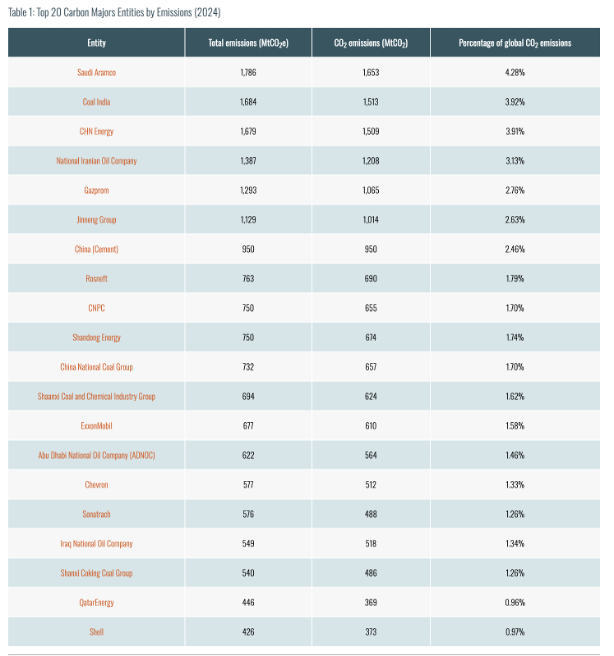 List of the world’s 20 biggest carbon emitters
Saudi Aramco also ranked third on the list of the largest carbon emitters over the period 1854 - 2024, with 72.457 billion tons of CO₂ equivalent.
According to the company’s 2025 reports, total Scope 1 and 2 emissions (market-based) rose by 5.1 percent, whilst the carbon intensity of emissions from exploration and production operations increased by 3 percent, compared with 2024.
Aramco’s total carbon emissions and carbon intensity
The company did not release market-based figures for 2020 and 2021
This contrasts with messages Aramco posted on Meta in 2024 to promote the construction of two natural gas plants in Saudi Arabia, which said that the project “marks the beginning of a new era in natural gas extraction”, and aims to increase gas production while reducing CO₂ emissions by around 40 million metric tons per year.
The rise in the company’s carbon emissions reflects its expansion of production. This is something it acknowledges on its website, attributing the increase in emissions from exploration and production activities in 2025 to “increased gas production to meet growing domestic demand in the kingdom (Saudi Arabia)”.
The Saudi government directly holds 81.48 percent of Aramco’s shares, while the Public Investment Fund (the Saudi sovereign wealth fund) and some of the fund’s companies hold 16 percent. Most of the company’s emissions therefore come from an entity under the control of the state, which signed the Paris Agreement in 2016, and in 2021 pledged to reduce its emissions by 278 million metric tons annually by 2030.
Aramco’s total production of liquids (crude oil, condensates and liquefied gases) reached 10.6 million barrels a day in 2025, compared with 10.2 million barrels a day in 2024, an increase of around 4 percent.
The company’s operating profits in the exploration and production sectors in 2025 were 731.8 billion Saudi riyals (US$195.1 billion), compared with 801 billion Saudi riyals (US$213.5 billion) in 2024. Aramco put this decline in profits down to a fall in oil prices from an average of US$80.2 per barrel in 2024 to an average of US$69.2 in 2025, though it partially offset this with an increase in the volume of crude oil sold.
Through its advertising campaigns on Meta, the company also promoted “carbon capture and storage” technology as one of the main ways of reducing emissions. It repeatedly stated in its ads between 2020 and 2025 that “reducing emissions requires solutions”.
The Stumbling Block When It Comes to Carbon Capture and Storage
Fahad Al-Dhubaib, Aramco’s Vice President for Strategy and Market Analysis, told the 2023 Future Investment Initiative meeting about the importance of “pacing the transition in the energy sector to achieve a realistic balance between emissions reduction and economic growth”, according to the text accompanying an ad the company posted on Facebook between October 27 and November 7, 2023. The video featured Fahad Al-Dhubaib announcing Aramco’s intention to build in Jubail one of the largest carbon capture, utilization, and storage (CCUS) facilities, with operations expected to begin in 2027.
A post of Aramco on X platform
By contrast, the World Energy Outlook 2025 report, published by the International Energy Agency (IEA) in November 2025, scaled back its assessment of the effectiveness of CCUS technology in achieving net-zero emissions. The agency now attributes only around five percent of total required global emissions reductions to this technology, compared with around 13 percent in its 2021 report. This cumulative decline over five years, reflects the IEA’s view that this technology has expanded globally at a slower pace than expected.
Recent scientific studies have also cast doubt on the feasibility of carbon capture and storage technologies. One such, titled “Carbon Capture and Storage: An Evidence-Based Review Reveals the Technology’s Limitations and Failure to Deliver on Its Promises,” published by Petroleum Research in October 2025 - indicates that, despite more than US$40 billion being invested globally in carbon capture and storage, the technology is capable of capturing less than 0.1 percent of annual global CO₂ emissions. This raises serious questions about how effective it can be as a “climate solution.”
Following a series of sponsored advertisements promoting this technology, Aramco signed the final shareholders’ agreement for the Jubail Carbon Capture and Storage hub, in December 2024, at the Saudi Green Initiative Forum in Riyadh. Aramco took the largest stake, at 60 percent, with Linde and SLB split the remaining shares equally. The first phase of the project was scheduled for completion in 2027.
Although more than a year has passed since the signing, the project is still described in the 2025 Sustainability Report as a “planned project”. And neither official statements nor publicity material mention a legal name for it, merely describing it as a “joint venture” between the three parties.
To verify the legal status of the project, we reviewed Aramco’s 2025 consolidated financial statements, in particular the note on “Investments in joint ventures and associates”, which, under International Financial Reporting Standard (IFRS) 12, is required to include the names of joint ventures of material significance.
However, we found no explicit mention of the project or any indication of its legal name. Even though the standard permits non-material projects to be grouped together without disclosing their names, this leaves open the possibility that Aramco’s investment in the project has not, as yet, reached the level requiring separate disclosure.
It is important to note that the signing of a shareholders’ agreement does not, in itself, constitute an accounting investment that should appear in financial statements. As long as a “final investment decision” has not been taken and capital has not been put in, there is no “interest in another entity” that would require disclosure under IFRS 12.
71 Sport Sponsorship Deals: The Other Side of the Sustainability Story
Sponsored conferences and advertisements were not the only arena Aramco chose to promote its climate narrative. In parallel, the company was building a platform with a wider audience and less scrutiny: world football.
In April 2024, FIFA announced that Aramco had become “FIFA’s exclusive global partner in energy” through the end of 2027 – taking in the 2026 World Cup and the 2027 Women’s World Cup. Neither side would disclose how much the deal was worth.
This did not go unchallenged from within the sport. More than 100 professional female footballers signed an open letter in October 2024, calling on FIFA to reconsider the deal, because of the company’s contribution to the climate crisis and Saudi Arabia’s human rights record.
The cost to the climate from this sponsorship deal was highlighted by the report FIFA’s Climate Blind Spot, published in July 2025 by the UK organization Scientists for Global Responsibility, in collaboration with the US-based Environmental Defense Fund, the Cool Down sports network for climate action, and the New Weather Institute. The report estimates that the 2026 World Cup was the most polluting in the tournament’s history, resulting in the emission in roughly 9.02 million metric tons of carbon dioxide equivalent.
Football was neither the first nor the most recent of these partnerships.On March 10, 2020, Aramco signed a long-term global partnership with Formula 1. And it moved into cricket in 2022, when it entered into a partnership with the International Cricket Council, which has since been extended by four years.
In golf, too, the company name has been attached to tournaments, like the Aramco Team Series and the Aramco Saudi Ladies International.
According to the report “Saudi Arabia’s Grip on Global Sport,” published by the Danish organization Play the Game in December 2024, Aramco is the second-largest Saudi sponsor of sport, with 71 sponsorship deals spanning football, golf, cricket and other sports. This is despite the company being considered the largest institutional contributor to global greenhouse gas emissions since 1965.
The report notes that this expansion into sport is being led by Yasir Al-Rumayyan, Chairman of Aramco, Governor of the Public Investment Fund (Saudi Arabia’s sovereign wealth fund), President of the Saudi Golf Federation, and Chairman of English football club Newcastle United. He is the same figure whose speech on carbon management technologies at the Saudi Green Initiative Forum was promoted by Aramco in a company ad on Meta.
These 71 sponsorship deals present a paradox.. Just like Aramco’s advertising campaigns, they cannot increase the company’s sales of crude oil and its derivatives (which account for 95.8 percent of its revenue), because the Saudi Ministry of Energy and its commitments to OPEC+ put a ceiling on production. So if the aim is not to attract new customers, what is the company seeking to gain through these sponsorships?
Coinciding With Climate Events
Data from the Meta Ad Library shows that a number of sponsored online posts coincided with international events related to climate action. Aramco put out a video in which Fahad Al-Dhubaib discussed the CCUS project in Jubail in the weeks leading up to the UN Climate Change Conference (COP28) in Dubai, which took place between November 30 and December 12, 2023.
According to the register of ads, Meta subsequently removed the ad after classifying its content as “relating to social issues, elections or politics” – a category that requires advertizers to clearly disclose who has funded a particular ad, which Aramco did not do in this case.
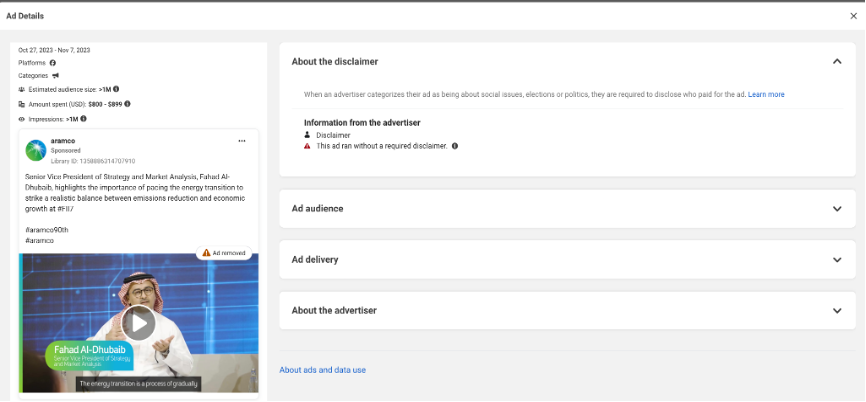 Details of Fahad Al-Dhubaib’s ad from the Meta Ad Library
A search of Meta’s data library over the same period turned up another Aramco ad entitled: “How is the Jazan Refinery Complex contributing to a smarter energy system with lower carbon emissions?” It was posted on November 30, 2023 - the day COP28 opened - and was viewed by more than 30,000 people before Meta removed it.
A report by the eco charity Carbon Copy said that the oil giants had spent around $5 million disseminating misleading climate information through advertizing on Meta ahead of the 2023 climate summit in Dubai.
Aramco published a third ad on December 4, 2023, two days after its signing of the Oil and Gas Decarbonisation Charter was announced. This sponsored post included a video featuring Aramco Chairman Yasir Al-Rumayyan speaking at the Saudi Green Initiative Forum about the company’s investments in technologies to manage carbon, as well as carbon capture and storage technologies.
The company’s promotion of its message “a realistic balance between emissions reduction and economic growth” came before Aramco and US company ExxonMobil spearheaded the Oil and Gas Decarbonisation Charter, which was signed by around 50 oil and gas companies during the Dubai summit. Under this charter, they pledged to decarbonize their operations, while committing to continue to meet the demand for energy, but did not publicly undertake to reduce oil and gas production.
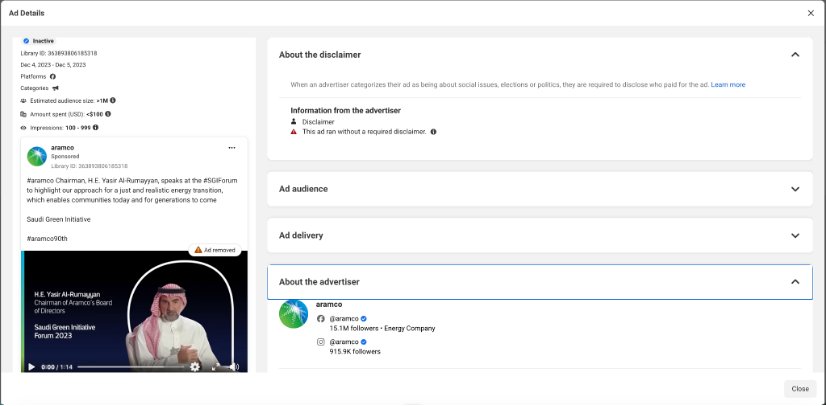 Aramco sponsored post on Meta in which Yasir Al-Rumayyan
discusses the company’s technology for managing carbon
Aramco sponsored post on Meta in which Yasir Al-Rumayyan
discusses the company’s technology for managing carbon
David Tong is Global Industry Campaign Manager at Oil Change International – a Washington-based organization that specializes in uncovering the true costs of fossil fuels and pushing for a transition to clean energy. He described the Oil and Gas Decarbonisation Charter as a “Trojan Horse” used by major oil and gas companies to whitewash their environmental reputations, with its vague promises and recycled commitments. Moreover, the charter only covers operational emissions, ignoring the fact that 80 to 90 percent of climate pollution caused by these companies comes from burning the oil and gas they produce.
Continued Gas Flaring
Aramco’s advertizing was not limited to claims about reducing its carbon emissions. It posted an ad on Meta - to coincide with the COP28 UN Climate Change Conference in Dubai at the end of 2023 – pledging to achieve “zero routine gas flaring” as soon as possible. Meta removed the ad, however, just one day after it was published, for the same reasons it had taken down the previous one.
Despite Aramco’s claims that it intends to reduce gas flaring, its 2025 Sustainability Report shows an increase in the volume of gas flared from 27.5 billion standard cubic feet (SCF) in 2023 to 32.5 billion in 2025, an increase of 18 percent. The intensity of flaring also went up from 5.64 SCF per barrel of oil equivalent in 2023 to 6.65 in 2025.
Saudi Arabia is one of the countries that had the highest levels of gas flaring in 2025, with 2.4 billion cubic meters of gas flared, according to World Bank data.
The Saudi government and Aramco have both said that they support the World Bank initiative, launched in 2015, to phase out routine gas flaring by 2030, since it causes CO₂ emissions and releases soot and other pollutants that accelerate climate change.
We contacted Aramco for a response to the increase in its carbon emissions and in routine gas flaring, but we have yet to receive a reply.
Total gas flared by Aramco and flaring intensity
Right up until July 2026 – the month the World Cup ended – Aramco continued to promote its climate messaging on Meta. This featured ads highlighting its support for biodiversity and wildlife in Saudi Arabia; its sponsorship of the World Cup’s Young Player award; and its efforts to inspire the next generation of engineers by connecting STEM students with engineers from the Aston Martin Aramco Formula 1 team.
At the same time, Aramco states on its website that: “Reducing carbon intensity in the early stages of the supply chain starts with asking the right questions”.
Asking the right questions, however, does not require an ad. And the answers are not to be found on billboards around stadiums, but in Aramco’s own reports. These state that carbon intensity rose from 9.1 kg per barrel to 10 kg between 2018 and 2025, despite the company’s pledge to reduce it to 8.6 kg per barrel by 2030. Absolute emissions totalled 1,786 million metric tons of CO₂ equivalent. This put the company at the top of the global corporate rankings, accounting for 4.28 percent of all global emissions.
The amount of gas flared also rose by 18 percent over two years to 32.5 billion SCF. And the carbon capture project in Jubail, more than a year after the shareholders’ agreement was signed, is still described in the company’s own report as a “planned project”.
Aramco’s partnerships with FIFA and with the International Cricket Council expire at the end of 2027. Its sponsorship contract with Aston Martin runs until 2028, while the partnership with Formula 1 continues until 2030 – the date by which Aramco has pledged to reduce its carbon intensity to 8.6 kg per barrel. Until then, the gap between promises and reality continues to raise unanswered questions.
This investigation was produced in partnership between ARIJ and Muwatin