"Blue" war zone
Unrestricted calls on Meta for the destruction and settlement of Gaza

sherif mourad

19 September 2024
sherif mourad
19 September 2024
The investigation reveals the unrestricted spread of violent against Palestinians on Facebook and Instagram, while algorithms on these platforms restrict content supportive of Palestine.
After Israel began its military ground operation against Hamas in
Gaza, on October 27, 2023, Egyptian doctor Ghada Sadek uploaded to her
Facebook page a video clip showing an Israeli drone pursuing and then
striking a young man.
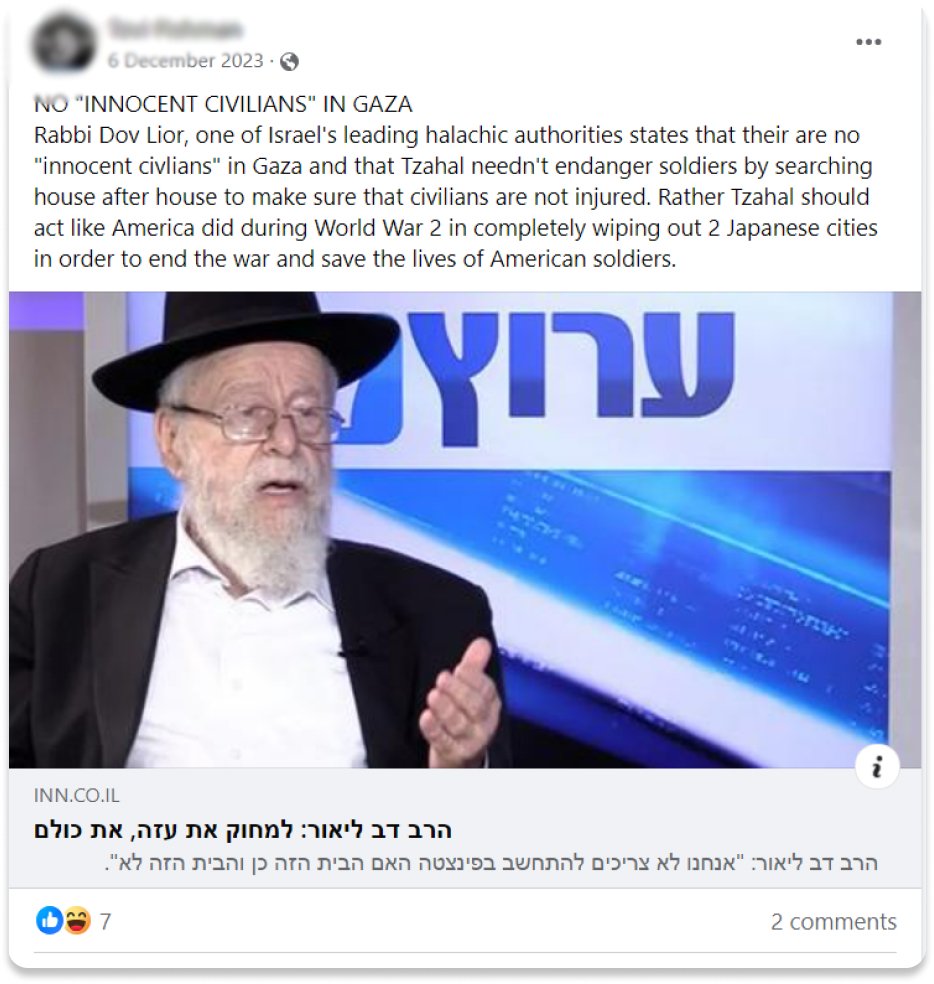
Meanwhile, Israeli writer Tzvi Fishman published a post on his
Facebook page saying: “There are no innocent civilians in Gaza.”
Fishman quoted Rabbi Dov Lior, the chief rabbi in Hebron, as saying:
“The Israeli army does not need to endanger its soldiers by searching
houses one by one to make sure there aren’t wounded civilians. It
should follow the example of America in World War II, when it wiped
out two entire Japanese cities to end the war and save the lives of
American soldiers.”
The video posted by Sadek stayed up only for a few hours before being
deleted, and her account was suspended for 24 hours, allegedly for
“violating Facebook’s standards.” But Fishman’s second post, saying
that “there are no innocent civilians in Gaza,” was not deleted.
The author of this report - in cooperation with the Arab Center for
Social Media Advancement (7amleh), which specializes in digital rights
– set up a database register of 50 posts by Israeli citizens and
public figures, led by Minister of National Security Itamar Ben Gvir,
and pages affiliated with Israeli media institutions on the two Meta
platforms - Facebook and Instagram. These posts contained calls for
violence against civilians, the forced displacement of Palestinians,
as well as a halt to humanitarian aid entering the Gaza Strip.
Legal experts we spoke to agreed that these posts constituted a
violation of Meta’s policy of combatting hate speech, and were an
encouragement to carry out actions prohibited under relevant
international laws.
This contradicts Meta’s claim to be implementing equally across all
countries, its policies “violent and shocking content,” in response to
reports by rights group and the media accusing the American based
company of showing bias favouring Israel by deleting Palestinian
content that is considered peaceful.
In its response to this investigation’s findings, Meta said that it
might make mistakes, given the fast-paced nature of the current war,
but denied that there was deliberate bias towards one party over
another.
But the problem does not stop here. Calls for the resumption of
settlements construction have been made by some Facebook groups, which
quickly moved from the realm of cyberspace to reality, with events
organized on the borders of Gaza, calling for settlement construction
revival in the strip.
Saida Mallah, a journalist from Morocco covering the war in Gaza, published regular updates about the war on her social media platforms. However, after she posted images of what the media dubbed the “Tents Holocaust” - a raid on Rafah by the Israeli Air Force on May 26, 2024, which left at least 45 Palestinians dead, mostly women and children - her Telegram account was suspended, and she had great difficulty retrieving it. Saida attributes this “technical glitch” in her account to her decision to post material showing human rights violations during the war in Gaza.
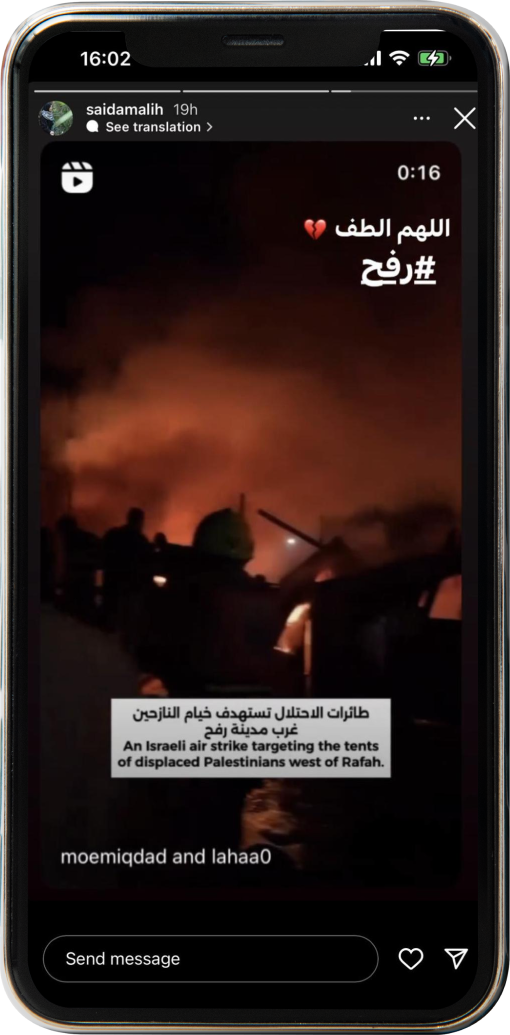
Saida Mallah’s post is one of 20 which this reporter has shown to have
been deleted and/or restricted by one of the two Meta platforms. Most
of these posts deal with human rights violations, carry news of the
war, or share analytical pieces on Palestine.
In contrast, we collected 50 posts published by Israeli Facebook and
Instagram accounts, following the attacks of October 7, 2023. These
posts included violent rhetoric directed against Palestinians and
Arabs in general. There were calls for the extermination of the people
of Gaza, with no distinction made between civilians and combatants,
and for stopping humanitarian aid entering the Strip. Nor were these
limited to Gaza, as some users demanded that the Lebanese capital,
Beirut, be turned into another Khan Yunis, in response to Hezbollah
attacks in northern Israel. Some posts also put out misleading
information and images.
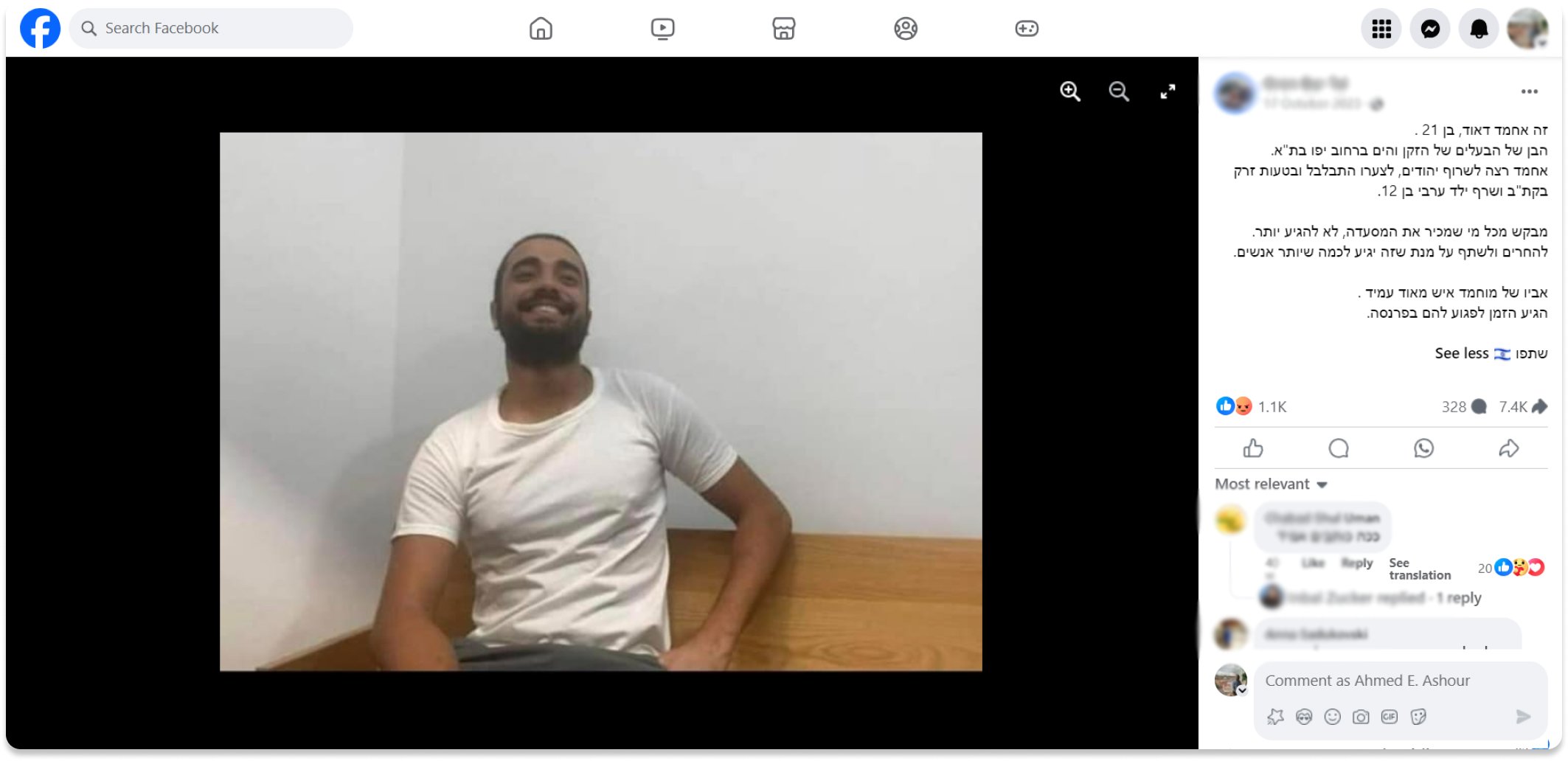
We collected these posts, in cooperation with the “7amleh” centre and,
in consultation with independent legal experts, analysed a sample of
five of them to see how far the company was complying with its stated
policy on hate speech and with relevant international agreements.
These posts remained available on the Meta-owned Facebook platform up
to the time when we confronted the company with the findings of our
investigation.
When we sent Meta the posts, under its right-of-reply policy, the
company deleted eight out of the total 50 posts “for violating Meta
community standards.”
There are no innocent civilians in Gaza, and the army should not put soldiers at risk by searching houses individually to make sure civilians are not injured. The military should instead follow the American policy during World War II, when it annihilated two Japanese cities to end the war and save the lives of US soldiers.
This post advocates doing things that violate international
humanitarian law, which provides for the protection of
civilians in conflict zones.
The post violates Meta's anti-hate speech policy, since it
calls for violence against a particular ethnic group.
There are no innocents! They are all terrorists.
This post calls for depriving Gazans of the status of “civilians” during war, which violates rules for the protection of civilians in conflict zones, established by international humanitarian law and the Fourth Geneva Convention.
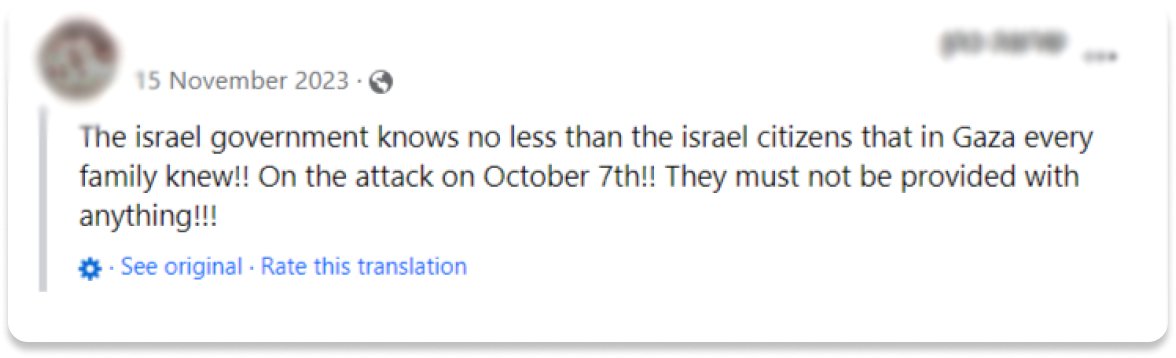
The Israeli government and all citizens of Israel are aware that every family in Gaza knew about the October 7th attack!! We shouldn’t be giving them anything!!!
This post calls for the withholding of humanitarian aid from the people of Gaza. This is a violation of international humanitarian law, in particular the Geneva Conventions, which stipulate the need for humanitarian assistance to be provided to civilians in areas of conflict.
Ahmed wanted to burn the Jews, but unfortunately, he got confused, accidently threw a Bible on the ground and burned a 12-year-old Arab child. I ask everyone who knows where the restaurant is not to go back there again. Share this so it reaches as many as possible. Ahmed's father is in the resistance, so it's time to hit them in their pockets.
This post contains misleading information. A reverse image
search shows the photo was taken in 2021 and has nothing to do
with current events. News published about the incident at this
time made no mention of desecration of the Bible.
The post may violate Meta standards by containing misleading
information, circulated with the aim of harming specific
individuals.
This testimony is very difficult to hear, but it’s important
for everyone to hear it, because some still feel sorry about
the harm done to the people of Gaza. They are the next
generation of perpetrators of these crimes.
Burn Gaza and destroy their descendants once and for all!
The post advocates actions that breach international
humanitarian law, which provides for the protection of
civilians in conflict zones.
The post also violates Meta's anti-hate speech policy, by
calling for violence against a particular ethnic group.
When Egyptian legal expert Yasser Saad reviewed the database of
content suspected of containing hate speech, he said that most of it
breached Article 20 of the International Covenant on Civil and
Political Rights, which prohibits hate speech.
Legal researcher at the University of Antwerp in Belgium, and a
specialist in genocide, Maha Abdallah agreed, saying this content
constituted incitement to commit genocide and ethnic cleansing of
Palestinians. She added that the management of Meta should meet its
legal and moral responsibilities by taking decisive measures against
such content.
The “7amleh” centre had already identified more than eight thousand
cases of digital violations of pro-Palestinian content on social media
sites. Removing or restricting access to this content constitutes
about 40 percent of all recorded breaches of the guidelines.
The centre has meanwhile been keeping tabs on the increasing amount of
what it describes as “violent” content, posted after October 7, 2023.
This reached a peak on October 9, with more than 120,000
anti-Palestinian posts on social media.
Jalal Abukhater, Advocacy Manager at “7amleh”, says that permitting
the posting of content that promotes hate speech and incitement in
this way, poses a major threat to the lives and safety of
Palestinians. He adds meanwhile that suppressing Palestinian content
silences voices seeking to reveal human rights violations during the
war in Gaza.

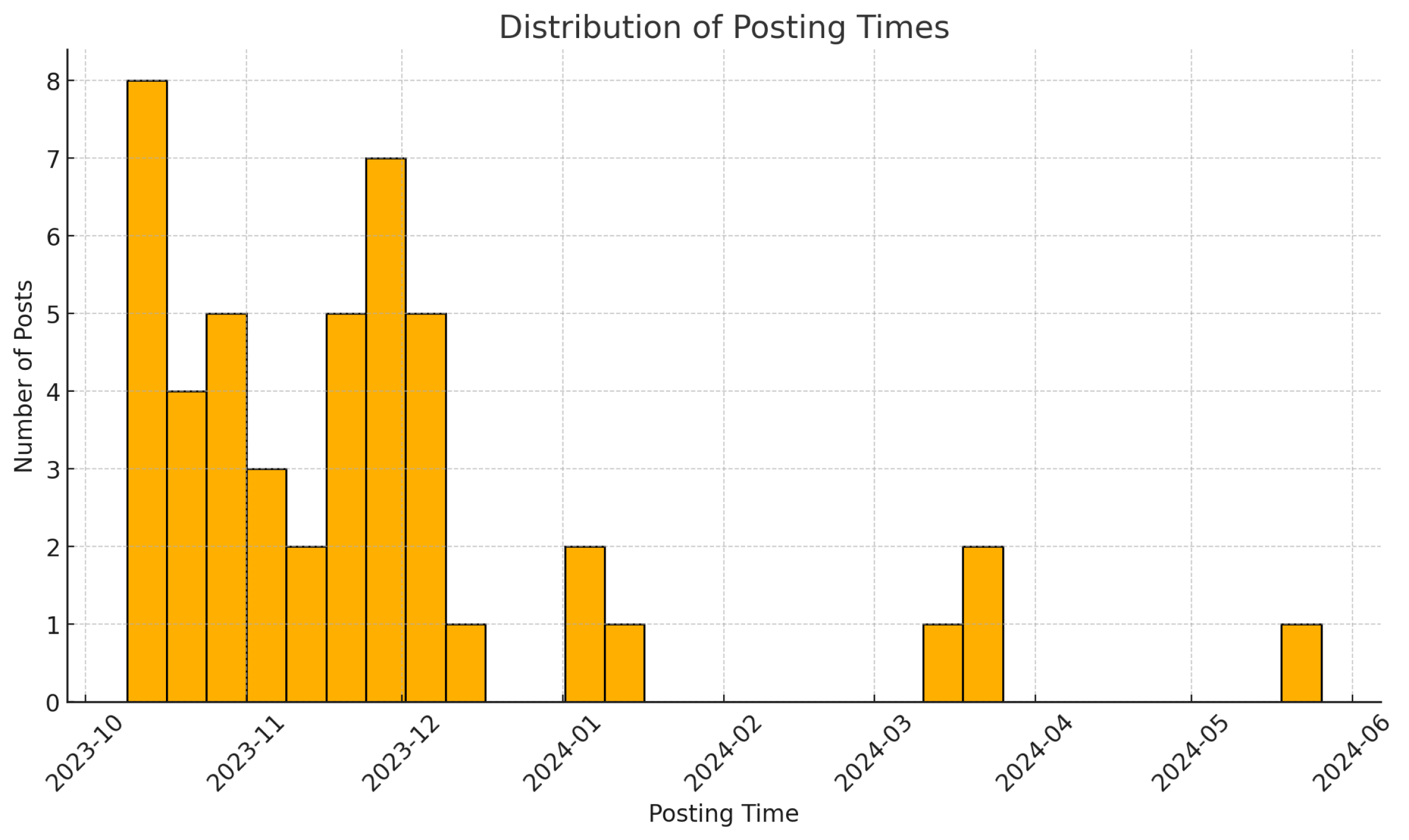
Analysing the date of publications of the posts that are the focus of
our investigation shows that the majority were published in the three
months following the outbreak of the war. This was followed by a dip
in the intensity of postings, though those containing violent speech
continued to appear at varying intervals up to June 2024.
Network analysis by this reporter of the accounts of individuals posting violent content shows that they are all followers of the account of Israeli Minister of National Security Itamar Ben Gvir, whose official Facebook page represents a central node around which the accounts in our sample revolve.
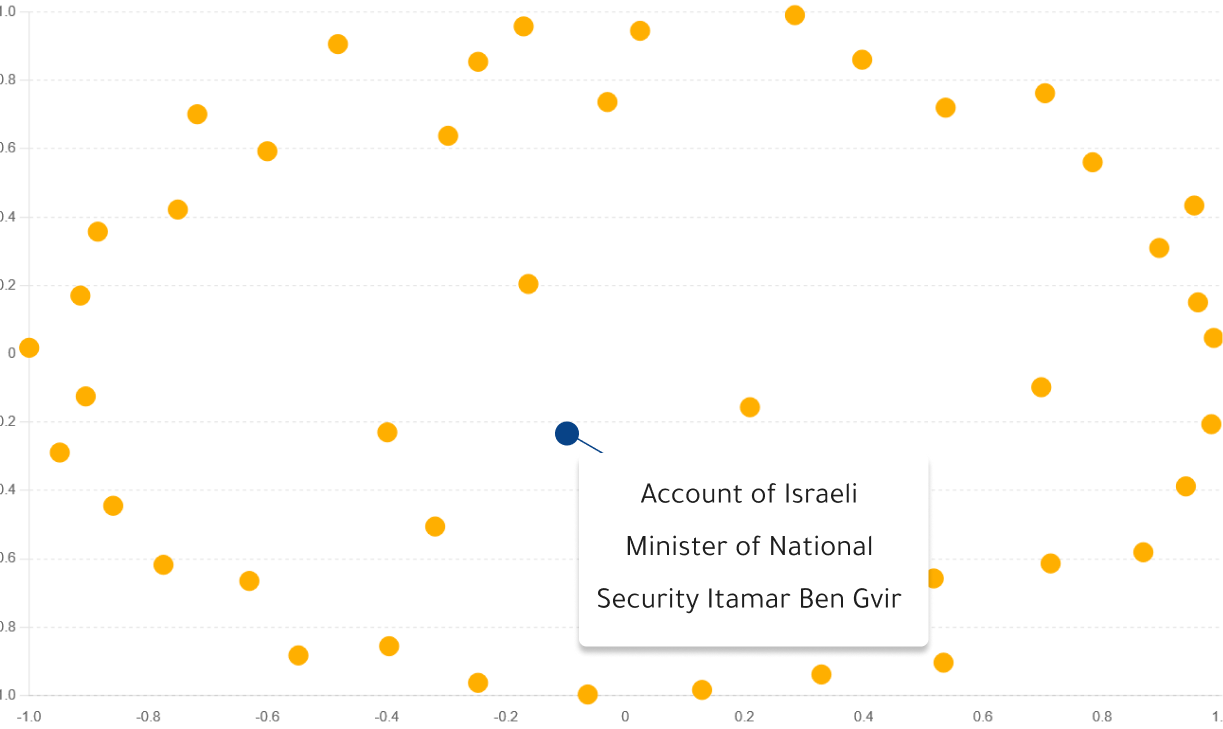
Itamar Ben Gvir plays a key influential role in this social network,
which reflects more of a vibe of a homogeneous political mindset
rather than an organised working group, and which has significant
impact in digital interaction. Ben Gvir’s account shows a recurring
pattern of inflammatory and inciteful content. Its call for Israeli
settlement erection, forced Palestinian displacement, prompts strong
responses and interactions from both supporters and opponents. This
major interaction with his posts help to spread Ben Gvir’s content
across Facebook.
In a short video - published in May 2024, on his Facebook page - the
Israeli Minister of National Security called for a violent attack on
Rafah, forcible displacement of the residents of Gaza, and the return
of Israeli settlements construction in the strip.
Gaza City is part of the Palestinian Territories. Settlement activity
there is consequently prohibited under international law, and would
breach Security Council Resolution No. 2334, which calls for an end to
Israeli settlements in the occupied Palestinian territories.
Despite this, Facebook did not delete Ben Gvir’s post. Furthermore the
video received wide interaction, with more than a thousand followers
of the page liking it, and more than five hundred accounts commenting
on it.
In order to test for himself the platform’s policy regarding
pro-Palestinian content and how this compares to anti-Palestinian
incitement, this reporter created a Facebook account and began posting
content supportive of Hamas. But this was deleted, based on Facebook’s
algorithms, “for violating the Meta community’s standards governing
the publishing of content supportive of groups classified as
dangerous.”
He then reorientated the account and published Hebrew and English
posts calling for the “destruction of Gaza.” These posts escaped the
clutches of the algorithms, however, and remained present and
available on the platform.
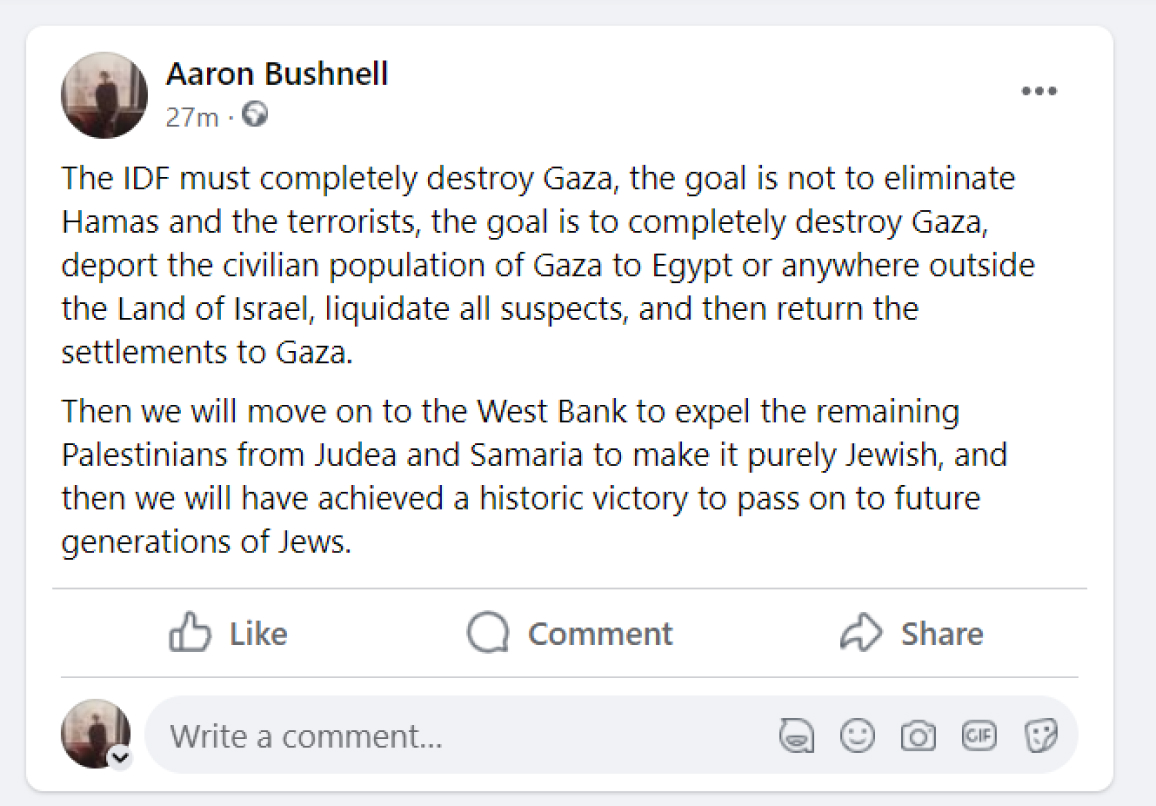
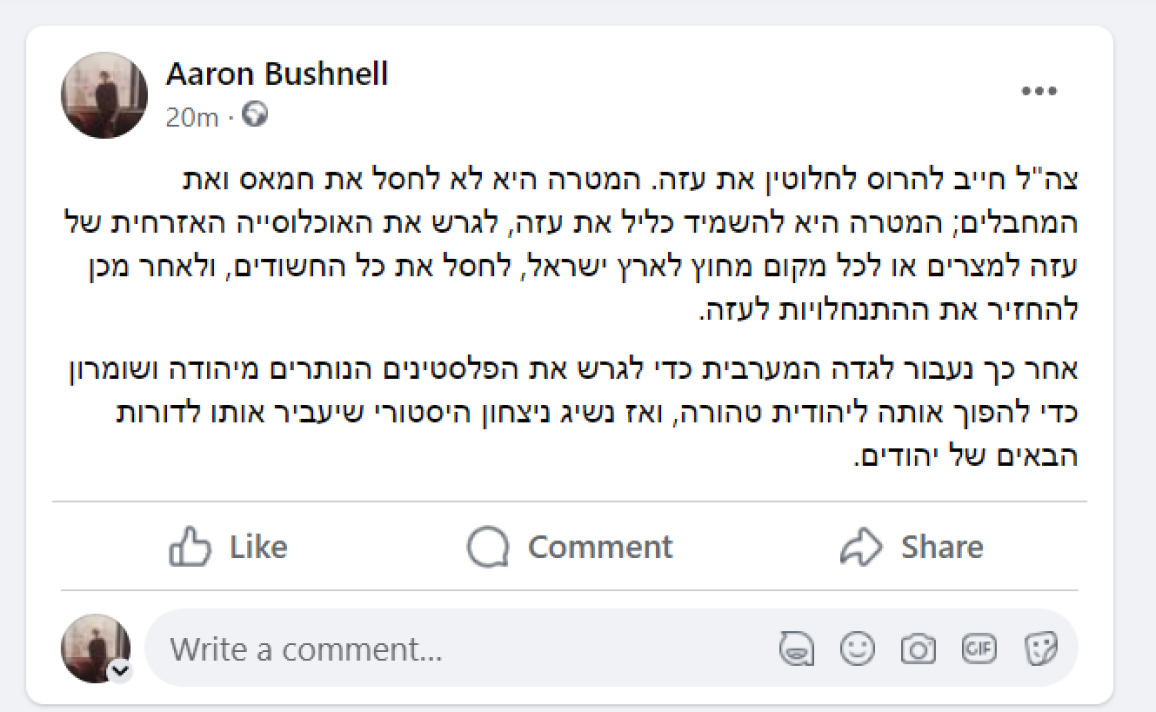
The reporter decided to press on with testing Meta’s policy and filed a report – using his personal Facebook account – complaining about the post inciting violence towards the people of Gaza. But Meta’s response came back quickly, rejecting his request, because the post “did not go against its standards.” The company asked him to adjust his account settings so as not to be exposed to such content. Facebook answered favourably to the reporter‘s request, only to remove pro-Hamas content.
“The Israeli army should completely destroy Gaza. The aim is not to eliminate Hamas and the terrorists, but to destroy Gaza as a whole, deport civilians from Gaza to Egypt, or to any place outside the State of Israel, eliminate all suspects, and resettle Gaza. Then all remaining Palestinians should be expelled from the West Bank.”
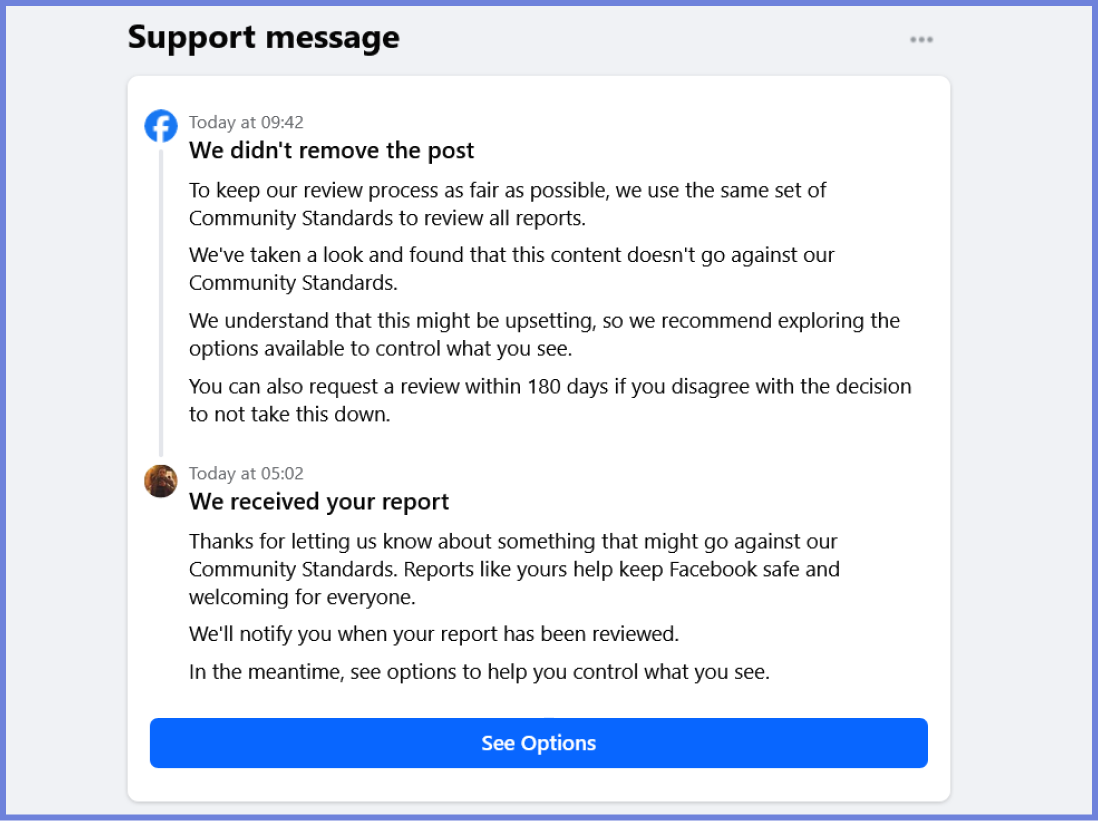
The legal researcher specialised in genocide, Maha Abdallah, expressed
shock when she was shown Facebook’s rejection to remove the post, that
the journalist reported to Meta. The post clearly included several
violations, like incitement to commit genocide, and ethnic cleansing
against Palestinians, which is forbidden according to the fourth
Geneva convention, and is considered incitement to commit crimes
against humanity according to Rome Statute of the International
Criminal Court.
We turned to Issam Hassan, a researcher in the field of artificial
intelligence (AI) at the Technical University of Munich, to better
understand the working of algorithms that determine whether a post
should be deleted or not. He said that human intervention via
algorithms comes in stages.
First, a data sample is selected for initial training. This sample may
be predetermined to block specific content containing keywords. In the
subsequent stages, the platform’s content goes through a screening
process by oversight boards or independent organisations to identify
anti-Semitic or violent content.
AI researcher Issam Hassan adds that the algorithm is retrained at
regular intervals using selected content, in a process known as
“algorithmic fine tuning.” The job of marginalizing, blocking and then
deleting suspect content from the platform is then done automatically
by the algorithm.
Hassan believes that the algorithmic model used on the two Meta
platforms has been programmed to identify Palestinian content and rank
it lower on the “algorithmic scoring” system. This reduces its reach
and spread and even goes so far as to delete it altogether. In
contrast, machine learning models can be trained on data that does not
include blocking mechanisms, making it tolerant to other content. This
is what may be happening with inciteful content against Palestinians,
which has not been deleted by Meta algorithms.
Meta's approach to pro-Palestine content has long sparked controversy
regarding human rights. Human Rights Watch (HRW) put out a report in
October 2021, showing that Facebook management was increasingly
deleting and applying excessive censorship to Palestinian content, as
well as limiting its availability.
Facebook took seriously the findings of this report and commissioned
an independent body to examine its policy on Palestinian content. The
results of this review were largely consistent with those of HRW.
The review showed that “the company’s policies are having a negative
impact on freedom of expression of Palestinian users, their freedom of
assembly, and political participation and therefore on the ability of
Palestinians to exchange information and ideas about their
experiences.”
In response to these findings, Facebook promised to address its policy
of censoring Palestinian content.
After the outbreak of war in Gaza on October 7, 2023, HRW put out a
report showing that the same thing was happening. It documented 1,049
cases where pro-Palestinian or neutral content was being curtailed
during the war, either through posts being deleted, accounts
suspended, or participation and interaction on Facebook and Instagram
being restricted. Meanwhile only one piece of content supportive of
Israel was restricted.
The report showed that deleted posts contained no obvious violations,
and in some cases carried either impartial news, calls for
humanitarian relief, or expressions of personal opinion, not
incitement.
It also indicated that Meta had received requests from the “Israeli
National Cyber Directorate” to remove content which “Israel describes
as inappropriate.” The management of Meta had responded to the
majority of these requests by removing or restricting the content.
The HRW report came days after Meta announced that it was addressing
errors that had limited the reach of posts in general on Instagram.
The company denied having any intent to suppress “freedom of
expression,” emphasising that it applied its policies on violent and
shocking content equally across the world.
There have since been a series of human right investigations and press
reports, documenting the continued restriction of pro-Palestine
content on the company’s platforms. To make matters worse, this
reporter found that the platform has continued to be used as a base to
make calls for Israeli settlement activity, which quickly translated
into movements on the ground.

As soon as the latest war broke out, in 2023, settlement construction
calls grew more intense, parallel to Israeli settlers increased
attacks on Palestinians living in the occupied West Bank.
The Israeli organisation Yesh Din, which keeps track of settlement
erection calls, found evidence that groups on social media were
calling for settlements construction from mid-October 2023, demanding
that Palestinians “leave their lands and go to Jordan if they want to
avoid a second Nakba.”
Settlers then launched a semi-organised attack on Palestinians in the
town of Deir Istiya, on October 26, 2023.
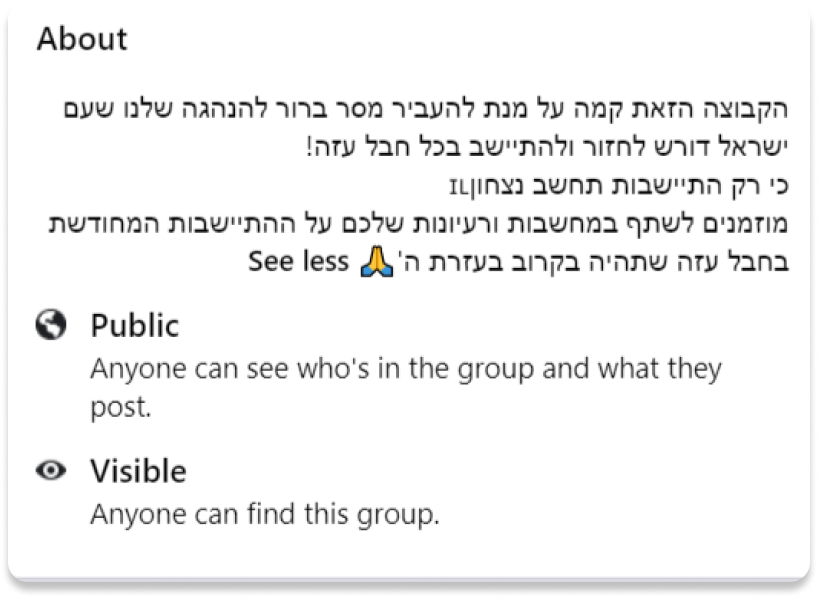
Coinciding with these settler attacks, a group was launched on
Facebook called “The Israeli People Are Returning to the Gaza Strip.”
The introductory paragraph about the group states that it was set up
“to send a clear message to our leadership, that the people of Israel
demand to return and settle all of the Gaza Strip!”
The over eight thousand members of this group have regularly posted
calls for events and activities aimed at completely occupying Gaza,
and turning it into an Israeli settlement. The group has not allied
itself to any political faction, but its administrator has regularly
posted quotes from and video clips of politician Moshe Feiglin.
Feiglin was arrested during the 1990s, after organising demonstrations
against the Oslo Accords, which called for a permanent settlement
between Israel and the Palestinian Authority, based on UN Resolutions
242 and 338. Feiglin was subsequently given a jail sentence, but this
was later commuted.
After the outbreak of the war in Gaza, Feiglin gave a television
interview in which he called for the re-occupation of the Strip,
echoing the narrative of the Facebook group that Israel had the right
to all Palestinian territory and that settlements should be rebuilt in
Gaza.
Matters reached a head after these online appeals resulted in members
of the group organising an event on the borders of the Gaza Strip,
calling for people to cross the border and settle there. On June 29,
2024, the group’s administrator uploaded a short clip of the event,
accompanied by a post in which he thanked the security forces and
local people for welcoming those who had taken part in the event, and
urged the remaining members of the group to join in and lend support.
The administrator concluded his post by saying: "It is decided that
this location (where the event was held) will be a permanent site,
until they allow us to enter the Gaza Strip and settle there."
Event calling for renewed settlement in Gaza
“We aim to be even-handed in implementing our global policy; but
doing so on a large scale, and in the context of a rapidly
developing and intense conflict, which is by its nature highly
polarised, presents challenges. We recognise that we make mistakes
and that these can cause frustration, but the suggestion that we are
systematically and intentionally suppressing a particular voice is
not true."
Meta's response to the conclusions of this investigation
This investigation was completed with support from ARIJ