16/12/2021

Like other landmarks in the Gaza Strip, archaeological sites are
vulnerable to Israeli aggression at any moment. They are also
literally subject to total destruction through violations by official
and unofficial Palestinian entities despite the laws that prohibit
encroachments on these sites. This investigation documents the
systematic violations against the most famous archaeological sites in
the Gaza Strip and the failures to protect them.
The archaeological site of Tall Al-Ajjul in the village of Al-Mughraqa
in the center of the Gaza Strip has been transformed into a
residential area and agricultural land. The features of the site have
faded over twenty years of repeated encroachments by residents.
In its classification, the British School of Archeology that focuses
on archeological research, says that this site dates back to the
Middle Bronze Age between (2200 - 1500 BC) and the Late Bronze Age
between (1500 - 1200 BC) after the excavations it conducted on
Palestinian sites during the British Mandate period (1920 -1945). The
site had also seen limited usage in the eras that followed, including
the Iron, Roman, Byzantine ages, all the way up to the Islamic period.
The excavations were carried out under the supervision of the British
scientist William Flinders Petrie in the early thirties of the past
century, who found artifacts, coins, ancient tools, buildings and
palaces. This was documented in four volumes entitled “Old Gaza,” and
relics from the site are on display even today at the British Museum
in London.

Documents of the archaeological discoveries at the site of Tall Al-Ajjul in the 1930s
Dr. Mu’in Sadiq, professor of History and Archeology at the University of Toronto explains that these discoveries are taught at universities in Canada, the United States and Britain.
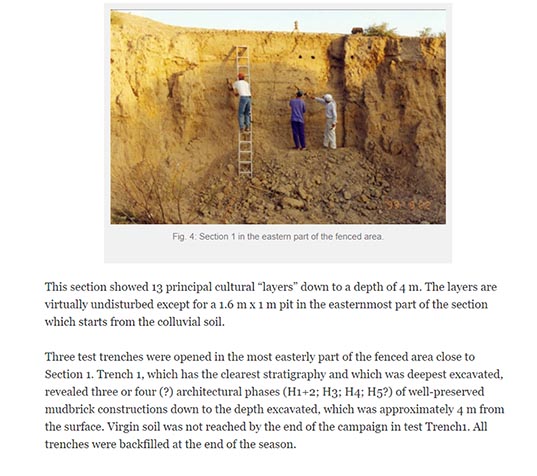
During a tour of the site in May 2021, we could only find some pottery pieces as the archaeological landmarks and the various layers as documented in the 1930’s as well the findings of an excavations team that had visited the site between 1999 and 2000 have faded. Houses and farmland have crept up on the site area.
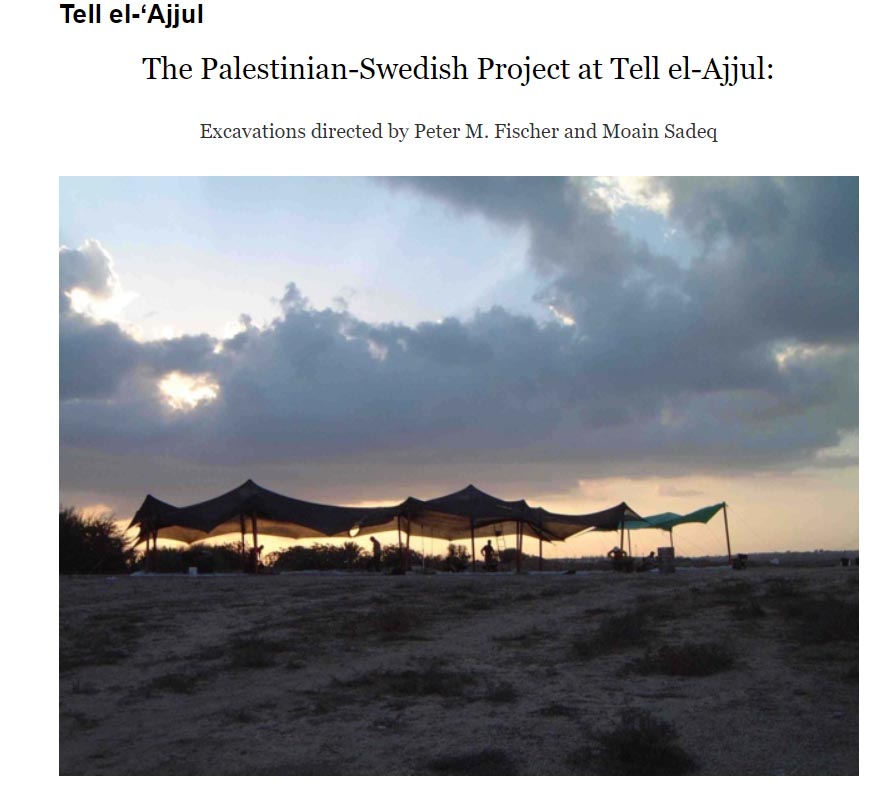
The new state of Tall Al-Ajjul site astounded the Austrian-Swedish
archaeologist Peter Fischer who specializes in Eastern Mediterranean
and Near East archaeology, and had led the Palestinian-Swedish
expedition in Tall Al-Ajjul in 2000.
When we showed Fischer the recent photos of the site, he said that
“From what I have seen, building houses, planting olive trees and
razing the site destroyed the most important ancient Palestinian
heritage. People think in the short term, and they ignore their
responsibility towards previous generations that have built our world.
It is our duty to preserve the ruins of that world.”
Fischer considers Tall Al-Ajjul a “multicultural site” important for
world heritage. He explains, “The site shows inter-connections between
cultures extending across the Mediterranean region and even to further
inland eastward. It was a gate linking Egypt and Syria and had
extensive trade relations with Cyprus, but (recently) humanity has
lost one of its most important heritage in the Levant.”
The recent deteriorating condition of Tall Al-Ajjul was preceded by a
series of violations documented by Fischer himself during his last
visit to the Gaza Strip in 2011 before Israel banned him from visiting
the area again. He explains how houses and olive trees were
encroaching everywhere on the excavation site that he had fenced off
on his first visit. He says that vestiges of the Late Bronze Age have
been destroyed. This made him wonder about the fate of the artifacts
that must have been found by the aggressors when they built the houses
or cultivated the land.
Today, the violating residents treat the land of the site as though it
was their own property. One of them confronted the investigator while
he was visiting the area claiming that “strangers are not allowed to
take pictures of my agricultural plot of land.” The new resident
expressed his fear of gangs that might steal antiquities from the site
as he pointed his hand towards a hole under an area planted with olive
trees which it seems (thieves) have been excavating at night.
We on passed this information to the Ministry of Tourism and Antiquities run by Hamas in Gaza. The Director of the Conservation and Restoration Department, Ahmad Al-Bursh, admitted that his ministry did not act to protect the site “because this process needs material and human capabilities.” He said, “The attack on Tall Al-Ajjul is an old issue, and the ministry has no knowledge of it. And that the site was abandoned after the days of the Palestinian Authority.”
Mu’in Sadiq was the Director General of the Antiquities Department
in the Ministry when the Palestinian Authority controlled Gaza
between 1994 and 2005. He admits that the site was subjected to
violations during that period as it also did during the Israeli
occupation of the Gaza Strip between 1967 and 1993. However, he
confirms that his ministry took some measures in order to secure the
site, this included placing a sign to warn against encroachments on
the site since it is an endowment property, as well as providing
security. These measures are currently not available.
Sadiq says, “Razing parts of the site used to happen on Fridays as
it is the day when the guards would be off duty. For example, some
bulldozing operations by unknown parties would happen to gain
additional agricultural plots on the hill, especially on its
southern side. Another violation was committed in order to build a
house before 2007 despite our objections. Unfortunately, the owner
of the house used his influence to proceed with the constructions as
he was well connected. Only people with influence or people
supported by such persons or their families would dare to do that.”
The status of Tall Al-Ajjul is not much different from the large
percentage of 82 other archaeological sites spread across the Gaza
Strip. These have been entered in the British surveys of sites,
published in the Palestinian Al-Waqai newspaper in 1944 and were
reviewed by Palestinian archaeologist Ayman Hassouna. The
authorities were clearly unable to protect these from infringements,
but they were also parties to the violations carried out in some of
them.
During the Palestinian Authority era of control of the Gaza Strip
between 1994 and 2007, four “intentional” violations of
archaeological sites were recorded while eleven other violations
were recorded during the period when Hamas controlled Gaza.
According to the investigator the Palestinian division since 2007 in
Gaza was a precursor for the increase in archaeological sites
violations.
Tall Al-Ajjul, Tall Al-Sakan, Al-Blakhiyah, and Tall Rafah, or
Zo’rob are the largest archaeological sites in the Gaza Strip,
covering around 740 dunums, that is 740 thousand square meters.
These sites were not protected, and three of them saw violations
carried out by official entities and citizens alike. Tall Rafah site
has escaped direct violations but it is a site at risk due to the
effects of the natural elements since excavations or restoration
operations have stopped.
The government provided the necessary security to only three
archaeological sites in the Gaza Strip: These are Tall Umm Al-Amer
or the Saint Hilarion Monastery in the center of the Gaza Strip;
Tall Rafah or Zo’rob south of Rafah; and the site of the Byzantine
Church in Jabalia north of the strip. These sites have been restored
using funds offered by international organizations, while seven
other sites lacked proper protection, and greenhouses now have
surrounded them. Other parts were littered with garbage.
A team of youths called “Canaan Team” that specializes in monitoring key ancient landmarks via an English and Arabic digital platform claimed that landmarks at thirty-one archaeological sites in the Gaza Strip have disappeared as a result of urban expansion and continuous encroachments due to the absence of any classifications as archaeological sites in the Gaza land registry according to one Canaan members, Sundos Al-Nikhaleh.
The Ministry of Tourism and Antiquities in Gaza holds the
Palestinian Authority responsible for protecting the lands from
encroachments by the population during the period it controlled the
strip. It also holds the PA responsible for not registering
archaeological sites or classifying them as untouchable. In fact,
that same Ministry (controlled by Hamas movement in Gaza) was also
unable to protect these sites from encroachments as per Law No. (11)
of 2018, governing cultural heritage in force in the West Bank and
the Gaza Strip. This law prohibits the violation of sites and the
destruction of elements and components of tangible and intangible
heritage sites.
The Ministry of Tourism and Antiquities of the Palestinian Authority
in the West Bank did not respond to our queries related to
violations that happened while it controlled the Gaza strip.
No person is permitted to do any of the following acts:
1. Blurring, distorting, sabotaging, changing, destroying or
altering any of the elements or components of immovable heritage.
2. Removing any element or component of the heritage site, moving it
from its place, writing or engraving on it.
3. Dumping waste, residue or dirt in the immovable heritage site and
the area surrounding it.
4. Selling, buying or trading any material extracted from an
immovable heritage site.
5. Digging or excavating in immovable or other heritage sites in
search of treasures or any other buried materials, even if they are
the private property of owner.
This investigation could reveal also that the violations at the site of Tall Al-Ajjul apply to most archaeological sites in the Gaza Strip.
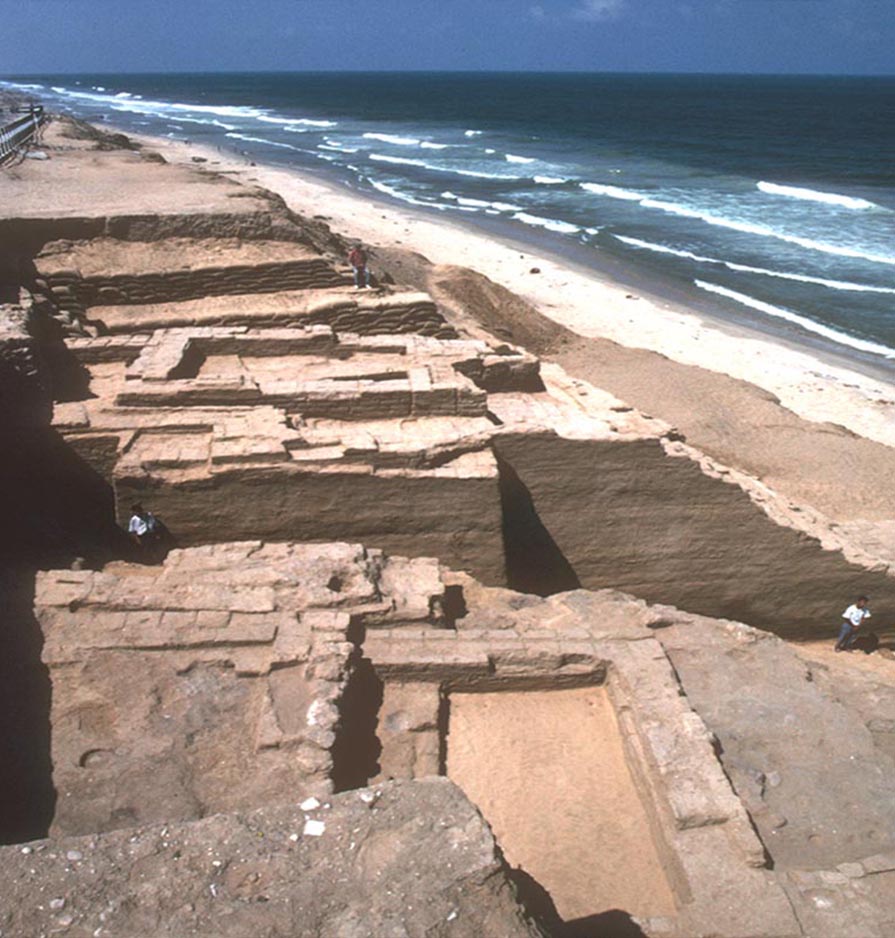
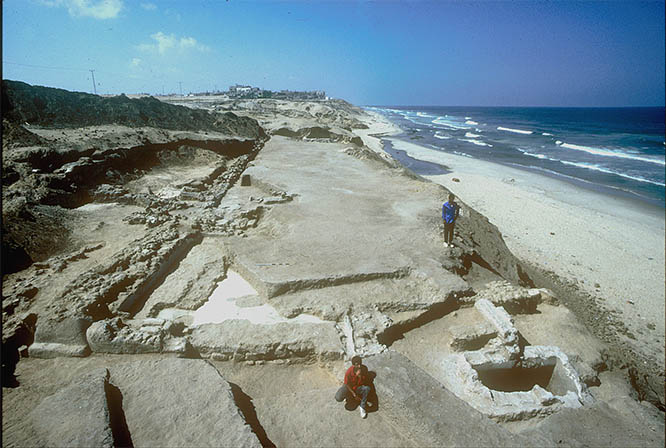
West of Gaza City
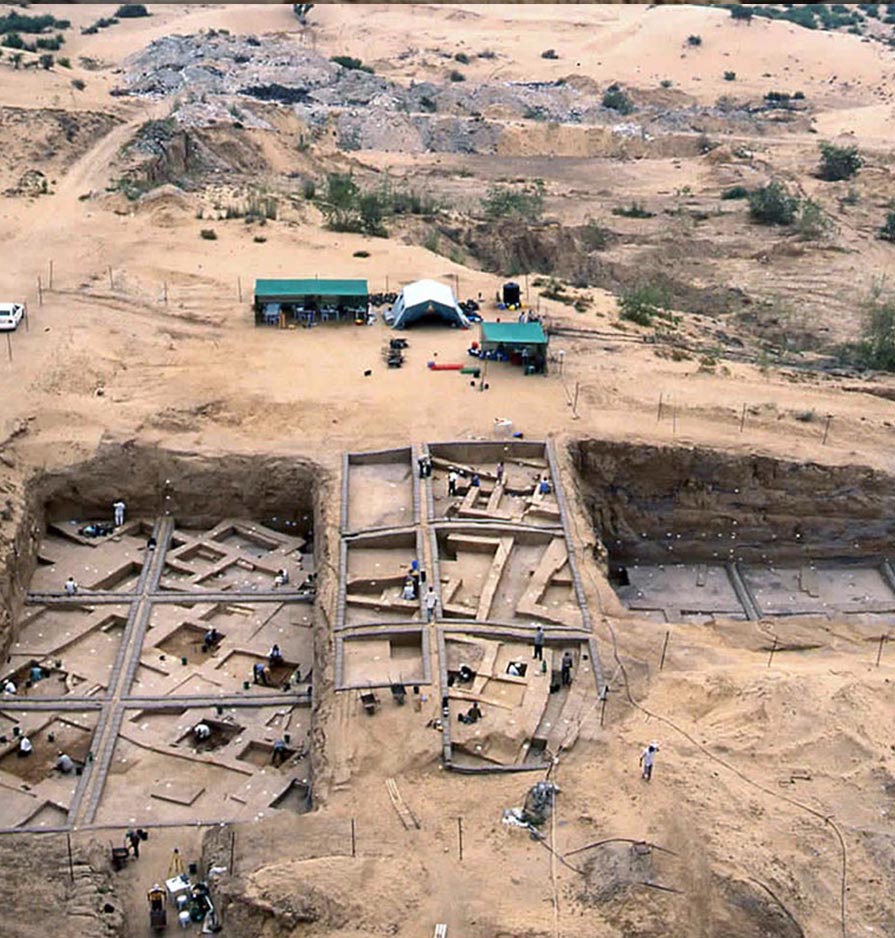
Madinat Al-Zahra’a, south of Gaza

Beit Lahia, north of the Gaza Strip

Deir al-Balah, in the central parts of the Gaza Strip
West of Gaza City
It dates to 800 BC or earlier
It used to be one of the most important commercial
ports in that period which is a testimony to the
mobility and trade activities of ancient Palestinians
with the outside world.
Buildings dating back to the Greek Hellenistic era and
a Roman wall
A city wall built in the era of the Assyrians
Coins and artifacts that date back to different
periods, starting from the Canaanites to all the way
to the Ayyubids
- Razing the mosaic floor of a Byzantine church before
2007 (the date Hamas took over Gaza and authority was
split between Ramallah and Gaza)
- Constructing the Shate’e Police Station on the site
in 2013
- Constructing the Shate’e Police Station on the site
in 2013
The director of the Department of Conservation,
Preservation and Restoration at the Ministry of Tourism
in Gaza Ahmad Al-Bursh claims that the violations
against Al-Blakhiyah site are not a cause for concern as
he believes that on site building help protect
archaeological sites when those constructions or
infringements are temporary. He explains that what harms
antiquities is demolishing the area and constructing
buildings with reinforced concrete walls. In his
opinion, the suspension of excavations and the failure
to secure archaeological sites were due to lack of
external funding. Meanwhile, the Ministry of Interior
did not respond to the investigator’s questions on the
construction of a police station on Al-Blakhiyah site.
The director of the Department of Archeology at the
French School of Biblical and Archeological Research,
Jean Baptiste, stressed that in 2013 the Palestinian
authorities in Gaza prevented him from continuing
excavations on the site. Jean Baptiste headed the French
team that excavated the site between 1995 and 2005. He
returned to Gaza in 2012 to resume excavations but was
banned in the following year when Al-Blakhiyah became a
police station.
Baptiste says, “In 2005, the French delegation obtained
approval from the Palestinian Authority so that the
entire site of Al-Blakhiyah would become a national
archaeological park, but Gaza’s government did not
recognize the decision, and the site is now under the
control of the police.”
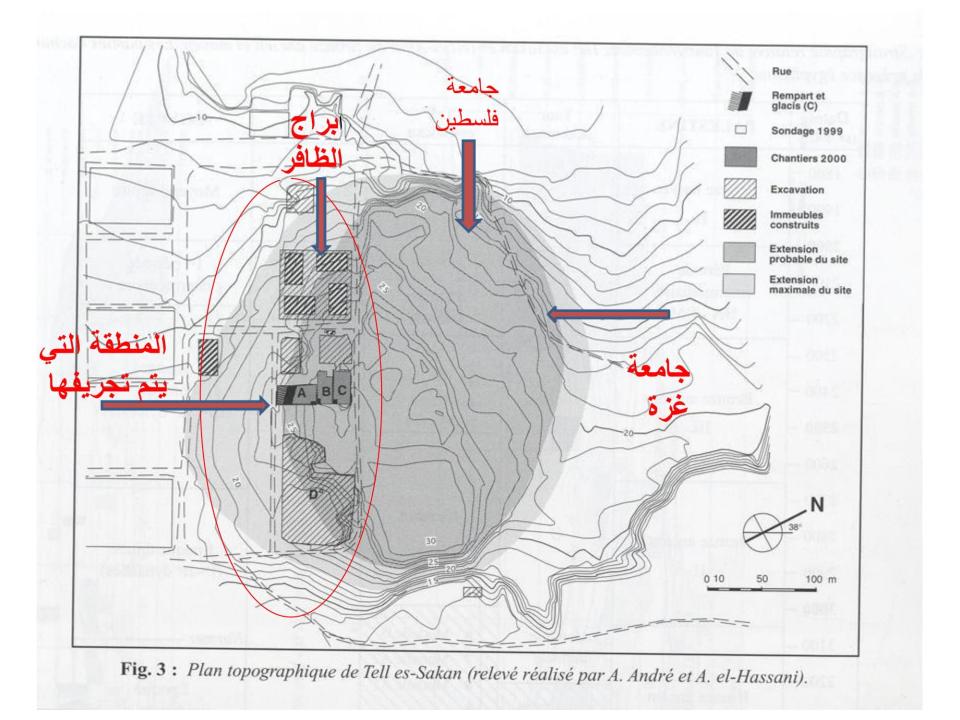
Madinat Al-Zahra’a, south of Gaza
This is one of the oldest archaeological sites discovered in the Gaza Strip. It represents evidence of human settlement that goes back to more than 5,000 years in the First Early Bronze Age (3000-3300 BC) and the Third Early Bronze Age (2650-2200 BC)
- Archaeological layers, remains of houses,
structures, roofs and walls
- Pottery remains that combine Pharaonic and Canaanite
antiquities, such as mixing bowls, plates, and jugs
- Seven facades of palaces dating back to the first
ancient Egyptian dynasty
- Demolishing operations by the government to erect
housing projects in 2017
- Expanding the buildings of the private University of
Palestine by encroaching on the site
- The private Islamic University of Gaza swept away
parts of the site as well


Beit Lahia, north of the Gaza Strip
It dates back to the Byzantine Age. Beit Lahia is referred to as “Beit Elijah,” which is the birthplace of the ecclesiastical historian Sozomenus who wrote about the history of the church in southern Palestine.
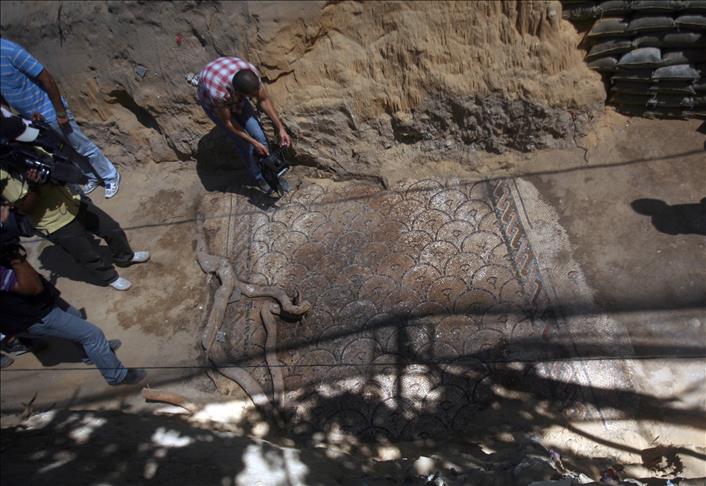
Mosaic floors dating back to the Byzantine era were discovered in 2012
- The majority of the site lies beneath residential
houses inhabited by various families
- Residents constructed a wall around the site